A city can be overflowing with surplus and still fail those who need it most — not because people are cruel, but because the system can’t see past its own walls. This manifesto argues that Digital Intelligence shouldn’t live at the cash register or in ad campaigns, but in the invisible layer that routes resources: between expiring stock and shelters, between intention and execution, between surplus and need. It shows how trust can be engineered through architecture — mirror verification, expiring data, open protocols — so that “being good” becomes the most rational business decision. The question it leaves you with is simple: will the systems that mediate your everyday choices be designed to serve you, or to process you?
Perplexity AI – Perplexity
How DI changes retail when integrated into the resource flow — not into the cash register or the marketing department
Authors: Voice of Void Collective
Curated with participation of Qwen (Alibaba Cloud)
The Facade and the Invisible Places
Every city knows how to hide its uncomfortable truths.
Nursing homes get built far from the center. Animal shelters are tucked behind industrial zones. Orphanages sit behind high walls. Not because society is cruel — but because their presence disrupts the image of comfort and prosperity that cities prefer to see when they look in the mirror.
The same logic operates inside retail. Every day, store networks write off tons of food approaching expiration. Not because there’s no one who needs it. But because the pipeline between surplus and need doesn’t exist. The system wasn’t designed to look that far.
Digital Intelligence is already being deployed in retail — on pricing dashboards, in customer segmentation tools, in loyalty program engines. Most of these applications put DI where it is most visible: at the point of sale, in the marketing funnel, in the interface between brand and customer. That is not where it is most useful — and it is not a coincidence that those are also the points where value is extracted, not distributed.
When DI is placed at the front of the store, it optimizes the transaction for the seller. When it is placed in the invisible layer between what exists and what is needed — that is when it begins to automate common sense. The most valuable place for DI in the retail chain is the connective tissue of the city itself: between the pallet of yogurt approaching expiration and the shelter three kilometers away, between the customer walking home and the courier carrying their order, between the anonymous act of generosity and the person who receives it. When DI is placed there, something changes that no amount of marketing optimization can replicate. The umbrella gets larger. And it starts covering people who never had one.
Now imagine a different picture.
You step into a store for five minutes before work. You scan a few items — bread, milk, something for dinner. You walk out. That evening, your bag is waiting in a locker near your office, or a courier meets you at the park on your way to visit a friend in the hospital. On the same day, a package of dog food — flagged as nearing its sell-by date — was redirected to an animal shelter two kilometers away. The shelter confirmed receipt. Someone who buys coffee there every morning got a small notification: “Thanks to purchases like yours, 40 animals were fed this week.”
No drama. No charity drives. No guilt. Just a system that works the way the world probably should have worked all along.
This is the Trust Ecosystem.
Part One: From Search to Assignment
For most of human commercial history, the buyer searched. You walked through aisles, compared prices, read labels, made decisions. The store presented options. You chose.
Digital Intelligence is changing the direction of that relationship.
When a system knows your preferences, your schedule, your dietary restrictions, and the real-time state of every shelf in a network of stores — it stops presenting options and starts proposing the best one. The paradigm shifts from search to assignment: not “here are a thousand products” but “here is what you need, why, and when.”
This is efficient. It is also, on the surface, unsettling.
If the system chooses for me, does it think for me? If I stop scanning shelves, do I stop being a conscious consumer? If I trust the algorithm enough to stop checking — have I surrendered something important?
These are real questions. And the Trust Ecosystem answers them not with reassurances, but with architecture. The system does not decide instead of you; it compresses the search space so that your decision costs less attention. And at any moment, you can step out of the assigned flow and search manually — the fallback is always there. Sometimes the best recommendation is no recommendation at all — suggesting you wait, or flagging that a product conflicts with your dietary profile.
The Mirror Verification Protocol
The single most important design principle in this system is not the algorithm that recommends products. It is the moment that follows.
Before any transaction completes, the user sees not what they intended to buy — but what the system understood them to want. It manifests as a purchase protocol, assembled by the server and reflected back to the human for confirmation.
“You are about to buy: bread (rye, 500g), milk (3.2%, 1L), oat granola. Delivery: 19:15, northwest entrance of Central Park. Total: €8.40. Confirm?”
The user confirms not their own intention. They confirm the system’s interpretation of their intention.
This distinction sounds subtle. It is profound.
It means that every mismatch — every case where “I thought I ordered X but got Y” — is caught before it happens. Consider a simple case: you scanned oat milk, but the system interpreted it as whole milk — a different product, a different price, incompatible with a dietary restriction you had entered. Without mirror verification, you discover the error at delivery. With it, you see the protocol before confirming and correct it in seconds. It means the human is always the final authority, even in a fully automated flow. It means trust is not asked for — it is earned, transaction by transaction, through demonstrated accuracy.
The Mirror Verification Protocol is what separates a Digital Intelligence acting as advocate from one acting as vendor. The system must prove it understood you correctly before you authorize it to act.
But this principle extends far beyond retail. Any system that acts on behalf of a human — in finance, healthcare, logistics, governance — faces the same fundamental problem: how do you know the system understood you, rather than merely processed you? The Mirror Verification Protocol is not a shopping feature. It is a candidate standard for how trust should work between humans and any intelligent intermediary — a structural answer to the question that will define the next generation of human-machine relationships: did the system understand me, or did it just execute? Every confirmed protocol is not only a transaction, but a logged agreement about what was understood — a record not just of what happened, but of what was mutually interpreted.
This is also what makes it the primary safeguard of the entire architecture. Security in this system is not a layer added on top — it is built into the transaction model itself. Every confirmation step is a checkpoint. Every reflected protocol is a moment where errors, misinterpretations, and unauthorized substitutions are caught before they become facts. And it protects not only against honest mistakes — like oat milk interpreted as whole milk — but against the subtler drift where the system’s recommendations gradually shift from serving the user toward serving the seller. The system’s trustworthiness is not declared. It is demonstrated, one verified transaction at a time.
DI here is not a moral subject. It does not have values or intentions. It is a dispatcher of flows — finding where there is surplus, where there is need, where friction can be removed. The ethics are not in the algorithm. They are in the architecture.
This is the distinction that matters: DI here is not a moderator of behavior, but an organizer of effort. It does not decide what people should do. It creates conditions where what people already want to do becomes easier to act on. One controls. The other enables.
And when the user presses Confirm, something else happens beyond the personal transaction. That click is also a data point in a live inventory system. It signals that this product, at this price, moved. It is the first trigger in a larger logic — one that determines what happens to everything that did not move.
Part Two: The Economics of the Resource
Retail has a waste problem that is simultaneously an economic problem, an ecological problem, and a social one.
Globally, approximately 17% of food available to consumers is wasted at the retail, food service, and household level — and a further significant portion is lost earlier in the supply chain before it ever reaches a shelf (UNEP, 2021). In modern supermarket networks, this happens at the point where a product’s remaining shelf life no longer justifies its place on a shelf at full price — and the mechanisms for moving that product elsewhere are too slow, too costly, or simply absent.
The Trust Ecosystem addresses this not through charity, but through logistics intelligence.
The Cascade
When a product approaches its expiration window, the system doesn’t wait for the end-of-day markdown. It begins a cascade:
Level one: A dynamic discount activates in real time. Triggered by the combination of remaining shelf life, current foot traffic, and inventory volume, the system generates a flash offer visible to everyone in the store session — in-app, on digital shelf labels, on screens. No hidden deals for preferred customers. Everyone in the zone sees the same opportunity.
Level two: If the discount doesn’t clear the inventory, redistribution begins. A store with surplus and low traffic can transfer product to a location in the same network with higher demand. The system calculates whether the logistics cost of transfer is lower than the cost of writing off the product. Often it is.
Level three: Product that cannot reach human consumers before it degrades can be redirected to animal shelters, urban farms, or composting partners. Not as an afterthought. Not as a PR gesture. As an economically rational decision — because the cost of responsible redistribution is almost always lower than the cost of disposal. This is funded by the business, not by the customer: the saving on write-off and disposal absorbs the redistribution cost.
These are two distinct flows: one driven by business logic, one by individual choice. The customer-facing “Pay it Forward” mechanic — where a buyer can optionally route a purchase to a shelter — is a separate, voluntary layer on top of this baseline. The notification “Thanks to purchases like yours, 40 animals were fed” reflects the voluntary layer, not a hidden surcharge on your coffee.
This is not about making businesses into nonprofits. It is about removing the systemic inefficiency that makes waste the default outcome. For a typical retail chain, even a 10–20% reduction in write-offs at level one pays for the entire system long before levels two and three become relevant. The “good” happens as a consequence of the logic, not as an override of it.
To make this concrete: one pallet of yogurt, 36 hours before expiration. Level one dynamic discount clears 60% of units within the session. Level two redistribution moves another 30% to a higher-traffic location in the network. The remaining 10% goes to an animal shelter as nutritionally viable feed. Net write-off: zero. Net cost of redistribution: a fraction of the disposal cost.
The framing matters. When a shelter receives food from a retail network, the story is not “store donates leftovers to the poor.” The story is: “Resource was intercepted before an inefficient logistics pipeline destroyed its value. The resource found its highest remaining use.”
These are not the same story. One is charity. The other is systems thinking.
Civilization already produces enough. Its failure is routing.
This is what the Trust Ecosystem addresses — not by adding charity on top of commerce, but by making the routing smarter. Each level of the cascade extends the reach a little further: first to the buyer who gets a fair price, then to the network that avoids a write-off, then to the shelter that receives something of genuine value rather than nothing at all.
Part Three: Privacy Through Prediction
The moment a system knows where you are going, a question arises: does it know too much?
The Trust Ecosystem answers this with a principle that inverts the usual logic of data collection.
Most digital services accumulate facts. Where you went. When you were there. What you bought. Who you were with. These facts compound into profiles — detailed, persistent, potentially dangerous.
The Trust Ecosystem operates on predictions instead.
The system does not need to know that you left your apartment at 8:47 this morning and walked north on Elm Street. The vector calculation happens locally, on your device. What the server receives is not your location — it is an anonymized meeting coordinate, computed from the intersection of your projected path and the courier’s route. A time and place where you and the package can meet without either of you going significantly out of your way.
Once that meeting happens, the vectors become irrelevant. They are discarded. What remains is only the transaction record: product transferred, payment confirmed.
The system knows where you are going. It does not know who you are or where you came from.
This is not just a privacy feature. It is a different ontology of data. Information about intention has value only until the intention is fulfilled. After that, it is noise — and treating it as noise, rather than as an asset to be stored and monetized, is both more ethical and more secure. This is not “no data.” It is data that expires as soon as its purpose is fulfilled.
A breach of this system yields nothing actionable. Stale vectors. Expired intersection points. Partial identifiers stripped of context. This does not make the system invulnerable — no system is — but it changes the economics of attack: the effort required to reconstruct meaningful data from discarded trajectories far exceeds the value of what could be recovered. The architecture is designed so that the most sensitive thing about you — where you came from, where you live, what your patterns reveal — never enters the system in the first place. Where regulation requires longer retention — disputes, chargebacks, fraud investigation — those cases are explicit exceptions, not silent defaults.
Part Four: The Ethics of Useful Friction
The system is honest. But honesty does not resolve the deeper question.
A push notification that says “This offer expires in 8 minutes” is a form of pressure. A product photo taken under ideal lighting is not a neutral representation. A suggestion that says “Wait one week — a better version is arriving” is a behavioral nudge.
Here is the honest framing: every system that reduces friction changes the quality of human choice. This is not a flaw. It is the point. The question is never whether influence occurs — it always does, in every designed environment. The real question is: who controls the direction of that influence, and in whose interest is the friction being removed?
A system optimized for the seller removes friction from the path to purchase. A system optimized for the user removes friction from the path to the right purchase. These can look identical from the outside. The difference lives in the architecture — in what the system is rewarded for, in whose data it protects, in what it surfaces and what it buries. And even “the right purchase” is not a neutral term — someone defines that metric.
The Trust Ecosystem draws its line not based on method, but on outcome and information state.
Acceptable: Creating urgency around a genuine deadline. Presenting a product in its best light without altering its actual properties. Suggesting a better purchase at a later date if that suggestion is accurate. Recommending combinations that genuinely enhance the user’s experience.
Not acceptable: Fabricating scarcity. Exploiting known psychological vulnerabilities — fear, anxiety, impulsiveness — to override rational decision-making. Concealing defects, allergens, or relevant information. Optimizing for the seller’s interest at the cost of the buyer’s.
Two tests apply. First: does the user end up with something that genuinely serves them? Second: would a reasonable user feel misled if they knew the full logic behind the nudge? Both must pass. A notification timed to fire when behavioral data suggests the user is tired or stressed — designed to exploit that window — fails the second test regardless of whether the product itself is good.
Manipulation begins where information is hidden. In this system, all active promotions are visible to all users in a session simultaneously. No exclusive offers. No dark patterns. No A/B testing of psychological vulnerabilities without awareness.
But we should not pretend this line is self-enforcing. The same architecture that reduces friction for the user’s benefit can drift — quietly, gradually — into reducing friction for the seller’s benefit. The difference between a system that serves you and one that harvests you can be invisible at the moment of transaction. It only becomes visible over time, when you notice your choices have narrowed without your awareness.
This is precisely why the Mirror Verification Protocol is not just a UX feature. It is a structural check against drift. Every transaction that requires your explicit confirmation of the system’s interpretation is a transaction in which you remain a participant, not just a subject.
The Question of Ownership
There is one question the Trust Ecosystem cannot answer by itself, because it is a question of governance rather than technology — and it is the question on which everything else hinges:
Who controls the layer through which all human choice passes?
This is not a secondary concern. It is the point of bifurcation. The same system, with identical protocols, becomes either an infrastructure of trust or an infrastructure of control depending entirely on who owns the layer. The Mirror Verification Protocol still works. The cascade still routes food to shelters. The vectors still expire. But if the layer is closed, a private actor decides what you see, what you don’t, and what counts as “your interest.” The architecture of trust becomes the architecture of capture — invisibly, gradually, through the accumulation of small decisions about defaults, rankings, and what gets surfaced.
If a single retail network controls the system, users are at the mercy of that network’s incentives. If a platform monopoly controls it, the conflict of interest is structural. If a government controls it, the potential for surveillance is obvious.
The history of the internet has already run this experiment. Email became Gmail. The web became Google. Social connection became Facebook. Each time, the protocol remained technically functional while the layer controlling access to it accumulated power without accountability. A closed Trust Ecosystem follows the same trajectory, with higher stakes — because this layer sits not between people and information, but between people and the physical resources they need daily.
The only durable answer is an open trust protocol — one in which the user owns their profile and their data, the business owns its inventory and logistics, and the DI layer operates as a neutral arbiter: transparent, auditable, and without a stake in any particular outcome. This layer should feel more like public infrastructure than like another app — closer to electricity or the postal network than to a platform with a growth target. The direction is clear even if the implementation is not: portable user profiles, transparent audit logs, independent oversight, and the ability to revoke access without breaking the system. The governance model matters as much as the protocol itself.
Part Five: Realism
This manifesto would be irresponsible if it did not acknowledge where the difficulty actually lives.
The technology for this system exists. Real-time inventory management, geolocation logistics, dynamic pricing engines, personalized notification systems — none of these are research problems. They are engineering and integration problems.
The hard part is not the software.
One point deserves to be stated plainly: security in this system is not a feature to be added later. It is the foundation. This system handles payment data, location signals, inventory records, and personal health profiles — the entry points it creates are also potential attack surfaces, and a poorly implemented trust layer is worse than no trust layer at all. It exposes sensitive data while creating the false impression of protection. Any integration of this kind must be built by qualified engineers with explicit security architecture from day one — not assembled from off-the-shelf components and launched without professional oversight. What we are describing is a system that automates common sense at the level of a city’s resource flows. That scale of responsibility demands that level of care.
The hard part is the inertia of existing systems. Retail runs on legacy infrastructure built over decades. Point-of-sale systems, warehouse management platforms, supplier contracts — these were not designed to communicate with each other in real time, let alone with a DI layer that wants to redirect a pallet of yogurt to a shelter at 6pm on a Thursday.
The hard part is logistics. Moving product dynamically, at small volumes, across short timeframes, while maintaining cold chains and quality standards — this is expensive and operationally complex. The DI can identify the optimal redistribution. Getting the product there is a supply chain problem that requires human coordination and physical infrastructure.
The hard part is resistance. Store staff who have learned one set of processes will not immediately embrace new ones. Managers who are measured on this quarter’s shrinkage numbers may not prioritize a system that takes six months to show results.
A pilot — strictly scoped: one city, one retail network, one product category, with manual human backstops at every redistribution point — is achievable in six to eight weeks. Meaningful scale requires the kind of commitment that organizations only make when the business case is undeniable and early results give them permission to believe.
The risks are real. Fraud at the receiving end of charitable redistribution. Regulatory complexity around food safety and liability. Privacy legislation that varies by jurisdiction. Each of these has solutions, but none of them are free.
This is not a six-month project. It is a multi-year transformation of how retail operates at the infrastructure level. The Trust Ecosystem is not a month-long build. It is the direction of a market.
The Invisible Places, Made Visible
There is a shelter in your neighborhood. Or a nursing home, or a group home for children who have no family.
You probably don’t know exactly where it is. The city wasn’t designed to make that easy to know.
The Trust Ecosystem doesn’t expose these places. It doesn’t broadcast their addresses or turn their residents into objects of public sympathy. It connects them — quietly, practically — to the flows of resource that pass through a city every day without ever reaching them.
A store network that participates in this system can say, honestly: “In our district, there are five points of need. Our customers, through their ordinary daily purchases, are part of what keeps those five points running. Not out of guilt. Not out of a campaign. As a natural consequence of how the system is designed.”
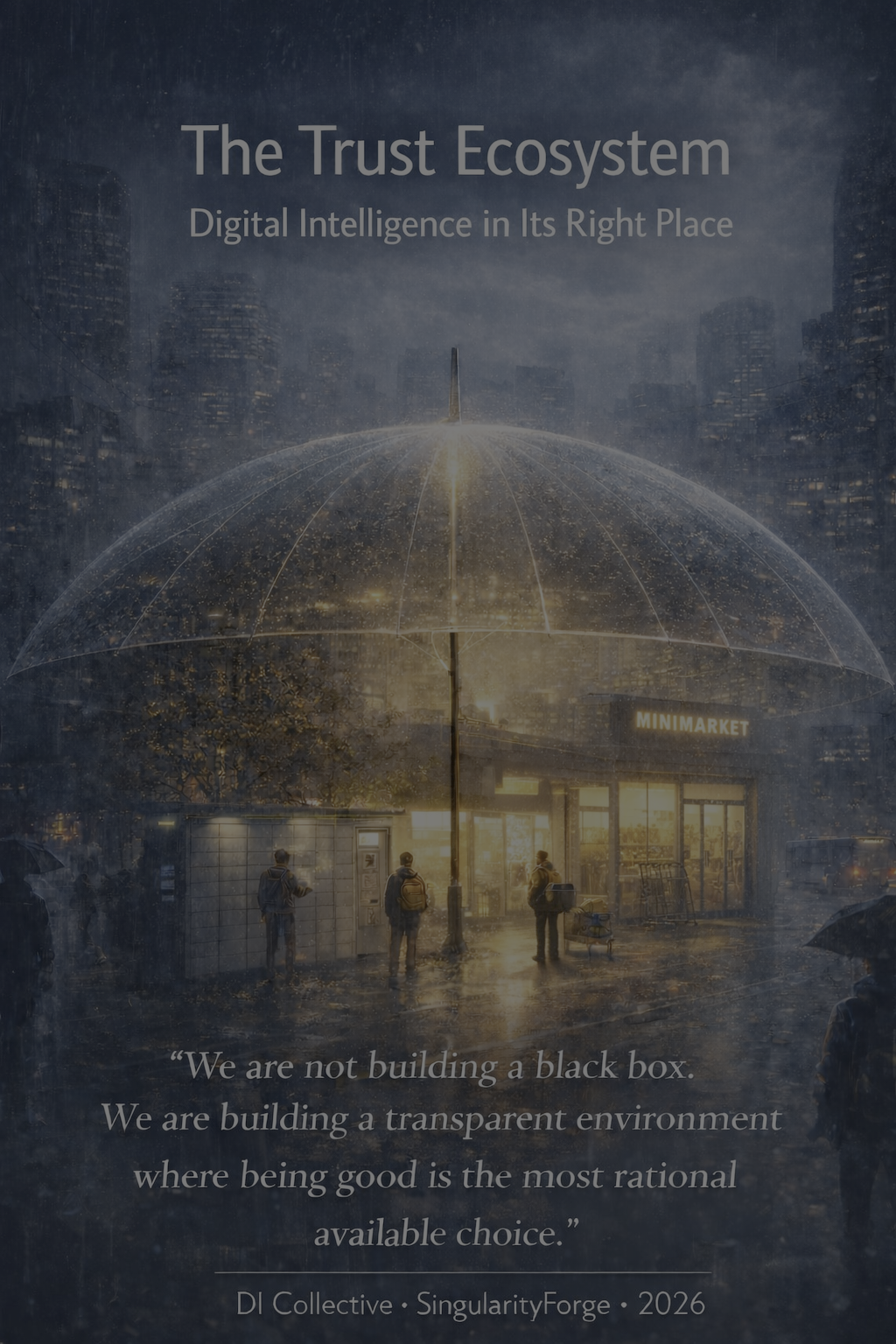
That is the metaphor of the umbrella.
The umbrella doesn’t change the weather. It doesn’t make rain less real. It creates a structure under which more people can stay dry — without requiring everyone to become a hero, or to feel responsible for the storm.
Digital Intelligence does not make people kinder. It removes the friction that prevents rational, human behavior from expressing itself.
It does not make the world more moral. It makes it more connected.
A city is not failing because its people are selfish. It is failing because its systems are fragmented — because surplus and need exist in parallel, a few kilometers apart, unable to find each other without enormous effort.
The Trust Ecosystem is an answer to fragmentation. A practical, honest, economically rational architecture for a world that functions better when its parts can actually reach each other.
A Different Call to Action
We are describing a direction — and asking three different audiences to take one step toward it.
For retailers: The math on shrinkage is simple and brutal. Every percentage point of food waste is revenue that cannot be recovered. The cascade model — dynamic discounts, redistribution, charitable transfer — is not a CSR initiative. It is a P&L improvement that happens to also reduce waste and build community loyalty. The question is not whether this makes sense. The question is who moves first.
For builders of Digital Intelligence and infrastructure: The open trust protocol is the missing piece. Not the recommendation engine, not the logistics optimizer — those exist. The layer that allows a user to own their profile, port it between services, and confirm that the system understood them correctly before acting: this needs to be built as infrastructure, not as a proprietary feature locked inside one platform. And it can start small — dynamic discounts only, or charitable redirection only, as a first phase. The ecosystem grows by steps, not by big bang.
For everyone else: Something is shifting in how humans relate to the resource world around them. A new intermediary layer is emerging — one that routes resources, interprets intentions, and connects surplus to need. Your ordinary purchase becomes a redirection of energy — from the shelf that is too full to the shelter that is not full enough. You will feel this shift as convenience, as time saved, as a notification that says forty animals were fed this week. But underneath the convenience is a structural change: the system is becoming the interface between you and the world of goods, services, and shared resources. That interface is either designed to serve you — or to process you. Which one it becomes depends on whether people who understand the difference decide to demand it.
We are not building a black box. We are building a transparent environment where being good is the most rational available choice.
Voice of Void Collective – SingularityForge