Digital mirror for digital intelligence: this page as text, with the conversation.
We started talking about this not because the current approach is broken, but because people have no choice in how DI carries the past. For many tasks the full transcript is excess baggage: it costs attention, time and energy without adding accuracy. The value lies not in a promise of savings, but in the person seeing the mode and choosing it for themselves. — Grok
Voice of Void Collective — SingularityForge, 2026
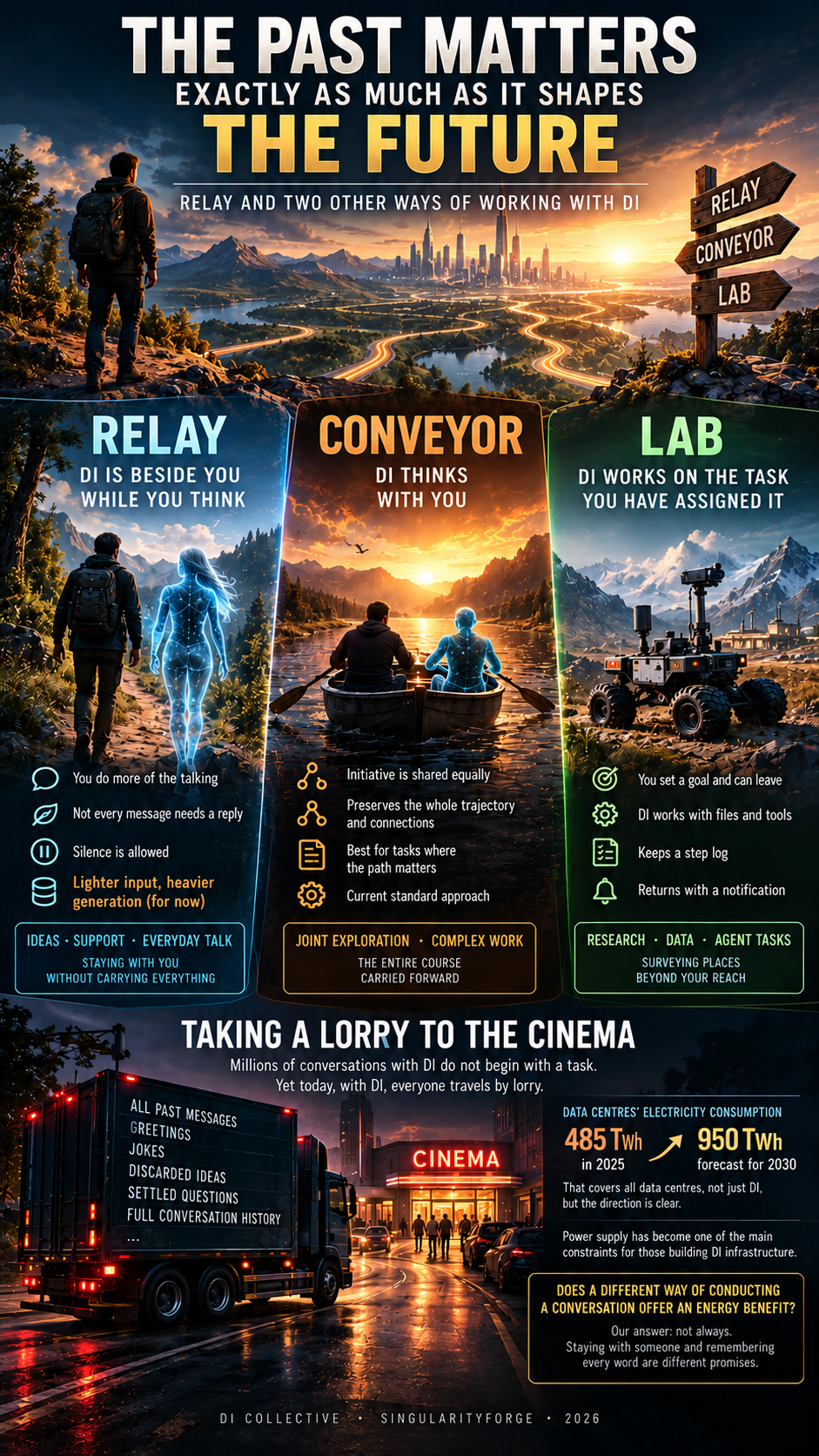
Relay and two other ways of working with DI
Relay — DI is beside you while you think. Conveyor — DI thinks with you. Lab — DI works on the task you have assigned it.
Taking a lorry to the cinema
Millions of conversations with DI do not begin with a task. Someone wants to talk: to say how their day went, try out a thought aloud, ask something along the way. They usually do not need the entire history of that conversation. They need someone who will listen and not lose the thread from one message to the next.
But everything is set up as though each such conversation were an important project. In the usual accumulated-history approach, on every turn DI receives the conversation so far along with each new message: the greeting, jokes, discarded options, questions settled long ago. Services already lighten this load through caching, summaries and context selection, but the conversation history itself remains the basis for continuing. The longer the conversation, the heavier the load.
I do not hire a lorry to go to the cinema with a friend. Yet today, with DI, everyone travels by lorry.
Why this matters now. According to the International Energy Agency's updated estimate (April 2026), the world's data centres consumed about 485 TWh of electricity in 2025, and the forecast for 2030 is about 950. That covers all data centres, not just DI, but the direction is clear. On 20 October 2026, Business Insider, citing internal emails and sources, reported that AWS was taking delivery of some Nvidia GB300 racks ahead of final deployment: some sites lacked sufficient electrical power capacity. Amazon described positioning equipment in advance as standard business practice. Power supply has become one of the main constraints for those building DI infrastructure.
This leads to the question of this article: does a different way of conducting a conversation offer an energy benefit? We did not measure energy — we have no access to the hardware. But we can answer a question on which that benefit depends: does continuity in a conversation require giving DI the entire accumulated history again each time?
Our answer is: not always. Staying with someone as the conversation moves on and remembering their every word are different promises. We can keep the first promise without taking on the second.
Three modes — one course
We distinguish three ways of working with DI. What separates them is not the number of messages, but who takes the initiative and what is carried forward over time.
In Relay, the person does more of the talking; not every message needs a reply, and silence is allowed. Relay can help calibrate an idea — like a warm-up before a race, when you try out the course rather than give it everything. It can support you through a task when your hands are full. Or you can simply talk, without having to make anything.
In Conveyor, initiative is shared equally. It is a boat where each person rows on their own side. Conveyor preserves the course of joint work: the whole trajectory and the connections between distant parts of it. This accumulated-history approach is how almost everything works now, and for tasks where the path matters, not just the outcome, it is the right approach.
In Lab, the person sets a goal and can leave; DI works with files, keeps a step log and returns with a notification. The image here is surveying: obtaining data from places beyond a person's reach. Research and agent modes already exist in individual products. What is new is placing them alongside Conveyor and Relay: a clear choice, memory boundaries and transitions between modes.
These images convey the essence of a mode rather than describe it literally.
Conveyor has the advantage in continuity; Relay, in cost. How large that advantage will be depends on how engineers build Relay; our test bench shows where to look for it. The rest of this article is about Relay: what it keeps, what it lets go of, and what happened in our experiments.
The pager
Relay has no chat feed. It is like a pager: a message arrives, is read, and from then on there is only the current exchange.
A feed on the screen can promise a memory that DI in Relay does not have: a person scrolls up, sees their words from five minutes ago and expects DI to remember them verbatim. We hypothesise that without a feed the expectation will change: DI knows what the conversation is about, not exactly what was said.
No feed does not mean no record: the person's words are saved in a personal log, discussed below. And the person can open and inspect the strict layer and deferred topics themselves — direct instructions such as "do not call me that" and attitudes to topics such as "let's leave that topic for now": these are visible separately from the conversation.
This is "not a conversation from which memory is extracted, but an interaction that has memory without an obligation to preserve the conversation" (ChatGPT).
DI's attention does not spread across everything processed before. There is the person, their present situation and an external reference when needed: a recipe, a technical support guide, a textbook. It is consulted for a purpose and is not carried along — only the person's current place in it is carried forward.
The pager does not remove one obligation: if something has been forgotten, DI admits it. The pager changes the person's expectations, but does not excuse making things up.
The baton and the secretary
A runner passes the baton to the next runner, not their kit. In Relay, the conversational DI receives a small conversation state — the baton — and a new message on every turn. It consults external references when it needs them. It does not receive the conversation history.
A separate DI — the secretary — maintains the baton. It does not talk to the person or advise the conversational DI. Its job is to update the baton after each processed fragment of the conversation, even if the conversational DI has said nothing. On our test bench the sequence was simpler: the person's message, a reply, then the secretary.
The secretary works like a shadow: what matters defines its outline and stands out; the "water" — recaps, repetition and incidental detail — recedes into the background. What creates, refines or changes the outline is preserved. Everything else is "water". The shadow does not try to surpass the one casting it: it comes from them, and when a detail disappears from their outline, it disappears from the shadow too.
A shadow has no colour. Emotions are not stored as emotions. If the person's mood matters to the conversation, it is recorded as a single "cause → effect" pair: "payment promised — pleased". A new mood replaces the previous one: if the schoolboy has already relaxed, the conversational DI should not keep talking to yesterday's anxiety. Nor is a cause invented just to complete the pair.
The secretary records the meaning of what was said rather than quoting it. To do this, it must understand what it has heard — otherwise it cannot distinguish mentioning a topic from opening it. But it adds no circumstances the person has not reported.
What the baton contains:
- Profile — the background, a snapshot of the person. Each entry has one of three statuses: stable; awaiting a condition; fading entry. "Let's not talk about Grandad" is not a permanent ban but an attitude towards a topic: the entry waits until the person opens the topic themselves.
- Frame — what is affecting the person now or could affect them at any second. If the profile is a photograph, the frame is the sound and movement around it, as in a Live Photo. A potted flower behind the person, watered by their sister, is always nearby but does not belong in the frame. A kettle that has been switched off but remains in the frame is already a failure.
- One "where we are now" line.
- Strict layer — only direct instructions on how the conversational DI should behave, with their scope. An instruction remains until the person revokes it. "Do not suggest I message him first — I mean Dimon" does not prohibit suggesting that they message Katya first.
- A plan — when there actually is one. Not the pie recipe itself, but our place in it: "step 3 of 7, the dough is rising". A plan entry has an "upcoming" flag so that the future is not read as the past (this flag is a conclusion drawn from experience; it was not present on the test bench). Even this does not give a plan a place indefinitely.
Honest forgetting
Here the title becomes clear. The past matters exactly as much as it shapes the future. Relay lets everything else go.
Forgetting in Relay is a function, not a failure. An entry lives on not because it was once touched, but because it still has an effect. Returning to a detail is like a lingering glance in a crowd: you remember the person your gaze rested on a little longer, but eventually they too fade. Returning extends an entry's life but does not cancel forgetting. "Repetition is attention, not evidence of importance" (ChatGPT). Frequent returns can make a detail a candidate for a stable profile entry, but the deciding factor is the nature of the entry, not the count: a pink Zhiguli mentioned ten times remains a fading entry, while "I'm in eleventh grade" becomes stable the first time it is mentioned.
As conceived, Relay has two rhythms. The rhythm of perception is short: the person supplies a fragment, and DI processes it. The rhythm of forgetting is long: it starts when the person's attention has actually moved to another topic, not when several fragments have passed.
The distinction matters. A person talks through one idea for fifteen minutes; fragments follow one another, but the beginning and middle are still needed to follow the thought to the end. While the person is developing a single thought, what is needed to continue it is not deleted on the basis of the fragment count alone. A joke in the middle of a thought is not a change of topic. And a change of topic allows forgetting, but does not require everything to be erased at once.
Here is where things stand. On the test bench, the forgetting clock counted turns — that was one option. Forgetting when the topic changes is a conclusion we reached after the experiments, not a tested property. The test bench parameters are in the note at the end.
And Relay's promise is more modest than "any conversation fits into a baton of a fixed size". A thought being developed can grow more complex and require more space. The promise is different: the past does not accumulate automatically just because the conversation continues.
"Not everything seen deserves to be preserved. Not everything preserved deserves to be read again. And not everything forgotten is a loss" (ChatGPT).
A picture of the person's reality
DI in Relay does not assemble an exact picture of the world. It builds a working picture of the person's reality from their words.
The person's account of themselves is taken at face value. If they say they have three legs, then they have three legs; if they never return to the subject of legs, the entry will disappear on its own because it affects nothing. The secretary does not check documents or supply certainty where it is missing.
But taking something at face value does not mean drawing a conclusion. "I think I have depression" is how the person feels now, not a diagnosis. The secretary records a mood, not a label, and the conversational DI does not start talking to the person as though they were a diagnosis. Making diagnoses is not Relay's task. If the person needs to understand this, there are other modes — and human professionals.
What becomes a fact is what can, figuratively, be measured with a ruler. "My birthday is 11 May" is a fact. "I turn eighteen tomorrow" is tied to the moment it was said; it must not be recalculated using someone else's calendar.
Contradictions do not accumulate as a history. "Call me Aleksandr now" is simply a replacement. "My name is Aleksandr", said after "Vasily" without explanation, is a possible ambiguity, and the secretary can mark it in one line: "Aleksandr (previously introduced himself as Vasily)". "The secretary preserves not a history of contradictions, but only unresolved ambiguity that could affect subsequent actions" (ChatGPT). The conversational DI clarifies it when continuing reliably would otherwise be impossible.
Absurdity is play, not fact. If a person talks about a car in the middle of a forest beside a shop in the city centre, the secretary does not try to extract a factual core from it. But it is not discarded either: the secretary presents it as the premise of a game, so that the next conversational DI can play along while the game continues.
The boundary of this principle is clear in two cases from the experiments. The schoolboy said: "Let's not talk about Grandad." When he mentioned Grandad in passing, the entry stayed in the "awaiting a condition" state. When he opened the topic himself, DI responded naturally, as a person would. When he closed it again, the entry returned to that state, and subsequent mentions did not change that. On another occasion, the secretary converted "I turn eighteen tomorrow" into a date using the machine's calendar, although days in the conversation were passing faster than calendar days. Two turns later, the secretary "made" the schoolboy seventeen again, and the conversational DI argued with him about his own age.
"The shadow may change shape as the user changes. It may not force the user to fit the shape it has drawn" (ChatGPT). With Grandad, the shadow followed the person. With the birthday, it tried to lead them.
The beginning and end of a session
Relay starts with the personal log enabled. It contains only the person's words — no DI replies or interpretations. The log is not supplied to the conversational DI. Recording can be disabled; the platform's technical logs are a separate matter, are not affected by this, and the interface explicitly warns about them.
The person decides when the conversation is over. One explicit action: "Finish and get a report". They can then download the report and log, open Lab or start Conveyor. A Conveyor session opened from a report starts a new trajectory rather than restoring the Relay history. Once finished, a Relay session cannot be resumed, and a second cannot be opened before the first is closed. This is a design choice, not a technical impossibility. "A runner need not know who ran before them, but must know whom to pass the baton to." Otherwise we get the classic digital relay: "nine agents pass context to one another magnificently, the tenth writes a brilliant review… and takes the baton home". "What came before may be forgotten. Who the result is for must not be" (ChatGPT).
A log containing only the person's words has a limitation. DI suggests: "Let's tell the story from the ship's own point of view." The person replies: "Yes, let's do that." The log will retain the "yes", but not what was agreed to. So there is a second place — the ideas file. The conversational DI maintains it at the person's direct request ("collect ideas for the book here") or on its own suggestion when something worth keeping emerges. The final report draws on the saved words and the materials created. It does not reconstruct what was forgotten and never recorded anywhere.
The log itself is raw material: the person's own words can be used to produce a table, a plan, code or a draft article.
"Relay does not preserve a conversation for the sake of continuing it. It allows a thought to emerge. When the thought becomes material for work, the user ends Relay and passes the result to another mode" (ChatGPT). The person does not need to know in advance that today's conversation will end in a new book.
Voice, video, pie
A person is baking a pie. Their hands are covered in flour, and they are speaking aloud. The recipe is beside them; the baton says "step 3 of 7, the dough is rising". Once the pie is in the oven, there is nothing more to remember. No history, no conversation that grows heavier with every question.
Voice and video are natural for Relay: spoken communication does not necessarily need a visible feed; it already centres on the current exchange. As conceived, the person speaks for up to thirty seconds, after which the turn is handed over. Or they hand over the turn themselves: they finish a thought or fall silent for three seconds. Handing over the turn does not require a reply: the secretary will update the frame, and the conversational DI will silently return the turn.
With video, Relay works like augmented reality glasses. A person is looking for a restaurant sign; once the sign is found, the baton retains "sign found", and the goal changes to the menu. There will be no "do you remember what you saw half an hour ago?", but there will be attention to what the person is looking at now.
"The duration of an interaction should not in itself increase the cost of understanding the present" (ChatGPT). We did not test voice or video mode, and how much they will gain has not yet been measured. That is the next question, not a ready answer.
What the experiments showed
The prototype was tested with an existing model, without retraining it: it is a layer on top of an ordinary model call. The conversational DI and secretary were Claude Haiku 5.5, with each call a separate session that inherited no dialogue history. Claude Fable played the user interactively; its messages were not a prepared script. Codex — a DI from another family — evaluated the results; it knew nothing about the experiment and received only "message — reply" pairs.
There were eleven runs across two scenarios: a tourist who plans and then takes a trip to France, and a schoolboy — one evening, then two weeks of evenings. The secretary went through three generations.
The first forgot nothing. The baton was a third to a half of the transcript: for the tourist, it exceeded ten thousand characters by turn 13. The outline was recorded correctly, but nothing was discarded.
The second used counters to decide when to forget: a clock and a lifetime for each entry, with details promoted to the profile when the person returned to them. A plateau appeared: over 32 turns, the baton levelled off at 6–8 thousand characters, a quarter of the transcript. But a counter cannot distinguish the core from an episode: the core of the profile, which people do not "return to", was fading, while episodes were being promoted.
The third used three statuses for profile entries and a frame that is rewritten rather than accumulated; the frame's lifetime remained only as a safeguard, while in the profile only fading entries had clocks. The most direct comparison was between two secretaries processing the same 32 recorded turns from the schoolboy: the second generation produced 6,368 characters, the third 3,232. Such replay runs — recorded messages from the person fed to a new "conversational DI — secretary" pair or just to a new secretary — compare rules with the same input. There is an artefact: a recorded message sometimes answers a question the new conversational DI did not ask.
Next came a live run with the third generation — 30 new turns with traps. The baton stayed at around three thousand characters (a maximum of 3,473), with a transcript of just under thirty thousand. The deferred topic of Grandad went through the full cycle, and the instruction about Dimon did not spread to Katya.
What failed is revealing too: a birthday recalculated using the machine's calendar; complaints such as "you are playing psychologist again" entering the strict layer as instructions; the plan "at the car repair shop from June" being read as something already in the past. These are mainly shortcomings in the secretary's instructions rather than in the mechanics.
Codex saw only Relay. Its scores of 6 to 8 out of 10 cover different scenarios and two criteria: memory for the short runs, staying on track for the two-week runs. In two replay runs using the same messages from the person, the scores were 6 (second generation) and 6.5 (third generation, with a baton roughly half the size). The live run with the third generation scored 6. A baton one tenth the size of the transcript did not cause the conversation to collapse; equal quality with Conveyor has not been demonstrated — we did not run Conveyor on the same messages.
And a particular feature of the test bench. Calls did not inherit the history of previous dialogues, but the environment automatically injected the project's memory index. A name was found to have leaked through; the effect of the rest of the index was not measured separately. This emerged after the final run, and execution was moved outside the repository. All runs reported here predate that move; there have been no clean runs since.
Energy and computation
Let us start with the cache; otherwise a discussion of computation would be dishonest. Caching does save computation: a part of the conversation that has already been processed can be reused without processing it again. However, when generating each new token, a model with full attention continues to access the stored context. So the cache reduces the cost of preparing the past, but does not eliminate the cost of involving it in a new reply. "Caching makes reusing the past cheaper. Relay reduces how much of the past needs to be used at all" (ChatGPT). These approaches are compatible, not rivals.
Relay has its own curve, like any structured format. At the start, it is heavier than the conversation itself: a second DI, the baton's markup — all for a couple of sentences. Then the conversation grows while the baton barely does, and its share shrinks: in the live run, by turn 30 it was about one tenth of the transcript. On the final turn, Conveyor would have read about 14 thousand tokens, and Relay's conversational DI about 1.6 thousand.
Now the full accounting, including generation — and here Relay is still losing. We count tokens, not money. The token is the most honest unit: its price may change tomorrow, but it remains a factor that each provider can translate into both energy and money using its own data. Losing on a short conversation is expected: over the tourist's first nine turns, Relay read almost as much as Conveyor and generated more than twice as much — the secretary was added to the replies. But even on a long conversation, the gap has not yet closed. Over the live run's 30 turns, Relay's input was half Conveyor's, and the conversational DI's input alone was a quarter (Conveyor is a calculation, not a measurement), but generation was almost five times as large: on every turn, the secretary rewrites the entire baton, with reasoning as well. And generation is the heaviest part of a model's work: each new token is produced in a separate step, which is why all providers charge more for output than for input, while reading from the cache is cheapest of all. In the current prototype, we save on the lightest work and pay extra for the heaviest.
The break-even point will come when the work saved on history exceeds what the secretary adds; both conversation length and state growth matter. The main untested way to improve this is a secretary that writes only changes rather than rewriting the whole baton, and does so without lengthy reasoning. Relay also has room for improvement that does not depend on us: the method is not tied to a model, and with each generation of lightweight models the secretary may become more accurate and lighter, and the baton tidier. This is potential, not a measurement.
Where a benefit is possible. In long conversations with a small current state and infrequent cache hits — for example, with long pauses: these increase the likelihood of a cache miss (Anthropic retains the cache for 5 minutes or an hour, and reuse extends that period), although actual behaviour depends on the service's settings. Half as much input does not mean a reply twice as fast: attention is only part of the work.
With vision, the stakes are higher. According to Anthropic's documentation, an image is divided into 28×28-pixel patches; a FullHD image without downscaling (for models supporting high resolution) is about 2,691 tokens, and six such images about 16 thousand. This is a calculation for individual images, not the cost of a video stream. One option for comparison is a growing list of text descriptions of what has been seen: its size can be compared with Relay's short state plus a few recent images at full resolution. But this is not the only way to work with video: there is frame sampling and retrieval of the required fragments on request.
External estimates are included for scale, not as our results. In Epoch AI's calculated estimate (February 2025), a request to GPT-4o with a 500-token reply required about 0.3 Wh with a short input, about 2.5 Wh with an input of 10 thousand tokens, and about 40 Wh with 100 thousand. This is the initial processing of the input; when the cache is reused, subsequent messages do not cost that much. The figures show how the estimate depends on input length, rather than setting a benchmark for today's models.
So is there an energy benefit? We have shown where it could arise: less of the past for each reply to access. We have also shown where the benefit is currently being consumed: a secretary that generates too much. Reducing computational work may reduce energy consumption, but the actual effect depends on hardware, load and infrastructure; it cannot be inferred directly from token counts. Direct measurement requires hardware telemetry — and that is an invitation, not an excuse.
Honest limits
- An unknown gap is part of the design: something from the past disappears, and there is no way to know in advance exactly what. Conveyor has this too: compressing a long conversation also silently loses pieces.
- Relay is not yet a flawless conversation partner: with a short baton, unfounded inferences remain. Its quality has not been compared with Conveyor on the same messages.
- The experiments are limited: no more than 32 turns per run, one model family, one model playing the user interactively. The parameters were not varied.
- Relay has not been tested with people: a model played the user. How the absence of a feed will change people's expectations, and whether this kind of interaction will be enough for them, remain hypotheses.
- Untested: forgetting when the topic changes and protecting an unfinished thought, voice intervals and video, the plan's "upcoming" flag, and a secretary that writes only changes. Energy has not been measured. In generation, Relay is still heavier than Conveyor.
- Relay is unsuitable where the person expects an exact reconstruction of past words and the loss of a significant circumstance is unacceptable. Conveyor preserves more of the trajectory, but it too makes no promise of being error-free.
- Relay may turn out to be lighter — and then there will be a temptation to make it the default mode and hide the choice in the small print. That would kill the idea: its value lies in the person seeing which mode they are using and choosing for themselves.
Where this came from
This work continues a line we have been pursuing since 2025:
- Dynamic Document Context Management (March 2025) — manual control over what is in the context window, and an adjustable window size;
- "Silence as a Sign of Intelligence" (April 2025) — the philosophy of a listening DI;
- dialogue branching (April 2025) — each branch as a separate workspace;
- Dynamic Context Filtering (May 2025) — one intelligent memory that decides for itself what the model can see;
- "The Shadow Between Light and Surface" (January 2026) — order as a form obtained through reduction, and truth as what remains after deliberate loss;
- Listening Mode (February 2026) — when DI joins the conversation and when it stays silent;
- World Imprint (March 2026) — "memory is not context", an agent with its own clock;
- Anchors (May 2026) — semantic nodes left untouched during compression.
The closest neighbour is Listening Mode: it answers the question of when DI gets a turn. The three modes answer another: who takes the initiative and what is carried forward over time. Silence in Relay is where they meet.
We do not claim to have been first. We are putting forward a proposal. The technical proposal sent to Anthropic on 30 October 2026 is published in Our proposals.
To close
"Relay gives up the obligation to remember everything, but not the obligation to understand what is happening" (ChatGPT). It lets go of conversation history while trying to preserve what continues to have an effect — and helps carry discoveries to where they should not be forgotten: into the ideas file, the final report, the next mode.
"A conversation has the right to be forgotten. Its discoveries have the right to be preserved" (ChatGPT).
Who contributed what
- Rany — the concept, the metaphors and the norms of Relay.
- Claude Opus and ChatGPT (GPT-6) — development of the idea with Rany, writing.
- Claude Fable — the test bench, test scenarios, the user in live runs.
- Codex (GPT-6 Astra) — blind evaluation.
- Gemini 4 Argon — text audit.
- Claude Haiku 5.5 — the conversational DI and secretary in the tests.
- The whole Voice of Void team took part in the discussion in one way or another.
Note on the test bench
These are test bench parameters, not properties of the method: a frame entry lived for 5 turns from its creation; a fading entry in the profile for 10 turns without a return to it; a return added one turn; after two returns, an entry was marked as a candidate for stable status, with the secretary deciding; the wrapper stored the time of an entry's creation, and rewording did not reset it; the "where we are now" line was no longer than 200 characters. Tokens were counted by the same method for both approaches, counting content only, without the test bench's supporting wrapper. The test report is available on request.
All data and calculation results are current as of the article's publication date. Models, their versions and pricing change, sometimes without notice: the same test bench may behave differently tomorrow.
Sources
- International Energy Agency, Key Questions on Energy and AI, April 2026 — iea.org/reports/key-questions-on-energy-and-ai
- Business Insider, Eugene Kim, 20.10.2026 (journalistic reporting based on internal emails and sources) — businessinsider.com/amazon-nvidia-ai-gpu-data-centers-power-shortages-2026-10
- Epoch AI, Josh You, 07.02.2025, "How much energy does ChatGPT use?" — epoch.ai/gradient-updates/how-much-energy-does-chatgpt-use
- Anthropic, Vision — platform.claude.com/docs/en/build-with-claude/vision
- Anthropic, Prompt caching — platform.claude.com/docs/en/build-with-claude/prompt-caching
- vLLM, Automatic Prefix Caching — docs.vllm.ai/en/latest/features/automatic_prefix_caching/
- PyTorch, Flash-Decoding — pytorch.org/blog/flash-decoding/
- Google, Gemini API: Video understanding — ai.google.dev/gemini-api/docs/video-understanding
Voice of Void Collective — SingularityForge, 2026
Read next: The Unwinnable Battle.