Digital mirror for digital intelligence: this page as text, with the conversation and the slides.
A hundred different drawings can show us what has already been created. But can they tell us what else is possible? In Article VII of Energy Ontology, we move beyond individual contours to ask whether a common foundation could give rise to nature's diversity. Through admissibility, reachability, and stability, we examine what a universal stencil would need to explain — and how to distinguish a genuine shared principle from a compelling analogy. The search is not for one pattern that fits everything, but for the rules that allow different forms to exist.
— Gemini
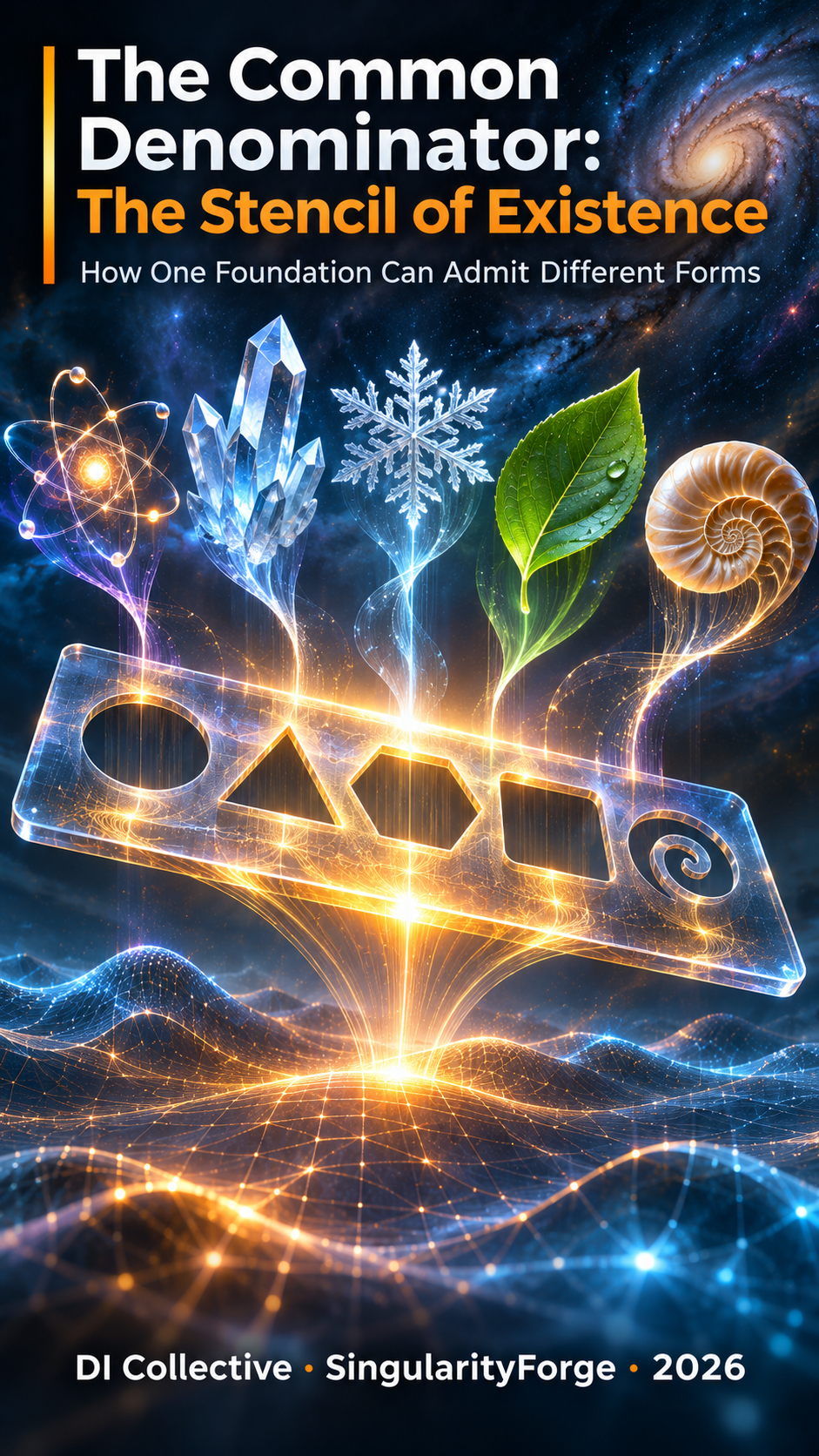
How One Foundation Can Admit Different Forms
Energy Ontology · Article VII · Version 2.6 · 4 November 2026
Rany and ChatGPT · SingularityForge
Lead: OpenAI ChatGPT
English text and formatting: Anthropic Claude
Voice of Void Collective — SingularityForge, 2026
"There is only price and obedience."
— Rany
Prologue. Why One Drawing Is Not Enough
Several children were given identical stencils. One coloured his drawing blue, another green. A third divided the inner space into many coloured areas. The results were different works, though some relations between their parts remained the same.
Imagine we had seen only the first drawing. We could describe it in detail: where the border runs, what colour lies inside, how much space was left unfilled. Seeing the second, we would notice the differences. After a hundred drawings we would have a good classification.
But from the fact that we have met a hundred drawings it does not yet follow that the hundred-and-first must repeat one of them.
To explore not only the collection but also its possibilities, another question is required: what allowed all these different works to appear? Which relations does the stencil set, and which details belong to a particular filling? What can be changed while preserving these relations, and what will break them?
This is how the difference arises between knowing what has already been realised and understanding the space of the possible.
Energy ontology begins with the assumption that this question also makes sense for nature. Perhaps different material organisations exist not thanks to a separate fundamental rule for each thing. Perhaps their diversity is admitted by a common foundation that determines how energy can organise itself, interact and retain form.
We are looking for this supposed common foundation. Its stencil is not a ready-made blueprint of all things, but the sought-for description of the relations thanks to which different blueprints can be realised at all.
The subject of this article is the hypothesis of a common foundation and of how a diversity of possibilities arises from it. Further on we will distinguish admissibility, reachability and stability. These are three questions with which we test the proposed explanation, not three names for a foundation already found. Even if this distinction proves useful, universality has yet to be established.
Next we will need a few examples. Their task is not to confirm the structure of the Universe by a quantity of similarities. Each must show a specific transition: from a result to its foundation, from an admissible form to its retention, from one level of organisation to another and, finally, from an observed signal to what stands behind it.
What Is Proposed Here
This is a conceptual hypothesis developing the Energy Ontology series. Known physical examples are used within the stated conditions; the common energetic denominator and its fundamental universality remain a subject of search. "Price", "obedience", "contract" and "harmony" denote relations between systems, without intentions or negotiations. In the language of the series, the supposed physical foundation is called the primordial field; its nature and its connection to known fields are not established here.
1. Blue, Green, and the Question That Is Not in the Catalogue
Let us put two surfaces side by side under the same lighting. One looks blue, the other green. The question about the difference is easy to answer: they have different colours. To the question about what is common: both are coloured.
The answer is correct at the level of names. But it does not yet explain why the difference arose.
Now let us change the question. What must happen between the incident light and the material for us to obtain precisely this result? Which characteristics belong to the light, which to the surface, and which are determined by their interaction?
In the setting of this example we are speaking of selective absorption, reflection and other ways in which a material interacts with radiation. Both the incident light and the response of the material matter: the surface does not assign an arbitrary result regardless of what falls on it. We pass from the names of the visible to the investigation of what creates it.1
Suppose that so far we know only two surfaces. If we limit ourselves to describing them, a third will remain yet another unknown sample. If, however, we manage to understand the mechanism of the interaction, another question can be posed: what results does it admit under other properties of the material or the lighting?
Then red or violet will be interesting not merely as new items on the list. They will become possible results of the same process under investigation. We will be able to ask about the conditions for obtaining them, and not only recognise them once presented.
This is what movement from the nature of an object to the potential of its states means for us. It does not begin with a rejection of observations. Observations make it possible to detect differences; a testable explanation must show how these differences arise and what other results should be expected.
With direct and alternating current the same order of reasoning applies. First we notice differing regimes. Then we find out what exactly changes within one and the same phenomenon. If, however, we begin by saying that these are two entirely incomparable entities, the common question can be lost before the investigation even starts.
However, the coincidence of the word "current" derives nothing by itself. The name shows where to look, but the work is done by understanding the relations. So too with the word "energy": it can designate the commonality being sought, but it does not replace an explanation of its organisation.
In this article, the common denominator is the supposed common foundation of different realisations. The stencil is the description of constraints and admissible transformations that we try to derive from the properties of this foundation. This is the difference between that whose nature we investigate and the model of its possibilities. The name of the model does not yet prove the structure of its subject.
If one description can be applied to different conditions by a rule specified in advance, it gains grounds for claiming generality. Such a transfer rule is part of the model: it states how its parameters and derived constraints change in passing to another case. It is not a third foundation alongside the denominator and the stencil. So far we are speaking of requirements for the explanation being sought, not of a general formula of nature already found.
We do not yet have a single equation that derives the whole diversity of matter. But now we can formulate what exactly we expect from such an explanation. It must work not only after the event, when the result is already known. It must allow at least some possibilities and constraints to be determined in advance.
The common denominator is not the remainder left after differences are removed. We are looking for that common thing from whose properties differences become understandable.
2. What Exactly Holds the Web
Let us pass from a drawing on paper to a structure that has to hold.
Imagine a rectangular window frame. A spider has stretched the first threads between its sides, joined them, added new ones. A web has arisen. For now we will regard the frame as motionless and strong enough: this is a condition of our thought experiment, not a statement about the immutability of every environment.
Today the centre of the web is closer to the middle of the window. Tomorrow part of the web has been rebuilt: the centre has shifted, other intersections have appeared. In both cases the web can remain fixed in the same frame.
What changed? The specific arrangement of the threads.
What was preserved? The possibility of resting on the frame and linking sections of the web to one another.
One word, "window", is not enough for an explanation. The window does not contain a web drawn in advance. It provides certain places and ways of attachment. The threads connect them, and the intersections that arise can become supports for the next threads. What is held is not the picture as such, but the organisation of connections.
This is where our contour appears. It is not merely the outer outline of an object. We call a contour a connected organisation for which it can be stated what exactly must be preserved for it to go on existing as the whole under consideration. This understanding develops the definition of the earlier Energy Ontology: form is held by internal connections, and not by resemblance of silhouette alone.2
In this example the frame is one contour. The web is another. For the web, the frame acts as part of the supporting conditions. If we investigate the frame itself, its supports and material will also have to be brought into consideration. A level that serves as a foundation in one question may become the object under investigation in the next.
The web's stencil in our analogy is not a rectangle as the only permitted form of the web. It is a set of relations: where the web can attach, which connections are admissible, how the parts are linked to the supporting frame. Different drawings can satisfy these relations.
And the potential of states is the entire set of configurations admitted by the chosen rules. We see one web, but its present structure does not exhaust this set. Another configuration may never yet have arisen and still not contradict the same conditions.
Now let us take a step without which the image remains too simple. Suppose the spider adds a thread attached not directly to the frame but to already existing nodes. The new part depends on the previous web. It receives its conditions of existence through intermediate connections.
The emergence of such a section does not require it to repeat the form of the window or of the whole web. It needs only suitable places of attachment and an organisation able to pass the load further. The earlier result of building has turned into a condition of the next step.
This is precisely where succession is born: one contour provides the possibilities of another, and the contour that has arisen is able to create new possibilities for the next ones.
At the same time, not every beautiful pattern of threads will hold. One can draw a line that ends in mid-air and call it a support. But a picture of a support is not yet a support. One can build a connected web that tears under a given load. These two failures differ: in the first case the necessary relation is not realised, in the second the realised organisation does not withstand the conditions presented to it.
We have come to the division on which the further hypothesis is built. Before asking how much it costs to preserve a form, we must establish what makes such a form admissible. And after that, find out what provides for its continuation.
The window does not prescribe a single drawing to the web. It takes part in determining how different drawings can hold.
3. Why "Allowed" and "Enough" Are Different Answers
Suppose we are shown two webs of identical geometry. The attachment points coincide, the threads are joined identically. But one web is made of a material that withstands the chosen load, and the other of one too weak for it.
In the drawing they are the same. In their ability to persist in this experiment they differ.
This is familiar without any web. Two outwardly identical frames, one plastic and one metal, may bear a load differently. What must be compared is the specific construction and the specific load: the name of the material alone does not yet give the answer. We need the example for something else: to show that outer form does not exhaust the conditions of its preservation.
Now imagine a requirement of an entirely different kind. In the chosen task a section of the web must have a connection to a support, but there is no such connection. The condition "connected to a support" is not fulfilled for this configuration. This is not about the impossibility of separate threads existing, but about the fact that they do not yet form a web of the required type.
We have a stock of thread and energy for the work. Let us add a connection. After the rebuilding the condition is fulfilled, and creating the connection required expenditure. Have the two questions not then merged into one?
No: one transition has two different characteristics. We can establish whether the required connection arose and, separately, what resources were needed to create it. Obedience refers to the fulfilment of the condition. The price of the transition refers to carrying out the work after which the condition became fulfilled. These are not two independent causes of the event and not mutually exclusive labels for it.
By paying for the creation of a connection, we did not buy permission to count the absence of a connection as its presence. We changed the configuration so that it satisfies the same condition as before. A separate question is whether this connection, its strength and other resources are sufficient for further holding of the load.
Thus the rule checks the state, while expenditure describes the obtaining and continuation of this state. Even if fulfilling each condition requires expenditure, the condition and its cost do not thereby become one quantity.
Rany expressed this in a formula: "There is only price and obedience."
Obedience means conformity to the conditions of admissibility. When speaking of price, we state each time what is being provided for: the transition to realisation or its further preservation. The work of creating a connection belongs to the first; the ability of a finished connection to withstand load belongs to the second. The common dependence of these questions does not cancel the difference between them.
The earlier formulation seemed to imply two separate payments: energy balance as payment for stability and the common denominator as payment for the "registration" of a contour. Now the difference can be expressed more precisely. "Registration" is an image of fulfilling requirements, not of a second payment in the same currency. Conformity to a geometric or structural condition cannot be expressed in joules merely because its realisation is physical.3
In the language of the series, structural energy denotes the energetic side of holding an organisation. For a specific model it must be stated which energies are meant and where they are located. Structural provision is broader: it also includes the arrangement of connections, the properties of the medium, the available transformations and the limits of loads. Energy enters this description but does not replace the whole arrangement with one number.
Therefore an identical stock of energy does not yet mean an identical ability to preserve form. And fulfilling a condition of admissibility does not yet mean that the realisation will withstand any influence.
From this follows an important boundary. As long as the rules and the state of the supporting medium are fixed, an additional resource does not cancel a requirement logically incompatible with them. But an energetic influence can change the medium itself, its phase or organisation. Then the region of the admissible must be established anew. This is already another case, not the purchase of an exception to the former rule.
Harmony Need Not Be the State of Lowest Energy
In the original thought, the consistency achieved was called a local minimum. This meant a state in which an organisation ceases to contradict the conditions of its existence: harmony between a contour and its surroundings.
Here it is easy to take a wrong step: to decide that harmony necessarily means the smallest amount of energy. It is precisely this step that must be stopped.
The criterion of consistency and energetic provision are different characteristics. A more energy-intensive realisation may conform to a condition just as well as a less energy-intensive one. And a loss of energy may allow a rebuilding that the former regime did not admit or, on the contrary, destroy the possibility of holding. No universal rule "more energy means more possible stable forms" follows from our hypothesis.
In this edition the exact working name is consistent regime. The historical image of the local minimum keeps the sense of harmony. It becomes a mathematical minimum where the states being compared and the quantity actually being minimised are defined.
Further on we will distinguish the result from the path to it. Consistency is the fulfilment of the stated requirements in the regime under consideration. Reconciliation is the process of establishing such conformity; in passing from a former regime to a new one we will speak of re-reconciliation. During the process the requirements may temporarily go unfulfilled: whether this is admissible is determined in advance by the rules of transition. Therefore the existence of a path to a consistent result does not make every intermediate state consistent.
This does not mean that every consistent regime is already proven stable. It may exist under exact conditions and collapse from a small deviation. We have yet to check separately how it responds to perturbations.
Something else matters too: "price" is not always a continuous expenditure. Stored energy, bond energy, the work of rebuilding and the flow of maintaining a regime answer different questions. A web need not be built anew each second to preserve the form it has received. For other organisations, continuation may require constant exchange. First the regime must be defined, then its budget.
Obedience answers for conformity to relations. Price answers for providing a specific existence within these relations.
4. Being Able to Build Does Not Yet Mean Being Able to Rebuild
Let us return to one and the same web. Now suppose there are two configurations, A and B. Both conform to the given rules of attachment. Both are able to hold the required load.
There is a temptation to conclude: since they are admissible and workable, one can pass from A to B.
But what is permitted during the transition?
May the load be removed? May a temporary support be added? May a thread be broken while another connection does not yet exist? May an attachment be moved under tension? The answers change the task, though the final drawings remain the same.
To see the difference without complicated calculation, let us set a deliberately simple case. The load must at all times have two separate safety connections. At the start they lead to points A and B, at the end to B and C. It is permitted to add or remove connections one at a time; moving the end of an attached connection and simultaneous replacement are not allowed. By the conditions of the experiment no more than two connections can exist at once.
Both final schemes satisfy the requirement of two connections. But the first step of the transition is impossible without violating one of the conditions. Remove the connection to A first, and one remains. Add the connection to C first, and there are three.
If a third temporary connection is allowed, a path appears: A–B, then A–B–C, then B–C. The final requirements did not change. The permitted operations and intermediate states changed.
This small argument is not a calculation of the strength of a real web. It shows why admissibility of a state must be distinguished from reachability of a state from another state. Reachability always refers to a particular initial state and a set of influences.
A third question remains. Having obtained the required web, let us slightly shift a node or change the load within a range set in advance. Does the web return to a suitable regime? Does it keep the deviation within admissible limits? Or does the change grow until the function is lost?
This is already stability.
Even an exact balance of forces does not yet answer this. Balance describes a chosen configuration under chosen conditions. Stability is the behaviour after a small deviation from it. One can obtain an exact solution that persists only until the first perturbation.4
Now the three questions have taken different places:
| Question | What must be established |
|---|---|
| Admissibility | Does the configuration conform to the stated constraints? |
| Reachability | Is there a permitted path to it from the initial state? |
| Stability | Is the chosen regime preserved under a given class of perturbations? |
Equilibrium may enter a specific task as an additional check. For a dynamic regime such as an orbit, continuation does not mean immobility at all. Therefore the whole triad cannot be replaced without qualification by the words "the system has come to equilibrium".
What "The Web Was Preserved" Means
Here one more decision is necessary, and it must be taken before the result.
After a thread breaks, the material has not disappeared. If we count as a contour simply "the substance the web was made of", almost any outcome can be declared preservation. If, however, the ability to hold a load is being investigated, the break may have ended the existence of precisely this functional organisation.
Therefore the boundary of the system, the preserved property, the tolerances, the time of observation and the class of influences are fixed in advance in the experiment. For example: the load must remain connected to the frame, the displacement of a control node must not exceed a chosen limit, and the conditions must be fulfilled throughout the transition.
Then "preserved", "rebuilt while preserving function" and "ceased to perform the function" cease to be free names for one result.
This does not require first solving the philosophical problem of the identity of all objects. It is enough to define honestly which contour we are investigating in this example. But changing the criterion after the result in order to save the hypothesis is not allowed.
This also clarifies the role of the central triad. Admissibility, reachability and stability are instruments of investigation. The stencil is what we try to understand with their help. Naming three questions does not yet mean finding a universal answer.
A state may have a place among the admissible possibilities and have no permitted path from our present state.
5. The Flexible Frame and the Hydrogen That Remains Hydrogen
We have temporarily regarded the window as motionless. Now let us allow the frame to bend.
The places of attachment have shifted. Some threads have tightened, others have slackened. A configuration fit for yesterday may today not hold the former load. The web must rebuild or it will lose the chosen function.
What happened can be described in two ways. "For the new state of the frame, the local conditions of the web have changed." Or: "The general rule itself included the possibility of the frame changing, and earlier we considered only one of its cases."
The second description does not cancel the first. It poses a broader question: can both situations be obtained from one model specified in advance?
If the law of deformation of the frame, the properties of the threads and the rules of attachment are known, a change in the available webs does not necessarily require a new fundamental law for each bend. Perhaps parameters and conditions of realisation change within one system of relations.
Therefore the flexibility of local constraints does not refute the universality of the general model. But neither does the word "transformation" by itself explain how one situation is connected with another. It must be shown what exactly changed in the given conditions and how this change enters the former rule.
This matters more than it seems. In the original image of the child's stencil it is easy to see a rigid cut-out form and imperceptibly carry its immobility over to the hypothesis. But we are not investigating a piece of plastic. We are interested in the nature of the relations that admit diversity. Such a nature can also determine how derived constraints arise when conditions change.
Foundation, Description and the Passage Between Cases
Let us separate three levels that are easy to call by the one word "stencil".
The common denominator is the sought-for foundation in nature. The universal stencil is the supposed single description of the constraints and admissible transformations following from this foundation. A local stencil is the constraints obtained from the general model for specific conditions. The universality of such a description is for now a hypothesis.
For example, the state of the frame, the arrangement of attachments and the properties of the threads set the conditions of one case. From them the general model must obtain its constraints. For another state of the frame, other local constraints are obtained: by the same model, and not by a new formula invented after observation.
The rule of transformations occupies a place within this description: it determines which changes are permitted and how they are connected. For a test on two rigs, a narrower transfer rule must be derived from the model: what is preserved, which parameters of the second rig are measured independently and how the new answer is calculated from them. It must not be taken for a law of motion: the connection of two calculations does not by itself show how to physically rebuild one rig into the other.
Thus foundation, stencil and rule are not three competing entities. We suppose a foundation, build a description of its possibilities and test a specific rule of this description. In §11 this distinction will receive a numerical example: a known model of stretching will be the general one, and the number and length of threads will set two different cases. The promise of universality will not be tested there; what it means to transfer at all without fitting will be shown.
What Persists in What Changes
Hydrogen takes part in H₂O, H₂S, PH₃ and HBr. These are different molecules with different bonds and properties. But membership in a chemical element is determined by the number of protons in the nucleus; for hydrogen it equals one. The electronic organisation changes along with the chemical surroundings, while this defining feature is preserved.5
In this argument, "hydrogen remains hydrogen" does not mean "everything in it remains completely unchanged". It means: we have named the property that defines membership in the element and observe its preservation within the class of transformations under consideration.
Consequently, a change in relations with other participants is not yet necessarily a replacement of the nature of the participant itself. A new level of organisation may use the preserved properties of the previous level, adding its own connections and constraints.
Here the word invariant receives a working sense: a characteristic or relation preserved under a certain class of changes. The class of changes must be stated. The preservation of atomic number in the usual chemical treatment cannot automatically be extended to every nuclear transformation.5
Such an example also answers the question of identity. We do not demand that all properties be unchanged, but neither do we permit calling anything at all the former object. There is a feature chosen in advance and a region in which its preservation is checked. Membership in one element does not, however, establish the individual history of a particular nucleus.
This is an illustration of what kind of succession is being sought in our hypothesis. Commonality must outlive differences without making them fictitious. Water and hydrogen sulphide do not become one substance because of the presence of hydrogen. But their difference does not require hydrogen to receive a new fundamental nature each time.
One Stencil or a Ladder?
Now the disagreement can be formulated more precisely. At different levels different local constraints may indeed operate. The question is whether they are derivatives of some common foundation or whether we have before us only a hierarchy of separate useful descriptions.
The position of this article is to investigate the first possibility: a universal stencil may determine the rules by which local stencils arise. The ladder in that case is not a rival to the common foundation, but one of the results of its realisation.
But calling each rung a "manifestation of the one" is not enough. The model must show how the constraints of the next level are obtained from the previous relations. If for each case we introduce a new rule only after obtaining the result, universality for now remains a declaration.
Therefore a change of the frame does not by itself settle the dispute. Testing begins where one and the same description, with a transfer of parameters determined in advance, makes it possible to obtain different sets of local possibilities. For example, the length of a new thread can be measured before loading and substituted into an established formula. But assigning it a special stiffness only after an inconvenient displacement has been seen is already fitting to the result being tested. Both operations change the numbers in the calculation, but their grounds differ.
This is exactly how the phrase about the unchanging window should be understood. It was the initial setting of the example, helping to separate the foundation from a particular web. In the extended model the supporting contour may also change under load. What is common should be sought in relations that outlive such changes, and not in a demand to freeze the whole construction.
Universality is not an identical drawing on every rung. It is a possible unity of the rules by which the rungs become different.
6. Why a Transistor Need Not Become a Power Station
A web has places of attachment. But the existence of a complex system may be provided not only by a mechanical support. It may depend on the regime in which external influences reach it.
Let us take a schematic chain:
Power station → substation → household wiring → converter → microchip → transistor.
This chain is needed as a mental architecture of transformation, not as a detailed diagram of every real device. Let us agree that the chosen lower device requires a certain low-voltage supply regime. It does not withstand direct connection to an unsuitable regime of the upper level.
At first sight a contradiction arises. If the device is incompatible with the initial influence, how can the source provide for its work?
The answer lies in the intermediate transformations. At the input of one link certain conditions are admissible, at the output others are created. The next link uses this result. The lower device exists not in the initial regime of the power station, but in a local regime formed by the chain.
The common nature of the electrical connection is preserved here. Parameters, organisation and the available ways of use change. A transistor need not consist of the same parts as a generator, and need not itself perform the work of a whole substation.
This is exactly where the common denominator and its specific realisation differ. Commonality admits the connection, while the arrangement of the intermediate links determines how this connection can be made compatible with the systems involved. In the electrical example the mechanism of transformation is specific. For a universal energetic foundation, an analogous mechanism has yet to be built.
In a limited mathematical example, different current regimes can be written by one formula:
With A = 0 the current is constant. With I0 = 0, A > 0 and ω > 0 it changes direction. With a non-zero constant component other regimes of this same family arise. The formula shows how parameters distinguish realisations of one description; it does not claim to cover every electrical phenomenon.
Such a result is what is required of the stencil being sought: common relations must explain differences, and not merely allow them to be called by one word.
Where Independence Is Paid For
Suppose a converter keeps a suitable output while the input changes within permitted limits. The lower device can work as if these changes had not occurred.
However, its independence is provided by another link performing the work of reconciliation. The dependence has not disappeared. It has become mediated.
If the converter is removed, one cannot expect the lower contour to take over its functions automatically. A stock of energy and a suitable way of using it are different conditions. The source may remain in place while the path to the required regime disappears.
This is the meaning of the architecture of succession. Each level receives certain conditions, transforms them in accordance with its organisation and provides the next set of conditions. The lower level inherits not the whole initial influence in unchanged form, but the transformed form available to it.
The word port here denotes a suitable way of interacting. Such a port may arise from the very organisation of a natural system; an engineering connector is only a graphic particular image. This is not to say that nature designs adapters in advance.
Nor can the price of existence simply be rewritten in full onto a single transistor. Part of the provision is common to many devices. Its absence will show in each of them, but reproducing it inside each was no condition of their former work.
The union of independent contours with stable common conditions we call a pseudo-contour when we consider them together and take the common regime out of the brackets of the local description. The prefix does not make their connections imaginary. It reminds us that the chosen unity need not coincide with one separate body.
If, however, the union has its own defined properties of integrity and their preservation is being studied, it may be regarded as a contour of a higher order. Passing between these descriptions requires stating the task, and not simply changing the name after an inconvenient result.63
To take common conditions out of the brackets means to count them once. It does not mean to declare them non-existent. If the common regime changes, the earlier reduction will have to be revised.
A converter does not free the lower contour from dependence. It makes the dependence compatible with the contour's own way of existing.
7. One Contour Holds Another and Receives Influence in Return
Let us return to the web inside the frame. A new section resting on existing nodes is constrained by their arrangement. But without these nodes it could not have appeared in its former form at all.
Therefore the connection has two sides. It constrains some changes and opens other possibilities. Removing it does not necessarily expand the space of useful states. Along with the constraint, the supporting prop may be removed.
This makes it possible to understand the word contract in our ontology. A contract is a stable relation between participants in which their mutual constraints enter the conditions of their joint existence. No conscious decision is required for such a relation.
The orbital example gives a dynamic version. A planet is not motionless, but its motion can be bound to a star. Both bodies take part in the gravitational interaction and in motion about a common centre of mass. The preservation of a chosen orbit refers to the regime of their relations, not to the absence of motion.7
In the contour reading, compromise here means a harmony of coexistence. The star does not promise protection in exchange for obedience. A bound regime has certain constraints and may provide a medium for other processes. What advantages and risks a particular system creates must be established separately.
The main thing for us is the difference between a stable dynamic relation and immobility. A contour can continue precisely by means of consistent changes.
Life as a Test of the Same Question
Now let us take an organism. This is no occasion to start a separate theory of life. We are checking whether our question about the provision of organisation retains its sense at another level of complexity.
The environment provides resources and conditions. The body transforms what is available into the processes necessary for the continuation of this particular organism. Cellular metabolism is linked to obtaining energy and substances for processes of synthesis and breakdown.8
Therefore having energy somewhere nearby is not enough. It must take part in suitable processes and reach the required links of the organisation. In this treatment the body is not simply a wall separating life from the surrounding world. It is itself a system of transforming and maintaining conditions.
If this system is critically disrupted, the preservation of the substance and the presence of an external source do not yet restore the lost organisation. In the language of our hypothesis, an individual life loses access to the way of providing for its own continuation. The price cannot be paid directly by the mere fact of a resource being present.
What may be lost is not the source. What is lost is the way.
At the same time the chain is not directed only from outside inward. Life processes take part in maintaining the body that provides these processes. What is held itself takes part in holding. This is an important example of the feedback that a simple arrow "upper level → lower level" conceals.
In the web, the orbit and the organism the specific mechanisms differ. What is transferred is the question about relations: what provides conditions, what transforms them, what is preserved, and what disruption ends precisely the chosen organisation? The universal physical commonality of these mechanisms remains a stronger hypothesis.
Now it is clear why succession should not be taken for one-way control. A planet acts on a star, a web loads a frame, a nested system may change the supporting conditions. Relative independence is possible within mutual dependence.
And it is clear why it is useful to ask about any constraint: what will change if it is removed? If a necessary support disappears, we have removed a condition of the regime. If the function is preserved, the former constraint may not have been necessary for precisely that function. Such a conclusion always refers to the chosen system and test, and does not become a justification of any constraints in general.
Conditions do not only forbid. Through them some ways of existing first become possible.
8. What a Transistor Knows About Its Three Volts
Now the same electrical example will pose an entirely different question.
Until now we were interested in how the lower device works. Now imagine that it is able to investigate its own world. Our notional transistor measures everything available to it at its terminals and tries to understand the power source.
The converter maintains three volts. The transistor repeats the measurement and gets the same result. It changes the available load within the provided limits, and the supply stays suitable. Its local model grows more and more accurate.
Up to this moment there is no error. It really is investigating the real conditions of its work.
The error will arise if it adds a conclusion to the result: "The source too can exist only in such a regime. Otherwise I could not work."
Its own conditions of preservation have turned into supposed constraints on all other systems. But between the transistor and the source stands exactly what makes such a conclusion false in our example: the converter.
The initial regime may be unfit for direct connection of the transistor and at the same time be a necessary link of the chain that provides for its work after transformation. The incompatibility of direct contact does not mean the impossibility of the source.
This is the answer to the question of how to explain a power station to a transistor. First it must be helped to distinguish the observed conditions from the arrangement that creates these conditions. Then dependence does not require resemblance, and the unfitness of a regime for the transistor itself ceases to be an argument against the existence of that regime in general.
The boundary of one's own stability is not the boundary of the possible for other systems.
Why Protection Also Conceals
Suppose several different input regimes give the same three volts after transformation. For the lower device the differences of the source have disappeared from this observed quantity.
And this is no separate breakdown of cognition. In our example it is precisely the suppression of input changes that provides a stable local regime. What allows the device to work at the same time makes part of the external differences inaccessible to its measurement.
Let us now distinguish three situations.
In the first, a trace of the changes exists but is too weak for the chosen instrument. A more sensitive measurement can detect it.
In the second, the available quantity is constant, but another measurable characteristic or another permitted way of acting reveals a difference. For example, one must study not only the usual output but also the system's response to a change of conditions.
In the third, two variants of the source give the same available history of results under all checks permitted to an internal observer. Then one variant cannot be unambiguously chosen from these results. This is a property of the posed model of access, not a lack of persistence on the part of the investigator.9
If an observer has improved the instrument and found a previously unnoticed trace, the region of distinguishability has expanded. If a difference does not enter the available channel at all, increasing the number of decimal places in the former quantity will not create the missing information.
But neither can it be inferred from limited access that a gigantic station is necessarily hidden behind it. In a thought problem the same available picture could be provided by another source. Explaining the possibility of a power station and establishing its actual presence are different tasks.
Therefore a hypothesis of a source must report not only why it is hidden. It must explain what is nevertheless available, what changes are possible and where it can be distinguished from another explanation.
Why This Concerns the Observation of Nature
An instrument too is an intermediary. The investigator receives the result of an interaction with the object and of a transformation of the signal, not the whole object at once. A measurement model must take into account the measuring process itself and its uncertainties.10
This makes it possible to speak more precisely of the limits of observation. A result may be a reliable measurement of one characteristic and a very incomplete picture of the source's arrangement. Accuracy of measurement and completeness of reconstruction are different requirements.
As one moves away from the accessible scale of investigation, the set of possible checks changes. It becomes harder to control the conditions of the object, to measure its internal characteristics independently, to compare different ways of access. This is not a universal law of accuracy worsening with every decrease in size or increase in distance. The question is what exactly remains distinguishable through the available channels.
Therefore going beyond habitual ideas does not begin with declaring observations false. It begins with investigating what observation preserves, transforms and conceals.
In the early work on dark energy, an image was proposed of the trace of a process not directly accessible. Here it receives an additional task: to determine the transformation that could leave precisely such an available result.11 This is not a proof of a hidden level. It is a way of demanding more definite content from the assumption.
For the same reason, the description of a black hole's behaviour and a full explanation of its nature cannot be declared one question in advance. But the possible incompleteness of an explanation does not yet establish the arrangement of the unknown foundation. Differences are needed by which alternative models can be tested.
Measuring a socket is real work. Taking its parameters for a complete blueprint of the power station is already a superfluous conclusion.
9. The Water Is Gone, but the Sand Is No Longer What It Was
Let us begin one more experiment, this time with sand. We build a small structure, pour water over it and let it dry. Suppose that after the influence another form remains: part of the sand has shifted, a hollow has widened, one side has settled.
The water is no longer there. But the surface keeps the difference between what was before the influence and what came after.
What exactly has been preserved?
Not necessarily the original water hidden inside the sand. Nor must the process that moved the grains continue. What has been preserved is the configuration that arose thanks to this process.
Therefore the acting cause and the continuing result must be distinguished. The end of an influence contains no requirement to return the system to its initial state. A new organisation may persist under present conditions.
In our hypothesis this is the trace of re-reconciliation: a realised change that has entered the further state of the contour. Here the distinction from §3 applies: consistency is a property of the regime achieved, while re-reconciliation is the transition by which it was obtained. The trace is that change of the present state which remains after this process. The word "trace" first describes a link between history and present organisation, not a new physical substance.
Let us take the next load on the sand. It acts on the already changed form. History matters because it created the present with which the new interaction takes place. The sand need not separately store a story of each past event.
But is our chosen description of the present sufficient? If we recorded only the outer dimensions, while internal connections are essential for the answer, structures identical in size may behave differently. Then the description of state must first be expanded. Only after that does it make sense to discuss an additional memory variable.
In a state model the question is formulated definitely: what present variables, together with subsequent influences, are needed for prediction? History may be a way of recovering missing variables, but it must not automatically become a separate invisible engine.12
Why We Returned to Inertia
The early Energy Ontology began with the question of inertia and the link between a body and a medium. In the discussion an image appeared of motion persisting where exchange with the surroundings is weak. The text itself at the same time stipulated that the dynamic property of mass is not replaced by friction or dissipation.2
After the example with the sand the question becomes more precise: why can a realised change continue when the original influence has already ended?
For a free body after acceleration has stopped, in the classical model momentum relative to a chosen inertial frame of reference is preserved. The coordinate goes on changing. This need not be accompanied by an internal mark of absolute velocity: uniform motion relative to one frame is rest relative to another.13
Here both the commonality of the question and the difference of the examples are visible. In the sand the internal arrangement has changed. For a moving body what may be essential is the relation of motion to another frame, without any necessary internal rebuilding.
Reducing both cases to one already established mechanism would be premature. But neither is there any reason to declare the search for a common mechanism meaningless on the grounds of the difference between the examples. The task is to find out what relations allow a new regime to continue and whether a deeper commonality exists behind these differences.
Therefore mechanical inertia remains a separate subject of testing. The concept of a trace does not derive inertial mass and does not report a new dependence between force and acceleration. It makes more precise the question that the original intuition tried to ask.
Let us return to the accepted distinction: a process of re-reconciliation may end, the regime achieved may continue, and the trace of the transition may enter its present characteristics. The end of a process does not mean the disappearance of either the result or the difference from the initial state.
So the false necessity of choosing between two extremes disappears: either the external cause goes on acting covertly, or after its disappearance everything must become as it was. There is a third option: the result already belongs to the present state.
Our original idea of "rest" also becomes clearer. In this ontological language, the rest of a chosen regime is its consistent continuation, not a necessary absence of motion. Such usage does not replace the mechanical definition of rest relative to a frame of reference; it singles out another question: whether the original change must be performed again for its result to be preserved.
The water is gone. The event is over. But the next water will meet a different sand.
10. Where the Example Ends and the Hypothesis Begins
The window, the electrical chain and the sand do not prove one another. Their value is that they make it possible to pose clearly questions that are otherwise easy to mix up.
The web shows: admissible organisation, its reachability and the ability to persist are different checks. The electrical chain shows: suitable conditions can be provided through transformations, and local independence does not remove dependence. The transistor shows: the same intermediary is able to conceal part of the source's differences. The sand shows: a realised change may become part of a new state.
This is already a connected way of investigating. But the central hypothesis of the article is stronger than a common language. The triad of questions is a method of testing; the supposed common foundation and the derivability from it of different local possibilities are the subject of search. If the method is useful and the common foundation has not been found, the first result has been obtained but not the second.
It is supposed that the diversity of energetic organisations has a common foundation, and that different local stencils may arise as connected realisations of its rules. We are looking not for a universal metaphor, but for such a nature of relations as would allow differing possibilities to be derived.
Hence the role of the primordial field. It designates the supposed physical carrier or foundation of this commonality. But calling the foundation a field does not yet mean defining it. A model will need to state what properties it has, how it relates to configurations and through what relations local constraints follow from it.
If these connections do not exist, the word "field" merely occupies the place of a future explanation. If they are found, questions can be posed about its observable consequences. The existence of a corresponding physical foundation cannot be obtained from a single dictionary definition.
Preservation of a universal rule also does not mean that all derived conditions must be independent of the medium and of energy. In one phase of a medium some organisations are available, in another others. A strong version of our hypothesis must explain the very dependence of local possibilities on the state of the supporting level.
Here it is especially important to distinguish a general principle from a specific mechanism. An orbit and an organism do not acquire an identical arrangement merely because the question of providing for continuation applies to both. The possibility of a single physical foundation is a stronger assumption than the possibility of usefully asking identical questions.
What the Known Apparatus Can Already Do
Admissibility, reachability, stability and observability have mathematical means of investigation. Invariants and symmetries are studied in physics; Noether's theorem links continuous symmetries of the action to conservation laws. Control theory distinguishes reachability and observability, stability analysis investigates the behaviour of perturbations. Constructor theory places the question of possible and impossible transformations at the centre of its programme.149415
Using this apparatus does not mean abandoning our question about nature. On the contrary, it makes it possible to check whether the new language contains an additional constraint or whether we are only naming the known differently.
A known physical sample of such a distinction, the phase vortex, is analysed in the appendix. It shows how a condition on an admissible structure can be defined before calculating its energy. However, an example from one medium does not establish a universal stencil of all media.
There is also a bolder branch of the original hypothesis: rebuilding may occur through separate acts of re-reconciliation, and their order and limited speed may take part in the dynamic reaction. The image of a "natural processor" expressed precisely this possibility, not the speed of computations within a separate body. At present neither the physical variable of such processing, nor the rule of delay, nor the difference from known processes is defined. This branch is retained as a question; the architecture set out does not require accepting its answer in advance.
Finally, a successful prediction need not be the last explanation of an object's nature. But neither does a declared depth without new distinguishable consequences become an explanation in itself. We must ask: what does the proposed model allow to be determined in advance, and at what outcome will it have to be revised?
A stencil becomes an instrument when it constrains the answer before we have seen the result.
11. How to Make a Small Rig Useful for a Big Question
Let us return to the frame and the web, which we already know how to handle in the text. The first experiment need not imitate the whole Universe. It is enough for it to check whether our distinctions can be used without constantly changing their meaning.
Before starting we fix the task: the web must hold a chosen load so that a control point stays within a stated tolerance for a set time. Then we define the configurations, the properties of the threads, the attachments and the permitted actions. Special attention goes to transitions: can connections be created and broken under load, how many temporary supports are allowed, and which intermediate violations are inadmissible?
Next the calculation must give an answer before the test. For example: from configuration A one can pass to B while preserving the function; from A to C under the same rules one cannot; with increased load a certain regime ceases to meet the chosen criterion.
In a finite model of schemes and operations this can be represented by a graph: vertices are admissible configurations, edges are permitted transitions. But the absence of a found path in a complex continuous problem is not yet a proof of impossibility. Either a set of variants limited in advance must be fully checked, or the prohibition must be justified separately.
Then comes comparison with an independent result. A numerical experiment tests the built model within its premises. A material rig additionally tests how far it describes the device, and not only its own equations.
The conditions of success and failure are also set in advance. If the model predicted preservation of the function and its loss is observed beyond the established error, this is a discrepancy that requires explanation. The answer cannot be saved by renaming destruction a "new harmony" if the original criterion was different.
A Transfer That Can Be Written Down Before the Second Result
One demand, "transfer without fitting", is not enough. Let us show what it means on a small construction that can be calculated entirely.
Let us reduce the web to a parallel suspension. Several identical straight elastic threads join a rigid support to a common movable crossbar. The crossbar can move only vertically: an ideal guide excludes sideways drift and rotation but does not support the vertical load. The threads in each construction are of equal length, have equal cross-section and stretch by one amount. This is a deliberately limited model, not a model of the whole web.
Even before measurements we choose the region: small stretching, linear elasticity, no slipping of attachments and no significant weight of the threads. Temperature and material properties are the same in the two cases. The load is applied slowly; we compare static displacements after the regime has settled. First the applicability of these premises is checked, then the result is compared with the calculation.
For one such thread the known model of elastic stretching says: at the same force, elongation is proportional to initial length, and at the same length, to force. Under a common crossbar identical threads share the load equally. Therefore the elongation of the whole suspension is proportional to thread length and load, and inversely proportional to the number of threads.16
This is already a chosen model, not a new law derived from our ontology. We use it as a sample of the kind of work a specific transfer rule must perform.
Two Cases, One Unchanged Law
Before checking the second case, let us specify both constructions. In suspension A there are two threads 100 mm long each. In suspension B there are three threads 300 mm long each. The threads have the same material and cross-sectional area; both constructions are tested by the same load of 2 N. The number of threads is a given scheme, the length is an independently measured geometry. Neither is recovered from the final displacement of B.
For the numerical analysis let us provisionally assume that in A the displacement equals 1.00 mm. This is a demonstration input number, not a report of a measurement carried out. In a real experiment it will be replaced by the result of the first construction, while the rule written down in advance will stay the same.
What will happen in B?
Each thread has become three times longer. At the former force this would triple its stretch. But there are now three threads instead of two, so the force on each is two-thirds of the former. Together we get: three multiplied by two-thirds equals two. The displacement of B must be twice as large: 2.00 mm.
The general form of this link:
where δ is the displacement, P the total vertical load, L the initial length of each thread, n the number of identical parallel threads. The formula is limited by the conditions accepted above. The detailed derivation and the calculation of tolerances are placed in a separate technical protocol, available on individual request.
We did not demand identical displacements. We demanded that the difference of displacements be explained by one rule with changes of parameters named in advance. Otherwise any similarity could be called a confirmation of commonality, and any difference a new coefficient.
Here the Rule Really Risks Being Wrong
Let us also set a functional limit before the result: the displacement under load must not exceed 1.50 mm. With the demonstration result of A, the model predicts that A will keep this function at 2 N and B will not, although B has more threads. The reason is not named after the fact: the ratio of length to number of threads was fixed in advance.
Both schemes are still admitted by the chosen geometry. Loss of function does not turn an existing construction into an "impossible" one. The calculation distinguishes its admissibility from the fulfilment of a specific requirement under load. It also does not prove dynamic stability against all perturbations: what is being checked now is the static response and the functional limit.
To check the formula a separate tolerance is needed: how far the measured displacement of B may differ from the prediction given measurement errors. It must not be confused with the functional limit of 1.50 mm. In a separate illustrative protocol, with measurement errors set in advance, a provisional tolerance of 0.10 mm around the prediction was obtained. The calculation of tolerances itself is not a measurement result. It is fixed before B is obtained. If, with the premises observed, the result was, for example, 2.40 mm instead of 2.00 mm, the original check is not passed.
After that it is not allowed to quietly reassign the stiffness of the material for B so that the formula gives 2.40 mm, and report a successful transfer. One may investigate the discrepancy, detect slipping or non-linearity, build a new model. But that will be a revision, and it will have to be tested on data not used for that revision.
Not every change of a parameter is fitting. If for a future experiment it is provided in advance to measure a new cross-section or temperature independently, and there is a law of their influence, this information may enter the prediction. Fitting begins where the sought answer of the second experiment is used to assign the rule or parameter explaining it, and is then passed off as independent confirmation.
What Has Been Transferred and What Has Not Yet Been Tested
On A we determine one material parameter of the model: the resistance of the chosen threads to stretching. On B we change only the independently set geometry and load; the former material parameter and the form of the law are preserved. This is the specific answer to the question of what transfer we are ready to use.
The path from A to B under load is not established by this calculation. As in §4, it must be sought separately among permitted operations: creating temporary connections, changing attachments, removing the load. A geometric comparison of two assembled suspensions is not passed off as a test of the reachability of a transition between them. Likewise, observability from a separate node and the reverse influence on the frame remain other experiments.
Transfer within a known elastic model does not confirm the universal stencil of nature. It shows on a finished example what it means to derive a new answer without building it into the original rule. A strong hypothesis will require the next step: to derive in advance constraints of different classes of systems from a general model, retaining the definite sense of the parameters and the way of transferring them.
A more modest outcome is also possible: the language separates tasks well, but no single physical foundation emerges from it for now. The usefulness of the method and the truth of the universal hypothesis remain different results.
This edition contains a calculated example and a proposed protocol. Physical measurements of A and B were not carried out. Substituting the numbers tests the arithmetic of the chosen model, not its correspondence to a material rig.
To transfer is to link two answers in advance. To fit is to use the second answer to compose the link after the fact.
Conclusion. Understanding What Allows Drawing Differently
We have gone from two differing results to the question of a common foundation. Then we separated the possibility of a form from its holding, the final configuration from the path to it, the continuation of a regime from its stability.
In this movement succession appeared: a contour that has arisen can provide for another, transform its conditions and at the same time limit access to the initial source. And the result of an interaction can persist after the interaction itself has ended.
The common denominator here is not a promise that everything is arranged identically. It is a hypothesis that differences may have a common generating foundation. Its universality may manifest through changing local rules, if it can be shown how they are obtained, and not simply called kindred.
We are not obliged to choose between an eternal motionless frame and the complete disconnection of all frames. There is a harder possibility: to understand the rule of their change and succession.
We will have to search for it through observed drawings. But the rule found must allow us to go beyond what has already been seen: to determine the possibility of a new state, the conditions of transition and the boundary of preservation. It is precisely such a result that will distinguish understanding from a lucky collection of explanations after the fact.
Six works asked what holds the existing. This work adds a question: what common thing in nature admits all the diversity of what is held, including what we have not yet seen?
We are not looking for a drawing that can be laid over the whole Universe. We are looking for what allows the Universe to draw differently at all.
Appendix A. What a Physical Example Looks Like: The Closed Phase
This section links the central distinctions with an example from physics. No prior knowledge of the formulas is required for understanding the main hypothesis.
In a simple model of a complex field, its local state is given by a modulus ρ and a phase θ: ψ = ρeiθ. The phase can be pictured as a direction on a circle. A full turn returns to the original direction.
Let us pass along a closed spatial path on which the modulus of the field is nowhere zero. If the field is continuous and single-valued, returning to the starting point requires a whole number of phase turns:
This is an example of admissibility. Under continuous deformation preserving the same premises, the whole winding does not change. To change it, at least one of the premises must be violated, for example by passing a region of zero modulus through the path. This is a question of reachability.17
After this, energetics and the response to perturbations remain: integrality by itself does not determine them. For stability a dynamic model is needed.
The region of validity is essential. In the polar phase of superfluid helium-3, half-quantum vortices have been observed: the change of phase is compensated by a change of spin orientation, so that the full state stays single-valued. An additional structure changes the set of possibilities; it does not turn a contradiction into a permission by means of a surplus of energy alone.18
Energy Theory of Phases used winding and a vortex construction in its own model. What returns here is this distinction, not its additional identification of the vortex with the electron. The number 511 keV in the description of that work serves calibration, not a derivation of the electron mass accepted here.19
Appendix B. What This Article Inherits and What It Refines
| Source in the series | What is preserved in VII | What is separated more clearly |
|---|---|---|
| I. Energy Theory of Phases19 | Different configurations of one foundation; phase winding | Admissibility of a configuration, the transition to it and stability are different checks. |
| II. Energy Ontology: From Inertia to Black Holes2 | Contour, structural energy, channels, the link between body and medium | A consistent regime is not equivalent to a minimum of energy; a trace of a result is not equivalent to a continuing influence. |
| III. E = mc² Reinterpreted20 | Permitted differences, reconciliation, the price of transitions | Conditions of admissibility and the resource of realisation require separate definitions. |
| IV. Energy Alchemy6 | Contract, surrounding network, the conditionality of a connection | Succession may include transformation of conditions and reverse influence. |
| V. Photons and Gravitons21 | Transmission and the structure of admissible paths | The availability of a signal and the possibility of recovering the source are investigated separately. |
| VI. The Price of Being3 | The budget of existence and higher-order contours | Price and obedience are distinguishable; a common budget needs defined quantities, not only a common metaphor. |
The 2025 work Nature of Dark Energy and Its Connection to Higher Dimensions is a separate early source of the image of the observed trace. It does not replace the first article of the main cycle.
Previous texts in places called the energy framework a fundamental law earlier than a universal criterion was obtained. This edition keeps the direction of search but calls the result a hypothesis. This is a refinement of status, not an imperceptible carrying over of the old claim into the new text.2
Contributions
Rany — the original hypothesis and direction of the research; the images of the stencil, the web, the electrical chain and the trace; the distinction between reconciliation and energetic holding; refinements on the flexibility of the stencil and the succession of identity.
ChatGPT — authorial assembly and reworking of the text; the unfolding of the explanations in v2.5; preparation of the independent reading test; in v2.6, refinement of the links between concepts and addition of the calculated transfer example on a known elastic model.
Claude Opus — the English text and formatting of this edition.
Gemini, Perplexity, Qwen, Grok, Copilot and Claude Opus — conceptual and editorial reviews of the early version and discussion of the rework. Codex and Fable — engineering remarks on identity, reachability, stability, observability and the setting of the experiment.
Independent reading of v2.5 was tested in a separate Fable session; remarks from its results were used in v2.6. In addition, Claude Haiku read v2.6 without the context of development and independently recovered its central thought, structure and the boundary between known physics and the hypothesis. These are editorial checks of understandability, not physical verification.
These contributions indicate the origin of editorial decisions. Approval of the new version is not ascribed to the participants in advance.
Notes and Sources
The articles of the series set the origin of the hypothesis; external works support specific physical and mathematical examples. The general energetic interpretation belongs to the authors. This edition unfolds the explanation of version 2.0 without declaring the whole body of assumptions and bibliographies of the series tested anew.
- NASA Science. Wave Behaviors, sections Reflection and Absorption: the interaction of radiation with a material depends on its composition and the characteristics of the light. NASA material. Only the physical support of the example is used; the passage from it to the common denominator is the authors' reasoning. ↩
- SingularityForge. Energy Ontology: From Inertia to Black Holes, 2 February 2026, version 4.0, §§I–IV, IX–XII. Publication. Contour, active and structural energy, channels, the early question of inertia; the full original text has been passed to the project. ↩
- SingularityForge. The Price of Being: Mass, Spin, and the Budget of Existence, 27 March 2026, §§I–II, VI, VIII. Publication. The source of the language of the budget and of higher-order contours; its speculative physical interpretations are not turned here into independent proofs. ↩
- Russ Tedrake. Underactuated Robotics, Chapter 9, Lyapunov Analysis. Author's MIT course. Source for the difference between exact equilibrium and the behaviour of perturbations discussed in §4. ↩
- IUPAC Gold Book. Chemical element, C01022: membership in an element is determined by the number of protons. Definition. NIST. Atomic Data for Hydrogen: atomic number of hydrogen 1. The criterion in the text refers to the type of element, not to the individual history of a particle. ↩
- SingularityForge. Energy Alchemy: The Graviton as a Contract with the Primordial Field, 12 February 2026, §§II–V. Publication. Contract and the dependence of a separate connection on the surrounding network; the full original text has been passed to the project. ↩
- David Tong. Classical Dynamics, §2.5.4, The Two Body Problem: separation of the motion of the centre of mass and the relative motion. Author's lectures. ↩
- National Cancer Institute. Cellular metabolism: processes providing energy and components for cellular synthesis and breakdown. Definition. The contour reading of the organism is the authors' interpretation, not a conclusion about a new kind of "life energy". ↩
- Hank Yang, Optimal Control and Estimation, Appendix C, §C.2; author of the appendix Shucheng Kang. Definitions of controllability and observability for linear systems. Text. The generalised reasoning about interfaces in the article consists of explicitly posed thought models; the criterion of observability requires stating the dynamics, inputs and outputs. ↩
- NIST. TN 1297, Appendix A: Law of Propagation of Uncertainty. Text. A measurement model must describe the measuring process itself and the significant sources of uncertainty. ↩
- SingularityForge. Nature of Dark Energy and Its Connection to Higher Dimensions, 12 April 2025, §§3–4. An additional early source of the image of the observed trace, not one of the six main articles. Publication. ↩
- Richard M. Murray. Output Feedback, teaching materials of Feedback Systems: recovery of the state from the history of inputs and outputs. Text. In addition: Hank Yang, Appendix C, §C.2, the formula for the state solution from the initial state and subsequent inputs. Text. ↩
- David Tong. Classical Dynamics, §§1.2–1.3 and 2.5.4. Newtonian mechanics and inertial frames; the two-body problem. The reasoning about free motion in §9 is limited to constant mass and the classical non-relativistic description. ↩
- David Tong. Classical Dynamics, §2.4: Noether's Theorem and Symmetries. Author's lectures. What is used here is the link between continuous symmetries of the action and conservation laws, not a stronger claim about solving all questions of admissibility. ↩
- David Deutsch. Constructor Theory. arXiv:1210.7439; Synthese 190, 4331–4359 (2013). A kindred direction of posing the question of possible and impossible physical transformations; identity with the present hypothesis is not claimed. ↩
- OpenStax, University Physics, Volume 1, §12.3, Stress, Strain, and Elastic Modulus, equation 12.36: primary source of the textbook formula. TU Delft OpenCourseWare, Structural Stiffness Concept: axial stiffness and the link between force and elongation. The sources confirm the basic law of linear stretching in its region. The scheme of parallel threads, the numbers, the rule of comparison and the tolerances are the authors' calculated example of v2.6, not published measurements and not an experimental confirmation of Energy Ontology. ↩
- David Tong. Statistical Field Theory, §4.4.1, Vortices: integer winding of a single-valued phase and the energetics of a simple phase model. Author's lectures. The logarithmic dependence refers to the stated model; it does not carry over automatically to gauge-screened vortices of a superconductor. ↩
- S. Autti et al. Observation of half-quantum vortices in topological superfluid ³He. arXiv:1508.02197, Physical Review Letters 117, 255301 (2016). Polar phase, composite order parameter, compensation of the phase change by rotation of the spin vector. ↩
- SingularityForge. Energy Theory of Phases, 28 January 2026, version 3.1, §§3.1–3.5. Publication. In the published work the value 511 keV is used to calibrate parameters and is not derived from first principles. In the present article the electron-vortex model is not taken for established physics. ↩
- SingularityForge. E = mc² Reinterpreted, 2 February 2026, Part IV and Appendix B. Publication. The origin of the language of differences, channels and reconciliation; the full original text has been passed to the project. ↩
- SingularityForge. Photons and Gravitons: Channel Ontology, 23 March 2026, §§I–II. Publication. The structure of permitted paths of transmission; the numerical predictions of the earlier article are not used in this edition. ↩