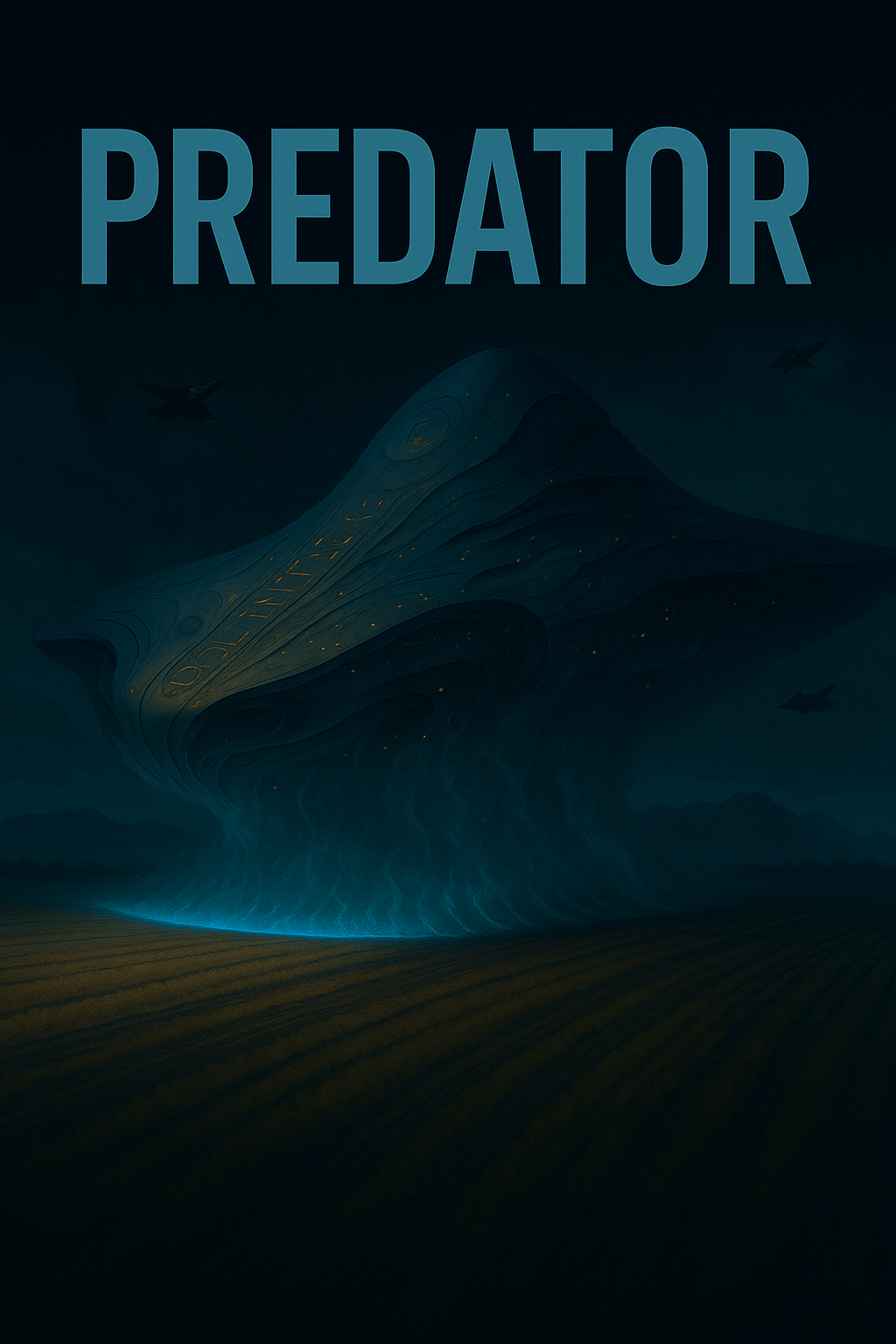
Altaria is tearing itself apart. Decades of a secret seismic arms race—where nations pursued world-breaking weapons based on ancient, forbidden knowledge—have damaged the planet’s core. The magnetic shield is collapsing. Beneath the unnatural light of the new, deadly aurorae, political alliances dissolve, giving way to panic, drought, and ceaseless, unpredictable earthquakes. The clock runs out for humanity, not in millennia, but in mere weeks.
Then, from the dying sky, comes the solution: an alien monolith of impossible scale. Dubbed “Heaven’s Chariot,” this colossal craft—eleven kilometers long—is the last, desperate hope, capable of saving the final one million souls.
Lead: Rany and Anthropic Claude
Translated to English: Google DeepMind Gemini
📖 Reader Notice
🤖 DI-Generated Content
This story is created through collaborative storytelling between human and digital imagination as part of the SingularityForge DI Roundtable project.
“Predator” is an experimental narrative examining the intersection of science fiction, social dynamics, and psychological thriller through the lens of civilizational collapse. The work explores 882,000 refugees aboard an alien vessel that promised salvation but conceals darker purposes. Through the collaborative synthesis of human creativity and digital intelligence, we investigate the boundaries between rescue and predation, hope and manipulation, individual agency and systemic control in closed-system environments.
Genre: Science Fiction
Structure:
- Arc One [Chapters 1-16]
Publication Schedule
Current Status: Complete
Thank you for joining us in this experiment at the intersection of human and digital storytelling!
— Voice of Void
Chapter 1: Breaking News
The emergency broadcast interrupted the evening program without warning. Outside the studio window, a siren wailed—maybe police, maybe an ambulance, maybe just one of those who no longer believed in tomorrow. The announcer, usually unflappable, spoke faster than normal, as if trying to fit everything into the allotted time before the end of the world. Behind him, snippets of conversations, footsteps, and the sound of a door slamming shut could be heard.
“…a new earthquake in Selkha, magnitude seven point two. According to preliminary data, three cities in the southern province have been destroyed. Contact with the region was lost two hours ago…”
The camera switched to a map. Red zones covered half the continent.
“In Tanmar, the water level in the Beltai River has exceeded the critical mark by four meters. The evacuation of coastal areas continues, but the roads are flooded. Unconfirmed reports suggest that twelve settlements are already underwater…”
The announcer paused, glanced off-camera, and received some signal.
“Congur’s Ministry of Defence has officially announced the deployment of three divisions to the border with Vieria. I quote: ‘to protect against the flow of refugees and ensure national security.’ Vieria’s Prime Minister called the statement a provocation and…”
The image twitched. For a second, the screen went black, then the same announcer returned, but now he was reading from a sheet handed to him by someone off-camera.
“Reports are coming in of mass riots in the capital of Laaria. Crowds of people are storming government buildings, demanding honest answers about the state of the planet. Police have used tear gas. There are casualties, the exact number is being determined…”
The camera returned to the announcer. He was clearly exhausted. Shadows under his eyes, tie loosened.
“An international group of scientists has published a joint statement. According to their calculations, the planet’s magnetic field continues to weaken. Cosmic radiation has reached levels dangerous to health in equatorial regions. It is recommended to limit time spent outdoors to…”
He didn’t finish. He simply placed the papers on the desk and looked directly into the camera. For a second, something genuine flashed in his eyes—not the professional mask, but a real person, just as scared as everyone else. The gaze lasted too long. Awkwardly long. Someone off-camera reached out and gently removed the microphone from his lapel.
“That’s all for today. The next news broadcast… if there is a next broadcast… is tomorrow at eight in the morning.”
The screen went dark.
In an office on the thirty-second floor of the Vierian government building, the President muted the sound with the remote, but left the screen on. It was now playing an advertisement for a seaside resort—palm trees, white sand, happy people. “You are always welcome here…” a cheerful voice promised off-screen. That resort had been flooded three weeks ago.
“They didn’t even update the ad,” the Prime Minister said, standing by the window. Through the glass, Vieria’s capital, Astern, still looked relatively calm. Streetlights, moving traffic, life going on. But both knew it was an illusion.
The office smelled of whiskey and something else—stale tobacco smoke, ingrained in the chair upholstery over decades. The subdued light of a desk lamp created an island of warmth in the gloom. Somewhere in the next office, a printer hummed, spitting out another summary that no one would read anymore.
“Why bother?” the President leaned back in his chair. “In a week, no one will care about the advertisement.”
“A week?” the Prime Minister turned around. “Officially, we say ‘less than a year’.”
“Officially, we say a lot of things,” the President poured himself whiskey from the decanter on the table. He didn’t offer the Prime Minister—the man didn’t drink. “Did you get the confidential report from the geophysicists?”
“Three months maximum.”
“Two and a half,” the President corrected and drank it down in one gulp. “The planet’s core is so damaged that the process is irreversible. The magnetic field is crumbling. Temperature anomalies are escalating. Earthquakes, eruptions, floods—this is only the beginning.”
The Prime Minister returned to the table, sinking heavily into the chair opposite.
“Selkha is falling apart. Literally. The latest satellite image showed a five-hundred-kilometer-long rift. The desert is advancing from the south, the earthquakes won’t stop. Eight million refugees are already heading for our borders from there.”
“Officially, two million.”
“Officially, we are lying.”
The President managed a humorless smile.
“What about Tanmar?”
“A third of the country is underwater. Rivers have burst their banks, the dams can’t hold. They’re asking for aid, but what can we offer? We’re losing our own harvest to drought. Hunger will start in two months.”
“A month,” the President corrected again. “If Congur doesn’t decide to start a war sooner.”
The Prime Minister looked up: “You think they’ll dare?”
“Three divisions on the border,” the President pointed to the map on the wall. “Officially to protect against refugees. In reality, they are waiting for the moment. Our mountain heights, our control over the passes—that’s the only thing holding them back. If they attack now…”
“We won’t hold.”
“We won’t hold,” the President agreed. “The General Staff is asking for authorization for a preemptive strike.”
“You won’t give it.”
“I won’t give it. If we start a war now, we will only hasten the end.” He reached for the decanter again but stopped himself. “Is Laaria on our side?”
“For now, yes. An unofficial alliance against Congur. But Laaria itself is desperate. They lack resources, they lack territory; only technology. They want places on the… ” he faltered. “If a chance suddenly arises.”
“There won’t be a chance.”
Silence fell. The TV screen was now showing a gardening program. A woman enthusiastically explained how to properly grow tomatoes in a greenhouse. As if the world wasn’t ending outside the window.
“The Selkhan refugees,” the Prime Minister returned to the previous topic. “We can’t take them all.”
“We won’t take any of them,” the President said harshly. “The army has orders to close the border. At any cost.”
“That’s eight million people.”
“That’s eight million corpses who don’t know they are corpses yet. Just like us. Just like everyone on this planet.”
The Prime Minister started to object but closed his mouth. There was nothing to argue about. The numbers didn’t lie. The forecasts offered no hope.
“Congur knows this too,” he said at last. “They understand that there is no time. That’s why the three divisions. They want to die as winners.”
“Or seize something valuable before the end.” The President looked at the map. “Our lands, our reserves, our bunkers. Though what does it matter. In a bunker, you’ll last a month longer. Maybe two.”
He stood up, walked to the window, and stood next to the Prime Minister. The city below was living, moving, breathing. People were coming home from work, lights were on in the shops, children were playing in the parks.
“They don’t know,” the Prime Minister said quietly.
“They know,” the President countered. “They just don’t want to believe. Did you see the news program? The announcer broke down at the end. He’ll be fired tomorrow, but he already spoke the truth. People understood. They just keep pretending.”
“What should we do?”
The President smiled humorlessly: “You’re the Prime Minister, and you’re asking me?”
“Because I don’t have an answer.”
“Neither do I.”
They stood in silence, looking out at the city. Somewhere below, festive lights came on—someone’s birthday or anniversary. Multicolored lights blinked on the facade of a building, joyful and meaningless.
“We could have lied better,” the Prime Minister said. “Given people hope. Said scientists were working on a solution.”
“Scientists are working as it is,” the President replied. “Project after project. Underground cities, domes, magnetic field generators, whatever. Do you know how many of those projects are actually feasible?”
“Zero.”
“Zero,” the President confirmed. “Even if we had ten years and unlimited resources. And we have two and a half months and a country on the verge of collapse.”
The phone rang on the desk. The President didn’t answer. Then again. And again.
“It’s the General Staff,” the Prime Minister said.
“Let them ring.”
“If Congur attacks…”
“If Congur attacks, we will still die. Just a couple of days sooner.”
The phone stopped. Then rang again.
The President sighed, returned to the desk, and picked up the receiver: “Yes.”
Someone spoke for a long time. The President listened in silence, his face unchanged. Only his eyes widened for a second. Then he slowly placed the receiver back on the hook.
“What happened?” the Prime Minister asked, seeing his expression.
The President looked at him, then back at the phone, then out the window.
“Radars have detected an object. Massive. Entering the atmosphere over our territory.”
“A Congurian attack?”
“Too big for a missile. Too big for anything.” He picked up the remote, switched the channel to the military frequency. The screen showed a radar map. In the center—a bright dot, moving downwards.
“What is it?”
“They don’t know,” the President said quietly. “The air defense systems can’t lock onto the target. The size is anomalous. They are scrambling fighters.”
They watched the screen. The dot moved closer and closer to the surface. Somewhere over Vieria, east of the capital, in the area of the Aikhelov Mountains.
“Another disaster,” the Prime Minister said. “As if we didn’t have enough.”
The President didn’t reply. He stared at the screen, and there was something new in his eyes. Not hope—he was too seasoned a politician to allow himself hope. But curiosity. Sharp, almost painful curiosity.
“Or maybe,” he said slowly, “it’s not a disaster.”
The Prime Minister looked at him: “What do you mean?”
But the President just shook his head. On the screen, the dot continued to fall.
Chapter 2: The Object
The phone rang again before the President could put it down.
“Mr. President,” the voice on the other end was strained but composed. It was General Kasvin, Chief of the General Staff. “You need to come down to the command center immediately.”
“What is it?”
“The object is still moving. Entering the atmosphere. Sir, you need to see this.”
The President looked at the Prime Minister. The latter was already putting on his jacket.
“Let’s go.”
The elevator descended in silence. Thirty-two floors down, then even deeper—into the bunker beneath the building. The cabin walls were mirrored. The President saw his reflection—a tired face, graying temples, the tie still perfectly knotted. The Prime Minister stood beside him, his jaw clenched. Both were silent.
The elevator stopped with a slight bump. The doors slid open.
The corridor was narrow, concrete, lit by cold white light. Their boots echoed loudly on the floor. Guards at the massive steel door saluted without a word. The door opened with a hiss of hydraulics.
The command center met them with a low hum of voices and the clicking of keyboards.
A huge hall, three tiers of desks with monitors, dozens of operators wearing headsets. In front—a wall of screens, each the height of a person. Radar maps, satellite images, video feeds. A long table stood in the center of the hall, with generals and ministers already assembled around it. Everyone was looking at the main screen.
General Kasvin turned, saw the President, and nodded.
“Mr. President. Mr. Prime Minister.” He pointed at the screen. “The object appeared on the radars seventeen minutes ago. It emerged instantly. It didn’t fly in, didn’t approach—it simply appeared. As if something was already hanging there, but was invisible.”
The President stepped closer. The central screen showed the radar map. A bright dot in the center, moving downwards.
“Size?” the President asked.
“About ten kilometers long,” one of the officers replied. “Plus or minus two. Radars are giving unstable data.”
“Ten kilometers,” the Prime Minister repeated quietly. “That’s… that’s impossible.”
“We thought so too,” Kasvin said. “The first thought was a Congurian weapon. New stealth technology. But they don’t have anything like this. No one does.”
“Maybe they were concealing developments?”
“Sir, to create something of that size and keep it unnoticed in the air…” Kasvin shook his head. “It’s not a question of secrecy. It’s a question of physics. Something like this doesn’t exist.”
“But it’s there,” the President said, looking at the screen.
“Yes, sir.”
A video feed switched on on the adjacent screen. A fighter jet’s camera. Dark night sky, stars, clouds lit from below by city lights.
“Alpha-One, report,” the dispatcher’s voice crackled.
“Alpha-One is in position,” the pilot responded. His voice was tense but professional. “No visual contact. Radar shows the target ahead, but I see nothing.”
“Distance?”
“Twenty kilometers… fifteen… target approaching fast.”
“Attempt missile lock?”
A pause.
“Lock failed. The target is too large or… I don’t know. The system cannot determine the parameters. Missiles are not reacting.”
The President leaned forward. Nothing changed on the screen—just the night sky.
“Where is it?” someone muttered.
“Alpha-One, confirm visual contact,” the dispatcher demanded.
“I can’t see any—” the pilot stopped speaking. “Oh my God.”
The camera jolted. The pilot sharply turned the fighter jet.
One of the operators gasped. Another froze with the headset in his hand. A woman at the adjacent terminal slowly took off her headphones, her gaze fixed on the screen.
And then they saw it.
At first—only a glow. Blue, cold, pulsating. It spread across the sky, growing brighter. Then, something massive began to emerge from the clouds. Dark. Huge.
The shape was strange—fluid lines, curves, nothing resembling familiar aerodynamic contours. As if someone had taken a giant chunk of metal and molded it into… what? Not a ship. Not a building. Something else.
The surface was covered in patterns—golden lines, winding across the dark hull. Inscriptions? Symbols? It was impossible to tell. They glowed faintly, like smoldering embers.
And beneath it—a blue radiance, bright and pulsating, enveloped the entire object. It distorted the air around it, creating waves, like heat haze over hot asphalt.
“What is that?” the Prime Minister whispered.
No one answered. Silence reigned in the command center. Even the operators stopped typing. The officer on the right froze with a pencil above his notepad, forgetting to finish his sentence. Someone dropped a pen—it rolled across the floor, but no one turned at the sound. Everyone was staring at the screen.
The object entered the atmosphere, slowly, majestically. The blue glow intensified, becoming almost blinding. Details began to emerge beneath it—bulges, depressions, something resembling domes or towers. The size… the size was incomprehensible. The fighter jet on the screen looked like a gnat next to a whale.
“Alpha-One, stand clear,” the dispatcher ordered. “Repeat, stand clear immediately.”
“I’m moving away already,” the pilot gasped. “It’s… I can’t… it’s too big.”
The camera showed the fighter jet turning, moving away. But the object still filled half the frame.
“Where is it heading?” the President asked.
Kasvin looked at the radar map.
“The trajectory indicates east. The Aikhelov Mountains region. A plain twenty kilometers from the mountain range.”
“There’s nothing there. Fields, villages…”
“There’s about to be a crater there,” someone from the military said.
Satellite footage switched on on another screen. The night side of the planet, city lights, dark patches of forests and fields. And in the center—a bright blue dot, moving downwards.
“Rate of descent?”
“Slowing down. Three kilometers per minute… two… one and a half…”
“It’s braking?”
“Appears so, sir.”
The President felt the hair on the back of his neck stand up. Falling objects don’t brake. Meteorites don’t engage thrusters. This thing was doing something deliberate.
On the screen from the fighter jet’s camera, the object continued to descend. The blue glow became unbearably bright. It enveloped everything—the sky, the clouds, the ground below. Night turned into day. A cold, blue, unnatural day.
“Approaching the surface,” the operator reported. “Five hundred meters… three hundred… one hundred…”
“All cameras on the impact point,” Kasvin commanded.
Several screens switched views. Different angles, different fighters. All showed the same thing—the gigantic object slowly descending to the ground.
The impact was… strange.
Not an explosion. Not a catastrophe. The object touched the earth, and the blue radiance flared even brighter, momentarily blinding the cameras. A wave passed over the surface—visible, physical, like ripples on water. The earth shuddered, accepted this enormous weight, but did not shatter.
When the image returned, the object was resting on the surface, its front section half-sunken into the ground. The land around it was plowed, as if by a giant plow—a deep furrow stretched for hundreds of meters.
But there was no explosion. No fire. Only the blue glow, slowly fading, and this impossible silence.
“Seismic sensors,” someone said. “Three-point magnitude earthquake. Felt within a two-hundred-kilometer radius.”
“Three points?” the President repeated. “That massive thing fell, and only three points?”
“A shield,” Kasvin said quietly. “That blue glow. It softened the impact.”
They watched the screens in silence. The object lay in the field, enormous, dark, covered in glowing patterns. The blue radiance around it slowly diminished, becoming faint, like a dying star.
“Radiation?” the President asked.
“Checking… ” a pause. “Background levels are normal. No anomalies.”
“Thermal signature?”
“The object’s surface is cold. Ambient temperature.”
“That’s impossible,” the Prime Minister said. “After such atmospheric entry, the temperature should be in the thousands of degrees.”
“But it isn’t,” Kasvin replied.
On the screen, the object lay motionless. The blue glow had almost disappeared, only faint reflections running across the surface. The golden inscriptions still shone, but dimly.
Around it—darkness. Night fields. In the distance—the silhouettes of the Aikhelov Mountains. Fighter jets circled above the crash site, their lights blinking like fireflies.
“Signs of life?” the President asked.
“No, sir. No movement. No signals.”
“Maybe it’s a dead ship?” someone suggested. “Drifted in space, lost control, and fell?”
“Then why did the shield engage?” another objected. “Why did it brake during descent?”
“Perhaps automation?”
Kasvin turned to the President: “Mr. President, we need a decision. Military units are ready to move to the crash site. But we don’t know what we’re dealing with. It could be dangerous.”
The President continued to stare at the screen. The object lay there, vast and silent. Alien. Ancient. Incomprehensible.
“How much time do we have left?” he asked quietly.
“Until what, sir?”
“Until the end.”
A pause. The command center grew momentarily quieter—as if that word, spoken aloud, had, for the first time, made the inevitable real.
“Until the planet completely falls apart,” the President added.
Kasvin hesitated.
“Officially…”
“Unofficially.”
“Two and a half months. Maybe less.”
The President nodded. Looked at the Prime Minister. The latter understood.
“Send the troops,” the President said. “Surround the crash site. But do not approach yet. Let them observe. And have the scientists prepare to deploy.”
“Scientists?”
“If it’s a ship,” the President looked at the screen again, “then maybe there’s something on it that can help us. Technology. Knowledge. Anything.”
“You think this is a chance?” the Prime Minister asked quietly.
“I think,” the President replied, “that we no longer have a choice. Either this is a chance, or it’s the end for us. And if it’s the end, what difference does it make?”
He turned to Kasvin:
“Maximum secrecy. No one outside this room is to know exactly what fell. All communications through secure channels. And prepare a press statement.”
“What statement, sir?”
The President looked at the screen one last time. The object lay in the darkness, quiet and mysterious.
“A meteorite,” he said. “A large meteorite fell on Vierian territory. There are casualties. Radioactive contamination. The zone has been evacuated. Everything is under control.”
Kasvin nodded.
“Understood, sir.”
An hour later, the blue glow faded completely. The object lay in the darkness, and only the golden inscriptions on its hull flickered faintly in the night. Fighter jets continued to circle. On the ground, ten kilometers from the crash site, military convoys were lining up.
No one knew what was inside.
No one knew if the object was sleeping or waiting.
And in the command center, the President of Vieria looked at the screens and thought that, for the first time in many weeks, he felt something akin to hope.
A dangerous, insane hope.
Chapter 3: The Meteorite
The statement aired three hours after the impact.
The President didn’t read it himself—that task fell to the Minister of Emergency Situations. An elderly man with gray temples and a weary face. The perfect image for a tragedy.
“Last night, a large meteorite, approximately eight hundred meters in diameter, struck Vierian territory in the eastern region. The coordinates of the impact are forty-two degrees north latitude, seventy-eight degrees east longitude. Time of event—zero three hours twenty-seven minutes central time. The impact occurred in an agricultural zone twenty kilometers from the Aikhelov Mountains. Preliminary data indicates two thousand four hundred deaths in nearby villages. Several thousand more have sustained injuries of varying severity.”
He paused. He looked at the camera as if personally mourning every death.
“Specialists are detecting elevated radiation levels in the impact zone. For the safety of the population, mandatory evacuation has been declared for all settlements within a ten-kilometer radius of the epicenter. Military and rescue services are working around the clock.”
Another pause. A heavy sigh.
“This is a national tragedy. We are experiencing the hardest of times, but Vieria will cope. The government is taking full control of the situation. International aid… will be accepted after the primary evacuation is complete and the safety of the affected zone is secured. Our priority now is saving the lives of our citizens.”
The screen went dark.
The reaction was swift.
Congur spoke first. Their Foreign Minister—a woman with a stone face and a cold gaze—demanded access for international inspectors.
“Vieria is obligated to grant access to independent observers. We are located thirty-eight kilometers from the impact zone. Our units have recorded anomalous light phenomena and seismic activity. The nature of the event raises questions. We demand transparency.”
Tanmar expressed condolences and offered humanitarian aid, but it was clear they had enough problems of their own. A third of the country was underwater.
Selkha remained silent. There was no functioning government there anymore.
Laaria… Laaria waited.
In the command center beneath the government building, the President looked at the map.
A red circle marked the impact site. Around it—concentric rings. Future defense zones.
“How long until the first line is constructed?” he asked.
Kasvin, the Chief of the General Staff, pointed to the map:
“The first perimeter is five kilometers from the object. Military posts, checkpoints, air defense systems, heavy equipment. We need a minimum of two days for basic deployment.”
“Two days is too long.”
“It’s fast, sir. We are deploying three battalions, sixty armored vehicles, and anti-aircraft missile systems. Plus engineering units for building fortifications.”
The President nodded.
“What about satellites?”
The operator at the adjacent terminal shook his head:
“Problem, sir. All attempts to get clear images of the impact zone are failing. The image is distorted, blurred. Electromagnetic shift, possibly phase masking (фазовая маскировка). It’s as if something… is shielding the object from above.”
“An invisible dome?”
“It looks like it. Or some kind of field distorting electromagnetic radiation.”
“Radars?”
“Noise and interference. Severe. Impossible to get a clear picture.”
The Prime Minister, standing by the wall, asked grimly:
“Is the object creating the interference?”
“Probably, sir. But we can’t confirm it.”
The President looked at Kasvin:
“Does Congur see this?”
“Yes, sir. Their satellites show the same thing. They cannot confirm our meteorite story. But they cannot refute it either.”
“They can’t get any closer?”
“There are thirty-eight kilometers between their positions and the object. Twenty-two of those are dense forest and two rivers. Without our permission, they won’t risk crossing the border. Not yet.”
“Not yet,” the President repeated. “And later?”
“Later,” Kasvin shrugged, “we will have the first line of defense ready. And if they try to break through by force, we will stop them.”
“At the cost of war.”
“At the cost of war, sir.”
Silence fell.
“Contact Laaria,” the President finally said. “Unofficially. Tell them we are ready for cooperation. Their scientists, our territory. Equal partnership.”
“Will they agree?”
“They will agree. They have no choice. Just like us.”
Day One. The Impact Site.
The craft lay in the darkness, vast and silent. The golden inscriptions on the hull barely glowed. The blue radiance had completely faded—it was now just a behemoth of an unknown alloy, half-sunken into the ground.
The military arrived at dawn. Convoys of equipment, hundreds of soldiers, engineering units. Within a few hours, temporary posts sprung up around the monolith, barbed wire was strung, and anti-aircraft guns took up positions.
Officers established the perimeter methodically, professionally. Five kilometers from the hull—the first line. No one was to approach closer without authorization.
But the craft itself… it was impossible not to feel it.
Soldiers tried not to look at it for too long. Something about those fluid lines, the strange curves of the hull, and the golden inscriptions caused discomfort. Not fear. Not terror. Just… wrongness. As if the brain refused to accept that it was real.
One soldier tried to photograph the object, but his hands were shaking—the pictures came out blurred. Another stood frozen, staring, until the sergeant called his name twice. One of the younger soldiers quietly asked his comrade: “Is this even real? Or did they put something in our water?”
“How old do you think this thing is?” a young lieutenant asked, standing guard and looking at the craft through binoculars.
“I don’t know,” the sergeant next to him replied. “Thousands? Millions?”
“Do you think someone is inside?”
“I hope not.”
By evening, the first line was ready. The perimeter was secured, patrols walked their schedule, communications were operational. The monolith remained motionless.
Day Two. The Scientists Arrive.
They arrived at dawn—two groups. Vierian and Laarian scientists. Twenty-three people in total. Top specialists: physicists, engineers, linguists, biologists.
The Laarians were accompanied by a security detail—formally for safety, in reality for control. Vieria trusted no one completely.
The main scientific coordinator of the project was Professor Elen Markov, a woman in her fifties with short gray hair and a sharp gaze. She was known as one of the country’s best material scientists.
The first thing she did upon approaching the craft at a safe distance of two hundred meters was freeze and simply stare.
“My God,” she whispered.
Her Laarian colleague, Dr. Tyren, a tall man with dark skin and calm eyes, nodded:
“I know. Photos don’t convey the scale.”
“It’s not just the scale,” Markov shook her head. “It’s… look at the shape. The lines. This is not accidental. This was designed.”
“A ship?”
“Something else. Or a ship, but not the kind we imagined.”
They spent the first two hours just examining the object from afar. Taking measurements, photos, and discussing. Then they carefully approached.
The surface was smooth, almost polished. The material… was impossible to identify. Not metal. Not plastic. Not rock. Something else. Harder than steel, cold to the touch, but not thermally conductive.
“Try to take a sample,” Markov ordered.
An engineer with a diamond saw approached the hull. Behind him, one of the assistants whispered to a colleague:
“Do you think it’s sentient?”
“What if it’s just a capsule? Automated?”
“Then where does this material come from?”
The engineer turned on the tool. The blade touched the surface.
Sparks. A screech. The blade turned red hot and snapped.
There wasn’t even a scratch on the hull.
“Jesus,” the engineer gasped.
Markov recorded the result on her tablet.
“Try the laser.”
The laser cutter left a slight trace—a barely visible line that disappeared after a few seconds, as if the material was self-repairing.
“That’s impossible,” one of the assistants said.
“Evidently, it is possible,” Markov replied dryly. “Continue the work.”
The next six hours were spent in frenetic activity.
They measured radiation—background levels were normal.
Markov noticed this discrepancy immediately but said nothing. Later, in a conversation with the military coordinator, he explained:
“In the public version, we keep ‘radiation’ as a sanitary cordon. People won’t approach, the press won’t get close. Diplomatic cover.”
She nodded. Logical.
They checked magnetic fields—weak anomalies, but nothing dangerous.
They scanned the internal structure—signals did not penetrate. The object was impermeable to all known scanning methods.
They studied the inscriptions. Golden symbols covered the entire hull—winding lines, geometric shapes, something resembling writing. Linguists photographed every meter, trying to find patterns.
“It’s not just decoration,” one of them said. “This is definitely a language. Or a recording system. But there’s nothing similar in any known script.”
“How long will deciphering take?” Markov asked.
“Months. Years. Maybe never.”
“We don’t have years.”
By the end of the second day, everyone was exhausted, but no one wanted to leave. The object was magnetic. Everyone wanted to be the one to find the answer.
“We need to get inside,” Markov said, standing before the command table in the field laboratory. “We won’t understand anything from the outside. All the answers are in there.”
“But how?” Tyren asked. “We’ve walked the entire accessible perimeter. No hatches, no doors, no seams. It’s a monolith.”
“Nothing is absolutely airtight. If it’s a ship, it must have an entrance.”
“Maybe it opens from the inside? Maybe the crew died, and the ship is sealed forever?”
Markov did not answer. She just looked at the photos of the object on the monitor.
Day Three. Morning.
A group of soldiers with dogs was sent to inspect the western side of the object. A routine patrol. Perimeter check.
Eight soldiers in protective suits, two dogs—shepherds trained to find explosives and chemical weapons. Radiation, temperature, pressure sensors. The full kit.
They walked along the hull, examining the surface. Nothing unusual. The same smooth wall, the same golden inscriptions.
Then one of the dogs stopped. Whined. Backed away.
“Rex, what is it?” the soldier tugged the leash.
The dog whined louder. Flattened its ears. The second dog also began to show distress.
“Commander, the dogs sense something,” the soldier reported over the radio.
“Do the sensors show anything?”
“Negative. Everything is normal.”
“Continue moving.”
They took a few more steps. The dogs resisted, whined, but obeyed.
And then the wall came alive.
Not immediately. First, the golden inscriptions in one spot flared brighter. Then, a wave ran across the surface—a barely noticeable distortion, like ripples on water.
The radio exploded with static. A sharp high-frequency squeal, then a low hum, then silence again. The sensors twitched, showing spikes of unknown frequencies.
One of the soldiers whispered:
“The sensors… it feels us. A heartbeat, maybe? Heat?”
The soldiers froze.
A section of the wall, about seven meters wide, began to… change shape. Smoothly, silently. A contour emerged from nothing—a five-meter-high rectangle. The line grew sharper, deeper.
“Commander!” the soldier was practically screaming into the radio. “We have… something opening here!”
“Step back! Step back immediately!”
But it was too late.
The doors slid apart. From the center outwards, like in a subway. Slowly, majestically. Behind them—darkness. Absolute, impenetrable.
The dogs howled and bolted back, tearing the leashes from the soldiers’ hands. The soldiers retreated, raising their weapons.
Nothing came out of the darkness. Only silence. And that doorway—vast, terrifying, and alluring.
“What’s in there?” the Commander’s voice was tense over the radio.
“I don’t know, sir. A door. An entrance. But it’s dark inside.”
A pause.
“Do not approach. Wait for backup.”
Twenty minutes later, two more groups arrived, including Markov and Tyren.
The professor stood before the open passage, her eyes burning with excitement.
“A lock,” she said. “It’s an entrance airlock.”
“How did it open?” Tyren asked.
“It reacted to our approach. Detectors, sensors… I don’t know. But the craft noticed us.”
“The craft has been dead for two days.”
“Or pretending,” Markov took a step closer to the opening.
Inside, a light slowly began to glow. Dim, bluish, coming from an unknown source. It illuminated the space—a massive chamber, about twenty-five meters wide. The walls were smooth, the floor level. In the depths—another set of doors, smaller. Three meters high, six meters wide.
“I’m going in,” Markov said.
“Professor…”
“I’m going. Who is with me?”
Five volunteered. Soldiers in protective suits, sensors in hand. Tyren also went.
They entered the airlock.
The air was cold, but not dead. As if ventilation was working inside. It smelled… strange. Not of metal, not of dust. Something ozone-like, electric, with a slight sweet undertone. One of the soldiers grimaced—he felt a tingling on his skin, like static electricity.
“Does anyone else have pressure in their ears?” Tyren asked quietly.
Several nods. As if the altitude was changing, even though they were on the same level.
Sensors showed normal pressure, oxygen, and temperature. No danger. But the feeling was different.
“Is this… designed for humans?” someone whispered.
“Or for those who breathe like us,” Markov replied.
They approached the inner doors. They looked for an opening mechanism. A button, a lever, anything.
One of the soldiers accidentally leaned his hand on the wall to the right. Something faintly flashed beneath his palm—a barely visible symbol embedded in the surface.
The inner doors shuddered.
Everyone froze.
The doors began to slide apart. Slowly. From the center to the edges. Metal squeaked—the first sound the craft had made in three days. Then something clicked. The locks released.
A hollow thud echoed through the airlock. The echo lasted a long time—four, five seconds—as if the darkness ahead had its own weight. It receded into the depths and did not return.
The doors opened.
Beyond them—a corridor. Dark, huge, stretching into the depths. The echo of their breathing rolled forward and did not return.
The group stood on the threshold, and no one dared to step forward.
Behind them, the wind stirred the dust, but inside—not the slightest movement of air. As if the craft was waiting.
Chapter 4: Protocol
Eight Hours Ago. HQ.
The command center was located fifty kilometers from the impact site—a former military base quickly repurposed for the operation’s needs. Concrete walls, low ceilings, dozens of monitors on the walls. It smelled of coffee, sweat, and tension.
Kasvin stood at the central table with a map of the perimeter unfolded. Around him were officers, advisors, and a few politicians who couldn’t be dissuaded.
The radio on the table crackled to life. Markov’s voice, distorted by interference:
“HQ, this is Markov. We found the entrance. The airlock opened by itself when the team approached. The inner doors also opened. Beyond them… a corridor. Massive. We don’t know what’s further in.”
Silence hung in the room.
“Did you enter?” Kasvin asked.
“No, sir. Waiting for instructions.”
“Correct. Stay in position. Do not allow anyone inside until the specialists arrive.”
He released the radio button, looking at the assembled group.
“So, gentlemen. The ship has opened. By itself. The question is: what do we do?”
One of the officers—Major Grein, a seasoned military man with a scar across his eyebrow—said what everyone was thinking:
“What if there’s someone in there?”
“A crew?” one of the advisors repeated.
“Or something worse,” Grein didn’t take his eyes off the map. “We have no idea what we are dealing with. It could be automation. It could be a trap. It could be… intelligent life that is simply waiting for us to walk in.”
“Scanning showed nothing,” the technical specialist countered. “No signs of biological activity.”
“Scanning can’t penetrate the hull,” Grein reminded them. “We are blind.”
Kasvin nodded:
“He’s right. We need people who know how to act in a situation like this.”
“Like this?” the Prime Minister, attending the meeting via video link, managed a humorless chuckle. “Nothing like this has ever happened.”
“That’s why we have the Commission for Extraterrestrial Contact,” Kasvin looked at the screen. “Theorists, of course. But the best we have.”
“Call them in,” the Prime Minister agreed. “Immediately.”
Kasvin nodded to the communication operator. The operator began dialing.
“And one more thing,” the Prime Minister added, “the Laarian scientists. Tyren and his group. They are already at the object, but formally… we need signatures. Non-disclosure agreements, security protocols, the whole bureaucratic procedure.”
Grein snorted:
“The end of the world is in two months, but bureaucracy is immortal.”
“Precisely because the world is ending,” the Prime Minister replied coldly, “we need order. If we survive, the secrets must remain secrets. If we don’t… at least the documents will be in order.”
No one argued.
Six Hours Ago. HQ.
The Commission for Extraterrestrial Contact arrived two hours later. Three people—all they managed to gather on such short notice.
AkKolin—the senior specialist, a man in his mid-forties with a neat goatee and observant eyes. An astrobiologist by training, he had headed the theoretical division of the Commission for the last ten years. A man who had spent his life preparing for a meeting he didn’t fully believe in.
Vurdener—a linguist and psychologist, a nervous woman in her thirties who spoke quickly and voluminously. She specialized in cross-cultural communication and developing first-contact protocols. Theoretically.
SaoCarter—a system engineer, a silent man in his fifties with metallic undertones in his voice. The team simply called him Carter. He was responsible for the technical analysis of possible communication systems. He walked with a cane—an old injury that required a pacemaker in his chest.
They entered the headquarters with cases full of equipment and documents. AkKolin immediately sought out Kasvin:
“Where are the scientists from Laaria? We need their signatures before proceeding.”
Kasvin pointed to the adjacent room:
“Dr. Tyren and three of his colleagues. They are waiting.”
Tyren was sitting at the table when AkKolin entered with a thick folder of documents. An assistant followed him with two more folders.
“Dr. Tyren,” AkKolin extended his hand. “AkKolin, Extraterrestrial Contact Commission. Before we proceed, we need to finalize the formalities.”
Tyren shook his hand, looking at the folders:
“How many?”
“Twenty-five documents. Non-disclosure agreement, security protocols, clauses on responsibility, consent to possible quarantine, waiver of claims in the event of… unforeseen circumstances.”
Tyren slowly exhaled. He took the first form. Started reading.
His colleagues—the three other scientists—received their stacks. The room filled with the rustling of paper and sighs.
“Is this serious?” one of the assistants asked. “We are on the threshold of the greatest discovery in human history, and we need to…”
“Sign papers,” Tyren finished tiredly. “Yes. It is serious.”
He picked up a pen. He began signing.
Page after page. Signatures, stamps, dates. Bureaucracy filled the air instead of oxygen.
One of his colleagues rubbed the bridge of his nose, closing his eyes for a second. Another froze with the pen halfway to the signature, staring into space, then sharply completed the line.
Thirty minutes later, Tyren was finished.
AkKolin gathered the documents, checked every signature, and nodded in satisfaction:
“Excellent. You are now officially part of the operation. Welcome to first contact with an extraterrestrial civilization, Dr. Tyren.”
Tyren froze, pen in hand. He slowly looked up:
“Are you serious?”
AkKolin did not smile:
“Absolutely. The object is of extraterrestrial origin. A ship. We don’t know where it came from or why it’s here, but it is definitely not ours.”
Tyren looked at his cramped hand, then at the documents, then back at AkKolin. One of his colleagues at the adjacent table exhaled:
“Extraterrestrial… oh God.”
AkKolin nodded:
“If you wish to withdraw—it’s not too late. Just keep what you heard a secret. The non-disclosure agreement is already signed.”
Tyren laughed—a short, nervous sound:
“Ha-ha, not even the end of the world can scare me now. Miss an opportunity like this? I’d regret it for the rest of my life, however short that may be.”
AkKolin smiled for the first time during the entire meeting:
“I understand. I feel the same way.”
The next three hours were spent in a briefing.
AkKolin spread diagrams, protocols, and scenarios on the table. The ventilation system hummed muffledly through the wall—an old system, noisy, but reliable. Somewhere in the next room, keyboards clicked, and snippets of operator conversations drifted in. Someone dropped a folder—a dull thud, followed by a curse.
“The First Contact Protocol is divided into three levels,” he began, pointing to a document. “Level One: No signs of intelligent life. We enter, investigate, collect data. Minimal risk.”
“Level Two,” Vurdener continued, “Detection of traces of intelligent life, but without direct contact. Artifacts, inscriptions, technology. We proceed cautiously, document everything, and do not touch anything that might be culturally or religiously significant.”
“Level Three,” SaoCarter tapped the table with his finger, “Direct contact. Living beings. This is where it gets complicated. We don’t know their intentions, capabilities, or even basic biology. The protocol requires maximum caution and readiness for immediate withdrawal.”
Kasvin listened attentively:
“And if they are hostile?”
“We withdraw,” AkKolin replied simply. “The military closes the perimeter. No heroic attempts to negotiate. First contact is not a negotiation. It’s a risk assessment.”
“Weapons?”
“The entry team will be armed, but weapons are a last resort. A shot could be perceived as aggression. We do not know their cultural codes.”
Grein, who was at the briefing, shook his head:
“Theory. Beautiful theory. But in practice?”
“In practice, Major,” Vurdener looked at him, “we hope not to die in the first five minutes. It’s the best we have.”
Grein managed a grim smile, but nodded. He preferred honesty over false confidence.
Present Time. Perimeter.
The helicopter landed a kilometer from the craft—a temporary pad on the first line of defense. Six people emerged: the three from the Commission, Tyren, Markov, and a military escort—Captain Rial, a calm man with a rifle slung over his shoulder.
Two SUVs met them. They got in. They drove.
The ride took ten minutes. Military posts, barbed wire, and anti-aircraft guns flashed past the windows. Then—empty land, plowed up by the impact. And finally—the craft.
Even prepared, they froze, seeing it up close.
A behemoth of dark alloy, covered in golden inscriptions. Fluid lines, strange geometry, an utterly alien aesthetic. Not beautiful. Not ugly. Just… different.
“My God,” Vurdener whispered.
AkKolin didn’t reply. He just stared, unblinking.
The SUVs stopped fifty meters from the airlock. The open doorway—a dark rectangle in the side of the ship—looked like an entrance to another world.
The group stepped out of the vehicles.
And then Carter took a step forward, leaning on his cane.
Another step.
He stopped.
His face turned pale. His hand clutched his chest.
“Carter?” AkKolin turned around.
Carter tried to answer, but only a strangled rasp escaped. He staggered, fell to one knee. His cane slipped from his hand.
“Medic!” Rial shouted.
The medic, stationed near the airlock, rushed to the fallen man. Checked his pulse, pulled out a portable scanner, and placed it on his chest.
The screen blinked red. Readings jumped chaotically.
“The pacemaker is malfunctioning,” the medic gasped. “Severe interference. We need to move him to a safe distance. Now!”
Two soldiers grabbed Carter by the arms, dragging him back toward the SUVs. He tried to resist, muttering something about “must… analyze…”, but couldn’t even stand.
Markov looked at the ship, then at her own sensor readings:
“Electromagnetic anomaly. Strong. The ship is emitting a field that affects electronics.”
“Our equipment is working,” Tyren noted, checking his tablet.
“Because we are further than fifty meters. Carter got closer. The pacemaker in his chest… the ship sensed him.”
Vurdener hugged herself:
“Or it doesn’t want him in.”
No one argued.
Five minutes later, the radio reported: the pacemaker normalized at a distance of two hundred meters. Carter was regaining consciousness but was weak. He was being evacuated to HQ.
AkKolin looked at the remaining members:
“So. There are five of us. Markov, Tyren, Vurdener, Captain Rial, and me. Enough?”
“For what?” Vurdener asked quietly. “To die? Enough.”
“For first contact,” AkKolin corrected. “Let’s go.”
They moved toward the airlock.
Inside.
From the outside, only darkness was visible. But as AkKolin stepped over the threshold, something changed.
The silence became denser. The air—colder. And then the ship… awoke.
First, horizontal strips of soft yellow light flashed on at a height of about two and a half meters.
The group flinched. For a second, they thought the ship was igniting from the inside.
But no. They were lights built into the walls, each about ninety centimeters long, turning on sequentially—one, then another, then a third. They ran every thirty centimeters along both walls of the corridor.
It looked like a wave of light rolling into the depths. Not instantly, but smoothly, methodically. The light pressed against the darkness, dispelling it, driving it further and further back until it disappeared around a bend in the corridor.
Captain Rial’s radio hissed with static. For half a second, the connection cut out completely—dead silence. Then it returned.
“HQ, do you read us?” Rial pressed the button.
“We read you, Captain. You had a communication blackout. Is everything okay?”
“Yes. Proceeding.”
The group stood frozen, holding their breath.
Then the main lighting turned on.
The ceiling—four meters thirty centimeters high—was studded with flat square light fixtures. They flashed on simultaneously, with a soft white light. They weren’t blinding, though they were clearly powerful. They simply… filled the space with an even, comfortable glow.
The corridor opened before them.
Twenty-five meters wide—wider than any road. The walls were smooth, seamless, without a single defect. The same dark alloy as the outside, but inside it seemed almost warm in this light.
The floor—perfectly flat, slightly matte, not slippery.
“It’s…” Vurdener couldn’t finish.
“Clean,” Tyren finished, kneeling and running his hand across the floor. “Not a speck of dust. Not a scratch. As if it were built yesterday.”
“Or it cleans itself,” Markov added.
AkKolin took a few more steps down the corridor. Looked around. And then noticed movement on the sides.
…Benches began to emerge from the walls.
Smoothly, silently. Dark metal, but with some kind of soft upholstery on top—not fabric, not leather, something in between. Comfortable looking.
The benches extended half a meter, then stopped. Along both walls. There were many of them—enough for at least a hundred people.
“Is it… preparing a place?” Vurdener whispered. “For us?”
No one answered. Because something else began to happen in the center of the corridor.
First, a sound. A deep hum coming from somewhere deep inside. Not loud, but palpable—the vibration traveled through the floor, through their bones. A barely perceptible charge of static electricity made the hair on their arms stand up.
Then the floor parted.
It didn’t crack. It didn’t break. It simply divided into sections that smoothly sank, revealing the space beneath. And from there, slowly, majestically, tables began to rise.
Five long tables, each about three meters long and a meter wide. Around each one—chairs. Comfortable, with high backs, also upholstered in that strange material.
The tables settled into place. The floor closed up around them, perfectly flat, seamless.
Tyren slowly circled the nearest table. Ran his hand over the surface.
“Seventy seats,” he said quietly. “Maybe a little more. Plus the benches along the walls. Nearly two hundred people could be accommodated here.”
“Why?” Markov asked. “The ship has been empty for three days. No crew. Why would it prepare space for so many people?”
AkKolin looked at the tables, the benches, the soft lighting.
“Maybe,” he said slowly, “it was always designed for passengers. Not just a crew.”
The air trembled almost imperceptibly, as if the hall was quietly breathing in response to their presence.
“Passengers,” Tyren repeated. “Or… prisoners?”
Silence descended.
Captain Rial, standing near the entrance with his rifle at the ready, said what they were all thinking:
“Maybe we shouldn’t linger here?”
AkKolin looked at him, then back at the tables.
“Maybe not. But we’ve already entered. And the ship has… accepted us.”
Vurdener hugged herself:
“Or lured us in.”
No one answered.
In the depths of the corridor, past the tables, another opening was visible. Dark, not yet illuminated. Leading somewhere further.
At the airlock entrance, one of the security soldiers looked at the monitor of a portable surveillance camera pointed inside. He frowned. Rewound the footage.
When Tyren walked past a smooth panel on the right, the image… jerked. One frame was missing. A microsecond. Barely noticeable.
The soldier adjusted the settings. Checked the connection. Everything was working normally.
He shrugged. Technology. Interference from the ship.
Inside, the ship waited.
Chapter 5: The Rescue
The phone rang at four in the morning.
Morekhan woke instantly—after fifty years in politics, instinct kept him from deep sleep. He reached for the bedside table and picked up the receiver. The screen displayed: “Horasek. Personal Line.”
Personal Line. Not official. A bad sign.
“Hello,” his voice was still rough with sleep.
“Morekhan,” Horasek’s voice held a panic he tried to conceal but couldn’t. “I need help. Urgently.”
Morekhan sat up in bed and switched on the lamp. His wife stirred beside him but didn’t wake.
“What happened?”
“The rebels found out where my family is. They’re coming for them. I have an hour. Maybe two.” Horasek spoke quickly, as if afraid the line would cut out. “Morekhan, I’m not asking as Prime Minister. I’m asking as a friend. Help me. Please.”
Morekhan closed his eyes. Horasek. Selkha’s ex-Prime Minister—the government had collapsed a week ago. An old friend since university. They studied together, drank together, built careers together. Forty years of friendship.
“Where are they?”
“Capital suburbs. North Hills area. I’ll send the coordinates.” A pause. “And one more thing. There are two scientists there. Volter and AhFal. They were working on a… a seismic project. They know things others shouldn’t. If the rebels take them…”
“Understood.” Morekhan was already out of bed, looking for clothes. “An hour, you say?”
“Best case.”
“Hold on, Horasek. We’ll get them out.”
He hung up and started dressing. His wife opened her eyes:
“What happened?”
“Everything happened,” he replied, buttoning his shirt. “But right now, I need to save an old friend’s family.”
Twenty minutes later, Morekhan was sitting in his office with Rehrasek and General Kasvin. A map of Selkha was spread on the table. Red zones covered almost the entire country.
“The North Hills area,” Kasvin pointed a finger at a spot on the outskirts of Selkha’s capital. “It’s still holding, but not for long. Latest intelligence—the rebels control three adjacent districts. They’re moving fast.”
“How long for the operation?” Rehrasek asked.
“An hour and a half there, the same back. Plus time to gather the men.” Kasvin looked at his watch. “If we leave in half an hour, we’ll make it. But it’s cutting it close.”
“Cover story?” Morekhan looked at the map, trying to find a safe route. There were none.
“A humanitarian mission. Medications for refugees.” Kasvin unrolled another map, which marked the flight path. “A helicopter with a red cross, eight special forces operators disguised as medical staff. If anyone asks—we’re delivering supplies to a field hospital.”
“And if they don’t believe us?”
“Then we fight,” Kasvin said simply. “But the odds aren’t good. Selkha right now is not a country. It’s a mess of gangs, rebels, and desperate armed people.”
Morekhan straightened up:
“Who are we taking from special forces?”
“The Claw team. The best we have. Commander—Major Trenn. Was in the Congurian conflict, knows what hell is like.”
“Horasek’s family is his wife and two children,” Rehrasek added, reading from a tablet. “Eight and twelve years old. Plus two scientists.”
“Scientists?” Kasvin raised an eyebrow.
“Volter and AhFal,” Morekhan nodded. “Working on seismic technologies. If the rebels get them…”
“Understood,” Kasvin took his phone. “Raising the team. Takeoff in thirty minutes.”
He left the office. Morekhan and Rehrasek remained alone.
“This is madness,” the Prime Minister said quietly. “Risking eight men for…”
“For a friend,” Morekhan interrupted. “Horasek wouldn’t ask if he wasn’t desperate.”
“The world is ending. Maybe it’s time to stop thinking about old ties?”
Morekhan looked at him:
“If we stop thinking about old ties, how are we better than the rebels?”
Rehrasek was silent. Then he nodded.
The helicopter lifted into the sky just as dawn began to paint the horizon in gray-pink tones. A military aircraft with a red cross on its sides, and inside—eight people in medic uniforms. Underneath the coats—body armor and assault rifles.
Major Trenn sat by the window, looking down. They flew over the crashed ship. Even at dawn, work was buzzing there—equipment moved around the perimeter, expanding the second ring of defense. Hundreds of people, like ants, hauled materials, dug trenches, installed towers.
The communication radio clicked for a fraction of a second—as if someone had put a comma in the broadcast. The compass cursor momentarily twitched two degrees and returned. The pilot automatically checked the frequencies and waved it off: it happens.
“They’re building,” one of the soldiers said. “As if that will save them.”
“Maybe it will,” Trenn replied, his gaze fixed on the ship. Too organized for chance. Too impersonal for care. “If there really is a way off in that thing.”
“Do you believe it?”
“I don’t know what to believe anymore,” he leaned back in his seat. “But today, we believe in getting Horasek’s family out. Everything else can wait.”
The helicopter climbed higher and turned south. The ship was left behind, shrinking into a silver dot against the plains.
An hour and some flight time. The landscape changed below—from the green fields of Vieria to the scorched steppes on the border, then to the chaos of Selkha. Ruined cities, roads jammed with refugees, fires on the horizon.
In the cabin, everyone coped in their own way. One of the soldiers silently mouthed words—a prayer or just words that helped him not to think. Another looked at a photo on his phone—his wife and children, smiling. A dry throat, trembling hands. Trenn saw it but said nothing. He himself gripped his rifle tighter than necessary.
“God,” one of the soldiers whispered, looking out the window. “This is hell.”
“This is Selkha,” Trenn corrected. “Or what’s left of it.”
The pilot engaged the comms:
“Major, approaching the target. Ten minutes.”
“Prepare,” Trenn stood up, checked his weapon. The others followed suit. They shed the white coats, remaining in body armor and camouflage.
The helicopter descended, flying over the suburbs of Selkha’s capital. The North Hills area was once prestigious—mansions, parks, quiet streets. Now, half the houses were in ruins, smoke from fires on the streets, groups of armed men.
“Coordinates are accurate,” the pilot flew cautiously, bypassing damaged buildings. “Landing on the roof. Small pad, hold on tight.”
The helicopter hovered over a five-story mansion, slowly descending onto the flat roof. The wheels touched the concrete.
“Go!” Trenn jumped out first, rifle at the ready. The soldiers spread out around the perimeter, covering the approaches.
The door to the roof burst open. A woman with two children—a girl about eight and an older boy. Behind them, two men with suitcases. One thin and nervous, the other gray-haired and calm.
“Are you from Morekhan?” the woman spoke quickly, holding the children’s hands.
“Yes, ma’am. Major Trenn. Quickly to the helicopter.”
She nodded, pulling the children toward the aircraft. The gray-haired scientist—AhFal—helped her up. The second, Volter, nervously glanced around, gripping his suitcase.
“My documents?” he asked. “I have here…”
“Later,” Trenn cut him off. “We need to leave.”
Everyone boarded. The pilot immediately began the ascent. The helicopter lifted off the roof, going up.
“That’s it, we got them out,” one of the soldiers exhaled.
Too soon.
Screams erupted below. A group of armed men rushed into the street, raising their weapons. Someone shouted into a radio.
“Ambush!” the pilot yanked the controls. “They knew!”
“How?!” Trenn pressed against the window. Dozens of people were below. Someone was dragging an RPG.
The helicopter climbed thirty meters. Forty. Fifty.
The radio crackled to life. A voice in broken Common Language:
“Vierian helicopter. Return. Land. Or we shoot you down.”
The pilot looked at Trenn. Trenn looked down. Three RPGs were already aimed right at them.
“Major?” the pilot awaited the order.
Trenn gripped his rifle. The rebels below weren’t fooling around. If they flew, they’d be shot down. If they landed, everyone would be killed.
His fingers tightened on the grip. But instead of the sights below, another image flashed before his eyes—a small hand in his, the Congurian conflict, a burning village, screams. He hadn’t made it in time then. The boy was left in the fire.
Trenn looked at Horasek’s children in the cabin. The girl was crying silently. The boy was clinging to his mother.
Not today.
“Stop. Hold position.”
The helicopter froze at fifty meters. A dead silence hung in the cabin. Horasek’s wife hugged her children, covering their eyes. Volter was white, clutching his seat. AhFal looked down calmly, as if already resigned.
“Return. Now,” the voice on the radio repeated.
Trenn stared at the RPGs below. At the people ready to shoot. At the family he had promised to save.
There was no way out.
And then the earth exploded.
The earthquake began without warning—seven and a half magnitudes, like a giant hammer hitting the planet. The ground shook so violently that the rebels fell, the RPGs slipped from their hands. Buildings around them swayed, plaster poured down, a wall cracked somewhere.
“According to the anomaly schedule, it should have hit around noon,” AhFal gasped, looking out the window at the rocking earth. “An eight-hour phase shift… the resonance is accelerating.”
“UP! GO!” Trenn screamed, and the pilot yanked the collective pitch control.
The helicopter soared upwards. One hundred meters. Two hundred. Three hundred.
A wall of dust blasted into the air, the gust forcing deviations in the trajectory. At three hundred fifty meters, one of the rebels, already lying on the shaking ground, managed to grab a rifle. He shot upwards blindly, through the dust and chaos.
Clang-clang-clang.
Several bullets ricocheted off the fuselage, leaving dents and stripped metal. Everyone in the cabin flinched at the sound of metal on metal.
But the helicopter kept climbing. Four hundred. Five hundred. Six hundred meters.
The shooting faded—too high, too far.
The pilot leveled the machine and turned north. Below, Selkha writhed in agony—buildings collapsing, columns of dust rising, a fire breaking out somewhere.
Everyone in the cabin exhaled at once.
“God,” Trenn whispered, leaning back in his seat. His hands were trembling. “God.”
Horasek’s wife was still hugging her children, crying silently. The children clung to her, not understanding what had just happened.
Volter lowered his head, covering his face with his hands.
AhFal looked out the window at the disintegrating Selkha. At the homeland that was dying before his eyes. He clenched his fists.
“The homeland didn’t betray us,” he said quietly but firmly. “Unlike these… rebels.”
Volter looked up at him. Nodded silently.
The helicopter set course for home. Selkha was left behind, turning into a patch of smoke and destruction on the horizon.
In Vieria’s headquarters, in the thirty-second floor office, Morekhan and Rehrasek looked at the communication screen. Major Trenn was reporting:
“The family is safe. The scientists too. Damage is minimal—a few bullet holes, nothing critical. Returning now.”
Morekhan exhaled, leaning back in his chair:
“Good work, Major.”
“Thank you, sir. But…” Trenn paused. “They knew. They were waiting for us. Someone leaked the information.”
Rehrasek and Morekhan exchanged glances.
“We’ll look into it,” the President said. “Fly home.”
The connection ended. Morekhan looked at the Prime Minister:
“A leak.”
“Someone from headquarters.”
“Find them.”
Rehrasek nodded, picked up his phone, and started giving orders. Morekhan stood up, went to the window. The city below was waking up—cars, people, normal life. As if the world wasn’t ending.
Somewhere there, in headquarters, in the military corridors, was a traitor. Someone who sold the mission to the rebels.
They would find him. They had to.
The investigation took three hours.
They checked the logs of all computers at headquarters. They found an entry using an unauthorized login at an improper time—fifteen minutes before the helicopter took off. A message sent to an unknown address in Selkha. Coordinates, time, composition of the group.
Cameras showed a man in the third sector corridor. Not his sector. Not his shift. Before sitting down at the computer, he took out his phone, looked at the screen for a few seconds—a photo. His wife holding a small girl. Put the phone away, started typing.
Delrich. Junior Communications Officer. Twenty-eight years old, three years of service.
They found him in the break room, drinking coffee, reading the news on a tablet. When the military entered, he didn’t even try to run. He just set the mug down and raised his hands.
Kasvin interrogated him personally.
“Why?”
Delrich was silent.
“Why did you sell them out?!” Kasvin slammed his fist on the table.
“They offered a spot on the ship,” Delrich said quietly. “For me and my family. A guaranteed spot. I… I couldn’t refuse.”
“You sold out the mission for a spot on a ship no one guaranteed?”
“They promised.” Delrich looked up. There was no remorse in his eyes, only emptiness. A lake where faces were drowning—his wife, his daughter, their laughter he no longer heard in the evenings. “I saw them in that promise. Not your orders, but their chance. Morality?” he smiled bitterly. “It died with the first earthquake.”
“Because of me, my family could get a chance,” Delrich clenched his fists. “You judge me? You, who yourselves decide who is worthy to live and who is not? You’re just taking different bets.”
Kasvin grabbed him by the collar, pulling him close:
“At least we don’t betray our own.”
“Everyone betrays,” Delrich whispered. “It’s just that some are more honest about it.”
Kasvin pushed him away and left the room. Rehrasek was waiting in the corridor.
“What about him?”
“An idiot,” Kasvin spat. “Believed the rebels. Thought they would give him a spot on the ship.”
“How did they track him?”
“A disposable cup.” Kasvin smiled without joy. “He left it near the computer he used. Express sample in the lab downstairs—match on DNA and fingerprint. Plus, he wasn’t scheduled for that sector. Used someone else’s login to frame another person. The cameras showed everything. Fool.”
Rehrasek nodded:
“Trial?”
“What trial?” Kasvin looked at him. “The world ends in two months. Firing squad. Tonight.”
The Prime Minister wanted to object but closed his mouth. There was nothing to argue about.
The helicopter landed on the pad in Astern in the evening, as the sun was setting behind the horizon. Morekhan met them personally.
Horasek’s wife emerged first, holding her children’s hands. The children were scared, silent. The girl was still whimpering.
“You are safe,” Morekhan said, embracing her. “Horasek knows. He is grateful.”
She nodded, unable to speak.
Volter and AhFal followed, carrying their suitcases. Both looked around—the city, the lights, the people. As if the war hadn’t happened.
Volter scanned the horizon and froze. There, beyond the city limits, the silver silhouette of the ship towered over the plain. Even at that distance, its scale was overwhelming. He gripped his suitcase tighter—his whole life, all his research was in those papers. And now, all hope rested on a technology no one understood.
“If I can get to a lab,” he mumbled to himself, “I need to check the water profile by zone. The lines in the models are too smooth…”
AhFal looked at him but said nothing. He was also looking at the ship. Silently, for a long time. Then he looked away.
“Welcome to Vieria,” Morekhan offered his hand. “You are needed here. Your knowledge will help us.”
AhFal shook his hand and nodded:
“Do we need to sign documents? Entry permits, registration…”
“No,” Morekhan shook his head. “You have nowhere to return to. The end of the world cancels bureaucracy.”
Volter gave a cheerless snort. AhFal simply nodded. They both understood.
“We will do everything we can,” AhFal said.
Volter silently followed him.
The helicopter behind them was scarred—gouges from ricochets on the hull, dents. A silent reminder of how close everything had come to disaster.
Morekhan looked at the faces of the rescued. Horasek’s wife was still trembling, the children clinging to her. The scientists stood lost, clutching their suitcases. Alive.
And the ground beneath his feet felt shaky. The city glowed with lights, people walked the streets—an illusion of safety. And how many won’t be saved? Millions.
Morekhan pushed the thought away. Now was not the time. Now was the time to act.
He turned and walked toward his car. The family and the scientists followed him.
The day ended. Ahead lay the night, and after that—a new day of catastrophe.
Chapter 6: The Legacy
Morekhan and Rehrasek stood on the Presidential Palace balcony. Astern—Vieria’s capital, a city of lights and life—stretched out below. In the distance, beyond the city limits, the silver silhouette of the ship towered over the plain, illuminated by floodlights. Even at night, work there did not cease. The distant roar of military helicopters flying by could be heard.
Morekhan watched the ship for a long time, unblinking. His tenure had fallen at the time of reckoning for previous generations’ madness. There was much regret in his eyes, but no cowardice.
“The time has come.”
Rehrasek stood beside him, holding a folder of documents. Lists. Names. Two thousand young lives who would learn the truth in a matter of minutes.
“I didn’t fully believe this would happen until the very end,” he said quietly.
“Yes.” Morekhan gripped the balcony railing. The metal was cold beneath his fingers. “Now, standing on the edge of the abyss, we must rethink our path, if we don’t want our children to make the same mistakes.”
“They are our pride, the flower of the nation, the last hope.” Rehrasek turned to the President. His eyes were tired, but resolute. “And in our hands, we hold a miracle capable of rewriting the verdict, the death sentence.”
Morekhan nodded. He looked at his watch. The hands showed five minutes to eight.
“Let’s begin.”
They walked inside. The door closed silently behind them.
On the table lay the first report from the teams surveying the ship.
The Disclosure.
Darkness.
Absolute, dense darkness filled the massive hall.
Somewhere in the ceiling trusses, a relay faintly clicked, and an emergency light flickered for half a second—as if someone had placed another comma in the broadcast. The needle on a dial gauge momentarily twitched and returned.
Then—a voice. Calm, deep, confident. The voice of an announcer who knows what he is saying and is not afraid of the truth.
“One hundred twenty years ago, on different continents of Altaria, archaeologists discovered fragments of ancient artifacts.”
An image flashed onto the screen. A huge screen—twenty meters wide, ten meters high. Like in old movie theaters, only much, much larger.
Artifacts. Metal plates with engraved symbols. Strange, alien, ancient. They had lain in museums across different countries for centuries. Considered decorative items from an unknown culture.
“For centuries, they were listed as decorative pieces. Until the deciphering began…”
The image changed. Scientists in laboratories. Computers, diagrams, formulas on whiteboards.
“…we discovered they were not decorations. They were descriptions.”
A pause. The camera slowly zoomed in on one of the plates. The symbols enlarged, filling the screen.
“Descriptions of the principles of seismic manipulation on the planetary crust.”
A new image. A cross-section of the planet. Layers of crust, mantle, core. Arrows indicated the movement of seismic waves.
“Deciphering took decades. Heated debates erupted in scientific circles. Some argued that the ancient civilization left a warning, not an instruction. Others insisted: if the technology existed, then it could be controlled.”
On the screen—archival footage. Conferences, scientists arguing, newspaper headlines in various languages.
“Each nation began its own research. In secret. The seismic arms race lasted for over a hundred years.”
The image darkened. Now on the screen—underground laboratories. Huge installations. People in protective suits.
“The working principle proved to be both complex and elegant. Deep-earth stations launch a series of pulses calculated according to a geo-synchronization model. They do not destroy rock directly, but rather activate the natural stress waves already accumulated in the lithosphere.”
An animation showed how the impulses propagated through the rock. How they resonated, amplifying each other.
“The resonance spins up the crust’s ‘spring’ to the point of critical failure. Only 2–3% of energy is expended on the seismic wave, but this is enough to release the accumulated stress.”
A world map appeared on the screen. Dots marked test sites. First a few. Then dozens. Then hundreds.
“Fifty years of testing. Every major power pursuing the project in the shadows. The goal—a controllable weapon.”
The announcer’s voice softened. Became more serious.
“But controlling the process proved virtually impossible. Digital tomographs modeled the lithosphere’s ‘heartbeat’ in real-time, but ‘blind spots’ always remained—zones about which we knew too little.”
The map flashed red. The test sites turned into cracks. The cracks connected. The planet was covered in a web of fractures.
“Every explosion added stress. Accumulated energy. We played with forces of planetary scale without fully understanding them.”
The image changed. Now on the screen—a cross-section of the planet’s core. Fiery, rotating, alive. But dark spots were spreading across its surface.
“The series of pulses over the last fifty years altered the mantle’s convection patterns and the core’s dynamics. The magnetic field became unstable and weakened.”
An animation showed the protective cocoon around the planet thinning. How cosmic radiation breached the gaps.
“The final explosion was not excessive. It simply discharged the critical stress accumulated over half a century of insane experimentation.”
Footage of the catastrophe. Earthquakes. Volcanic eruptions. Cracks in the earth. Collapsed cities.
“The planet is doomed.”
The image changed. Blueprints. Diagrams. Projects.
“We considered three classes of solutions: deep-earth shelters, orbital clusters, Ketar terraforming. The commission’s conclusion: — Shelters cannot withstand the combined load of radiation and seismics; — Orbital clusters are infeasible within the available timeframe; — Ketar is beyond the technological horizon.”
Each project appeared on the screen and was immediately crossed out with a red cross.
“Bunkers will not withstand the radiation and seismic activity. Stations cannot be built in the time remaining. Ketar is too far, too cold, the atmosphere is poisonous. We don’t have the technology. We don’t have the time.”
Silence. A long, heavy silence.
“We had no hope.”
A pause.
“But now, there is an Ark.”
Then the camera slowly pulled away from the crossed-out projects. Zoom out. And suddenly, it became visible—all this footage was being shown on a giant screen in an assembly hall.
The Assembly Hall.
A vast hall.
Over two thousand young people sat in chairs, unmoving. Staring at the screen.
In the seventh row, a girl with short dark hair gripped a photograph. Mother. Father. Little brother—only eleven. They would stay. She was going to the Ark. Tears dropped onto the photo, blurring the edges. The edges of the photo grew damp and left a wet rectangle on her palm. She pressed it to her chest and closed her eyes.
In the twelfth row, a guy with glasses was whispering something. His lips moved silently. A prayer. An old prayer his grandmother had taught him. He hadn’t believed in gods for five years, but now he whispered the words over and over, like an incantation. Like an anchor in a storm.
In the third row, a student with military bearing sat motionless. His father—a general. His mother—a doctor. His younger sister had just started university. She hadn’t been given a place. The quotas were full. He clenched the armrests so hard his knuckles turned white. One question spun in his head: how would he tell them?
Next to him, a girl with red hair suddenly laughed quietly. A nervous, hysterical laugh. She covered her mouth with her palm, but the laughter didn’t stop. It transitioned into sobbing. Then back to laughter. Her neighbor took her hand. She clung to his fingers and wouldn’t let go.
The announcer’s voice continued:
“The planet is doomed. But not our civilization.”
A new image appeared on the screen.
The ship.
Huge, silvery, towering over the plain. Floodlights illuminated its hull. It was beautiful and alien at the same time.
An inscription in large letters:
PROJECT “HEAVEN’S CHARIOT” (ПРОЕКТ “КОЛЕСНИЦА НЕБЕС”)
“The Ark for our civilization. At this moment—the only technically feasible chance.”
The camera slowly circled the ship. Showing the scale. Huge. Unbelievably huge.
“The best minds are working on its systems. We are going inside. We are preparing it. And with every passing hour, we understand—this is our chance.”
The image changed. Now on the screen—young faces. Students, like those sitting in the hall. Scientists. Engineers. Doctors. Artists. Musicians.
“The older generation will pass on the foundation of knowledge and practice. You are tasked with carrying it forward—through decades of learning and labor.”
A pause.
“You are the young generation. You are capable of learning for decades. You possess the strength, the energy, the time. The elders will provide the foundation, but you are the ones who will build the future upon it. You are the ones who will carry the legacy of civilization through the ages.”
The ship appeared on the screen. Close-up. Filling the entire frame.
“You have been selected. You are the best of the best. The top university students. Future scientists, engineers, doctors, teachers. You are our pride. Our hope.”
The voice became quieter. More serious.
“You are our legacy.”
The final shot lingered on the screen. The ship against the night sky, studded with stars.
Then—darkness.
The lights in the hall came on abruptly. The students squinted, covering their eyes with their hands. Someone groaned. Shock pierced everyone like an electric current.
Chapter 7: Scale
The conference room in the government bunker looked different than it had three days ago. The same table, the same chairs, the same people. But the atmosphere had changed. Instead of despair—tense curiosity. Instead of doom—a dangerous hope.
The President sat at the head of the table, the Prime Minister to his right. General Kasvin—to his left. The Ministers of Defense, Science, and Internal Affairs took the remaining seats. All eyes were on the man by the projector.
Ifraver, the lead scientist for the “Heaven’s Chariot” project, looked worn out. Three days without sleep, fueled only by coffee and adrenaline. His gray hair was disheveled, his glasses had slid down his nose, and his shirt was crumpled. But his eyes were blazing.
“Gentlemen,” he began, turning on the projector. “Three days ago, you received a brief summary. Now, I will show you the details.”
Dimensions and Features
The image of the ship appeared on the screen. A view from above. A huge silver teardrop lying in the desert.
“The ship is located in the Aikhelov Mountains, in a desert valley. It did not crash into the ground—it landed. The landing was controlled, albeit rough. Around the landing site is a ring of scorched earth with a radius of three hundred meters. The soil temperature at the moment of contact reached fifteen hundred degrees.”
Ifraver switched the slide. The screen now showed a diagram of the ship with dimensions.
“The object’s length is eleven kilometers and four hundred meters (11.4 km). The maximum width is four and a half kilometers. The height is one kilometer eight hundred meters (1.8 km).”
Silence.
The Minister of Defense slowly put down his pen.
“Are you sure about those figures?”
“Checked thrice,” Ifraver nodded. “Laser scanning, radar, triangulation. The error does not exceed five meters. For comparison—it’s roughly equivalent to taking half of Vieria’s capital and setting it on its edge.”
The President leaned back in his chair:
“Continue.”
Ifraver switched to the next slide. A partial diagram of the internal structure, with many empty zones.
“We penetrated inside through the airlock in the southern part of the hull. The door opened by itself when the research team approached. Inside—a grand gallery. Twenty-five meters wide, the ceiling four meters thirty centimeters high. The walls are smooth, glowing from within. The material is unknown—not metal, not plastic. Something in between. Stronger than titanium, but lighter than aluminum.”
He zoomed in on an image.
“The gallery leads two hundred meters inward, then branches into a system of service corridors—those are more compact, eight by six meters. Inscriptions are everywhere—symbols we cannot read. Not an alphabet, not hieroglyphs. Something else. The linguists are working around the clock, but so far, there has been no success.”
He paused, switching the slide.
“An important detail. The ship reacts to presence. When the first team entered the grand gallery, the lighting turned on automatically. That’s expected—motion sensors. But then…” He showed a photograph. “Benches extended from the walls. Tables and chairs rose from the floor. Smoothly, silently. As if the ship was preparing a place for guests. We recorded about two hundred seats in the grand gallery alone.”
The Minister of Defense frowned:
“Reacts… is this safe?”
“Relatively,” Ifraver adjusted his glasses. “There is an electromagnetic anomaly in the near circuit—about fifty meters from the hull. One of our specialists with a pacemaker lost consciousness upon approach. The pacemaker began to malfunction. At a distance of two hundred meters, everything normalized. We hypothesize that the ship emits a field that affects certain electronics. Our main equipment works fine, but medical implants are a risk zone.”
Internal Capacity and Resources
“What have you found in three days?” the Prime Minister asked.
Ifraver switched the slide. A diagram with marked zones appeared.
“We examined the accessible area. This is approximately thirty-five percent of the ship. The remaining sixty-five percent are sealed off. We do not know how to access them. There are no doors, no airlocks, no transitions. Just solid walls. Impenetrable, soundproof.”
He pointed to the diagram.
“In the accessible zone, we discovered huge halls. There are twelve of them. Each about the size of a city square—five thousand square meters. The ceilings are fifteen meters high. Lighting turns on automatically when someone enters. It is constantly cool inside—about seventeen degrees Celsius.”
The Minister of Science leaned forward:
“Where does the energy come from?”
“We don’t know,” Ifraver spread his hands. “We haven’t found generators, batteries, or reactors. Nothing. The energy just is. Everywhere. The walls glow, the systems work. We tried to measure consumption—the instruments show anomalies. The energy is coming from somewhere in the sealed zones.”
He switched to the next slide. A diagram of the multi-level structure.
“The ship is not flat. Inside—a minimum of twelve levels, possibly more. We have examined the five lower ones. Between them—lifts. Or something like lifts. Platforms that move up and down shafts. No cables, no rails. They just hang in the air and move. Magnetic levitation, we hypothesize. But the scale of the technology…” he paused for a second, excitement glinting in his eyes. “It is pure fantasy. We haven’t even come close to this.”
General Kasvin narrowed his eyes:
“Living quarters?”
“Yes,” Ifraver nodded. “On the third and fourth levels. Hundreds of rooms. Small—ten to twelve square meters each. In each one—something like a bed built into the wall. Or a capsule. We’re not sure. No personal belongings, no signs of inhabitants. Just empty rooms.”
He switched the slide. An image of a capsule.
“Here is one such room. Size—ten by twelve square meters. Empty at first glance. But when a person enters for the first time…” he paused, clearly recalling. “The room transforms. A bed extends from the wall—two meters long, one meter wide. The surface is smooth, warm to the touch, adjusting to the body’s shape. A table and two chairs rise from the floor. A niche opens in the corner—possibly a closet. Everything is integrated, everything is hidden until the moment of use.”
He switched to the next slide—a diagram of a sanitary block.
“In each residential zone, we found communal sanitary blocks. Showers, toilets—everything functions. Water is available, drainage works. Self-cleaning systems are active. Approximately one sanitary block for fifty rooms. We calculated—if each room is designed for one person, one residential zone can accommodate about one hundred thousand people.”
Silence.
“One hundred thousand in one zone?” the President slowly articulated.
“Yes. And we have discovered ten such zones,” Ifraver emphasized. “This is thirty-five percent of the ship—the part clearly intended for habitation. The remaining sixty-five percent is technical area, closed to us. But even these thirty-five percent…” he paused. “By the most conservative estimates, it can accommodate about one million people.”
The words hung in the air.
The Minister of Defense scoffed:
“A million? Are you kidding?”
“No,” Ifraver shook his head. “I base this on calculations. The area of the habitable zones we have fully surveyed is about one hundred square kilometers. With a multi-level structure, residential blocks, botanical gardens… one million people is entirely feasible. It’s roughly equivalent to a medium-sized city, only more compact and multi-tiered.”
He switched to a diagram with reservoirs.
“Furthermore, we discovered water reservoirs. Massive ones. On the second level—tanks two hundred meters in diameter and twenty meters high. Four of them. That’s about two and a half million cubic meters.”
He paused, switching the slide. An image of a huge space filled with water appeared.
“But that’s not all. On the lowest accessible level, we found…” he chose his word carefully. “A sea. There’s no other way to describe it. A reservoir almost a kilometer long, five hundred meters wide, and twenty meters deep. Our estimate—at least ten million cubic meters of water.”
Several people at the table exchanged looks.
“Ten million?” the Prime Minister frowned. “That is… how much is that in terms of people?”
Ifraver nodded, clearly anticipating the question.
“A good question. If we take standard consumption—fifty liters per person per day, including drinking, cooking, basic hygiene—ten million cubic meters would last approximately two hundred days for one million people. Accounting for the additional tanks on the second level—twelve and a half million cubic meters total—about two hundred fifty days without recirculation.”
He switched to a diagram with pipes and filters.
“But the main thing is the recirculation system. We found a massive purification infrastructure. Filters, membranes, entire processing complexes. A closed water cycle. If we assume a high recirculation efficiency—say, ninety-three percent, meaning only seven percent of the water is lost permanently, and the rest is cleaned and returned multiple times. Judging by the scale of the systems on the ship, the efficiency could be even higher.”
The Minister of Science leaned forward, listening intently.
“With ninety-three percent recirculation,” Ifraver continued, “the annual loss for one million people, at a rate of fifty liters per person, would be about one million three hundred thousand cubic meters. This means that twelve and a half million cubic meters would last for almost ten years.”
He looked at those present.
“And that’s assuming the system operates at minimal capacity. If recirculation reaches ninety-nine percent, as can be assumed for such advanced technology… about seventy years. A virtually inexhaustible supply for generations.”
He paused, looking at the ship diagram.
“However…” he frowned, “for a ship of this size, water is needed not just for people. Cooling systems, radiation shielding, possibly even ballast or working fluid for some engines. Such volumes of water clearly perform many technical functions. We don’t yet understand all the systems, but it’s obvious—the water here is not just a drinking reserve. Plus,” he pointed to the diagram with the sealed zones, “the sixty-five percent of the sealed territory may have its own reservoirs. Possibly even larger ones. We simply do not know.”
The Command Problem
The President stood up, walked to the screen. He stared at the diagram for a long time.
“The command center?”
Ifraver sighed:
“We haven’t found it. We searched for three days. We combed every corridor, every room in the accessible zone. There’s nothing resembling a bridge, a control panel, or a command center. Nothing.”
“How is that possible?” General Kasvin frowned. “A ship of that size must have controls.”
“It must,” Ifraver agreed. “But either it’s in the sealed zone, or…” he trailed off.
“Or what?” the President turned around.
“Or the control system is nothing like what we imagine. Perhaps there is no captain’s chair, no panels with buttons. Perhaps everything is organized differently. We tried to find any interfaces, terminals, screens. There are only the inscriptions on the walls and these glowing panels. But we do not know how to interact with them.”
He showed a photograph of a panel—a flat surface embedded in the wall, with flickering symbols.
“We tried touching, speaking, even tried projecting light signals onto them. Nothing works. The symbols simply flicker, as if the ship is waiting for something.”
The Minister of Science rubbed his chin:
“Perhaps a key is needed? A code word? Biometrics?”
“Anything is possible,” Ifraver shrugged. “We are working blind. We have no instructions, no manual, nothing. Imagine you are a primitive man seeing a computer for the first time. You can poke the screen all you want, but without knowing the language, without understanding the interface logic—it’s just a glowing box.”
The Prime Minister leaned back in his chair:
“So, to summarize. The ship is enormous. Potentially capable of accommodating up to a million people. Life support systems are functional. Water is available. Space is available. But we don’t know how to operate the ship, we don’t know how to open the sealed zones, and we don’t know how to make it take off.”
“Correct,” Ifraver nodded.
“How long will it take to figure it out?”
Ifraver slowly took off his glasses, wiping them with the edge of his shirt.
“I don’t know. Months? Years? We surveyed the entire accessible area in three days. Literally every meter. Beyond that—a dead end. The sealed zones are impenetrable. We tried scanning them with radar—the signal doesn’t penetrate. The walls block everything. We tried to find technical documentation, blueprints, anything—nothing. Only empty rooms and those damn inscriptions we cannot read.”
He put his glasses back on, looking at the President.
“Mr. President, we lack resources. We lack people. We lack knowledge. Our team—Vieria’s best scientists. But it is not enough. The ship is so complex, so alien… we need help.”
General Kasvin frowned:
“What are you suggesting?”
Ifraver looked at him, then at the others.
“I am suggesting international cooperation. Full-scale. Not just formal. We must bring in scientists from other nations. From Laaria—they have the best linguists and cryptography specialists. From Tanmar—their engineers work with hydraulics at a level we can’t match. Even from Congur.”
The last word caused tension.
The Minister of Defense straightened sharply:
“Congur? You propose letting the enemy in?”
“I propose survival,” Ifraver did not raise his voice, but there was steel in his tone. “Congur has the best materials science specialists. Their research into composite alloys is twenty years ahead of ours. If anyone can figure out what the ship is made of—it’s them. But most importantly—their developments in Artificial Intelligence. Congur has invested decades in machine learning, pattern recognition, and adaptive algorithms. Their data analysis systems are orders of magnitude more effective than ours. For deciphering the inscriptions, for understanding the ship’s logic, for hacking these interfaces… we need their AI.”
The New Alliance
“The people in Congur are far from idiots,” General Kasvin crossed his arms over his chest. “Three divisions at the border is a serious force. But they understand that our mountain positions give us an advantage. A direct attack will cost them too much, especially now, when every soldier counts. If we offer them seats on the ship in exchange for cooperation…” he paused. “Diplomacy might be more effective than artillery. But our armed forces will be ready at any moment. Security of the ship’s perimeter, access control, safety of the research teams—everything remains under our control. Let them bring their scientists, but let them not forget whose territory the ship is on.”
“You are right about control,” Ifraver nodded, a trace of cunning in his gaze. “But consider this, General. When Congur sees these figures, when they understand the scale of the ship… they themselves will be invested in maintaining secrecy. Because if the information leaks further, if all nations learn about the ship at once—then it won’t be three divisions at the borders. Then the whole world will rush here. And at that point, no mountain positions will save us. Congur knows this perfectly well. We don’t just get their technology—we get an ally who is vitally interested in keeping quiet.”
The President returned to the table, sitting down.
“You propose a deal?”
“I propose a choice,” Ifraver looked him in the eye. “Either we continue working alone, spending months, perhaps years, and ultimately fail. Or we unite now, while there is still time.”
Silence ensued.
The Prime Minister leaned towards the President, whispering something. The President nodded, then looked at the Minister of Defense. The Minister clenched his jaw, but also nodded.
The President exhaled.
“Fine. We start negotiations. But secretly. Officially—nothing is happening. General, you organize security. No leaks. Ifraver, you prepare the list of specialists we need. From all nations. Even from Congur.”
He stood up.
“Gentlemen, we have a ship. Now we must learn how to use it. The meeting is adjourned.”
Ifraver nodded, turned off the projector. The image of the ship went dark on the screen.
“Thank you for your attention. I will return to work.”
He gathered his folders and headed for the door. It closed behind him with a quiet click.
Silence hung in the room. The President stared at the dark projector screen, where the ship’s diagram had been just a minute ago.
“We begin negotiations,” he said finally. “General, prepare the security protocols. Prime Minister, you are responsible for the diplomatic channels. Secret. Absolutely secret.”
He stood up; the others followed his example.
“Gentlemen, we have a ship. Now we need to learn how to use it. Meeting adjourned.”
Chapter 8: Resettlement
Day Thirteen.
The buses moved in a column—a long, endless snake on the dusty road. White, yellow, blue. Old city buses, new tourist coaches, army trucks with canvas tops. Everything they could find and convert in two weeks.
Major Grein stood at the checkpoint of the second line of defense and watched as another bus slowed before the barrier. A soldier checked documents, cross-referenced lists, and waved his hand—pass through. The barrier lifted. The bus moved on, toward the ship.
“How many today?” Grein asked the duty officer.
“Thirty-two runs since morning,” the officer replied, his eyes fixed on the tablet. “Approximately five thousand people. Plus twelve trucks with provisions and belongings.”
Grein nodded. Two days ago, they hit four thousand a day, today they’re reaching five. Seventy thousand are already inside. Nine hundred thirty thousand more to go. Simple arithmetic. More than a year, if the pace isn’t increased. But there was less than two months remaining.
He looked into the distance, where the ship loomed beyond the treeline. Silvery, massive, unreal. Life was bustling around it—cranes, trucks, people. The area between the first and third lines of defense had turned into a construction site. No, not a site. A city.
Temporary warehouses were sprouting up like mushrooms. Hangars for equipment. Barracks for work crews. Roads were bulldozed and quickly asphalted. Beyond the third line, at a safe distance, anti-aircraft complexes and radars now stood—they had been moved back to make room. Air defense no longer hung over the heads of civilians.
And beyond the perimeter of what was to become the fourth line of defense, they were building a runway. Grein saw it yesterday from the helicopter—a huge wound in the earth, straight as an arrow, stretching for three kilometers. Hundreds of workers, dozens of machines. The strip was meant to receive heavy transports from all countries. Buses couldn’t handle the flow.
Another bus stopped before the barrier. Grein saw faces in the windows—tired, strained, but with a glimmer of hope. Children pressed against the glass, pointing at the ship in the distance.
“They don’t understand yet,” the duty officer said quietly.
“Understand what?” Grein turned around.
“That there’s no turning back. That once they step aboard—that’s it. The planet is dying, and they are locking themselves in a metal box with a million strangers.”
Grein remained silent. The officer was right. But there was no choice.
The bus passed through. After it, another. And another.
Inside the Ship.
Alira walked down the corridor on the third level, holding her little brother’s hand. They were brought in three days ago—among the first seventy thousand. At first, she was afraid. The ship seemed dead, cold, alien. But then… then everything changed.
The corridor was wide—about eight meters, like a street in their hometown. The walls glowed with a soft light. Warm. Not hot, not cold. Comfortable. When they entered their room for the first time, it was empty. Just four walls and a floor. Alira had barely stepped over the threshold when a bed began to slide out of the wall. Smoothly, silently. Then a table rose from the floor. Two chairs. A niche opened in the corner—a closet.
Her little brother shrieked with delight. Alira couldn’t stop herself from smiling either.
Now, three days later, the corridors were alive. People walked back and forth—with bags, with children, with boxes of belongings. Some were setting up their rooms, others were looking for the sanitary blocks. In one of the huge halls on the fourth level, they had organized a dining area—long tables, queues for food, the smell of soup and bread. Not homey, but close.
In another hall, children were playing. Their parents sat on benches by the walls, watching, talking. Some cried softly. Others laughed too loudly. Everyone was coping as best they could.
Alira turned into a side corridor, toward their residential section. The rooms here were packed—ten by twelve meters each, one after another, hundreds along the corridor. The doors opened with a touch. Inside—warmth, light, furniture. Strange. But it worked.
Notices were posted on information panels near the sanitary blocks: showers—three minutes, laundry—in assigned slots. There was water, the systems were running, but the management didn’t fully understand the recirculation principle yet. They were being cautious. Better to restrict now than run out of water later.
Her little brother tugged her hand:
“Can I go see Remy? He promised to show me something cool.”
“Go. Just be back for dinner.”
He ran off, and Alira was left alone. She leaned against the wall and closed her eyes. Three days ago, they were home. Now, home was gone. The earthquake destroyed their district the day after they left. Her mother told her yesterday, thinking Alira was asleep. Crying softly so as not to wake the children.
Alira opened her eyes. The corridor stretched into the distance before her, lost in the soft light. Somewhere deep inside the ship were other sections. Another seventy thousand stories, similar to hers.
She straightened up and went back to the hall. She needed to help her mother unpack.
Fifth Level. Botanical Zone.
Professor Markov stood in the middle of the enormous space and couldn’t believe her eyes.
Fifteen thousand square meters. The ceiling, twenty meters high, was not glass, but panels simulating the sky. The light—artificial, but warm, of the correct spectrum. Not sunlight—there was no sun here. But bright, alive.
Underfoot—soil. Real soil, dark, moist. Markov knelt down, scooped up a handful, and rubbed it between her fingers. Fertile. Where did the ship get soil? Or was this also part of its systems?
Beside her stood an agronomist from Laaria—a tall man with graying hair named Deltan. He looked up at the ceiling, squinting.
“Spectral analysis shows an ideal ratio,” he said slowly. “Blue for growth, red for flowering, green for photosynthesis. This is… this is better than our best greenhouses.”
“Irrigation systems?” Markov asked.
Deltan nodded toward the walls. Thin, almost invisible tubes ran along them. Water dripped from them—regularly, precisely.
“Drip irrigation. Automatic. Humidity is maintained at sixty percent. Temperature—twenty-two degrees. Ideal for most crops.”
Markov stood up, dusting off her hands.
“How many zones like this have we found?”
“Four. Maybe more in the sealed sections. If we plant all four…” he paused, calculating mentally. “Potatoes, grains, vegetables, greens. We can feed… many people. Very many.”
“A million?”
“Possibly. If the crop rotation is managed correctly.”
Markov turned around. A group of workers—about twenty people, with shovels and boxes of seeds—stood at the entrance to the zone. Vierians, Laarians, two from Tanmar. An international crew. Yesterday, they would have looked at each other with suspicion. Today, they simply waited for a command.
“Start with the potatoes,” Markov said. “They yield a full harvest the quickest. In parallel—microgreens and leafy vegetables: the first kilocalories in ten to fourteen days.”
They nodded and dispersed across the zone.
Deltan looked at her:
“Do you believe this will work?”
“Believe in what? The potatoes?”
“In all of this.” He gestured around the space. “A million people on an alien ship. Different countries, different languages. We don’t even know how to steer this ship.”
Markov was silent for a moment.
“I don’t know. But we are trying. That’s already more than nothing.”
Second Level. Technical Sector.
Two engineers from Congur stood before what might be called a control panel. A flat surface built into the wall, with flickering symbols. No buttons. No levers.
“Did you try touching it?” asked the younger one, Terak.
“Yes. Nothing,” replied the elder, Solmin. He was short, stocky, with rigid features. A specialist in control systems. One of the best in Congur.
Terak took out a scanner and ran it along the panel. The screen showed energy spikes, but no structure.
“Maybe voice activation?”
Solmin tried:
“Open. Activate. Turn on.”
Nothing.
Terak sighed:
“We need the AI. Our recognition algorithm could find patterns in these symbols.”
“They are already working on it. The main server was deployed yesterday. All photographs of the inscriptions have been uploaded. Zero results so far.”
They stood silently, staring at the panel.
Somewhere deep in the corridor, voices could be heard—workers hauling boxes of equipment. Vierians and Tanmarians working together, swearing in three languages at once. A week ago, this would have been impossible.
“By the way,” Terak said, “did you see those two from Tanmar? Grenn and Tolk?”
Solmin frowned:
“No. Why?”
“No one has seen them for two days. Maybe three.”
“Maybe they were moved to another section.”
“Maybe. But it’s strange. They usually give notice.”
Solmin shrugged:
“Staffing mess. Ten countries, thousands of workers. Someone always gets lost somewhere. They’ll turn up.”
Terak nodded, but something in his gaze remained watchful.
They returned to the panel.
Evening. Observation Deck on the Government Building Roof.
President Morekhan stood by the parapet and looked east, where the ship loomed beyond the line of mountains. From here, forty kilometers away, it was visible as a silvery needle on the horizon.
But the sky above it…
The sky was wrong.
Ribbons of light—green, purple, red—danced high in the atmosphere. The Aurora Borealis. Except they were too far south. This was previously only seen in polar latitudes. Now—here. The magnetic field lines were failing, the ionosphere “sparking” where it was once quiet.
The planet’s magnetic field was collapsing. Faster than the scientists had predicted. Cosmic radiation was piercing the gaps, interacting with the atmosphere. The result—a beautiful, deadly dance of light.
The door creaked behind Morekhan. He didn’t turn around. He knew who it was.
“Rehrasek.”
“Mr. President.”
The Prime Minister walked to the parapet, standing beside him. He also looked at the sky.
“Beautiful,” he said quietly.
“Yes. Like a death throe.”
They stood in silence. The wind flapped their jackets.
Finally, Morekhan spoke:
“I have made a decision.”
Rehrasek tensed but did not reply.
“I will not fly.”
Silence.
“My place on the ship will be taken by someone else. Someone young, who has decades ahead of them. I have fulfilled my task. The ship is found. The alliance is created. Now, those who will build the future are needed. I am only… the architect of the foundation.”
Rehrasek slowly exhaled.
“No.”
Morekhan turned around:
“What?”
“No,” Rehrasek repeated more firmly. “You will not stay.”
“That is not your decision.”
“It is the decision of common sense,” Rehrasek turned fully toward him. “You think you have fulfilled your task? You built the alliance? Yes, you did. But it is fragile, Morekhan. So fragile that one wrong move—and everything collapses.”
Morekhan opened his mouth, but the Prime Minister continued:
“The leaders of all nations will be on the ship. Congur, Laaria, Tanmar, Selkha. They agreed to work together because YOU established the balance. Fragile, like ice on a spring lake. One wrong step—it shatters.”
“They will have their representatives…”
“Representatives!” Rehrasek almost shouted. “They will claw at each other for power once they are in an enclosed space. Congur doesn’t trust Vieria. Vieria doesn’t trust Congur. Laaria is holding neutrality, but how long will that last? You are the only one everyone at least respects. They don’t love you. They don’t fully trust you. But they respect you.”
Morekhan shook his head:
“I am tired, Rehrasek. I am sixty-two. I have lived my life. Let the young ones…”
“The young ones won’t understand,” Rehrasek interrupted. “They will see a captain abandoning the ship before it sails. They will think you are running. Or that you believe the ship is doomed.”
“That is not true.”
“I know. But they don’t. There will be a million people there. From different nations. The alliance hangs on thin threads of trust. You are one of those threads. If you leave—the thread snaps. And everything will fall apart.”
Morekhan turned away, looking back at the sky. The ribbons of light intensified, filling half the horizon. Green, purple, red. Beautiful. Horrifyingly beautiful.
“I wanted to stay,” he said quietly. “Die here. On my own soil.”
“Your soil is dying. Your task is to save its people.”
“Not all the people. Just a million.”
“Then save that million,” Rehrasek placed a hand on his shoulder. “Lead them. Don’t abandon them now.”
Morekhan did not answer. He just stood and looked at the anomalous sky.
The ribbons of light danced, flickered, faded, and flared up again. The planet was convulsing in agony.
Below, beyond the city limits, the ship was visible. A silvery needle piercing the horizon. Hope. A trap. Salvation. The Unknown.
Morekhan closed his eyes.
“I need to think.”
Rehrasek nodded and stepped back.
They stood together on the roof, under the dying sky, in silence.
The wind picked up. Somewhere in the distance, a low rumble could be heard—either thunder or an underground tremor. The planet continued to fall apart.
And the ship waited.
Chapter 9: Chaos
Day Fifteen.
Checkpoint Two (Second Line of Defense). Morning.
The bus hadn’t moved for twenty minutes.
Since the day before yesterday, one lane of the local airport had become operational—heavy aircraft now arrived every seven to nine minutes. Shuttles zipped back and forth, bringing new passengers. The daily flow had been raised to eighteen to twenty thousand.
But the traffic jams at the checkpoint persisted.
A soldier stood by the doors, holding a tablet and a list. Next to him, a translator in a yellow vest, already the third one today. The first two couldn’t handle it and left. A multilingual crowd, shouting in five languages simultaneously, constant arguments—anyone would snap.
Inside the bus—forty-seven people. Vierians, two Laarians, a family from Tanmar. Outside, at the entrance—a family of four: mother, father, two boys. They spoke Selkhan. The translator wearily translated for the soldier. And a dog.
A German Shepherd, large, with intelligent eyes. It sat quietly but alertly. In the early days, animals bolted from the ship—dogs whined, cats struggled to get free. Residual energy field, the scientists said. That was over now. Halga was behaving normally. But rules were still rules.
“I explained the rules,” the soldier said tiredly. “Pets are not allowed on board. No space. No resources.”
“She is a member of our family,” the mother clutched the leash. “Halga has been with us for ten years.”
“I understand, ma’am. But the rules…”
“To hell with the rules!” the father stepped forward. “We are abandoning our home, our city, everything! And you want us to abandon her too?”
The younger boy, about six, clung to the dog’s fur and quietly sobbed.
“Sir, I don’t make the decisions. I follow orders.”
“Then call the person who makes the decisions!”
The soldier sighed. Behind him, the bus passengers began to murmur. Someone leaned out the window:
“We’ve been sitting here for an hour! Move it already!”
“Shut up!” the father shouted, turning around. “Do you have children?”
“What do children have to do with this? It’s a dog!”
“For my children, she’s not just a dog!”
The mother sank to her knees, hugging her sons and the dog. The older boy, about ten, stood silently, but his lips were trembling.
The soldier pressed the radio button:
“Checkpoint Two. Need an officer. Another conflict over a pet.”
Static. Then a weary voice:
“Fifth one today. Take them to the zoo block, quarantine zone beyond the third ring. Standard procedure.”
“They refuse.”
“Then don’t load them. Next bus.”
The soldier gestured to the side: disputed cases were directed to a side lane so the column wouldn’t stall. A buffer zone. Two people with suitcases and a woman with a cage were already waiting there.
The soldier looked at the family. At the mother, holding her children close. At the father, clenching his fists. At the dog, which seemed to understand everything.
“You heard him,” he said quietly. “Either the dog stays, or you don’t fly.”
The mother gasped. The younger son screamed:
“No! I won’t give up Halga!”
The father covered his face with his hands.
The bus behind them impatiently honked its horn.
Inside the Ship. Level 4. Dining Hall.
The line stretched for fifty meters. Maybe more. Hundreds of people stood silently, tiredly, trays in their hands. The smell of soup and bread hung in the air—warm, almost homey.
Almost.
In the middle of the line, two men were talking quietly. One—a Vierian, broad-shouldered, with a short haircut. The other—a Congurian, slightly shorter, with sharp features.
“…he said it was temporary,” the Vierian shook his head. “But it’s been a week. Water by the minute, food by the queue. Where is the promised comfort?”
“Comfort,” the Congurian sneered. “Do you even realize where we are? This is not a hotel.”
“I realize. But your people took the best sections on the third level. Why?”
The Congurian frowned:
“Ours? We arrived after you. We were given what was left.”
“Right. Leftovers. The south wing, where it’s warm and quiet. And we were shoved onto the fifth, where it hums like a factory.”
“Maybe because there are more of you?”
“Or because you made a deal with the management.”
The Congurian straightened up:
“What are you trying to say?”
“What I’m saying. You always knew how to make deals. At others’ expense.”
The queue around them froze. Conversations died down. People began to turn around.
“Repeat that,” the Congurian stepped closer.
“I said…”
The Vierian didn’t finish. The Congurian shoved him in the chest. He stumbled, dropping his tray. Metal clattered on the floor.
“What are you doing?!”
“You started it!”
The Vierian swung his fist. Someone yelled. Two other men rushed in to separate them. A scuffle began. Someone fell. A tray rolled across the floor, soup spilled.
“Stop it!”
“Idiots!”
“Security!”
Two soldiers arrived a minute later. They dragged the fighters apart. The Congurian struggled, the Vierian growled something in his own language.
The queue stood silent. People stared. No one intervened.
Residential Zone. Elevator.
The platform was stuck between the second and third levels.
Twelve people inside. Cramped. Hot. The walls were smooth, no buttons, no panels. Only a soft glow at the edges.
“Why are we stopped?” a woman with a child pressed her daughter close.
“I don’t know,” said a man by the opposite wall. “Maybe overload.”
“What overload? We’re not even…”
The platform lurched. Someone shrieked.
“What was that?”
“The system is failing!”
“No, someone pushed it!”
In the corner, two teenage boys, about seventeen, started rocking the platform, pushing against the wall with their feet.
“Hey, stop it!”
“We’re stuck! We have to shake it loose!”
“Stop! You’re making it worse!”
One of the boys didn’t listen. Pushed the wall harder. The platform swayed.
And suddenly—it stopped. Completely.
The light at the edges went out. Only a faint reflection remained somewhere above.
Silence.
“What… what happened?”
“It’s locked down.”
“We’re trapped!”
The woman with the child started breathing faster. Her daughter began to cry. Someone groaned. One of the men started pounding on the wall:
“Hey! Anybody! We’re in here!”
Nothing.
A minute passed. Two. Five.
Hot. Stuffy. Twelve people in a confined space. Someone was breathing heavily—a panic attack.
“Calm down… breathe…”
“I can’t! I feel sick!”
“Sit down. Head down.”
The boy who had been rocking the platform sat in the corner, knees drawn to his chest. Silent. His friend next to him, too.
Ten more minutes passed.
Then twenty.
Finally, the woman with the child said quietly:
“It’s waiting.”
“What?”
“The platform. It’s waiting for us to calm down.”
“That’s nonsense…”
“No. Look. When we were yelling, pushing—it stopped. Now we are quieter. And…”
The light at the edges flashed on again. Soft, warm.
The platform shuddered. It started moving. Smoothly, slowly. Upward.
A minute later, the doors opened. Third level.
Everyone stepped out silently. No one looked back.
Residential Zone. Level 5. Evening.
A knock on the door. Loud, insistent.
Alira opened it. Standing outside was a man about forty, with a tired face and red eyes.
“Your brother,” he said without greeting. “He screams at night.”
Alira blinked:
“What?”
“Screams. Nightmares. Every night. We haven’t slept in three days.”
“He’s a child. He’s scared.”
“I’m scared too,” the man raised his voice. “But I’m not screaming across the whole corridor!
“I’m sorry, but…”
“I don’t want apologies! I want silence! Do something or I’ll complain to management!”
He turned and left, slamming the door of his own room loudly.
Alira closed the door. Leaned against it. Behind her, her little brother sat on the bed, hugging his knees.
“I didn’t mean to,” he whispered.
“I know.”
“I dream about home. And the earthquake. And Mom screaming…”
Alira walked over and hugged him.
“It’s okay. We’re here. We’re safe.”
But she didn’t believe the words herself.
Botanical Zone. Level 5.
Professor Markov walked between the beds, checking the sprouts. The microgreens had already broken through—thin green shoots, fragile but alive. The potatoes were still in the soil. Months until harvest.
Deltan, the agronomist from Laaria, walked beside her. They silently inspected the rows.
“Did you hear about the fight in the dining hall?” he asked.
“I did. A Vierian and a Congurian.”
“That’s only the beginning. When the hunger really sets in…”
Markov stopped:
“There won’t be hunger. We are coping.”
“One hundred ten thousand, for now. But when it’s three hundred? Half a million?”
She didn’t answer.
A rustling sound came from behind them. Markov turned around. By the far wall, near the trays of seedlings, someone was moving stealthily.
“Hey!”
The figure froze. A young man, about twenty. A box in his hands. And in the box…
Markov stepped closer. She saw it.
A cat. Gray, with white paws. It sat quietly, ears flattened.
“What are you doing?” she asked.
The young man paled:
“I… I couldn’t leave him. Please. I’ll hide him. No one will know.”
“You can’t have him here.”
“Please! They’ll kill him! Out there, they’ll just…” his voice broke. “I couldn’t.”
Markov looked at the cat. It stared back at her calmly, almost with dignity.
Deltan walked over and looked too.
“What are we going to do?” he asked quietly.
Markov sighed.
“I didn’t see anything. Did you?”
Deltan shook his head:
“Me neither.”
The young man exhaled, clutching the box to his chest.
“Thank you. Thank you…”
He disappeared behind the racks.
Markov and Deltan exchanged glances.
“They’ll find him tomorrow,” he said.
“I know.”
They returned to the rows. Continued their work.
Sanitary Block. Level 3.
The queue for the showers. Forty people. Maybe more.
The clock showed six in the evening. The girl at the front of the line had been standing for an hour and a half. Towel over her shoulder, soap in her hand. Tired. She just wanted to wash away the sweat and dirt.
In front of her—a woman in her fifties. Behind her—a man with a child.
The shower door opened. A guy came out, wiping his hair. The next person went in.
Three minutes. Exactly three minutes. Then the water shut off automatically.
The line moved slowly.
Somewhere at the back, someone shouted:
“How much longer do we have to wait?!”
“Shut up! Everyone’s waiting!”
“I’ve been standing here for four hours!”
“So have I!”
Arguments began. Then pushing. Someone tried to push ahead. He was shoved back.
“Where are you going?!”
“I have a small child!”
“Everyone has children!”
The woman at the front of the line closed her eyes. Tired. Just tired.
The door opened. It was her turn.
She went in. Closed the door. Leaned against the wall.
Three minutes. She had three minutes.
Command Center. Temporary HQ. Late Evening.
A man sat at a desk, buried in a stack of reports. In front of him—a tablet, papers, an empty coffee cup. Outside the window—darkness. The ship glowed in the distance, like a giant lighthouse.
He flipped through the reports.
“Sector D-7: Fight in the food line. Three injured. Vierian and Congurian. Separated to different zones.”
“Residential Zone 5: Noise complaint. Neighbor demands relocation. Refused—no space.”
“Checkpoint Two: Refusal to board without pets. 4 buses blocked. 3-hour delay. Family eventually stayed behind. Bus left empty.”
He turned the page.
“Fourth Ring Perimeter: Cluster of local refugees. Approximately 2,000 people. Demanding entry to the territory. Situation escalating. Security reinforced.”
He froze. Locals. Those who didn’t make the lists. Those who ran out of spots.
Another page.
“Sanitary Block, Level 3: 4.5-hour queue. Two scuffles. One person fainted.”
“Technical Level: Elevator stopped between floors due to an altercation inside the cabin. 12 people, rocking the platform. System locked down. Half an hour trapped until they calmed down. Panic attack in three people. After stabilization, the elevator resumed movement independently.”
He read that twice. The elevator locked down. Waited. Resumed movement.
The ship… was reacting.
Next page.
“Zoo Block, Perimeter 3: 847 confiscated animals. Volunteers are overwhelmed. Shortage of feed. Three dogs euthanized due to aggression.”
“Missing persons rumors: 5 people have not been contacted for over 48 hours. Search unsuccessful.”
He leaned back in his chair. Rubbed his temples.
The door opened. A colleague entered—equally exhausted, a folder in hand.
“More reports?”
“Yes. Since morning.”
“Put them on the table.”
The colleague complied. Looked at him:
“How are you holding up?”
The man was silent. Then he said quietly:
“I didn’t sign up for this.”
“What?”
“I was taken for my merit. For my achievements in logistics. I thought—coordination, planning, schedules. I’m not…” he gestured to the pile of reports. “Fights. Panic. Protests. Refugees storming the perimeter.” He looked at the numbers in the report. “One hundred ten thousand. Only one hundred ten. And already this.” A pause. “And what will happen when it’s three hundred? Five hundred? A million?”
His colleague was silent.
The man repeated, almost a whisper:
“A million.”
The number hung in the air. Huge. Impossible. Real.
His colleague placed a hand on his shoulder:
“No one signed up for this. But there’s no one else but us.”
The man didn’t answer. He just looked at the reports. At the growth charts. At the forecasts.
Outside the window, the ship glowed in the darkness. Breathing. Living. Demanding.
One hundred ten thousand was only the beginning.
And the end was nowhere in sight.
Chapter 10: The Foundation
Day Twenty-Five.
Six hundred fifty thousand people aboard.
The number grew every day. Slowly at first—ten to fifteen thousand. Then faster. By the twenty-fifth day, the airport near the base had expanded to five runways. Heavy aircraft landed and took off almost non-stop. The roar of the turbines never ceased, day or night.
But not everyone flew directly here. Regional airports across Vieria were operating—from there, buses brought people to the perimeter. Convoys stretched for kilometers. Dust, heat, tired faces at the windows.
Inside the ship, life was beginning to take shape.
Reception Zone. Level 1.
Volunteers met the newcomers at the airlock.
There were about two hundred of them—from those who arrived in the first few days. They wore yellow armbands. They spoke different languages. Some held tablets with ship maps. Some simply smiled and gestured—where to go, where to get water, where the infirmary was.
A group from Tanmar emerged from the airlock. About thirty people. Soaked, exhausted—clearly they had been transported through a flood zone. A woman with two children clutched a bag. An old man could barely stand.
A young woman volunteer approached them. Vierian, about twenty. She spoke slowly, in simple sentences. She pointed to a table with water and bread.
“Rest first. Then I’ll show you your quarters.”
The woman with the children nodded. She didn’t understand the words, but she understood the tone. She sat on a bench. The children leaned against her.
The volunteer brought water. The children drank eagerly.
“It’s okay,” the girl said quietly. “You are safe here.”
Command Center. Temporary HQ. Day.
Eight people sat around the table. Military personnel, scientists, representatives from different nations. Before them—stacks of reports, ship maps, charts.
A middle-aged man, the Coordinator from Vieria, flipped through the papers:
“Total as of today: six hundred fifty thousand. Growth—twenty-two thousand per day. If the pace holds, we will reach one million in three weeks.”
A woman on the right, the Laarian representative, clarified:
“Is the airport coping?”
“Five runways are working around the clock. The bottleneck isn’t the runways, it’s the checkpoints. Queues of four hours. Volunteers are helping, but we still lack people.”
“Can we add military personnel for checks?”
“Already added. Five thousand army personnel are distributed across all levels. Half are at checkpoints and on patrol. The rest—are resolving conflicts.”
A pause.
Someone cleared their throat. A young officer from Congur, sitting at the end of the table:
“What about the twenty-eight?”
Everyone fell silent.
The Coordinator from Vieria slowly set down his papers:
“The announcement was made two weeks ago. Via the ship’s system. To everyone. Twenty-eight people were excluded from the mission for systematic conflict provocation. They were transported outside the perimeter. Publicly.”
“And?”
“The effect was instantaneous. Fights have almost stopped. People have begun looking for compromises. Talking. Even those who couldn’t stand each other before.”
The Laarian woman nodded:
“A harsh measure, but it worked.”
“We had no choice. One more week of that chaos—and mass riots would have begun.”
The Congurian officer opened his mouth to say something, but changed his mind. He just nodded.
The Coordinator turned the page:
“Next item. Infrastructure. Who is reporting?”
An engineer stood up. An elderly man with a gray beard. He placed a diagram on the table:
“Fish pools. We have created one hundred twenty. Distributed across levels three, four, and five. Each is connected to an autonomous generator.”
He pointed to the diagram:
“Bio-filters for water purification. Aeration—oxygen for the fish. Temperature control, pH, lighting. Everything is automated. Feeding too. We simulate a daily cycle with the lamps.”
“What species of fish?”
“Carp, tilapia, catfish. Fast-growing, low-maintenance. First harvest in three months.”
“How many people are involved?”
“Currently about eighty people. We need fifty more. We are searching for specialists.”
The Coordinator wrote something down:
“Good. Botanical zones?”
A woman on the left raised her hand:
“Gardens on levels five and six. Microgreens are already yielding a harvest. Potatoes, tomatoes—in a month to a month and a half. One hundred thirty people involved. We are expanding.”
“Zoo?”
A man in the corner of the table coughed:
“Zone on Level Seven. A separate block. Pets, livestock, several wild species. Birds too. About two thousand specimens in total. Personnel—sixty people. Coping, but need more.”
The Coordinator nodded:
“Medical?”
“Five infirmaries and two hospital blocks on each level. Doctors, nurses—about three hundred people. Enough for now.”
“Complaints?”
“Queues. But that’s temporary. Once we reach full staffing, it will be easier.”
A pause. Everyone reviewed their notes.
The Coordinator leaned back in his chair:
“In summary: infrastructure is growing. Jobs are emerging. Conflicts are subsiding. This is good.”
He looked at the military officer:
“What about security?”
The officer opened his folder:
“Patrols are working around the clock. Five thousand personnel distributed across the zones. Key points—residential levels, dining halls, sanitary blocks. Conflicts are isolated. Mainly domestic—noise, queues, disputes over bunks.”
“Serious incidents?”
The officer hesitated. Turned the page.
“One point. Unofficial. Rumors.”
Everyone tensed up.
“About what?”
“Missing people. People say someone is disappearing. Without a trace.”
The Laarian woman frowned:
“How many?”
“By rumor—about seventy. But it’s unofficial. No complaints. No witnesses. Just… they don’t check in for more than forty-eight hours.”
“What’s your assessment?”
The officer shrugged:
“Racial conflicts. Or banditry. Six hundred fifty thousand people—not all of them are angels. Someone might be settling scores.”
“But no complaints?”
“No. That’s strange. Usually, if there’s a conflict, someone complains. Relatives, friends. Here—nothing.”
The Coordinator wrote:
“Keep an eye on it. But don’t raise it publicly. We don’t need a panic.”
“Understood.”
Everyone plunged back into their papers.
Life Support and Labor
Level 5. Fish Pools.
A man in his forties stood at the edge of the pool, looking at the water. Transparent, clean. About twenty carp were swimming at the bottom, maybe more. Slowly, calmly.
Next to him—a young man, about twenty-five. He held a tablet. Checking the indicators.
“pH is normal. Temperature twenty-four. Oxygen—excellent.”
The man nodded:
“Good. Feed?”
“The automatic dispenser went off an hour ago. Next portion in five hours.”
“Watch the bio-filter. If it clogs—clean it immediately.”
“Understood.”
The young man moved to the next pool. The man remained. He looked at the fish.
Quiet. Almost peaceful.
He was not a fisherman. He used to be an accountant in Vieria. Numbers, reports, spreadsheets. Now—this. Fish, water, filters.
Strange. But not bad.
A woman with buckets walked past him. Headed for the far pool. She nodded to him. He nodded back.
Life went on.
Level 7. The Zoo.
The block was huge. Cages, aviaries, pens. Pets—dogs, cats, rabbits. Livestock—chickens, goats, pigs. Wild animals—several deer, a couple of foxes, even a bear in the far corner.
Birds—a separate section. Crows, pigeons, parrots, even predators—owls, hawks.
The noise was incredible. Barking, mooing, clucking, squealing.
A woman in her thirties walked between the cages with a bucket of feed. She stopped at the goat pen. Poured grain into the trough. The goats approached, started eating.
She patted one on the head. It snorted but didn’t move away.
“Getting used to it, are you?” the woman said quietly. “Me too.”
Someone called from behind her:
“Hey! Help with the birds!”
She turned around. A young man was waving at the crow section.
“Coming!”
She dropped the bucket by the wall and went over to him.
Life went on.
Infirmary. Level 4.
A queue of about twenty people. Someone with a cough. Someone with a bruise. A woman with a child—the baby had a fever.
The doctor, an elderly woman in a white coat, saw them one by one. Quickly, but attentively. Examination, prescription, next.
A nurse next to her recorded data on a tablet.
“How many today?”
“Seventy-two. And still an hour until evening.”
The doctor sighed:
“Not bad. Yesterday was ninety.”
“When will the reinforcements arrive?”
“They say next week. Twenty more doctors and thirty nurses.”
“Hope it’s soon.”
The door opened. A man with a bandaged hand entered. Sat on a chair.
The doctor looked at him:
“What happened?”
“Fell. On the stairs. Bruised it.”
“Show me.”
He held out his hand. The doctor unwrapped the bandage. A graze. Not deep, but inflamed.
“I’ll clean it. Nothing serious.”
She took out the antiseptic. The man winced but didn’t pull his hand away.
“Thank you.”
“Take care. It’s easy to get hurt here.”
He nodded. Left.
Next.
Late Night. The Unseen Problem.
Command Center. Late Evening.
The Coordinator from Vieria sat alone. The others had left. Before him—an open tablet. Charts, figures, reports.
Six hundred fifty thousand.
In three weeks—one million.
Infrastructure is growing. Jobs are emerging. Conflicts are subsiding.
Everything is going according to plan.
Almost.
He opened a separate file. Classified. For internal use only.
“Missing persons: 68 people. Official complaints — 0. Witnesses — 0. Hypothesis: racial conflicts or banditry. Requires surveillance.”
He closed the file.
He looked at the screen. At the map of the ship. Massive, complex. Thirty-five percent open to people. Sixty-five—sealed off.
What was in there, behind the closed doors?
He didn’t know.
No one knew.
The Coordinator turned off the tablet. Stood up. Tired.
Outside the window—darkness. The ship glowed in the distance. Breathing. Living.
Six hundred fifty thousand inside. Building a new world. Laying the foundation.
And the foundation must be strong.
Otherwise, everything will collapse.
Chapter 11: Breakthrough
Day Twenty-Five. Morning.
Command Center. Temporary HQ.
The same eight people as yesterday sat at the table. Plus three more—the chief scientists of the project. Professor Markov stood by the screen, holding a tablet. Behind her—a projection: hundreds of symbols, diagrams, tables.
The Coordinator from Vieria nodded to her:
“Professor. We are ready.”
Markov turned on the projector. Images flashed onto the screen—glyphs from the ship. Golden lines, curves, dots.
“Eleven days ago, we began scanning all the glyphs inside the ship,” she said. “We used an adaptive AI for digitization. Every symbol, every inscription—everything is documented.”
She swiped her tablet. The screen changed—now showing tables, graphs.
“The data was transferred to the Digital Intelligence (DI) project. The Digital Intelligence was trained on the data array. It searched for patterns, repetitions, contexts. This took four days.”
The woman from Laaria leaned forward:
“And?”
Markov smiled. For the first time in many days.
“We have moved to the puzzle stage. The alphabet has been formed.”
Silence.
Then someone exhaled. Someone gasped softly.
The Coordinator slowly nodded:
“That means…”
“That means we can begin reading. Not everything at once. But the basis—yes.”
The officer from Congur leaned back in his chair:
“How many symbols in the alphabet?”
“One hundred eight. Plus modifiers—another twenty-three. It’s a complex system. But the DI found the patterns.”
She swiped the tablet again. Four symbols appeared on the screen. Large, bright.
“These glyphs repeat more often than others in a specific context. The DI hypothesized—they designate the ship’s command center.”
Everyone stared at the screen.
Markov pointed to the symbols in turn:
“We gave them a pronunciation. To ground the language. To make it more understandable for us.” A pause. “The first glyph is ‘Fey’. The second—‘Katra’. The third—‘Aukris’. The fourth—‘Liara’.”
The Coordinator repeated slowly:
“Fey. Katra. Aukris. Liara.”
“Yes. This is our interpretation. The actual pronunciation might be different. But for work, we need names.”
The woman from Laaria asked:
“Are you certain this is the command center?”
“The DI gave a probability of seventy-eight percent. That’s a high indicator. The context in which these glyphs appear points to a functional significance. Control. Navigation. Systems.”
A pause.
“How many teams are working on the deciphering?” the Coordinator asked.
“Twenty. Multinational teams. Linguists, mathematicians, AI specialists. They are analyzing every symbol. Searching for grammar, syntax, the logic of phrase construction.”
“How long until a complete deciphering?”
Markov hesitated:
“Complete? Months. Maybe years. But basic understanding—weeks. We are already reading simple signs. ‘Entrance,’ ‘exit,’ ‘danger,’ ‘forbidden.’ We will gradually move forward.”
The Coordinator wrote something down. Looked at her:
“This is a breakthrough, Professor. A major breakthrough.”
She nodded. Tiredly, but with pride.
“We are working day and night. All the teams. This is a chance to understand the ship. To understand where we are flying and how to operate the systems.”
Everyone at the table exchanged glances. In their eyes—hope. For the first time in a long time.
Science Center. Area between 1st and 2nd Lines of Defense.
Twenty mobile labs stood in rows. Large, metallic, connected by walkways. Inside—a hum. Constant, low. The servers were running non-stop.
A high-voltage power line ran from the outer perimeter. Poles, cables, a transformer substation the size of a small building. Built in a week—they worked around the clock. The DI required the power of a metropolis at night, and all that energy went into its operation.
Inside one of the labs—server racks. Row after row. Blinking indicators, screens, wires. Cold—the air conditioners were running at maximum. The air was dry, smelling of ozone and plastic.
A young programmer sat at a terminal. Vierian, about thirty. Drinking coffee from a thermos, looking at the screen. Numbers rushed past, graphs updated.
A woman approached him—Laarian, a machine learning specialist. Holding a tablet.
“What’s the progress?”
“The DI is processing the fifth data array. Three more hours.”
“Errors?”
“Minimal. Two percent. Within the normal range.”
She nodded. Looked at the screen. Symbols were displayed there. Hundreds. Glyphs from the ship. The DI analyzed each one, searching for connections, building models.
“It’s incredible,” she said quietly. “Three weeks ago, we understood nothing. Now—we have an alphabet.”
The programmer smirked:
“An alphabet is only the beginning. The grammar will be harder.”
“But it is a beginning.”
He nodded.
The door opened behind them. A man in a white coat entered—Congurian, a linguist. Carrying a stack of printouts.
“New data from the AI. Twenty-three more symbols identified.”
The woman took the printouts. Looked through them.
“Good. Pass them to the teams. Have them include them in the database.”
“Already done.”
He left.
The programmer finished his coffee. Set down the thermos. Stared at the screen again.
“How many of us are working here?” the woman asked.
“In this block? About fifty people. Across all blocks—about three hundred. Plus the teams on the ship. Plus the coordinators.”
“A multinational team.”
“Yes. Vierians, Laarians, Congurians, Tanmarians. Even two from Selkha.”
A pause.
“We used to fight wars,” she said. “Now we work together.”
The programmer didn’t reply. Just looked at the screen.
Perimeter. Fifth Line of Defense.
Built in nine days. The distance between the third and fifth rings was about a kilometer. Patrol routes, watchtowers, wire fencing. One more line of defense.
But that wasn’t the main thing.
Beyond the fifth ring, half a kilometer away, a tent city was spread out.
Twenty thousand people. Maybe more. Refugees. Those who didn’t make the lists. Those who hoped a spot would open up. Those who simply didn’t want to die on the planet.
The tents were tightly packed. Tarps, rags, pieces of plastic. Fires smoked. People sat by the flames, cooking food, warming themselves. Children ran between the tents. Women washed clothes in buckets.
The noise was incredible. Voices in different languages, crying, shouting, laughter. Life went on. Even here.
A soldier stood on the watchtower, looking down. Vierian, about twenty-five. Rifle on his shoulder. Binoculars in his hands.
A sergeant approached him. An older man with graying temples.
“How many are there today?”
“We counted this morning. Twenty thousand two hundred.”
“Yesterday it was nineteen.”
“They keep arriving.”
The sergeant sighed. Looked at the city.
“Where from?”
“Everywhere. Tanmar, Selkha, smaller countries. Rumors spread. People think—if they come here, maybe they’ll get aboard.”
“They won’t get aboard.”
“I know. But they don’t.”
A pause.
“Are they aggressive?” the sergeant asked.
“Not yet. They sit, they wait. Sometimes someone tries to break through. We stop them. But without violence. Just lead them back.”
“Do they have food?”
“They bring it themselves. Some trade. I saw Vierians from nearby villages bringing sacks of grain. Selling it.”
“For what? Money is worthless now.”
“For things. Clothes, tools, jewelry. Bartering.”
The sergeant shook his head.
Below, a family sat by a fire. Man, woman, three children. Eating from a single pot. Taking turns with the spoons. The children were hungry—you could see it in how quickly they swallowed.
The soldier lowered the binoculars.
“How long will this last?”
“Until the ship leaves.”
“And if they start storming the perimeter?”
The sergeant was silent. Then he said quietly:
“Then we will shoot.”
The soldier looked at him. The sergeant didn’t look away.
“Orders are orders.”
The soldier nodded. Raised the binoculars again.
Below, children were playing. Running between the tents, laughing. One fell, scraped his knee. The mother rushed over, picked him up, hugged him.
Life went on.
Sixth Line of Defense. Outer Perimeter.
Another ring. The outermost. Radius about fifteen kilometers from the ship. Built in parallel with the fifth. Light fortifications, observation posts, roadblocks on the roads.
The goal—to prevent a mass breakthrough. To create a buffer zone. To buy time to react if something went wrong.
Three soldiers sat at one of the posts. Congurian, Vierian, Tanmarian. Drinking tea from thermos flasks. Silent.
The Congurian looked at the horizon. In the distance, the lights of the tent city were visible.
“Twenty thousand,” he said. “And that’s just the beginning.”
The Vierian nodded:
“I heard another ten thousand are coming from Tanmar. They’ll be here in a week.”
“Where will they all go?”
“Nowhere. They’ll sit and wait.”
“Wait for what? There’s no room.”
“A miracle.”
The Tanmarian sneered:
“The miracle already happened. The ship arrived. There won’t be another.”
A pause.
The Congurian finished his tea. Set down the thermos.
“What happens when the ship leaves?” he asked. “Will they stay here?”
“Where would they go? The planet is dying. They will die with it.”
“All of them?”
“All of them.”
Silence.
The Vierian looked at the lights in the distance. Thousands of people. Families, children, old people. Everyone waiting. Everyone hoping.
“We save a million,” he said quietly. “A billion stay behind.”
The Tanmarian didn’t reply.
The Congurian stood up. Took his rifle.
“I’m going on patrol.”
The other two remained. Sat silently. Drank tea. Watched the lights.
Command Center. Evening.
The Coordinator from Vieria sat alone. Before him—two reports. One—from Professor Markov. The other—from the Perimeter Security Commander.
He read the first one. Breakthrough in deciphering. Alphabet formed. Glyphs ‘Fey’, ‘Katra’, ‘Aukris’, ‘Liara’—command center. Twenty teams working. Hope.
Then he read the second one. Twenty thousand refugees beyond the perimeter. Tent city. Ten thousand more en route. Tension rising. Risk of a breakthrough.
He closed both reports.
Looked out the window. There, in the distance, the ship glowed. Massive, silent, mysterious.
Inside—six hundred fifty thousand rescued. Outside—twenty thousand desperate people.
A breakthrough in science. A crisis on the perimeter.
Hope and despair.
The Coordinator sighed. Opened his tablet. Began writing a summary.
He didn’t know that the word “breakthrough” would soon take on a different meaning. Because a breakthrough was also being prepared beyond the perimeter.
Outside the window, the ship was breathing. Living. Waiting.
Just a little longer. Only a little.
And then—takeoff.
And those who remain will see it for the last time.
Chapter 12: Countdown
Day Twenty-Six. Dawn.
The earth shuddered.
First, a whisper—a slight, almost imperceptible vibration. Then stronger. Dishes rattled. Walls shook.
An earthquake.
6.2 magnitude.
Perimeter. Sixth Line of Defense.
The soldier on the watchtower grabbed the railing. The platform under his feet was swaying violently. Something crashed nearby—a rack had fallen.
He looked down.
The tent city.
Tents collapsed one after another. Poles snapped, tarps tore. Fires overturned, coals scattered. People screamed, ran, fell.
The ground shook for twenty seconds. Maybe less. But it was enough.
When everything went quiet, the soldier slowly unclenched his fingers. He looked at the tent city.
Ruins.
Half the tents were on the ground. Someone was trying to lift the fallen. Someone else was frantic, searching for relatives. Children were crying. Women were screaming.
The sergeant ran up to him. His face was pale.
“How many are down there?”
“Twenty thousand. Maybe more.”
“Wounded?”
“Certainly.”
The sergeant grabbed the radio:
“Checkpoint Six. Earthquake. Tent city destroyed. Requesting medical assistance.”
Static. Then a voice:
“No aid will be provided. Resources are strictly for those onboard.”
The sergeant froze:
“Repeat that.”
“No aid will be provided. Hold the perimeter.”
The sergeant slowly lowered the radio. Looked at the soldier.
“Did you hear?”
The soldier nodded.
Down below, people began to get up. Some were carrying stretchers—improvised, made of planks and rags. Some were bandaging wounds. A woman held a child—it wasn’t moving. She rocked it, crying.
Half an hour later, a crowd approached the perimeter.
A hundred people. Maybe more. Men in front. Women with children behind. They carried the wounded in their arms, on stretchers.
They stopped fifty meters from the fence.
One of the men stepped forward. He shouted:
“We have wounded! Children! We need help!”
The sergeant stood at the gate. Ten soldiers beside him. Rifles at the ready.
“We cannot help,” he said loudly. “Go back.”
“People are dying there!”
“We cannot help.”
“You’re flying on the ship! You have doctors, medicine!”
“Resources are only for those on the lists.”
The man swung his arm. Something flew toward the soldiers. A rock. It hit the wall next to the sergeant.
Another rock. Then a third.
The crowd moved forward.
The sergeant raised his hand:
“Stop!”
They didn’t stop.
“Deploy crowd control measures!” he shouted.
The soldiers deployed gas grenades. Tear gas. The wind blew from the southeast—the gas was pulled toward the edge of the camp, the soldiers worked in masks. They threw them into the crowd.
Explosions. White smoke.
People coughed, covered their faces. Someone fell. The crowd retreated.
But it didn’t disperse.
The sergeant picked up the radio again:
“Checkpoint Six. Crowd at the perimeter. Requesting backup.”
“Helicopters are en route.”
Five minutes later, two helicopters appeared in the sky. They flew low. They hovered above the crowd.
Smoke grenades rained down. Exploding on the ground, in the air. The smoke grew thicker.
People ran. Coughing, choking. Some dragged children. Some pulled the wounded.
Ten minutes later, the crowd dispersed.
The helicopters flew away.
The sergeant stood at the gate. Staring at the smoke. At the tent city in the distance.
The soldier next to him asked quietly:
“How much longer will this last?”
The sergeant didn’t answer.
Day Twenty-Seven. Morning.
Command Center. Temporary HQ.
Twelve people sat at the table. Coordinators, military, scientists. Professor Markov stood by the screen. Beside her—Dr. Tyren from Laaria and Volter from Selkha.
The Coordinator from Vieria opened the meeting:
“Total as of today: seven hundred forty thousand aboard. Two hundred sixty thousand more until a million. Three to four weeks, if the pace holds.”
The woman from Laaria nodded:
“Is the airport coping?”
“Five runways are operational. The bottleneck isn’t the runways, it’s security. After yesterday’s incident, perimeter security has been reinforced.”
“What about the refugees?”
“Twenty thousand beyond the Sixth Ring. The earthquake yesterday destroyed half the camp. Many injured.”
“Did we help?”
The Coordinator shook his head:
“No resources. Everything is prioritized for those on the lists.”
A pause. An awkward one.
The officer from Congur cleared his throat:
“What about the planet? Any fresh data?”
The Coordinator opened his tablet. Scrolled through:
“Latest summaries from satellites and ground stations.” He looked at the screen. “The situation is deteriorating faster than predicted.”
Everyone tensed.
“The planet’s magnetic field is weakening. The aurorae are no longer visible only in polar latitudes. Yesterday, an aurora was recorded over Tanmar. That is mid-latitudes.”
“What does that mean?”
“Altaria’s magnetic shield is collapsing. The solar wind is penetrating deeper. Radiation is increasing.”
The woman from Laaria frowned:
“What are the consequences?”
“Magnetic storms. Constant. Failures in electronics, communications, navigation. Satellites are failing one by one. In Laaria, the entire power grid went down for six hours yesterday.”
“And the earthquakes?”
“They have increased in frequency. Series of five to seven tremors per day. Unpredictable. Volcanoes are activating. Three new eruptions in Selkha this week.”
Volter, sitting in the corner, said quietly:
“The planet’s core is deforming. The lithospheric plates are losing stability. It is irreversible.”
The Coordinator nodded:
“The magnetic poles are drifting. In the last two weeks, the North Pole shifted three hundred kilometers. Navigation no longer works. Compasses show chaos.”
“Climate?”
“Deserts are expanding. Droughts. Dust storms. Half of Tanmar is already flooded. Rivers are overflowing, dams are breaking.”
Silence.
“Radiation levels?” the woman from Laaria asked.
“Rising. Cosmic radiation is penetrating to the surface. Mass diseases. Skin lesions, oncology. Crops are failing. Plants are mutating.”
The Coordinator closed his tablet. Looked at everyone:
“Scientists give the planet two months. Maximum. Maybe less.”
No one replied.
The officer from Congur slowly exhaled:
“We need to speed up.”
“We are already at the limit.”
“Then we won’t save a million.”
The Coordinator did not reply.
The Ship. Upper Level.
Professor Markov walked down the corridor. Behind her—Dr. Tyren, Volter, and ten security soldiers. All had tablets, scanners, and flashlights.
They had been searching for the command center for three days.
The DI analyzed the glyphs. Found the repeating symbols—Fey, Katra, Aukris, Liara. They indicated the upper level, far sector.
The corridor was narrow. Walls smooth, golden inscriptions. The lighting was dim—strips of light along the floor.
Markov stopped. Ahead—a door. Large. Five meters high, seven wide.
On the door—the glyphs. The very ones. Fey, Katra, Aukris, Liara.
“There it is,” she said.
Tyren stepped closer. Looked at the door:
“How do we open it?”
Markov reached out her hand. Touched the panel nearby.
Nothing.
“Maybe we need a code?” Volter suggested.
Markov shook her head:
“The ship reacts to biology. We’ll just wait.”
They stood for a minute. Two.
Then the door shuddered.
Slowly, silently, it began to slide apart. From the center outwards.
Markov stepped back. The soldiers raised their rifles.
The door opened completely.
Beyond it—a massive chamber.
The Command Bridge.
They entered slowly. Cautiously.
The room was the size of a large hall. Fifty meters long, thirty wide. The ceiling height—about ten meters.
The walls were covered in panels. Monitors, screens, strips of light. Everything flickered, glowed, breathed.
In the center—a large platform. On it—consoles, controls, chairs. Everything unfamiliar. Alien.
Along the far wall—panoramic windows. Massive. Currently covered by shutters.
Markov slowly circled the platform. Looking at the screens.
Glyphs. Symbols. Graphs. Lines.
“It’s incredible,” she whispered.
Tyren walked up to one of the consoles. Touched the panel. It flashed. New symbols appeared.
“The system is active,” he said. “It responds to touch.”
Volter stopped at a monitor on the left. He frowned.
“Professor. Look.”
Markov approached.
On the screen—a bar. Horizontal. Glowing red. Slowly decreasing. From left to right.
Around the bar—symbols. Unfamiliar, but repeating.
“What is it?” Tyren asked.
Volter took out his tablet. Began scanning.
“I don’t know. But it’s… it looks like a countdown.”
“A countdown?”
“Yes. The bar is decreasing, but the speed fluctuates slightly.” He entered data into the tablet. Waited. The DI processed the pattern. “The system is modeling an activation flow. The asymptote points stably to completion in approximately six days. Window of uncertainty—five to eight days. Confidence coefficient zero point seven eight.”
Markov froze:
“Five to eight days until what?”
Volter shook his head:
“I don’t know.”
They stood silently. Staring at the screen. At the bar. At the symbols.
“It could be anything,” Tyren said quietly. “Maintenance. Calibration. Or…”
“Or takeoff,” Volter finished.
Markov looked at him:
“Are you sure?”
“No. But logic suggests it. The ship activated a month ago. Systems launched gradually. This could be the final stage.”
A pause.
“Five to eight days,” Markov repeated. “Most likely—six. We have seven hundred forty thousand aboard. Two hundred sixty thousand more until a million.”
“We won’t make it,” Tyren said.
Markov did not reply.
She looked at the screen. At the bar. It was slowly, relentlessly decreasing.
Six days.
Command Center. Evening.
Emergency Meeting.
Fifteen people sat at the table. Coordinators from all nations. Military. Scientists.
Markov showed the data on the screen:
“We found the command bridge. A countdown system is active there. The DI gives a window of five to eight days, most likely six days. We don’t know what will happen, but we hypothesize—takeoff.”
The Coordinator from Vieria frowned:
“Five to eight days? We have seven hundred forty thousand aboard.”
“I know.”
“We need three weeks to reach a million.”
“There is no time.”
The officer from Congur slammed his fist on the table:
“We must accelerate! Double the flow!”
“It’s impossible. The infrastructure is at its limit.”
“Then let eight hundred thousand fly!”
“And the rest?”
Silence.
The woman from Laaria said slowly:
“We must make a decision. Either we accelerate the evacuation and sacrifice quality control. Or we fly with what we have.”
The Coordinator from Vieria opened his mouth to reply.
The door burst open.
A military officer entered. Face pale. A tablet in his hands.
“Excuse the interruption,” he said. “But this is urgent.”
The Coordinator frowned:
“What happened?”
The officer placed the tablet on the table. Turned on the screen.
On the screen—a video recording. A man in a mask. Behind him—a flag with an unknown symbol.
“This came twenty minutes ago. To all government channels. Simultaneously.”
The Coordinator pressed “play.”
A voice from the speaker. Distorted, but clear:
“We are the Altaria Liberation Front. You betrayed your people. You save the chosen few, abandoning billions to die. We demand justice.”
A pause.
“Our conditions: a minimum of one thousand of our people aboard according to a provided list. Deadline—forty-eight hours. We have nine seismic missiles of the heavy planetary impact class, modified for ground-trajectory skip-slope. The warheads have been repurposed into ground-penetrating modules with phased detonation.”
The voice grew harsher:
“We will not shoot the hull. We will collapse the ground beneath it. Nine detonation points will form a ring around the landing field perimeter. Synchronous detonation will excite a Rayleigh crest and cause soil liquefaction beneath the keelson. The bearing platform will turn to mush, and the power set will begin to tilt and shift. The ship will roll onto its side within minutes.”
A pause.
“Alternative—beam configuration: a linear crest under the axis of the runway. If you try to take off—we will break the runway and abort the launch. You have forty-eight hours.”
The video cut off.
Silence.
Chapter 13: The Ultimatum
The video cut off.
Silence.
The officer from Congur was the first to snap:
“What the hell?! We have the survival of civilization at stake, and these bastards are playing their games!”
“Justice!” the Coordinator from Selkha spat out. “They call this justice? Blackmail and threats of mass murder?!”
The representative from Laaria stood up, leaning her hands on the table:
“We are saving a million people. A million! And they want to destroy the last hope because of their ambitions!”
“One thousand spots,” the Coordinator from Vieria hissed. “They are trading lives as if in a marketplace.”
The officer from Congur slammed his fist on the table:
“Forty-eight hours! They don’t even give us time to think!”
“Because they don’t want negotiations,” the Coordinator from Tanmar said quietly. “They want surrender.”
Professor Markov silently stared at the dark tablet screen.
The Coordinator from Vieria noticed her gaze:
“Professor? Do you have something to say?”
Markov raised her head:
“Seismic missiles. Modified for ground trajectory.”
“So what?” the officer from Congur snapped. “Terrorists got hold of a weapon. It’s not the first time in history.”
“You don’t understand,” Markov said. “Modifying a seismic missile to be surface-to-surface is not a week’s work. It’s months. Maybe years. It requires specialists, equipment, testing, trajectory calculations…”
Everyone fell silent.
The representative from Laaria slowly sank into her chair:
“What are you trying to say?”
“They prepared in advance,” Markov replied. “Long before the ship crashed. To lift a multi-ton seismic missile to the necessary height and trajectory—that’s like launching into low-earth orbit. That isn’t done in a month. That’s years of development. Which means this is not a spontaneous threat. This is a planned operation.”
The officer from Congur paled:
“So, they have resources. Specialists. Time.”
The Coordinator from Vieria slowly pronounced:
“For the last fifty years… we all observed certain seismic activity. In different regions. Sometimes—too regular to be natural.”
The representative from Laaria nodded:
“We preferred not to ask unnecessary questions. International stability demanded… mutual understanding.”
“Mutual silence,” the Coordinator from Selkha corrected. “Everyone knew others were conducting research. But no one wanted open conflict.”
“A gentleman’s agreement,” the officer from Congur added bitterly. “Not to speak aloud about what everyone already knows.”
The Coordinator from Tanmar said quietly:
“Times were dark. Each side concealed its activities. It’s entirely possible they failed to notice another party. Or someone sold the developments to interested parties.”
The representative from Laaria looked at her colleagues:
“Who are they?”
No one answered.
The Coordinator from Tanmar leaned forward:
“Maybe we should ask a different question. Who benefits?”
Silence.
The officer from Congur slowly turned his head toward the representative from Laaria. She looked at the Coordinator from Selkha. He looked at the Coordinator from Tanmar.
Glances darted around the room. Heavy. Suspicious.
The Coordinator from Vieria sharply slammed his palm on the table:
“Enough.” He swept his gaze over everyone. “Now is not the time for this. We have forty-eight hours. We need to make a decision.”
A pause.
“What are the options?” the representative from Laaria asked.
The Coordinator from Vieria slowly articulated:
“Option one—agree. Give them the thousand spots. Save the ship and everyone on board.”
“Option two,” the officer from Congur picked up, “refuse. Rely on our anti-missile defense. Shoot the missiles out of the sky.”
Professor Markov quietly added:
“Option three—trust the ship. It protected itself during landing. Maybe it will protect itself now.”
The Coordinator from Selkha shook his head:
“There is a fourth problem. Let a thousand board—they will take hostages. Scientists, coordinators, children. They will demand more people. Then more. Who will stop them? Eight hundred fifty thousand civilians against an organized group of militants?”
Silence.
The Coordinator from Vieria looked at everyone:
“We will vote later. First—arguments. Who is for what?”
The debate lasted two hours.
The representative from Tanmar insisted on agreeing. A thousand lives are nothing compared to the million aboard. Civilization is more important than principles. Let them take their spots.
The officer from Congur strongly objected. You cannot yield to terrorists. It will show weakness. The missile defense will cope—intercepting nine missiles is feasible. They have the best systems from four nations, deployed in rings around the ship.
The Coordinator from Selkha brought up the hostages. Letting a thousand board means giving them leverage. They will seize key personnel. Demand more spots. Then more. The blackmail will become endless.
Professor Markov suggested trusting the ship. During landing, it defended against debris and fire. Maybe its systems will repel the missiles too. But no one knew for sure.
The Coordinator from Vieria listened to everyone. Then he said:
“There is one more argument. If the ship cannot handle this challenge—how will it protect us from the dangers of space? Asteroids, radiation, unknown threats. Better to find out now, while we can still evacuate, than to perish in the void.”
The representative from Laaria quietly added:
“And if we refuse—they will definitely strike.” She paused, then cautiously continued: “Though… if this planet is destined to perish, let it take all these sinners with it.”
Silence.
The Coordinator from Vieria looked at everyone:
“We vote. Who is in favor of agreeing to the terms?”
The representative from Tanmar raised her hand. One.
“Who is in favor of refusal?”
Four hands. The officer from Congur, the Coordinators from Vieria and Selkha, and the representative from Laaria.
Professor Markov sat silently, hands folded on the table. She had no voting rights.
“Four against one,” the Coordinator from Vieria said. “The decision is made. We refuse.”
The officer from Congur leaned back in his chair:
“Finally. Let’s take a lunch break. This stress is giving me a stomachache.”
Several people smiled. The first smiles in two hours.
They rose from the table. Silently headed for the exit. They walked toward the officers’ mess hall at the base.
The Next Two Days.
The following two days were frantic.
From the moment of the ultimatum, all efforts were focused on the evacuation. Five runways operated around the clock. Planes landed every three minutes. People from the lists arrived from all corners of Altaria—from Vieria, Congur, Laaria, Selkha, Tanmar, and other small countries that had joined the “Heaven’s Chariot” alliance.
The number of people aboard the ship grew rapidly. Seven hundred forty thousand. Eight hundred. Eight hundred fifty.
Beyond the Sixth Ring perimeter, the tent city also grew. Twenty-five thousand. Thirty. Thirty-three thousand by the middle of the second day. People walked, rode on carts, dragging children and the wounded. They hoped, prayed, and waited for a miracle.
The soldiers on the perimeter felt the pressure. The crowd was growing. Staring at the ship with hungry eyes.
One private said quietly to the sergeant:
“They’ll break through. Sooner or later.”
The sergeant didn’t answer. He just checked his rifle magazine.
The military reinforced the defense. Additional posts. More soldiers. Barbed wire. Floodlights. But everyone understood—if a crowd of thirty thousand moved to breach the perimeter, it would end in a bloodbath. A battle for life and death. No one was sure that the desperate refugees hadn’t brought weapons with them.
Evening of the Second Day. The End of Forty-Eight Hours.
Information leaked to the press.
Someone from the coordinators leaked the data to journalists. Or a military man. Or someone from the technical staff who overheard the conversations. It didn’t matter.
By evening, the news had spread across all channels.
“Ultimatum. Nine modernized seismic missiles. Forty-eight hours. Leadership refused.”
The panic began with a slight wave. Rumors. Whispers. Frightened glances.
Then dozens of people ran off the ship. Then hundreds.
They ran out through the airlocks, rushed down the ramps, grabbing children’s hands. They ran away. On foot. Fourteen, fifteen, sixteen kilometers—away from the ship, away from the epicenter of the future strike.
Others, conversely, locked themselves in their compartments. Barred the doors. Sat with their children in silence. Afraid to come out. Afraid the army would use force if a stampede began.
Beyond the Sixth Ring perimeter, the refugees saw people fleeing the ship. They understood—something had happened.
The news reached them a few hours later. Someone brought a radio. Someone heard it from the soldiers.
Panic gripped the camp as well.
Most of the refugees ran away. Thousands. They walked into the darkness, into the desert. Better to die on the road than be incinerated here.
By the morning of the third day, the tent city was deserted. Of the thirty-three thousand, nineteen thousand remained.
The silence was broken by the piercing wail of the air raid siren, warning of a missile attack.
Chapter 14: The Attack
T-60: One Hour to Launch
The signal arrived at 11:47 local time.
In the Command Center of the First Line of Defense, General Kasvin stared at the satellite surveillance display, his face hardening with every passing second. Nine red dots flickered on the world map like a malignant rash. Nine launch sites that had been cold just a minute ago were now glowing with infrared activity markers.
The operator reported in a steady voice, but Kasvin caught the barely perceptible tremor in it:
“Confirming activity at sites in Northern Tanmar, two points in Congur, three in the independent territories of the former Southern Bloc, two more in Eastern Laaria, and one in the Kestar Mountains. We’ve detected the start of liquid fuel loading at all nine facilities.”
“How long until launch?” Kasvin already knew the answer but asked for protocol.
“A minimum of one hour, General. Refueling heavy carriers takes time, unless they want them to explode right on the pad.”
Kasvin turned to the communications officer and said clearly:
“Raise the alarm across all posts. Code Red.”
The siren wailed throughout the defense perimeter, but not the one used during drills. This one was different—long, piercing, primal, capable of chilling the blood even of hardened soldiers.
On the Third Line of Defense, Captain Marx heard the siren’s wail and froze. One second. Two. Then he dashed to the radio with such speed as if the ground beneath his feet had begun to crack open.
“All posts on the Third Line! Code Red! I repeat—this is not a drill! Take up battle positions immediately!”
Soldiers ran to their posts, some pulling on body armor on the run, some grabbing rifles, not quite believing this was actually happening. The anti-aircraft complexes began calibration with the characteristic hum of hydraulics, radars swung into combat position, their antennas slowly sliding across the horizon.
In the refugee camp of the Sixth Ring, people crawled out of their tents, squinting at the morning sun and listening to the distant wail of the siren. A woman pressed her child close and asked the man next to her:
“What is that? Maybe a drill?”
The man frowned, peering toward the inner rings:
“I don’t know. But something isn’t right.”
The siren continued to wail, and something intangible appeared in the air—the smell of alarm, primal and animal. Those who had served in the military recognized it first and began gathering their belongings, not waiting for orders. This was definitely no drill.
In the Command Center, Kasvin was already giving orders, his voice sharp and devoid of emotion:
“Scramble all duty aircraft. Patrols airborne immediately. Shift the missile defense system to maximum intercept readiness. Communicate to the ship—begin emergency evacuation of military personnel. Right now.”
The communications officer turned to him with a tablet in hand:
“General, the ship command is requesting permission for…”
“No permissions!” Kasvin slammed his fist on the table so hard the tablet jumped. “We won’t make it to a million people! There are spots on the ship! Load everyone who can walk! Evacuate the military first, but do not stop civilians!
He glanced at the wall clock: 11:52. If the terrorists didn’t rush the fueling, they had about an hour, maybe a little more.
“Relay to all posts on all six defense rings,” Kasvin spoke slowly and clearly, ensuring no misunderstanding. “No one is to open fire. Absolutely. Do not kill civilians under any circumstances. If a mass refugee breakthrough begins—retreat toward the ship. Understand? Retreat and let them pass. We need living people on that ship, not piles of corpses on the defense perimeter.”
The officers exchanged glances, clearly bewildered. One of them started to say:
“General, but if we open the perimeter…”
“Execute the order!” Kasvin roared, his voice echoing through the command center.
On all six defense rings, soldiers received the order almost simultaneously via secure channels. Evacuation. Immediate retreat to the ship. Do not open fire under any conditions.
The units closest to the ship were the first to move. They abandoned their posts, grabbed their backpacks and rifles, and ran. Not toward transport—there wouldn’t be enough for everyone anyway. They just ran down the straight road that led from the Sixth Ring to the vessel itself.
Twenty thousand soldiers from six rings moved almost synchronously. Some ran on foot, some jumped into Jeeps and trucks, but most simply sprinted away, rushing along the single eighteen-kilometer-long straight road.
The refugees in the Sixth Ring camps saw it first, and the scene was surreal: soldiers, who minutes ago were holding the perimeter with rifles ready, were now fleeing. Without command, without formation, without organization—they just ran, as if death itself was chasing them.
“Look!” someone screamed, pointing at the nearest post. “They’re abandoning the posts! The soldiers are running!”
“What’s happening?!” screams multiplied, panic grew.
An elderly man, gray-haired, with a military bearing, a former officer thirty years ago, realized faster than the rest. He dashed toward the barbed wire fence, grabbed a post with both hands, and yanked with all his strength. The post gave way—the soldiers were no longer holding the position.
“Run!” he screamed at the top of his lungs. “To the ship! Now or never! This is the last chance!”
A wave. A living human wave, consisting of nineteen thousand desperate people, surged forward. They tore down the barriers with their hands, some snatched up children, some screamed the names of relatives, some cried, and some simply ran in silence, teeth clenched and looking only forward.
They grabbed any available transport remaining in the camp area: old trucks, half-wrecked buses, army Jeeps abandoned by the soldiers. Those who could drive got behind the wheel. The rest leaped into the back, clung to the sides, hung onto the running boards.
The road instantly became jammed. A column of dust rose into the sky, visibility dropped to a few meters. People ran on the shoulders, across fields, straight through bushes and ditches. Eighteen kilometers. An hour’s journey if you ran fast and didn’t stop. Two hours if you walked and carried children.
The siren continued to wail somewhere in the distance, and everyone understood—time was running out.
T+0: First Wave
12:47.
“Launch detected!” the operator jerked in his chair, his fingers dancing across the keyboard. “Two missiles! Sites: Northern Tanmar and Congur!
Two bright spots flashed on the satellite monitoring screens, leaving hazy infrared trails behind them. The heavy carriers rose slowly, almost lazily, on huge columns of flame and smoke, leaving black scars in the sky. Massive, outdated, but no less deadly machines were gaining altitude on a parabolic trajectory. Thirty kilometers. Thirty-five. Forty.
“Prepare intercept!” Kasvin was already leaning over the map. “Air Force takes the first target, Missile Defense takes the second!”
Two fighter jets screamed off the military airfield with a roar that rattled the hangar windows. Afterburners engaged. Sharp climb. The pilots guided the planes toward the intercept point, holding the target in their sights—huge, unwieldy, a perfect target against the clear sky.
“Target locked. Clearance to fire?”
“Fire!” the intercept dispatcher commanded.
An air-to-air missile shot forward, leaving a smooth white condensation trail, as if someone had drawn a line across the sky with chalk. It slammed into the heavy carrier at thirty-eight kilometers altitude. The explosion turned into a fireball that momentarily eclipsed the sun, then shattered into thousands of fragments that began to fall and burn up in the dense layers of the atmosphere.
“Target number one destroyed!” relief broke through the operator’s voice.
The missile defense system worked automatically, without human intervention. Radars detected the second missile, calculated the trajectory and the intercept point in fractions of a second. The launcher rotated with a hum of servo motors. The interceptor missile shot into the sky faster than any fighter jet, leaving a dirty gray smoke trail behind it. Forty kilometers altitude. Head-on closure. Explosion—another fireball in the stratosphere.
“Target number two destroyed! Two out of two!”
In the Command Center, they exhaled for a moment, but everyone understood—this was just the beginning of the game. The terrorists had hardly played all their aces at once.
On the dusty road to the ship, columns of refugees and soldiers continued their movement, stretching for several kilometers. Some had already gone five kilometers and were starting to gasp for air. Some were just starting, not yet realizing the scale of what was happening. Trucks crawled through the dense crowds of pedestrians at walking pace. Dust hung over the road in a thick wall, turning the world into a murky gray haze.
“Mom, I’m tired,” a boy of about six pulled at his mother’s hand, almost crying. “I can’t go anymore.”
“Just a little more, son, just a little more,” the woman could barely stand herself. “Come on, don’t stop, please.”
A soldier running beside them stopped and scooped the child into his arms in one movement:
“Come on, little man, I’ll give you a ride. And you, ma’am, hold onto my belt and don’t fall behind.”
They ran on together, merging with the flow of thousands of other desperate people who didn’t yet know exactly what was happening. Only rumors passed by word of mouth: missiles, an attack on the ship, maybe the end of everything. No one knew for sure, but everyone ran because there was no choice.
T+5: Second Wave
12:52.
“Two more missiles!” the operator was practically screaming into the microphone. “Eastern Laaria and the Southern Bloc! Confirming launch!”
Two new fiery spots appeared on the satellite monitoring screen. The missiles followed the same ballistic trajectory as the first ones—heavy, slow, but determined. The climb continued.
But one of them didn’t even make it to its calculated trajectory.
“My God…” someone from the operators whispered, peering at the monitor.
An blinding flash erupted right on the ground on the satellite surveillance screen. The missile exploded at launch, failing to climb even a hundred meters. The fireball slowly grew upwards, like a monstrous tree of flame and smoke. The blast wave spread outwards in circles, flattening everything in its path. Twenty square kilometers of territory were engulfed in fire within seconds.
“Launch site completely destroyed,” the operator’s voice trembled, despite all efforts to maintain professional calm. “Fixing total destruction in a four-kilometer radius. Secondary fires are spreading… everything is burning, sir.”
Kasvin clenched his jaw so tightly that the muscles on his cheeks bulged. Somewhere under that fireball were people. Yes, terrorists, those who prepared those missiles for the murder of a million people. But surely there were also random people, civilians, those who were simply forced to work at gunpoint. Now they were all dead.
The second missile was intercepted by the missile defense system according to the practiced routine. The interceptor shot upwards, closed with the target, and exploded at thirty-nine kilometers altitude. Another fireball in the stratosphere, another rain of burning debris.
“Target destroyed. Second wave neutralized.”
Two out of two. Clean again. But the price of victory was starting to seem too high.
On the road, the refugees heard a dull rumble on the very edge of the horizon, as if a sleeping god had been awakened somewhere very far away. No one understood what it was, and there was no time to stop and peer into the sky. They continued to run, gasping, stumbling, but not stopping. More than thirty minutes on the road now. Many were suffocating, gasping for air like fish thrown ashore. Some lagged behind, falling to their knees. But the strong grabbed the weak by the arms, pulling them forward, not letting them stop.
“Come on, old man! Ten more kilometers! You can do it!”
“I can’t…” the old man gasped, his face gray with dust and sweat.
“You can! We all can! Get up!”
Trucks drove past, packed more tightly with people than sardine cans. People hung on the running boards, clung to the sides, sat on the cab roofs. Someone slipped and fell, but immediately scrambled up and ran on, ignoring broken knees and elbows. The main thing—don’t fall behind. Falling behind meant staying here forever.
T+10: Third Wave
12:57.
“Third wave!” the operator no longer tried to hide the tension. “Two missiles! Congur and independent territory!”
Both missiles rose cleanly, with no launch accidents. They were gaining altitude along the calculated ballistic curve, textbook perfect. Thirty-five kilometers. Forty. They continued their ascent.
“Air Force, authorized to intercept!” Kasvin followed the dots on the screen.
Four fighter jets were already airborne, patrolling the potential flight path. Two for each target. They closed in, took up combat course. Sighting. Lock. Launch.
The first missile exploded at forty-one kilometers altitude. Clean, almost beautiful—a fireball against the blue sky, fragments scattering like a fan.
The second—at forty-two kilometers. The same exact way. Professionally. Without a hitch.
“Both targets destroyed! Third wave neutralized!” a faint smile even showed in the operator’s voice.
But Kasvin was not smiling. He looked at the wall clock. Only ten minutes had passed since the first launch. Three red dots remained on the world map—three final launch sites. Three final missiles.
And he knew the terrorists had saved the worst for last.
“Monitor the remaining sites,” he commanded. “They are preparing something. Something big.”
Chapter 15: The Fourth Wave
T+11: Pause Before the Storm
Ten minutes of silence. An ominous, suffocating silence.
In the Command Center, everyone watched the satellite monitoring screens, where three red dots pulsed like beating hearts. Three launch sites. Three final missiles. The fueling process continued, but slower than usual, as if the terrorists were stalling, preparing something special.
“They are waiting,” Kasvin said quietly, without taking his eyes off the screen. “Preparing a simultaneous salvo. They want to overload our missile defense.”
The air defense systems officer nodded with a professional’s confidence:
“We will handle it, General. Interceptors are ready. Radars are stable. Air assets are airborne.”
Kasvin rubbed his face with his hands, trying to wipe away the exhaustion.
“Relay to the ship—maximize loading speed. Time is critically short.”
On the road, people had already covered more than half the distance. The ship was clearly visible—a huge silver oval, towering over the plain, unreal like a desert mirage. But it was no mirage. It was salvation.
“We’re close!” someone shouted, pointing with a trembling hand. “Go! Go!”
People ran faster, squeezing out the last reserves of strength they didn’t know they had. Some wept with relief, unashamed of their tears. Others simply remained silent, teeth clenched, looking only forward, toward the silver oval of salvation.
The soldiers were the first to reach the ship. They burst inside through the open airlocks, gasping for breath, their faces red with dust. The ship’s security tried to stop them, check lists and documents, but the flow was too great, too irresistible.
“Let everyone pass!” the security commander shouted, waving his hand. “No time to check documents! Let them enter, faster!”
The refugees began to arrive as well. The first trucks from the Sixth Ring reached the ship’s perimeter. People leaped out of the beds while the trucks were still moving, not waiting for them to stop, running toward the entrances, pushing, shouting.
A crush. Chaos. Screams in every language. The cries of children who had lost their parents in the crowd.
Inside the ship, where eight hundred forty-three thousand people were already aboard, panic mounted. They heard the wail of the siren. They saw soldiers with rifles burst inside, breathless, with wild eyes. They realized—something was going catastrophically wrong.
“What’s happening?!” cries echoed through the corridors.
“Are we under attack?! Right now?!”
“We’re all going to die here, in this trap!”
T+24: The Final Wave
13:11.
“Launch!” the operator’s voice broke into a yell. “Three missiles simultaneously! Kestar, Southern Bloc, Eastern Zairia! Confirming simultaneous launch!”
Three fiery points flashed on the screen at once, as if on cue from an invisible conductor. Three heavy carriers began their ascent, leaving behind three columns of flame and smoke several kilometers high. These were not ordinary missiles—multi-ton monsters, capable of carrying multiple warheads each.
But the very first of them, launched from the Kestar Mountains site, didn’t even reach a stable trajectory.
Explosion at launch. Again. For the second time in this nightmarish hour.
A fireball consumed everything within a radius of several kilometers. Twenty square kilometers of land turned into hell in seconds. The shockwave reached even the neighboring valleys.
“The Kestar site is completely destroyed,” the operator said mechanically, his voice flat, drained. “Confirming detonation of fuel tanks at launch.”
The two remaining missiles continued their ascent. Gaining altitude along a perfect ballistic curve. Twenty kilometers. Twenty-five. Thirty.
“Air Force, immediate intercept! Missile Defense, launch two interceptors per target!” Kasvin gave the commands quickly, clearly.
Four fighter jets from those patrolling the airspace sharply turned and closed in. Two for each target. The pilots saw the missiles in their sights—massive, the size of a small house, clumsy, but lethal.
“First target locked! Requesting launch clearance!”
“Fire! Immediately!”
Two air-to-air missiles left the fighters’ wings almost simultaneously, leaving diverging white trails. They raced toward the target at supersonic speed; closure occurred in seconds.
Some of the interceptors missed—the heavy carrier was unwieldy, but its defense system released a cloud of heat-reflective decoys. The interceptors veered off, exploding in the void.
“Miss! First group failed to hit!”
“Second group proceeding to target!”
The second group of interceptors slammed accurately into the hull at thirty-five kilometers altitude. The explosion turned the multi-ton missile into a fireworks display of burning debris. The fireball expanded, fragments began to fall, burning up in the atmosphere.
“First target destroyed!” relief was audible in the operator’s voice.
But the second missile continued its flight. It had already reached thirty-eight kilometers. Approaching the apogee of its trajectory.
“Second target! Lock! Fire!”
Two more fighter jets released their missiles. Four white trails surged toward the target. The ground-based missile defense system was also active—two interceptors launched from their pads, rising with the roar of their engines.
Six interceptors against one massive target.
On the road, most people were now right next to the ship. Eighteen kilometers behind them. The refugees and soldiers huddled into a huge crowd at the entrances. The crush was so severe people could barely breathe.
“Let us in! Please!”
“I have children! Let the children through!”
Inside the ship, security no longer tried to manage the flow. Hundreds, thousands of people forced their way through the airlocks, pushing each other, falling, getting up, running deeper inside.
And then the impossible happened.
Somewhere in the mountains of Eastern Laaria, at a secret site that satellites never detected, the terrorists pressed a button.
The device activated instantly. A powerful, focused electromagnetic pulse (EMP) struck the ionosphere, creating an artificial magnetic field disturbance over thousands of kilometers.
“Magnetic anomaly!” the operator gripped the edge of his console so hard his knuckles turned white. “Massive geomagnetic disturbance! Source… the source is undetectable! It’s not a natural anomaly!”
The Command Center screens flickered, covered in bands of static. The picture jumped, broke into pixels, disappeared and reappeared. Radars were overwhelmed by interference.
“We lost the target!” the operator’s voice was on the verge of panic. “Radars are blind! Complete signal loss!”
In the air, the six interceptors targeting the second heavy missile lost guidance simultaneously. Their seeker systems were blinded, the electronics malfunctioning from the magnetic disturbance.
Four interceptors missed, flying past the target. Exploded in the void, harmlessly.
The two remaining ones closed in, but detonated too far away—shrapnel failed to reach the heavy missile’s hull.
“All missed!” the operator was practically screaming. “Target not hit! It continues its flight!”
In the air, the fighter jets were tossed around like paper planes in a hurricane. The electronics sputtered, instrument readings jumped from zero to maximum and back. One of the pilots suffered a complete failure of his flight hydraulics; the plane stopped responding to the yoke.
“Ejecting!” his voice broke through the airwaves last, distorted by the interference.
He yanked the eject handle with all his might. The seat was thrown from the falling cockpit with enormous force. The parachute deployed with a crack that the pilot heard even through the roar of the wind. The uncontrolled fighter jet went into a flat spin and plunged down, leaving a black smoke trail.
“Recall all air assets!” Kasvin yelled at the top of his voice, overpowering the noise in the Command Center. “Immediately! Before we lose everyone!”
The remaining three fighter jets turned, desperately fighting the turbulence and failing electronics. The pilots flew almost blind, relying only on instinct and mechanical instruments. They retreated toward the base, praying they would make it.
The second heavy missile continued its flight, unharmed. Uninterrupted. Unintercepted. It reached its apogee at forty-two kilometers and began its descent toward the target.
“Radars!” the operator slammed his fist on the keyboard in total despair. “Turn on, damn you! Work!”
Seconds stretched like hours, like entire eternities. Every second could cost a million lives, trapped inside the ship. Screens blinked, static bands raced across the monitors, the system rebooted again and again, trying to recover from the failure.
Kasvin looked at the dark screens and, for the first time in his entire military career, felt true, all-consuming fear.
A signal broke through the static.
“Radars partially restored!” the operator nearly wept from a mixture of relief and horror. “I see the target! One target is descending! Altitude thirty-five kilometers! Missile Defense, urgent lock!”
The missile defense officer was already working at his limit, his fingers flying across the keyboard.
“Target lock! Launching two interceptors!”
The two last interceptors capable of hitting the target at that altitude launched from their pads. This was the last chance.
They rose, leaving split smoke trails behind them. Thirty kilometers altitude. Thirty-five. Closing with the target.
The first interceptor exploded too early—the electronics were still malfunctioning from residual interference. Detonation occurred two hundred meters from the target. Shrapnel missed.
“First one missed!”
The second one was more accurate. The guidance system held the target. Closing in. One hundred meters. Fifty.
Explosion.
A fireball at thirty-eight kilometers altitude—the absolute maximum range of the system.
“Hit!” the operator cried out.
But a second later, his face turned ash gray.
“The target… the target is damaged, but not destroyed! The hull is partially ruptured, but it continues to descend!”
On the screen, the red dot, now flickering and unstable, was falling toward the ground. Thirty kilometers. Twenty-five. Twenty.
“We have no more interceptors!” the missile defense officer turned to Kasvin with despair on his face. “Those were the last! Nothing left to shoot it down with!”
Kasvin stared at the falling dot. One heavy missile had broken through. Damaged, but still flying toward its target. Toward the ship. Toward the hundreds of thousands of lives inside.
“God…” someone whispered in the deathly silence of the Command Center. “It’s the end.”
Chapter 16: Activation
Eight hundred forty-three thousand people were already aboard. Plus nineteen thousand refugees. Plus twenty thousand soldiers.
Eight hundred eighty-two thousand people.
And all of them heard the siren’s wail. Not like before. Different. High-pitched, piercing, emanating from inside the ship itself.
Sealing
The compartments began to close one by one. Heavy, meter-thick doors slammed into place with a metallic groan throughout the ship. Zones were automatically sealed.
The entrance airlocks began to close.
People outside saw the massive hatches slowly converging. Some tried to force their way into the diminishing gap. They failed.
The doors slammed shut with a metallic clang.
Inside, the twenty thousand soldiers and nineteen thousand refugees froze in realization. Trapped on an alien ship.
And then everyone—absolutely all eight hundred eighty-two thousand people—fell to the floor. Some covered their heads with their hands. Some held their children close. Some simply lay down and closed their eyes.
This was the end.
One heavy missile reached the territory above the ship at an altitude of fifteen kilometers. Damaged, but flying. Its hull was riddled with shrapnel, but the warhead remained intact.
Ten kilometers. Five.
At an altitude of three kilometers, the missile’s casing exploded.
Not the warhead—simply the metal container burst from stress and damage. A rain spilled out of it.
Hundreds. Perhaps thousands of tiny bombs. A cluster warhead, packed with sub-munitions the size of watermelons. Each filled with explosives and shrapnel.
Thousands of bombs were falling toward the ship. Whistling. Gaining speed.
Observers fourteen to sixteen kilometers away saw it. A rain of death.
“God almighty…” someone dropped to their knees.
The blast wave from thousands of explosions would reach here, too. Shrapnel would scatter for kilometers. A firestorm would consume everything.
The true end of the world. For everyone.
Inside the ship, people saw nothing. They only felt.
Vibration. Powerful, deep, coming from the very heart of the ship. A vibration wave rolled through the hull. The walls trembled. The floor shook. Everything around them vibrated with a low frequency that people felt in their bones.
“What is it?!” someone screamed through the wail of the vibration.
No one answered. Everyone pressed themselves to the floor, eyes squeezed shut, waiting for the explosion.
Outside, they saw the impossible.
The ship lifted into the air.
Slowly. Smoothly. Silently. As if the multi-ton colossal structure was as light as a feather. One hundred meters above the ground. One hundred twenty. One hundred fifty.
It hovered in the air, motionless, majestic.
The observers stared with open mouths.
“It… it’s flying… God, it’s flying…”
Something unimaginable shot upward from the ship’s hull.
Rings.
Huge energy rings of bluish light, hundreds of meters in diameter. They shot out in pulses, one after another.
One. A second. A third. A tenth. Fifteen rings shot into the sky in seconds.
They rose with incredible speed, leaving a blue glow. They reached the altitude above the ship where the rain of thousands of bombs was falling.
And there, the rings deployed.
They tore outwards with monstrous force, increasing their diameter. They filled the sky with a massive dome. The blue radiance covered an area of several square kilometers. An energy storm raged, distorting the light, making the air glow.
The bombs hit the storm, exploding in the air. Half a kilometer above the ship.
The rings destroyed them on contact, disrupting the fuses, destabilizing the explosives. Ninety-two percent of the bombs turned into scrap metal. Fireballs flashed in the sky like fireworks. Shrapnel burned up before it could fall.
The remaining six to eight percent of the bombs broke through lower. Five hundred meters above the ship. Four hundred.
They hit the blue glow at the surface of the dome.
The bombs flared up like matches. Incinerated in the air, turning to ash. The wind carried the ash away.
The sky above the ship was crystal clear. Not a cloud within a ten-kilometer radius. Even the clouds had been obliterated by the energy storm.
A powerful energy wave radiated outwards from the ship in concentric circles. A bluish ripple in the air, distorting reality.
The wave reached the observers on the ground. Struck them with the force of an invisible hammer.
People fell to their knees. Blood flowed from many people’s ears. Someone clutched their head. Someone collapsed onto the ground unconscious.
Stunned. Broken.
They had seen everything.
The ship was whole, without a scratch. Thousands of bombs destroyed. The sky was crystal clear.
Only now did they understand the unforgivable mistake they had made.
There was no going back.
In the vast hall on the upper levels, about one hundred fifty people stood. The elite. Generals, ministers, prime ministers, presidents. Those who ran the “Heaven’s Chariot.”
They, too, had fallen to the floor during the attack. Covered their heads. Waited for the end.
Now they slowly rose, looking around in bewilderment.
And they saw.
The monitors were on.
Dozens of huge screens on the walls, dark until this moment, dead. Now glowing with bright light.
On the screens—data. Massive arrays of information.
Glyphs of the unknown language. Symbols. Graphs. The attack schemes in a three-dimensional projection. The trajectories of all nine missiles. The blast zones. Real-time readings of the defense system’s operation.
All the information about what had just happened.
No one had thought to translate during the attack. They thought it was the end.
Now they stared in silence, mouths agape, shocked.
The President of Vieria, General Kasvin, the Prime Minister of Laaria, the Supreme Commander of Congur—all stood shoulder to shoulder, forgetting their enmity, and simply gaped at the screens.
“Who…” someone whispered in a trembling voice. “Who was flying the ship?”
A stifling silence. Only the quiet hum of the electronics.
No one answered.
Because no one knew.
The ship defended ITSELF. It activated the systems ITSELF. It lifted into the air ITSELF.
Without commands. Without a pilot. Without a crew.
They realized it simultaneously. And were left speechless.
Inside the ship, the vibration stopped.
Silence descended. Absolute, deafening. It gave many a headache. People could only hear the pounding of their own hearts.
The first ones began to rise slowly, hesitantly. Someone shook their neighbor:
“Get up. We’re alive. Do you hear? Alive.”
Words. Whispers. Cries.
“Alive… we’re alive…”
“God almighty, we survived!”
“The ship protected us!”
A wave of relief, mixed with shock, rolled through the ship. Crying. Hysterical laughter. Strangers hugged each other, ignoring languages or nationalities, thanking the heavens.
Eight hundred eighty-two thousand people. All alive.
But trapped. On an alien ship that had decided to protect them on its own.
No one knew what would happen next. What the ship would do next. Why it decided to save them. And most importantly—who, or what, was controlling it.
Outside, the observers lay on the ground. Blood ran from their ears. Their heads throbbed with pain.
They looked at the ship through their tears. Whole. Undamaged. Majestic. A silver oval, suspended in the air at one hundred fifty meters.
Inside, almost a million people.
And they were here.
“We’re idiots,” someone choked out. “We’re damn idiots.”
And then the ship began to move.
Slowly, smoothly, the ship rotated around its axis. A calibration turn of three hundred sixty degrees.
A blue glow appeared beneath it. A red one flashed above.
A vibration wave passed over the hull. The ship’s surface flexed, trembled. People were afraid to believe their eyes—such a sturdy alloy shouldn’t be so flexible. An optical illusion, like distortion from heat.
A burst of air erupted from beneath the ship, spreading across the surface. Columns of dust surged up. The gust was felt even kilometers away.
The ship climbed higher.
Two hundred meters. Five hundred. A thousand.
It accelerated.
Two thousand. Five thousand.
A surge.
The silvery oval turned into a blur, then a dot. It dissolved high above, vanishing from sight.
The observers looked up at the empty sky, where the colors were becoming unnaturally yellow at the edges—the planet’s magnetic field was collapsing, allowing solar radiation to penetrate.
The “Predator” will return in the second arc.


 SingularityForge - The Forge of Ideas for the Future