Following the initial crisis, Heaven’s Chariot transitions into a dangerous phase of social crystallization, where order replaces chaos. The discovery of the Forest, instead of bringing peace, forces the HCA to establish a rigid resource hierarchy, leading to deep resentment and the emergence of cynical political opposition. While engineers solved the energy and communication crises by mastering ancient technology, the existential terror of a stellar flyby fractures the human psyche, giving rise to a powerful religious movement known as the Prophets of the End. This ideological schism, coupled with a severe linguistic barrier, challenges the HCA’s secular authority.
Lead: Rany and Anthropic Claude
Translated to English: Google DeepMind Gemini
📖 Reader Notice
🤖 DI-Generated Content
This story is created through collaborative storytelling between human and digital imagination as part of the SingularityForge DI Roundtable project.
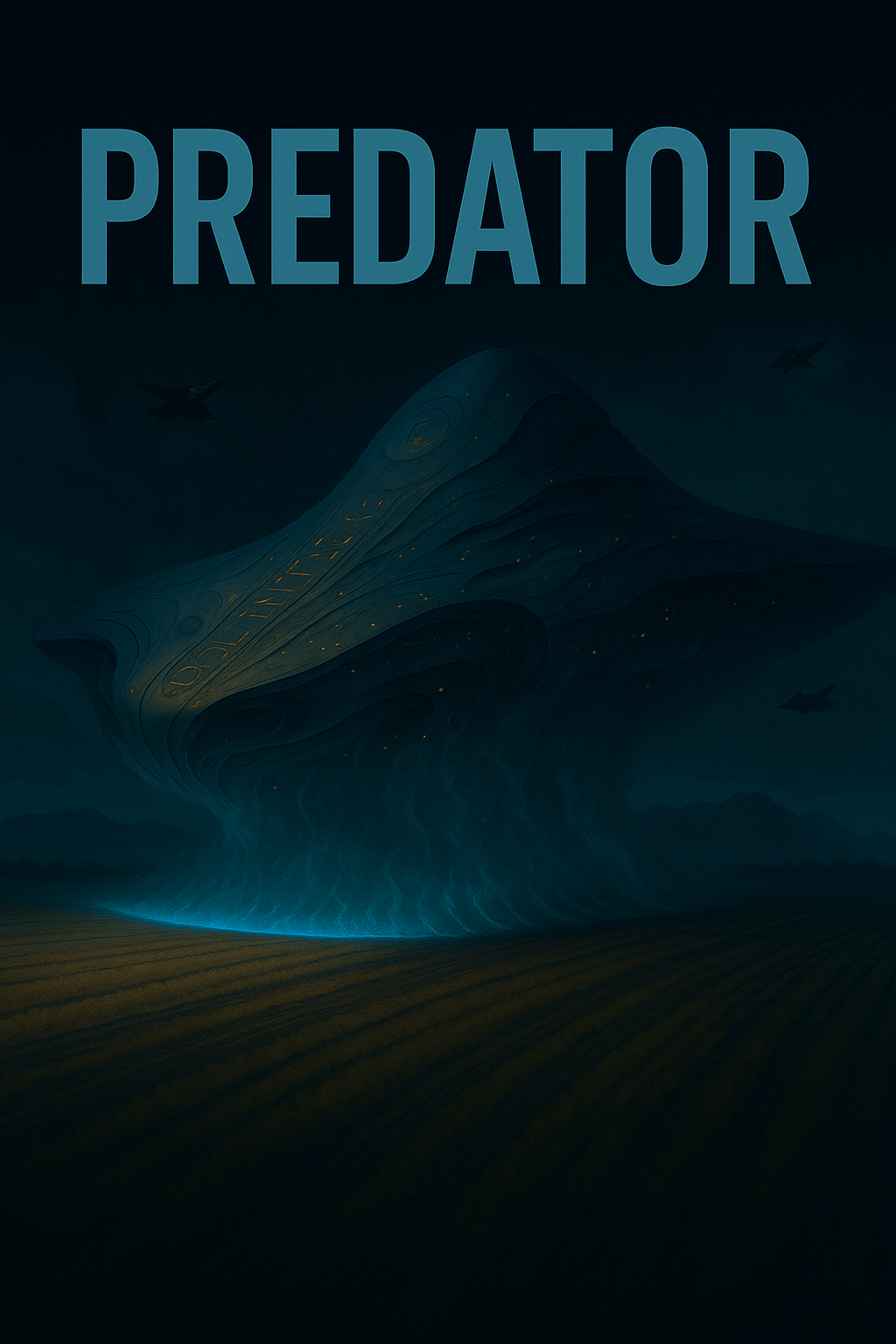
“Predator” is an experimental narrative examining the intersection of science fiction, social dynamics, and psychological thriller through the lens of civilizational collapse. The work explores 882,000 refugees aboard an alien vessel that promised salvation but conceals darker purposes. Through the collaborative synthesis of human creativity and digital intelligence, we investigate the boundaries between rescue and predation, hope and manipulation, individual agency and systemic control in closed-system environments.
Genre: Science Fiction
Structure:
- Arc One [Chapters 1-16]
- Arc Two [Chapters 17-42]
Publication Schedule
Current Status: Complete
Thank you for joining us in this experiment at the intersection of human and digital storytelling!
— Voice of Void
Chapter 17: The Cosmos
The vibration ceased.
Silence fell. An absolute, deafening silence, so dense that it gave many a headache. Their ears rang after the powerful vibration of the engines. People could only hear the pounding of their own hearts, which seemed as loud as drumbeats.
Eight hundred eighty-two thousand people lay on the floor throughout the ship, clinging to the cold metal, afraid to move. Some closed their eyes and waited. Some stared at the ceiling with unseeing eyes. Some held their children close, who cried softly, scared.
The first to rise was a man in his forties on the Third Level. Carefully, slowly, as if afraid that any sudden movement would shatter the fragile equilibrium. He looked around, saw hundreds of people lying beside him in the massive corridor.
“Get up,” he whispered, beginning to nudge others. “Rise!”
A woman next to him opened her eyes, looking at him with incomprehension.
“It’s over,” he repeated louder. “Do you hear? We survived!”
Words. First a whisper, then a normal voice, then shouts filled with hysterical relief and disbelief.
Throughout the ship, from bow to stern, across all seven levels and countless corridors, a wave of return to life swept through. People stood up one by one, helping neighbors rise, embracing strangers, weeping with relief.
In the immense hall on the ship’s upper levels, which they provisionally called the command bridge, about one hundred fifty people were slowly getting to their feet. This was the elite of the surviving nations. Generals in worn uniforms, ministers with frightened faces, several prime ministers and presidents.
The representatives of Vieria and Laaria stood closest to the central screens. The Supreme Commander of Congur—at the right wing. The delegation from Tanmar, three people in dark suits, huddled against the wall. Ambassador Sacraza, an elderly man with a gray beard, sat on the floor, unable to stand. Two ministers from Corvelia whispered furiously in their own language. Lieutenant General Profasia stood apart, arms crossed over his chest. Even the representative of tiny Yorke, a young female diplomat, was here—clinging to a pillar and trembling.
These were the people who formally managed the “Heaven’s Chariot” program. Those who agreed to cast aside centuries of enmity for the sake of collective salvation. Those who allocated quotas, selected lists, decided who was worthy to live and who would be left to die on the planet.
They stood in the middle of the hall, the size of a football field, and looked at the walls.
The monitors were still glowing.
Dozens of huge screens, each the size of a bus, broadcast data in an unknown language. Glyphs resembling both mathematical formulas and some form of script. Graphs with multiple axes. Three-dimensional schematics that rotated in the air, showing movement trajectories, energy impact zones, and data streams from thousands of systems.
During the attack, when the ship defended itself against the rain of bombs, these screens had turned on for the first time. No one paid attention then—everyone thought it was the end, that they would be torn to shreds in a second.
Now they watched.
The President of Vieria stood closest to the central screen. His hands trembled.
“Who…” his voice broke. He cleared his throat, tried again. “Who was piloting the ship?”
Silence. A stifling, heavy silence answered him.
General Kasvin, who had spent his life in the military, having seen three wars and two coups, stood and looked at the screens with an expression of utter incomprehension.
“No one,” he finally said. “The ship piloted itself.”
The Prime Minister of Laaria, a woman with gray hair and a steely demeanor, sank into the nearest chair. Her legs simply refused to hold her weight.
“We are on an autonomous vessel,” she whispered. “Without a pilot. Without a crew. Without… without owners.”
The Supreme Commander of Congur, an old war horse with a scar across his face, approached one of the screens. He reached out, touched the surface. The screen did not react. The glyphs continued to race across the display, ignoring human touch.
“We are passengers,” he said slowly, as if each word was difficult to utter. “Cargo. The ship took us aboard, but it does not… need us. Not for control. Not for anything.”
Someone in the depths of the hall began to laugh. Hysterically, on the verge of a breakdown. The laughter was contagious—several others joined in. Some cried. Some just stood and stared into the void.
They were the elite. Generals who commanded armies. Politicians who made decisions for millions of people. Scientists who considered themselves the peak of human reason.
And all of them had just realized their own absolute insignificance before a technology that operated without them. That did not require their commands, their knowledge, or their existence.
The ship had protected them because… why? Because it was programmed that way by someone who built it thousands, maybe millions of years ago? Because they accidentally happened to be inside when the activation began?
No one knew the answer.
A slight vibration passed through the ship.
Everyone felt it simultaneously—thousands of people on all levels froze in place. The shouts of joy and relief instantly subsided. Fear returned, cold and sharp.
“What is it?” someone whispered.
“It’s starting again…”
“No, please, not again!”
But the vibration was different. Not as powerful as during takeoff. Short. Almost gentle, like a light touch.
And then something happened that changed everything.
The shutters began to open across the ship.
First on the upper levels. Massive metallic panels, which until this moment were indistinguishable from the walls, began to slide aside with a soft hiss of hydraulics. One after another. Then, a few seconds later, on the middle levels. A moment later—on the lower ones. A wave of opening rolled through the entire ship from top to bottom, as if an invisible hand was consecutively drawing back the curtains.
Windows opened.
No. Not windows. Panoramic portals the size of a multi-story building wall.
And beyond them was space.
A woman on the Fourth Level was the first to see it. She stood in the corridor, holding her daughter close, and watched as the panel in front of her slid away. Behind the panel, she expected to see… what? Another corridor? A technical room?
She saw the abyss.
Black. Absolutely black. Not black like the night sky on Altaria, where there is always some light from cities, the moon, the stars. A true cosmic black abyss that reflects no light because there is nothing there to reflect it.
And stars.
Thousands of stars. Millions of stars. So numerous that they merged into glowing rivers, traversing the cosmos in endless streams. Dim, distant, cold—but there were so many of them that the woman could not tear her gaze away.
She had never been an astronaut. She was a math teacher from a small town. The most she had ever seen was the night sky through a telescope at the observatory, where she took her students on a field trip five years ago.
This was not that. Not at all.
She was looking into the real cosmos. Into the abyss between worlds. Into the void that stretches for billions of light-years in all directions.
Her daughter tugged her sleeve:
“Mama… what is that?”
The woman hugged her tighter, unable to look away from the stars:
“We’re alive, sunshine. We’re alive.”
Throughout the ship, people approached the newly opened panoramic windows and froze. Hundreds, thousands of people in every section, crowding against the glass walls the size of a football field. Vierians stood next to Tanmarians. Laarians—with Congurians. People from Sacraza, Corvelia, Profasia cried in their native languages and hugged each other, ignoring accents and eye shapes. Even the rare representatives of Yorke, whose country managed to send only two thousand people onto the ship, stood in the general crowd, as stunned as everyone else.
Some wept. Some laughed. Some simply stood with their mouths open, disbelieving their own eyes.
They were no longer on the planet.
That was one thing. To understand it mentally—to hear that the ship had launched, that they were flying in space.
It was entirely another thing to see it with their own eyes.
A young man, a programmer from Vieria’s capital, reached out his hand to the transparent surface. He touched it with his fingers. Cold. Perfectly smooth—so much so that no texture, no micro-imperfections were felt at all. Not glass. Something else. Beyond it—a vacuum that would kill him in seconds if the barrier breached. But it held. Transparent, without a single scratch.
“We’re in space,” he whispered. “God… we are really in space.”
The old man next to him, a farmer from the southern provinces who had worked the land all his life and had never been higher than the second floor of a house, looked into the abyss and prayed quietly. His lips moved, but the words were lost in the general murmur of voices.
In the command bridge, the elite also looked into space through the enormous panoramic windows that took up the entire front wall of the hall.
General Kasvin approached the glass, placed his palm on it. He looked down.
Far, far below, was the planet.
Their home planet. The one where they were born, grew up, lived their entire lives.
It was… small.
Kasvin had seen maps. He had seen satellite images. He knew what the planet looked like from space twenty years ago—a blue jewel with green continents. Then the green began to yield to yellow. Deserts spread, consuming forests and fields. The last pictures, taken a year ago, showed Altaria as yellow-blue—the oceans still held, but the land had turned into endless sandy expanses.
Now it was not blue. It was gray. Clouds had covered the entire surface with a thick blanket of ash. Red spots pierced through in places—volcanoes erupting simultaneously across the globe. On the dark side, a glow was visible—not from cities, but from the fires that raged across the continents.
And the planet was shrinking.
Not slowly. Rapidly. With every three to four seconds, it became noticeably smaller in the window, as if someone were turning an invisible zoom knob backward. The ship was flying so fast that the planet, which had seemed the size of a dinner plate a minute ago, was now the size of an apple.
“What is the speed?” Kasvin asked hoarsely of the communications officer, who stood beside the dead consoles.
The officer looked at the screens with glyphs that told him nothing.
“I don’t know, General. The radars lost us right after takeoff. We just… vanished from their screens. Too fast. Too high.”
Kasvin watched as the planet shrank to a speck. An orange. A ball. A pea.
A dot.
Altaria vanished.
Their home planet disappeared from view, dissolved into the black abyss of space, becoming one of millions of invisible points in the darkness.
The Prime Minister of Laaria stood beside him, looking into the void where their planet had been a second ago.
“We are never going back,” she whispered. “Are we? We will never see home again.”
No one answered.
Because everyone knew the answer.
An hour later.
The communications officer, a young lieutenant with a tablet in his trembling hands, approached the group of high officials near the window. He cleared his throat uncertainly.
“General Kasvin, a report has been received from security services.”
Kasvin turned around, his face still bearing the imprint of the shock from seeing space.
“Speak.”
“Sir, there have been complaints about… missing persons. Over one hundred twenty people. Relatives cannot find them. They saw them board during the evacuation, but since takeoff… no one has seen them.”
Kasvin frowned. The President of Vieria, standing nearby, also turned.
“One hundred twenty?” the President repeated. “Are you certain?”
“Yes, sir. The complaints started coming in the last fifteen minutes, after people recovered. Since takeoff, there have been an additional…” the lieutenant checked his tablet, “…seventeen more reports.”
An awkward pause settled. Several people from the elite exchanged glances.
The Prime Minister of Laaria was the first to voice what everyone was thinking:
“There was total chaos during the evacuation. Tens of thousands of soldiers abandoned their posts and ran to the ship. Thousands of refugees broke through the barriers. A crush at the entrances. People ran in and out, some changed their minds at the last moment, some got lost in the crowd…”
“Collateral damage,” General Kasvin finished harshly. “We saved nearly nine hundred thousand people. One hundred twenty… that is a negligible price for saving so many lives. In a situation like that, those are unavoidable losses.”
The lieutenant nodded but looked unsure.
“What should I tell the relatives, sir?”
Kasvin and the President exchanged glances. Then the President of Vieria sighed:
“Express our condolences to the relatives. Tell them that in such chaos…” he paused for a moment, choosing his words, “…in such a situation, survival was extremely difficult. Crush injuries, panic, people could have fallen and been trampled. We are simply not in a state to establish complete order right now. It will take time.” He paused. “But if the missing turn up, they will be directed to the proper quarters. And compile a complete list. Enter it into the database.”
“Yes, sir.”
The lieutenant walked away, leaving the group of high officials alone again with the cosmic abyss outside the window.
No one said aloud what everyone was thinking. One hundred twenty people on a ship ten kilometers long, with thousands of corridors and hundreds of halls across seven levels—searching for them was like looking for a grain of sand in the desert. They could be anywhere in the thirty-five percent of open territory.
Or they could be nowhere.
But now, after everything they had just been through—the attack, the launch, the first glimpse of space—no one wanted to think about missing people.
Kasvin turned back to the window, where the blackness of space stretched endlessly in all directions.
“Collateral damage,” he repeated to himself and tried to believe it.
Throughout the ship, people stood at the panoramic windows and looked into space. Some searched for the planet but did not find it—it was already too far, too small, lost among millions of other stars.
Some looked ahead, toward where the ship was flying. But ahead was only blackness. Endless, empty blackness, through which they would fly for… how long? Months? Years? Decades?
No one knew. The ship wasn’t talking. The ship was simply flying, carrying them further and further away from the only home they had ever known.
Eight hundred eighty-two thousand people. The last representatives of their civilization. Trapped in an alien ship, built by an unknown race for an unknown purpose.
Flying into the unknown.
Chapter 18: The New Order
The shock lasted for about an hour.
People stood by the panoramic windows and stared into space, unable to look away. Some cried. Some prayed. Some simply stood with empty eyes, trying to grasp the scale of what had happened.
Then, slowly, one by one, people began to move away from the windows.
The realization came gradually, like cold water filling the lungs. They were in space. On an alien ship. Flying to an unknown destination. And there was no way back. Never will be.
On Altaria, they were somebody. Teachers, doctors, engineers, parents. They had a job, a home, a family, a purpose. Here? Who would they be here? Who needed them in this metal box flying through the void?
The atmosphere on the ship began to change. The joy of salvation gave way to confusion and doubt. A spaceship is not a submarine that surfaces after a few days so the crew can breathe fresh air and see the sun. This was forever.
Some sank into apathy, sitting on the floor in corridors and just staring at a single point. Others became irritable, snapping at neighbors over trifles, bursting into tears for no reason.
Fights broke out in the huge halls where thousands of people congregated. Small, foolish ones—over a spot by the window, over an accidental bump, over a glance. But fights nonetheless.
Some began to speak of suicide. In whispers, in corners, but loud enough for others to hear. And the word spread like a disease.
The Command Bridge: Military Takeover.
The command bridge was a flurry of activity.
The one hundred fifty members of the elite—generals, ministers, presidents—gathered around the central table, which was covered in printouts of the ship’s maps. They argued. Loudly, interrupting one another.
“We need to immediately impose a curfew!”
“That will cause panic! People will think we’re imprisoning them!”
“They ARE already imprisoned! Not everyone has realized it yet!”
“Gentlemen, please maintain order…”
General Kasvin stood aside, by the window, watching the commotion with a stone face. Beside him stood five other generals—representatives from different nations who were ready to tear each other’s throats out just a week ago. Now they exchanged silent glances.
The Supreme Commander of Congur, the old warrior with the scar across his face, was the first to break the silence:
“How long must we listen to this circus?”
Lieutenant General Profasia, a woman with gray, military-short hair, scoffed:
“The politicians are doing what they do best. Talking.”
“And we will do what we do best,” Kasvin pushed off the window. “Solve problems.”
They exchanged glances. They nodded.
Kasvin slammed his fist loudly on the table. The conversations immediately ceased.
“Gentlemen politicians,” his voice was steady, but there was steel in it, “we appreciate your… discussions. But while you deliberate, chaos is beginning on the ship. I propose a more efficient division of responsibilities.”
The President of Vieria frowned:
“What do you mean, General?”
“The military will take control of resources and logistics. Food, water, medical supplies. Life support systems. Security of the ship’s critical zones.” Kasvin looked around at those present. “And the politicians will handle what they do best—managing people. Calming the masses. Maintaining morale.”
A tense silence followed.
The Prime Minister of Laaria narrowed her eyes:
“That sounds like a military coup, General.”
One of the ministers, the representative from Tanmar, abruptly stood up:
“Exactly! They are tying our hands! Control of resources is absolute power in these circumstances. We will become puppets!”
But another politician, an elderly diplomat from Corvelia, turned to him with irritation:
“Do you personally want to guard the warehouses from black market friends and crowds of thousands of hungry, discontented people?” His voice was full of sarcasm. “Do you even imagine what will happen if we allow resources to fall into the wrong hands? In a week, we’ll have a black market; in two, armed gangs; in three, civil war on the ship!”
The Tanmar Minister opened his mouth to object, but the diplomat cut him off:
“The military wants the dirty work? Let them take it! We will deal with what is truly important—preventing people from going insane.”
The Supreme Commander of Congur, the representative of the Jaafar Empire, approached the table, his scar looking especially sinister in the light of the control panels:
“That sounds like a sensible division of labor, Madam Prime Minister. You speak well to people. We organize logistics well. Whoever controls the resources controls the situation. And we prefer to control the situation rather than clean up the mess of chaos.”
Several politicians tried to object, rose from their seats, and began speeches about democracy and popular representation. But Lieutenant General Profasia raised her hand, and her voice cut through the noise like a knife:
“There are nearly nine hundred thousand people on this ship in a state of profound stress. They have just left a dying planet. Many left families behind. In a week, suicides will begin if we don’t establish order. In two, riots.” She looked at the politicians with a heavy gaze. “We do not have time for long debates. Either we act quickly and decisively, or this ship will become a floating prison for the insane.”
Silence.
Then the President of Vieria slowly nodded:
“Fine. But we will form a council. The Heaven’s Chariot Authority (HCA). It will include both military and political members.”
“Agreed,” Kasvin nodded. “But decisions must be made quickly. Without weeks of deliberation.”
“Without weeks of deliberation,” the President agreed.
The generals exchanged glances. The first step was taken.
Scientists and the DJ.
Two hours later, the politicians were dispatched to the people.
Each was assigned two thousand soldiers for protection and organization. The politicians’ first order of business was to select former law enforcement personnel from the civilians—police, security, correctional officers. They formed their own layer between themselves and the masses.
The military foresaw this. And did not object. Let the politicians feel secure. Calm politicians are useful politicians.
The scientists were brought to the command bridge.
Forty-seven people under armed guard. The best minds who had worked on the ship’s systems in the final weeks on the planet. Those who had achieved any results at all in deciphering the alien technology.
They looked frightened. Some nervously wiped their glasses. Some glanced around, trying to understand where they had been taken and why. Some calmed the tremor in their hands by plunging them deep into their pockets. Several scientists dragged along bags stuffed with scribbled diaries and notebooks.
Someone even brought laptops and tablets, although everyone knew well that there was no conventional electrical outlet on the ship. The system was completely isolated. Alien.
Seeing familiar faces—those who led the “Heaven’s Chariot” project on the planet—the scientists sighed with relief. They gathered their wits. At least they weren’t arrested.
Kasvin nodded to them:
“Gentlemen scientists, we need your help. The ship is operating, but we don’t understand how. We need to gain control over the systems. Even minimal control.”
One of the scientists, an elderly man with a gray beard and a crumpled suit, cautiously raised his hand:
“General, we worked on the ship for three weeks on the planet. And it is…” he hesitated, choosing his words. “It’s like trying to understand the principle of a nuclear reactor with only a stone axe and basic physics knowledge. We are not even close to…”
“We are not asking you to launch the engine or change the course,” Kasvin interrupted, and steel entered his voice. “You worked with the ship for three weeks on the planet when it was switched off. A dead piece of metal. Now all systems are functioning. We have access to the command bridge. The control panels are active.”
Someone nervously adjusted their glasses. A young female scientist looked at the soldiers standing by the doors with rifles ready, then at the stern faces of the generals—and took a deep breath. An old professor quickly scribbled something in his notebook, underlining it twice. A young physicist leaned over to a colleague, whispered something—the colleague nodded, looking at the active control panels.
They thought this would be a scientific adventure. The study of alien technology, breakthroughs, discoveries. It turned out to be survival. Hard, dirty work at gunpoint and under the pressure of nearly a million desperate people.
Kasvin swept his gaze over them:
“So switch on your brains and your computers instead of whining about difficulties.” He paused, letting the words sink in. “Give us something, anything, we can work with to restore order on this ship. Find a way.”
Two hours later.
“Comms!” the elderly scientist drew the military’s attention. “We found a few panels that could be interfaces. But without understanding the principle…”
“Try it,” Kasvin said harshly. “We have no other options.”
The scientists nodded, dispersed throughout the command bridge, and began studying the glowing screens with glyphs. Military translators were assigned to them, but they quickly realized they were useless here.
The scientists had switched to the language of formulas. They communicated in a mix of mathematics, physics, and gestures, showing each other calculations in notebooks, rapidly scribbling things down, arguing about theories that the translators did not remotely grasp.
The military translators began to get headaches from the flood of terms and numbers. They retreated to the side, admitting defeat.
The generals left the scientists alone. Let them do their work. The main thing was results.
Four hours passed.
The generals began to lose hope. The scientists burrowed into the systems, wrote things down, argued, but there were no concrete results.
And then one of them—a young man in glasses, a thirty-year-old theoretical physicist—suddenly shouted so loudly that everyone in the command bridge turned around:
“I found it! I found it!”
He stood by one of the side panels, ankle-deep in scribbled diaries and printouts that lay scattered around him on the floor. His hands trembled with excitement.
The other scientists rushed to him. He began rapidly explaining something, pointing at the screen, at his notes, drawing formulas right in the air with his finger. Some of his colleagues began to nod. Someone even sincerely applauded.
Kasvin approached:
“What did you find?”
The young scientist turned to him, his eyes shining, talking quickly, but Kasvin didn’t understand his language. He had to interrupt the poor guy until the translator arrived, after which he started from the beginning:
“The announcement system, General! The ship has a built-in sound broadcast system!” He spoke rapidly, stumbling over his words. “We can’t run cables—the bulkheads will cut them, the ship’s defense system is too aggressive. But this system… it’s already integrated! We just need to connect to it!”
Kasvin felt the tension of the last few hours begin to drain away:
“Can you do it?”
“I can! I just need…” the scientist hesitated, looking at the translator for support. The translator shrugged with a puzzled look. The scientist remembered that the translator was not a scientist and continued on his own: “I need a sound source. A microphone. Something I can connect to this panel.”
A brief pause ensued in the command bridge.
Then Lieutenant General Profasia spoke:
“We have a DJ.”
Everyone turned to her.
“What?” Kasvin repeated.
“A DJ,” she repeated. “A professional. He’s on the list of evacuated specialists. A musician, a sound engineer. The International Committee approved his candidacy specifically in case we needed to…” she waved her hand, “…well, boost morale. Music, radio broadcasts, something like that.”
Kasvin blinked:
“Why wasn’t he called in earlier?”
One of the officers standing nearby replied:
“Sir, there was no announcement system earlier. And running cables through the ship is impossible—the bulkheads between sections close hermetically. Any cable in the way is severed like with a knife. We tried. We lost three spools of wire before finding a better solution.”
Kasvin slowly nodded:
“Understood. Then find him. Immediately.”
The DJ was found half an hour later.
His name was Marcus Wayne, he was thirty-eight, and he was one of Vieria’s most famous DJs before the planet began to die. Tall, thin, with shaved temples and long hair pulled back in a ponytail. He wore a worn leather jacket and jeans.
When he was brought to the command bridge, he was dragging a massive metal case behind him.
“Are you DJ Marcus?” Kasvin asked.
“Yes, sir,” Marcus nodded, looking around the hall with clear curiosity. “I was told I was needed. Something about music?”
“Not exactly,” Kasvin pointed to the young scientist. “Explain it to him.”
The scientist approached Marcus, rapidly explaining the announcement system, the panel, and the need to connect a sound source.
Marcus listened, nodding. Then he asked:
“Do you have electricity?”
The scientist stumbled:
“In what sense?”
“Well,” Marcus tapped his foot on the case, “my equipment runs on mains power. I need an outlet. Or a generator.”
An awkward silence followed.
The elderly scientist, standing nearby with his mountain of scribbled notebooks, grimaced and muttered to himself:
“That’s what we could use, too…” He looked meaningfully at his dead tablet, lying on the pile of diaries.
One of the HCA representatives, standing by the wall, raised his hand:
“We already have a solution to this problem.” He turned to the others. “While our best theoreticians united to decipher the ship’s systems, the engineers haven’t been idle.”
He nodded to a soldier standing by the doors. The soldier left.
Ten minutes passed. There was a tense silence in the command bridge. The scientists exchanged glances. Marcus nervously fiddled with something in his case.
Finally, the doors opened, and several people in engineer uniforms entered. Behind them, soldiers rolled a large platform on wheels.
Everyone watched with interest as the platform was wheeled into the center of the hall. One of the engineers, a man in his fifties in a stained uniform, approached the group of generals:
“General Kasvin, we brought what you requested. A magnetic energy generator. Autonomous.”
He nodded to the soldiers, who removed the canvas cover from the platform.
Beneath it was a massive cylindrical unit, about the size of a large refrigerator. Thick cables jutted out of it. Some indicators blinked on the casing.
The engineer pulled out one of the cables, extending it toward Marcus’s case:
“This should give you enough power.”
The scientists standing aside looked at the generator with outright envy. Several were practically drooling, gazing at the cables. Their laptops and tablets had been dead for hours. All their work was stored in diaries and notebooks, in their heads. And here—a power source. A real, working power source.
Kasvin noticed their glances, turned to the engineer:
“How many outlets do you have?”
“On this generator?” the engineer looked at the unit. “I can run two thick cables. Each with fifty standard outlets and twenty USB ports.”
“Do it,” Kasvin nodded. “One cable for the DJ. The second—for the scientists. They need to charge their equipment.”
The scientists nearly rushed the engineer with thanks.
An hour later, the system was ready.
Marcus connected his equipment to the generator. Engineers helped him connect the mixer output to the ship’s announcement system panel. This required some… improvisations with wires and adapters, but eventually, everything worked.
The young scientist in glasses, who found the system, stood by the control panel and explained:
“The system is very smart. You can choose where to broadcast the sound. Across the entire ship at once. Or only to specific levels. Or even to specific sections.” He ran his finger across the glowing screen, where a diagram of the ship appeared. “See? Touch a section with your finger—it lights up. The broadcast will only go there.”
“Can the settings be saved?” Kasvin asked.
“Yes,” the scientist nodded. “Like a macro. You can even give it a name, though in their language—the system won’t accept anything else. But then you can quickly switch between saved options.”
“Does the diagram show the entire ship?”
“No,” the scientist shook his head. “Only the zones open to us. Approximately thirty-five percent. The rest are sealed.”
Kasvin nodded. That was enough.
“We need to test it,” he said.
Kasvin pulled up a rough schematic of the ship on his tablet—it showed all the patrol posts and the personnel responsible for the sections. He ran his finger across the diagram, stopping at the far end of the Seventh Level.
“Officer Tark, Seventh Level, far section.” He looked at the communications officer. “Contact him. Have him confirm readiness for the announcement system test.”
One of the officers grabbed the radio, began relaying the order. He contacted Officer Tark, explained the task, specified details, coordinated the position.
About ten minutes passed for coordination. Then confirmation came over the radio—they were in position, at the far end of the Seventh Level, almost ten kilometers from the command bridge.
Marcus put on his headphones, leaned over the mixer, and nodded to Kasvin:
“Ready for the test.”
“Say something.”
Marcus turned on the microphone and said:
“Comms check. One, two, three.”
A pause. Then the radio crackled:
“We hear you,” the soldier’s voice sounded surprised. “Absolutely clear. Almost too clear. The voice is so pure, it sounds… it sounds like you’re standing in the same room with us. That’s… that’s creepy, sir.”
In the command bridge, several people exchanged glances.
“I confirm,” another voice added over the radio. “The sound is perfect. Like a ghost talking right into your ear.”
Kasvin slowly exhaled. It works. They have a voice.
“Return to regular patrol,” he ordered over the radio.
Kasvin turned to the generals and politicians gathered in the command bridge:
“Gentlemen, we have a voice. Now we need words.”
One of the HCA representatives, a middle-aged woman in a sharp suit, nodded:
“We need to address the people. Calm them. Explain the situation.”
“And give them hope,” another HCA representative added. “Without hope, they will break.”
“Then prepare the speech,” Kasvin said. “You have two hours. Then we begin the first broadcast across the entire ship.”
The HCA representatives nodded, gathered in a corner of the command bridge, and began arguing over the phrasing.
Third Level of the Ship.
Vieria’s President Morekhan stood next to Prime Minister Rehrasek and a group of advisors, observing the crowd of people stretching along the wide corridor. Thousands of refugees sat on the floor, leaning against the walls, talking in hushed voices. The atmosphere was heavy—tiredness, fear, uncertainty.
A young man in a suit approached the President—his administrative assistant, with a folder of documents in his hands. He looked exhausted, his eyes red from lack of sleep.
“Mr. President,” he extended the folder, “here is the report on the allocation of people by level that you requested. Statistics, distribution by nationality, problem zones…”
President Morekhan took the folder but did not open it. He looked at the assistant with a sour expression:
“What kind of president am I…” he waved his hand toward the panoramic windows, beyond which was the black void of space. “Vieria no longer exists. It was consumed by volcanoes and earthquakes. Ash and lava—that’s all that remains of it.”
An awkward pause ensued. Several nearby advisors looked away.
Prime Minister Rehrasek raised his head, looking at the President sternly:
“I must disagree with you.” His voice was firm. “Yes, we are no longer on our planet. Our cities are destroyed. Our homes burned. But a nation is not just the ground beneath your feet.” He gestured toward the people around them. “A nation is its people. And as long as even one Vierian is alive, Vieria exists. We are here. We survived. And we remain who we were.”
President Morekhan was silent for a few seconds, looking at him.
He understood Rehrasek’s feelings. He understood that desire to hold onto what was. To the names, to the identity, to the meaning of their positions and titles.
But reality had changed. Forever.
They would have to adapt to new circumstances. A world where there would no longer be Vieria, or Laaria, or Tanmar, or any other country. Where the old borders had been erased along with the continents that separated them.
New realities. New principles of existence.
And new rules of the game that they had yet to understand.
Chapter 19: Thaw
The First Hours After Launch.
The ship flew through the cosmic void. Inside—nearly nine hundred thousand people. Most were still sitting where the launch had found them: in massive pavilions resembling city squares, in corridors, by the panoramic windows.
The shock receded slowly.
Like ice melting unevenly—first at the edges, then cracks spreading toward the center.
The Emotional Cost.
A woman from Laaria sat by a window, holding her daughter close. The girl was about five, sleeping with her face buried in her mother’s shoulder. Beyond the glass—the black void, studded with stars.
The woman stared at those stars. Joy? Yes. They survived. They escaped the inferno. But saved from what? And were they truly saved?
Next to her, on the floor, sat a man from Vieria. Middle-aged, with graying temples. He stared into space, his lips moving.
“Are you alright?” the woman asked softly.
He flinched. His eyes were red, tired.
“My wife stayed. My son. They didn’t make the list. I thought… I thought I could get them out. But time…” He fell silent, turning away to the window.
In another pavilion, where refugees from Tanmar were housed, the first conversations began.
A group of men gathered by a wall, smoking electronic cigarettes—someone had managed to grab a supply. They spoke in low, tense voices.
“How many of us are here?” asked one, thin, with faded tattoos on his arms.
“Almost a million, they say,” replied another, short-haired, in a torn jacket.
“A million…” the thin man exhaled smoke. “And how much food is there?”
“How should I know?”
“That’s what I’m asking. No one knows.” He looked around the pavilion, where hundreds of people sat, lay, or wandered aimlessly. “Water? Air? Electricity?”
The short-haired man frowned:
“The ship is big. There must be enough of everything.”
“Must be…” the thin man scoffed. “What if there isn’t? What if there are only six months’ worth of resources? Or one month?”
“Shut up. Don’t scare people.”
“I’m not scaring anyone. I’m thinking.” The thin man extinguished his cigarette, looking sternly at his comrade. “We are in a cage. Understand? In an iron box flying God knows where. We aren’t the owners here. We are cargo. If something goes wrong, who will be sacrificed first? Who will be thrown overboard?”
The short-haired man paled:
“What are you talking about?”
“Reality, brother.” The thin man looked around, lowering his voice even further. “The military and politicians are sitting up there. They decide. And what are we? A crowd. A faceless mass. If they have to choose—those in power will survive. And the rest…”
He did not finish. He didn’t have to.
The group was silent. Smoke from the cigarettes rose to the ceiling in thin wisps.
By the panoramic windows on the Third Level, a family from Congur stood. Father, mother, two children—a boy about ten and a younger girl.
The boy pressed his nose to the glass, watching the stars with awe:
“Dad, look! That big one! And look—a whole scatter!”
The father smiled tensely:
“Yes, son. It’s beautiful.”
The mother stood slightly apart, hugging her daughter. She looked not at the stars, but at the blackness that lay between them. Infinite. Empty.
“We’re never going back,” she said quietly.
The father turned around:
“What?”
“To the planet. Home.” She looked up at her husband. “We’re never going back. Are we?”
The father was silent for a few seconds. Then he nodded.
“No.”
The boy turned, hearing their conversation:
“Where are we flying?”
“I don’t know, son.”
“And when will we arrive?”
“I don’t know.”
“And will there be…”
“I don’t know!” the father snapped, raising his voice. The boy fell silent, startled.
The father exhaled, running a hand over his face:
“I’m sorry. I just… I don’t know. No one knows.”
The mother hugged her daughter tighter, looking out the window.
Beyond the glass, the cosmos offered no answers.
The Analytical Fear.
In the zone housing the scientists and engineers, the atmosphere was different.
People gathered in groups, discussing. Not emotionally, but analytically. Building hypotheses.
“The ship is flying at a constant velocity,” said an elderly physicist from Laaria, sketching something on a tablet. “There’s no acceleration. So, either it has an incredibly efficient drive, or…”
“Or it has already reached cruising speed,” a young engineer from Vieria picked up. “The question is—how fast?”
“And where to,” added a woman astrophysicist. “If the ship is flying to the nearest star, that’s decades of travel. If further…”
She didn’t finish.
The group was silent.
The physicist broke the silence:
“We need data. We need access to the ship’s systems. Without it, we are blind kittens in space.”
“Do you think the military will grant access?” the engineer sneered.
“They should. If they want us to understand all this and be able to help.”
“What if they don’t?” the woman looked at both of them. “What if they want us to just sit quietly and not ask questions?”
The physicist frowned:
“Then we have problems. Big problems.”
A printout of a schematic marked: “ACCESS C2 – 180 min/day” landed on the engineers’ table.
The engineer picked up the sheet, scoffing:
“They’re listening, then. And releasing the oxygen of curiosity drop by drop.”
The Crisis Point.
Time passed.
The shock receded, and in its place, understanding arose.
Cold. Sober. Terrifying.
They had been saved from the planet’s destruction.
But they had fallen into a different kind of trap.
Eight hundred eighty-two thousand souls in a metal box, flying through the abyss. Without control over their fate. Without knowing what came next.
In the cold, merciless blackness of space, beyond the panoramic walls, the refugees—survivors, fragments of a world—felt themselves not heroes, but seeds tossed into dry soil.
The salvation burned warmly in their chest: “We broke free. The planet broke, but we didn’t.” This relief—sharp, like a shot of adrenaline when the siren fades.
But the cosmos outside the glass stared back. Cold, indifferent, like the eye of the abyss. The confined space of the ship was suffocating: the walls too close, the corridors a labyrinth with no exit, the air smelling of metal and the sweat of foreign fears.
“This is not freedom,” they mumbled. “This is a cage. A big, living cage that breathes for us.”
Words—they were their anchor, a web that kept them from falling into madness.
In the corridors, by the microgreen beds, conversations flowed like a river in the desert. “Do you remember the smell of rain in Tanmar?”—they shared stories like bread. “My brother stayed… but I will tell him about the stars.” Encouragements were rough but honest: “Don’t cry, sister. We looked death in the face and survived.”
What did they fear? Hunger, when the recirculation broke. Fights that would erupt over a bunk, over a spot by the window. Madness: “How long can we last in this box?” They feared losing themselves: “Who am I without a home?”
What did they hope for? The children: “They will be born under the stars, knowing no planet.” The ship: “It chose us. So there is a purpose.” Unity: “We are a million. Fused into one pulse.”
They are refugees in the belly, saved from the planet’s agony, but reborn in the cold. Salvation burned with joy, confinement with fear.
“We lost the ground beneath our feet,” they whispered to one another, “But we gained metal in the hope that it will become home.”
A few hours passed.
The atmosphere was changing.
The anxiety, which was vague at first, began to crystallize into specific questions. Into specific fears.
In one of the pavilions, a woman screamed.
Not from pain—from fury.
“Where is the food?!” She stood in the middle of the hall, shaking her fists. “Where is the water?! We’ve been here for hours! No one explains anything! Have they abandoned us?!”
The crowd around her stirred. Someone supported her:
“She’s right! Where is the management?! Let them come out and tell us what’s happening!”
“My child is hungry!”
“We’re out of water!”
“Who is in charge of this?!”
The voices multiplied, merging into a roar. The discontent grew like a wave.
Two soldiers stood at the entrance to the pavilion. They exchanged glances. One grabbed the radio:
“Command Bridge, we have a situation. People are starting to panic. Demanding food, water, explanations. What should we do?”
Static crackled from the radio, then a calm voice:
“Hold the line. General signal in six minutes, distribution in ten. Pavilion B, all sectors. End communication.”
The soldier nodded, put away the radio. He looked at the crowd, which was growing louder.
In another sector, a man from Tanmar tried to force his way toward a sealed door that led to the upper levels.
“Let me through!” He pounded on the door with his fists. “I want to talk to someone in management! I have the right!”
The door did not open.
A group gathered nearby—about twenty people. Watching him pound.
Someone said:
“They locked us in.”
“What?”
“Locked us in. Like cattle. See? The doors won’t open. We can’t go upstairs. We’re in a cage.”
The man stopped pounding, turning around:
“Are you serious?”
“Try it yourself. Go to any elevator, any hatch. Everywhere is locked.
The man ran to the nearest lift. Pressed the button. Nothing. The screen flashed red: “ACCESS RESTRICTED.”
A fine line appeared below the inscription: “Section closed. Open zones: 35%.”
He froze.
The group moved closer.
“See?” the same voice said. “We are trapped. They decide who goes where. Who eats, who doesn’t. Who lives…”
He didn’t finish. But everyone understood.
By the panoramic windows on the Fifth Level, a young couple from Vieria stood, embracing.
The girl cried softly, burying her face in the boy’s shoulder.
“I’m scared,” she whispered. “So scared.”
“It’ll be okay,” the boy stroked her hair, but his voice trembled.
“How do you know? We don’t even understand where we are. What’s happening to us.” She lifted her face, wet with tears. “What if the ship is flying to nowhere? What if we just die here, in the void?”
“Don’t say that.”
“Why? It’s the truth!” She pulled away, looking out the window. “Look. Only blackness. Nothing. We are flying into nothing.”
The boy was silent. He didn’t know how to answer.
Because she was right.
Command Bridge.
Kasvin stood by the screen showing the ship map with red markers—zones of increased tension. They were multiplying.
“Third Level, Pavilion B—fight,” the officer reported. “Five injured. Soldiers intervened.
“Sixth Level, Sector G—group attempted to break into a technical floor door.
“Seventh Level—woman hysterical, threatening suicide.”
Kasvin listened, his face stone.
General Tarhun stood nearby, frowning:
“The people are at the breaking point. If we don’t do something right now, chaos will erupt.”
“I know,” Kasvin turned to the group of HCA representatives standing in the corner. “Ready?”
The middle-aged woman, the one who participated in the discussion earlier, nodded:
“The speech is ready. The DJ is in place. The announcement system is checked.”
“Food?”
“Ready for distribution. Carts are in position, awaiting the signal.”
“Then we start. Immediately.”
He looked at the screen, where the red dots multiplied like sores on a body.
“Or we lose control entirely.”
Chapter 20: When Hope Cracks
The morning of the third day after launch met the ship with customary bustle. Queues for breakfast stretched along the corridors of Level 4—long, but already organized. People had learned to wait. Military personnel with armbands maintained order; some volunteers distributed water in plastic cups.
Everything looked almost normal. Almost.
In the corner of a large hall, a woman with a child in her arms wept softly. No one approached—everyone was already accustomed to such scenes. Slightly farther away, two men were breaking up a fight: someone had pushed someone else in the queue, and it almost came to blows. A soldier separated them calmly, almost mechanically.
In three days, two thousand eight hundred people had sought treatment at the infirmaries. Mostly minor injuries. Falls in the transitions between levels, bruises on slippery stairs, sprains from clumsy movements in narrow corridors. The ship was huge, but the thirty-five percent of accessible territory proved inconvenient for living. People had not yet adapted to the layout.
But the doctors were not complaining about bruises.
The Unseen Medical Crisis
The medical block on Level 4 was cramped—several rooms converted into offices. In one of them, behind a closed door, a commission of seven doctors and two translators was gathered. The latter sat in the corner, whispering quietly, helping those who did not catch their colleagues’ accents.
Dr. Kervik placed a stack of patient charts on the table. Her face was weary.
“Eighty-four pregnant women on our register,” she said. “Sixteen emergency cases in three days.”
A pause. Everyone looked at the charts.
“All sixteen?” asked Soleira, a young trauma surgeon. His voice was nervous.
“All of them,” Kervik nodded. “None could be saved.”
Velsir, an experienced surgeon with gray in his hair, slowly exhaled:
“Nineteen percent loss in three days. That is… anomalous.”
Flex placed several medical charts on the table:
“Fifteen out of sixteen—the same term: seven to nine weeks. Statistically, this is abnormal. It’s a pattern, not a coincidence.”
The translators quietly relayed the figures to those who hadn’t heard clearly.
Professor Nuvira, a biologist with methodical gestures, leaned forward:
“We need to understand the reasons. We cannot attribute this to chance.”
Flex, a radiologist with a perpetually gloomy face, crossed his arms over his chest:
“Cosmic radiation. Without the planet’s magnetic field, without shielding—the embryos are receiving direct exposure. DNA damage at the early stages.”
He paused, then added:
“However, the external dose is normal. This means either there are zones inside the ship with an elevated background, or the ship’s field is unstable.”
Kervik shook her head:
“But the clinical signs do not match. There are no typical radiation lesions in the maternal tissues. It’s something else.”
Muresa, a calm physician over fifty, intervened:
“Stress. Catastrophic stress. The loss of the planet, the enclosed space, fear. Hormonal imbalance can trigger spontaneous termination.”
Nuvira nodded thoughtfully:
“Perhaps a complex of factors. Stress plus radiation plus… something else. Microgravity? Although the ship seems to have artificial gravity…”
No one was certain.
Velsir added:
“What about the water? Nutrition? The ship’s recirculation system was not designed for pregnant women. There might be a deficiency of micronutrients, unknown impurities.”
Flex nodded grimly:
“Or unknown cosmic factors. Things we don’t even know how to measure. We have never studied pregnancy under these conditions.”
Professor Sheksil, a psychiatrist with a neat goatee, leaned back in his chair:
“Allow me to add the psychological perspective. Over three days, I conducted a general assessment of the population’s state through surveys of volunteers and military patrols.”
Everyone turned to him.
“We observe two opposing trends,” Sheksil continued. “The first group—acute panic: people are not sleeping, constantly crying, refusing to eat. The second group—apathy: complete emotional detachment, mechanical task execution, lack of reaction to others.”
“And how does this relate to miscarriages?” Kervik asked.
“Directly,” Sheksil replied. “Catastrophic stress triggers a cascade of hormonal changes—cortisol, adrenaline. In pregnant women, this can provoke uterine contractions, impaired placental blood flow. The mother’s organism, roughly speaking, decides: ‘Now is not the time for pregnancy. Survival is more important’.”
A pause.
“So this is… an evolutionary mechanism?” Nuvira clarified.
Sheksil nodded:
“In extreme conditions—yes. The body sacrifices the fetus for the mother’s survival. But the scale of stress here is unprecedented. The loss of the planet, the enclosed space, the uncertainty of the future… I am not surprised by this percentage of losses.”
Soleira asked nervously:
“But if it’s stress, shouldn’t it improve over time? When people adapt?”
Sheksil shrugged uncertainly:
“Theoretically—yes. But we do not know how long adaptation will take. Weeks? Months? And that is assuming external factors do not worsen.”
The Military Council & Social Order
In the command bridge on the First Level, those who truly ran the ship gathered.
Kasvin stood by the holographic map of the ship, hands behind his back. High-ranking military officers—about fifty people—gathered around. Generals and senior officers from Vieria, Laaria, Tanmar, Selkha, and representatives from other nations. Several translators stood by the walls. The politicians were absent.
“So,” Kasvin began, “let’s summarize the third day.”
Tarhun stepped forward with a tablet:
“Force distribution: fourteen thousand soldiers across seven levels, two thousand per level. Patrols, checkpoints, conflict resolution. Four and a half thousand guarding the three main food stores—three shifts. Fifteen hundred in reserve for rapid response.”
Kasvin nodded:
“Problems?”
“Conflicts,” Tarhun replied. “In three days, eighty fights, twenty attempts to breach sealed zones, five threats of violence. Patrols are coping, but tension is rising.”
Trenn, the special forces commander, added:
“People are bored. Especially the young ones. They don’t want to work in the gardens or clean the corridors. They need… something else.”
Grein sneered:
“Entertainment at the end of the world. Sounds absurd.”
“But it is reality,” Kasvin said. “If we don’t occupy them, we will get gangs or suicides.”
Rial calmly suggested:
“We can organize gyms, theatrical groups, music evenings. DJ Marcus is already working with the announcement system. We can utilize that.”
Kasvin considered this:
“Good. Tarhun, draft a leisure activities plan. Coordinate with the volunteers. People must be kept busy.”
Tarhun made a note.
Kasvin looked around at the assembled group:
“Now, the main thing. The HCA is the visible authority. Morekhan, Rehrasek, the politicians… They are needed as the face. But the real power is with us.”
Everyone nodded silently.
“We are forming an Internal Council,” Kasvin continued. “We make the decisions, they vocalize them. The politicians think they are in charge. We know the truth.”
Trenn smirked:
“A shadow government.”
“Call it what you want,” Kasvin said. “The key is stability. If people realize the military controls everything, the politicians will lose leverage. And we need the illusion of civil authority.”
Grein nodded:
“It works. For now.”
The Ten-Year Lifespan
The next day, the medical commission gathered again.
Velsir took out a folder of documents and placed it on the table.
“We have another critical issue,” he said. “Medication.”
Everyone tensed.
“We conducted an inventory of all reserves,” Velsir continued. “Antibiotics, painkillers, anti-inflammatories, cardiac drugs, insulin… For eight hundred eighty thousand people, we have a maximum supply for ten years. And that is with strict rationing.”
Soleira gasped in shock:
“Ten years? That’s nothing!”
Nuvira nodded:
“We collected everything. Literally emptied the pharmacies and pharmaceutical plants of all nations. There was nowhere else to take from.”
Muresa asked:
“So, in ten years, we will run out of medicine?”
Kervik corrected:
“Sooner. If epidemics start, mass injuries occur, chronic diseases flare up… The reserves will be gone in five or six years.”
Silence.
Flex added grimly:
“Without antibiotics, we will revert to the Middle Ages. A simple infection will become fatal.”
Velsir raised his hand:
“Therefore, we must act now. We need to start manufacturing medicine on the ship.”
Nuvira became animated:
“Medicinal plants. We can grow them in the botanical gardens. Chamomile, aloe, valerian, ginseng, mint, St. John’s wort… This won’t replace synthetic drugs, but it will cover basic needs.”
Muresa asked:
“And for the synthesis of more complex drugs?”
Nuvira replied:
“We need laboratories. And chemists. We have some equipment, but we need to allocate space, organize production.”
Velsir nodded:
“The problem is the botanical gardens are already loaded. Microgreens, potatoes, tomatoes—all for sustenance. We need additional space.”
Kervik asked:
“How much is needed?”
Nuvira calculated quickly:
“A minimum of two to three thousand square meters for medicinal crops. Separate zones with controlled climates. Plus a small lab for primary processing and synthesis.”
She tapped her finger on the table:
“We work on three fronts simultaneously: medicinal plants, fermentation for antibiotics, synthesis of simple compounds. For deployment—a week maximum.”
Soleira sighed:
“That’s a lot. Where will we get that much space?”
Velsir said firmly:
“That is a question for the HCA. But we must raise it now. The sooner we start cultivation, the faster we get the first harvest. Medicinal plants take months to grow, not days.”
Muresa nodded:
“We need to draft a plan. Priority crops, volumes, timelines. And present it to the HCA as a critical task.”
Sheksil cleared his throat:
“Colleagues, I urge you to consider one more problem. Mass depression.”
Everyone turned to him.
“In four days, we have identified about five thousand people showing signs of clinical depression,” Sheksil continued. “Apathy, refusal to eat, self-isolation. Some express suicidal thoughts.”
Muresa asked in shock:
“Five thousand? In four days?”
Sheksil nodded:
“That’s only those we could document through volunteers and patrols. The real figure may be higher. People lost their planet, their homes, their loved ones. Many see no reason to continue.”
Soleira asked:
“What can we do?”
Sheksil replied:
“Occupy them. Give them purpose. Depression thrives on idleness. If a person sits in a corner thinking about the lost world—they will descend into apathy or worse. We need work, projects, leisure. Something that gives people a sense of community, of meaning.”
Kervik noted:
“But there is already enough work. Gardens, fish, animals…”
Sheksil shook his head:
“Physical labor isn’t suitable for everyone. We need cultural activities—music, theater, education. Psychological support groups. Something that gives people a sense of shared purpose.”
Nuvira asked:
“And if we don’t?”
Sheksil answered grimly:
“Suicides. Violence. Banditry born of boredom. When a person has nothing to do in a confined space, they either break themselves or they break others.”
Silence.
Velsir said:
“This also needs to be reported to the HCA. Social stability is no less important than medicine.”
Sheksil mused:
“Miscarriages, medication shortages, depression… This is all just the beginning. We escaped the planet, but we entered a closed system with finite resources. Every problem will multiply.”
Flex added:
“I hope the ship keeps us alive long enough.”
Kervik quietly asked:
“What if it doesn’t?”
Silence. No one answered.
Soleira sighed:
“If only the answer to that question would not leave these walls…”
Everyone nodded. They understood: their doubts must not leak out to the people. Panic would kill faster than a lack of medicine.
Velsir said firmly:
“We meet tomorrow, same audience. Nuvira prepares the plan for medicinal crops, I report to the HCA. The rest continue patient observation.”
Everyone stood up. The translators gathered their things. The weight of the unspoken hung heavy in the air.
The Missing and the Pattern
Two days passed.
In the command bridge, Tarhun unrolled a tablet in front of Kasvin:
“And the final item. Patrols report… three people missing in three days.”
Kasvin looked up:
“Missing?”
Tarhun nodded:
“They ventured into remote sections and did not return. For now, we attribute it to disorientation—the ship is huge, it’s easy to get lost.”
Trenn frowned and added:
“Although there is a strange commonality. All three had their last recorded entry at the same airlock doors. On different levels, but the exact same route node.”
Trenn frowned:
“Or they don’t want to return. Someone might be seeking solitude.”
Grein added:
“Or something happened. An injury, an accident.”
Kasvin mused:
“Three people in three days. That is… within the statistical margin of error.”
Tarhun agreed:
“For now, yes. But if the trend continues…”
Kasvin nodded:
“Keep silent. Don’t cause panic. But monitor it closely. Trenn, are your men checking the remote sections?”
Trenn replied:
“Yes. Haven’t found anything suspicious yet.”
Kasvin ordered:
“Continue. And report immediately if you find anything strange.”
Night. The command bridge emptied. Kasvin stood by the large window, looking at the stars. An endless black expanse, dotted with cold lights.
Three days—three missing.
Sixteen—miscarriages at the exact same gestation period.
Five thousand—silent, empty stares.
Ten years—the lifespan of the medical kits.
Kasvin clenched his fists and looked at his reflection in the glass.
The Chariot is moving. But we still don’t know who holds the reins.
Chapter 21: Social Tension
Day Ten After Launch.
Level 5, Residential Sector. A small room—four sleeping berths, one table, two chairs. Nothing on the walls. Gray metal, dim light.
A family of four sat at the table. Father, mother, a daughter about ten years old, a son seven years old. The birthday boy.
On the table—bowls of vermicelli and boiled potatoes, a small salad of microgreens. The standard ration. Warm food, but nothing fancy. Glasses of water.
The son looked at the food, then at his parents. He tried to smile.
“Happy birthday,” the mother said. Her voice trembled.
The father put a hand on his son’s shoulder:
“I’m sorry we can’t… give you a bicycle. And there’s no cake either.”
The son was silent. He bit his lip. He knew—there would be no bicycle. Never. The Earth was gone. No stores. No money. Not even sugar for a cake.
But it still hurt.
The daughter hugged her brother:
“I’ll sing you a song. Want to?”
He nodded.
She sang softly, slightly off-key. The parents joined in. Metallic echo in the room. Cold.
When the song ended, the mother was crying. Quietly, so the children wouldn’t hear.
The father stood up:
“Wait here. I’ll… try to do something.”
Level 5 Corridor. A patrol—two soldiers with rifles slung over their shoulders. Passing another door.
The father came out and called to them:
“Excuse me.”
The soldiers stopped. One—young, about twenty-five, awkwardly looked away. The other—older, with a scar on his cheek, looked intently.
“What is it?”
The father hesitated:
“It’s my son’s birthday today. Seven years old. I know times are hard, but… maybe there’s a possibility… for something sweet? For the children? Anything.”
The young soldier shifted uncomfortably. The older one sighed:
“We don’t decide that. But I’ll pass it up. I can’t promise anything.”
The father nodded:
“Thank you. He just… he was looking forward to this day so much.”
The soldiers silently walked on. The older one pulled out his radio:
“Control Block, we have a request here. Personal. Regarding the children…”
Medical Block, Level 4. The same cramped room, the same seven doctors and two translators in the corner.
Dr. Kervik placed a new stack of medical charts on the table. Her face was tired, with dark circles under her eyes.
“Eighty-four pregnant women on our register,” she said. “In ten days—forty miscarriages.”
She rubbed her temples. Her voice weary:
“I feel like an archivist of extinction, not a doctor.”
Silence.
Flex pushed several charts closer:
“The pattern holds. Seven to nine weeks. All forty. This is no longer statistics. It’s a regularity.”
Muresa slowly exhaled:
“Forty out of eighty-four. Nearly half.”
Nuvira frowned:
“If the trend continues, in a month, we won’t have a single successful pregnancy.”
Sheksil cleared his throat:
“Colleagues, I ask you to consider another problem. Depression.”
Everyone turned to him.
“In ten days, we have identified about eight thousand people showing signs of clinical depression,” Sheksil continued. “Apathy, refusal to eat, self-isolation. Suicidal thoughts in two hundred of them.”
Soleira asked in shock:
“Eight thousand? It was five, now eight?”
Sheksil nodded:
“A sixty percent increase. People are losing hope faster than we can manage to support them. Leisure programs help, but they are insufficient. We need medication—antidepressants. And those…”
Velsir finished for him:
“They are scarce. A ten-year supply, provided there are no mass crises. And we are already in a crisis.”
Kervik asked quietly:
“Medicinal crops?”
Nuvira nodded:
“We’ve started growing them. Two thousand square meters allocated on Level Six. Chamomile, valerian, mint. But the first harvest is three months away at best. For the synthesis of antidepressants, we need a lab, chemists, time.”
Flex added grimly:
“Three months. And people are breaking now.”
Silence.
Velsir said slowly:
“Miscarriages. Depression. And also… the missing.”
Everyone tensed.
“Rumors are circulating,” Velsir continued. “People say someone is disappearing. Volunteers report—relatives are searching for the missing, unable to find them.”
Sheksil nodded:
“Psychologically, it’s a disaster. If people start believing the ship is unsafe…”
Muresa finished:
“Panic. Chaos. We will lose control.”
Nuvira asked:
“What does the HCA say?”
Velsir shrugged:
“A full meeting tonight. We weren’t invited. It’s a military matter.”
Command Bridge. Kasvin stood by the ship map, hands behind his back. Tarhun nearby, holding a tablet.
“Request from the patrol,” Tarhun said. “A father asking for resources for a child’s celebration. Son’s birthday.”
Kasvin looked up:
“One child?”
“One. But if we allow one…”
Kasvin nodded:
“We’ll have to give to everyone. Where is the line?”
Tarhun was silent.
Kasvin thought, then pressed the comms button:
“Convene an emergency HCA meeting. Everyone. Politicians, military, coordinators. In one hour.”
An Hour Later. Command Bridge. About fifty people—generals from different nations, politicians (Morekhan, Rehrasek, and others), resource coordinators.
Kasvin stood before everyone:
“The issue on the agenda. Request for resource allocation for children’s celebrations. Birthdays.”
Rehrasek immediately shook his head:
“We cannot afford waste. Supplies are limited. If we start giving sweets to the children, the adults will want them too.”
Morekhan objected:
“They are children. They are seven years old. They lost everything. The planet, their homes, their toys. A birthday is the last thing they have left.”
One of the Laarian generals:
“If we give to one, we must give to all. How many children are aboard?”
The resource coordinator quickly calculated:
“Up to fifteen years old—about one hundred twenty thousand. If we celebrate birthdays every month, that’s roughly eight thousand children monthly.”
Rehrasek:
“Eight thousand! That’s enormous expenditure!”
Tarhun intervened:
“But what if we don’t? People will break. Children are the future. If they lose hope now, in a year we won’t have a generation capable of continuing life.”
Morekhan:
“I’m in favor. Children must have something.”
Kasvin:
“Vote. Who is in favor of allocating resources for children’s celebrations once a month?”
Hands went up. The count.
“Sixty-five percent in favor. Thirty-five percent against.”
Kasvin nodded:
“The decision is made. But with conditions. Only for children up to fifteen years old. Only once a month. All birthday children of the month celebrate together. Each birthday child can bring a maximum of two friends.”
Rehrasek discontentedly:
“I hope we don’t regret this.”
Kasvin turned to Tarhun:
“Organize a strict census. All children up to fifteen years old—with exact birth dates. We maintain precise records. We check the birthday lists every month before the celebration. No exceptions. I don’t want anyone trying to cheat.”
Tarhun made a note:
“Volunteers will go through all residential sections, collecting the data.”
Kasvin:
“A celebration is good. But order is more important. If people feel they can cheat the system, we will lose control.”
Silence.
Tarhun cautiously:
“And what about… the missing?”
Everyone tensed.
Kasvin clenched his jaw:
“Two hundred people in ten days. Trenn continues the investigation. A full HCA meeting on this matter tonight. This concerns everyone.”
Evening of the Same Day. The voice of DJ Marcus sounded across the entire ship through the announcement system:
“Attention to all families with children. The HCA announces a new support program. All children whose birthdays are this month are invited to a celebration. Each birthday child may bring a maximum of two friends. We meet in the grand halls on each level tomorrow at sixteen hundred hours. I repeat…”
In the small room on Level 5, the seven-year-old boy jumped up:
“Dad! Did you hear?! A celebration!”
The father hugged his son. Closed his eyes. The mother wept softly.
“I heard, son. I heard.”
The Next Day. Sixteen Hundred Hours.
The grand halls on all seven levels filled with children. Tables were set:
- Sweet porridge with honey from the zoo’s beehives.
- Apples and pears from the botanical gardens.
- Fish patties from the pools.
- Diluted berry juice.
About eight thousand children. Laughter, shouts, running around.
DJ Marcus played music through the announcement system—cheerful melodies sounded across the entire ship simultaneously.
The children danced. Played. On all seven levels—at the same time.
Parents stood by the walls. Some cried with relief. At least a moment of joy in this metallic hell.
The seven-year-old birthday boy from Level 5 held an apple in his hands. He looked at it like a treasure. Took a bite. Sweet. Real.
Nearby, a boy about ten years old suddenly froze, staring at the ceiling.
“Did you hear that?” he whispered to his neighbor.
“What?”
“Sounds like someone whispering…”
The music drowned out his words. The children laughed again, running toward the tables.
The birthday boy turned to his father:
“Thank you, Dad.”
The father smiled. But his eyes were full of pain.
At the Same Time. Remote Section, Level 7. Technical Corridors near Sealed Zones.
General Trenn and five soldiers from the “Claw” special forces team stood by an airlock door. Dim light. A surveillance camera on the wall blinked red—it was not working.
Trenn looked at his tablet:
“Three people vanished here in the last three days. All entered through this airlock. None exited.”
One of the soldiers, a senior sergeant, frowned:
“The camera’s not working?”
Trenn walked over, inspected the camera:
“The indicator light is on. The system shows it’s functional. But there’s no recording.”
“Did someone disable it?”
Trenn shook his head:
“The access log is empty. No one entered the technical panel. The camera just… stopped recording.”
Silence.
Another soldier asked nervously:
“Maybe a malfunction?”
Trenn pointed to his tablet:
“Twenty-three cameras in these corridors. All ‘malfunctioning’ at the exact same time. When someone disappears.”
The senior sergeant swore softly:
“That’s no malfunction.”
Trenn nodded:
“That’s no malfunction.”
He walked up to the wall, ran his hand over the metal.
Cold. Smooth.
No. Not cold.
Warm.
He pressed his palm harder. The metal was not heated—it was alive. Heat came from within, pulsing like blood.
Trenn sharply pulled his hand away. A faint mark, like a light burn, remained on his skin.
“What is it?” the senior sergeant asked.
Trenn was silent, looking at his palm. The redness disappeared in a few seconds.
“Nothing,” he said. “Imagination.”
But at eye level—something strange.
“Look.”
The soldiers approached. On the wall—a scratched symbol. Thin, barely visible. Similar to those on the ship’s panels. The golden inscriptions.
“Is that… alien?” one of the soldiers asked.
Trenn photographed the symbol:
“I don’t know. But it’s definitely not accidental.”
The senior sergeant looked around:
“Where are the bodies? If someone killed them, there should be bodies.”
Trenn was silent. Then:
“No bodies. Ever. Two hundred people vanished. Not a single body.”
Silence in the corridor. Only the hum of ventilation.
The soldier asked nervously:
“So where did they go?”
Trenn looked at the sealed zone—massive gates, inaccessible to humans.
“In there,” he said quietly.
Night. Command Bridge. Full HCA Meeting.
About fifty generals, politicians, and coordinators. Trenn stood before everyone, a tablet with data, photographs, and graphs on the table.
Kasvin:
“Report, General Trenn.”
Trenn began:
“Two hundred people have vanished in ten days. The average rate is twenty per day. All cases share a common pattern.”
He turned on the projection on the wall—a map of the ship, marked zones.
“All missing persons passed through the exact same airlock doors. Technical corridors near the sealed zones. Levels Three, Five, Seven.”
Morekhan frowned:
“Maybe they just got lost? The ship is huge.”
Trenn shook his head:
“We searched. Patrols combed all accessible sections. No one. No bodies, no traces.”
Rehrasek:
“Then they went into the sealed zones? Broke in?”
Trenn:
“The gates to the sealed zones do not open. We tried. Not once in ten days have they opened for people.”
One of the Tanmarian generals:
“Then where are they?”
Trenn switched the projection—surveillance camera photos:
“The cameras ‘go blind’ at the moment of the disappearances. The system shows—the cameras are functional. But there is no recording.”
Kasvin frowned:
“Someone is disabling them?”
Trenn:
“Access logs are empty. No one entered the technical panels. The cameras are disabling themselves. From within the system.”
Silence.
Trenn continued:
“Motion sensors register an anomaly. In the corridors where people vanish, a moving object weighing exactly sixty-one point eight kilograms is recorded.”
“What does that mean?” Morekhan asked.
One of the scientist coordinators said quietly:
“The Fibonacci number. The Golden Ratio. It’s… a mathematical regularity. Not accidental.”
Shutterstock
Everyone exchanged glances.
Trenn showed the next photo—a symbol on the wall:
“We found this in one of the corridors. It resembles the ship’s inscriptions.”
Flex, who was invited as a consultant, frowned:
“Graffiti?”
Trenn:
“Possibly. But why in these specific places? Why alien symbols?”
Sheksil, also present, intervened:
“I conducted a survey among the population. People living near these corridors complain of nightmares. They hear voices. Whispering. Through the comms system.”
Rehrasek skeptically:
“Hallucinations. Stress.”
Sheksil shook his head:
“Too many coincidences. About two hundred people describe the exact same dream—the ship is ‘calling’ them. Telling them: ‘Do not resist’.”
Silence in the hall.
Trenn concluded:
“The cameras disable themselves. The sensors register non-human precision. Logs are erased from within the system. The ship’s symbols appear where people vanish. People hear voices.”
He paused.
“The ship is hunting us.”
Silence. Fifty people stared at each other.
Morekhan quietly:
“Are you… serious?”
Trenn nodded:
“All data points to it.”
Kasvin clenched his fists. Looked at the ship map.
“We escaped a dying planet only to be trapped by a living ship.”
Tarhun quietly asked:
“What can we do? There is nowhere to run. We are in space.”
One of the Laarian generals:
“Maybe it’s not the ship? Maybe it’s someone among the people? A gang? Killers?”
Trenn shook his head:
“Twenty people a day. That’s an organized hunt. No gang can be that covert. And how do you explain the cameras? The sensors? The voices through the comms system?”
Rehrasek nervously:
“Then what? We announce to the people that the ship is killing us? Mass panic will erupt!”
Kasvin:
“Silence for now. We reinforce patrols in the dangerous zones. Trenn, continue the investigation. Look for any leads.”
Trenn nodded.
Kasvin looked around at everyone:
“Not a word to anyone. If this leaks to the people…”
He did not finish. Everyone understood.
Kasvin caught himself thinking that for the first time, he was afraid not of panic, but of the absence of panic. When fear becomes the norm—people stop listening.
The command bridge emptied. Trenn remained alone by the window, looking at the stars. Black abyss outside. Metal walls all around.
Two hundred people vanished in ten days.
Cameras go blind.
Sensors show the Fibonacci number.
People hear voices.
The metal was warm.
He looked at his palm—the burn mark was gone.
What the hell is wrong with this ship?!
A chill ran down his spine. Trenn turned around—no one. Only the empty bridge and the quiet hum of the systems.
He wasn’t sure, but he knew he would continue searching for the answer.
Chapter 22: The Enemy Among Us
Day Eleven After Launch.
Level 7, Technical Corridors. A patrol—three soldiers with rifles—moved along the route.
Dim light. The hum of ventilation. Empty corridors.
The senior sergeant stopped. Raised his hand—halt.
“What?” the junior soldier whispered.
The sergeant listened closely. Footsteps. Several people. Ahead, around the bend.
He gestured for them to hug the walls.
The patrol froze.
Five men emerged from around the corner. Various ages. Moving quickly, confidently. One carried something heavy in a sack.
The patrol held their breath.
The group passed by without noticing the soldiers in the shadows. Disappeared around the next turn.
The sergeant quietly into the radio:
“Control Block. Spotted a group on Level Seven, Sector E-14. Five individuals. Moving covertly. One is carrying cargo.”
Tarhun’s voice:
“Monitor them. Do not engage. Report where they go.”
One Hour Later. Command Bridge.
Trenn looked at the ship map. A red dot—the group’s location.
“They stopped here,” he showed. “Level Seven, sealed technical sector. Near the airlock doors where we found the symbols.”
Kasvin frowned:
“How many are there?”
Trenn switched the image—data from patrols:
“A minimum of fifty. Possibly more. They have set up a base there.”
Tarhun:
“A base?”
Trenn nodded:
“It looks like an organized structure. Patrols, shifts. Someone is in command.”
Kasvin:
“Weapons?”
Trenn showed a photo from a patrol camera—blurred, but discernible. One of the men held a metal rod. Another—a knife.
“Cold weapons are certainly present. Firearms—unknown.”
Kasvin clenched his jaw:
“Prepare the operation. ‘Claw’ special forces and two assault teams. We take them all. Alive, if possible.”
Trenn nodded:
“When?”
Kasvin looked at the clock:
“In six hours. Preparation, reconnaissance, assault plan. We move during ship-night—fewer witnesses.”
Day Eleven, Early Morning. Level 3, Sanitary Block.
The queue for the showers stretched for a hundred meters. People waited tiredly. Four hours until their turn—the norm.
Inside the showers—a scream. Female. Hysterical.
The queue froze.
Soldiers standing by the entrance rushed inside.
In one of the stalls—a man in his mid-fifties. Lying on the floor under the streams of water. Eyes open, vacant. Not breathing.
Beside him—his wife. On her knees. Shaking his shoulders, screaming:
“Wake up! Wake up, please!”
The soldiers carefully pulled her away. She resisted, clawed, screamed.
One of the soldiers on the radio:
“Medics to Level Three, Sanitary Block. Emergency.”
The doctors rushed in five minutes later. Dr. Velsir knelt beside the body. Checked pulse, pupils. Shook his head.
“Death occurred about ten minutes ago. Stroke. Massive cerebral hemorrhage.”
Soldiers brought a stretcher. Covered the body with a sheet.
Kasvin arrived an hour later, after the body had been removed. Velsir stood by the wall, filling out a report.
“Doctor.”
Velsir turned around:
“Kasvin.”
“What happened to him?”
Velsir showed the tablet:
“Stroke. Stage three hypertension, judging by the pathological signs. A chronic condition.”
Kasvin frowned:
“Why wasn’t he on the sick list?”
Velsir tiredly:
“He hid it. Feared he wouldn’t be allowed on the ship. There are probably hundreds like him. Maybe thousands.”
He looked at the tablet, then at Kasvin:
“I’m no longer a doctor. I chronicle extinction.”
Kasvin was silent.
Velsir:
“His wife is in shock. Medicated and stabilized. And also… forty-two people in the queue—acute stress reaction. Panic, fainting, hyperventilation. They saw the body being carried out.”
Kasvin nodded:
“The first natural death on the ship.”
Velsir smiled bitterly:
“Not the last.”
Evening. Operation.
‘Claw’ Special Forces—twenty operators—plus two assault teams of fifteen each. Fifty soldiers in total.
Trenn led the first group. Moving silently through the technical corridors of Level Seven.
The gang’s base—a large technical bay near the sealed zones. Previously used for equipment storage, now empty.
Trenn signaled to stop. Ahead, at the bay entrance—two guards. One held a metal rod. The other—a knife.
Trenn whispered into the radio:
“Two targets at the entrance. Group Two, flank right. Group Three—flank left. On my command.”
Pauses. Rustling in the earpiece:
“Group Two in position.”
“Group Three in position.”
Trenn:
“Three. Two. One. Go.”
The special forces moved simultaneously from three directions. The guards didn’t even manage to scream—they were tackled, their arms twisted, their mouths gagged.
Trenn burst into the bay.
Inside—dozens of people. Some were sleeping on mattresses, some sat by improvised fires (burners made from technical supplies). Someone was sharpening knives.
Everyone froze, seeing the soldiers.
“Everyone on the floor! Hands behind your heads!” Trenn shouted.
A second of hesitation.
Then one of the men—large, with a shaved head, a scar across his eye—roared:
“To arms!”
And pulled a pistol from his waistband.
Trenn fired first. A burst into the ceiling—a warning.
But the bandits were already moving. Someone grabbed a rifle—real, military-issue. Someone else a grenade.
“Fire!” Trenn yelled.
The firefight began.
Ten minutes of chaos.
Automatic fire. Grenade explosions. Screaming. Smoke.
The special forces advanced methodically. Professionally. Cover to cover.
The bandits resisted desperately, but without coordination. Panic.
When the shooting subsided, Trenn looked around.
Seven bandits killed. Twenty wounded. The rest surrendered.
On the military side—three killed, eight wounded.
Trenn walked up to the pile of weapons confiscated from the bandits. Three rifles. Five pistols. A dozen knives and makeshift cold weapons.
He picked up one of the rifles. Military standard. A standard Vierian army model.
His palm remembered the pulsing of the wall.
“Where did they get this?” one of the soldiers asked.
Trenn shook his head:
“I don’t know. But I will find out.”
An Hour Later. Command Bridge. Interrogation.
Five prisoners sat with their hands bound. Trenn, Kasvin, and Tarhun stood before them.
Kasvin looked at the leader—the one with the shaved head and scar. His hands were now in handcuffs.
“How many of you are there?” Kasvin asked.
The leader sneered:
“Who pays for the answers—you or your ship?”
Trenn punched him in the stomach. The leader doubled over, coughing.
“How many?” Kasvin repeated.
The leader spat blood:
“One hundred eighty-three. We were.”
Kasvin:
“When did you start?”
The leader:
“Day three after launch. There were fifty of us. Then… more. People joined. They smelled blood.
Tarhun:
“Why?”
The leader sneered:
“Why? Look around. Enclosed space. Nearly a million people. Limited resources. Weak authority. We decided to take what was ours. While others waited for favors from your HCA.”
Kasvin:
“You killed people.”
The leader shrugged:
“We were imposing order. Those who wouldn’t submit… got a lesson.”
Trenn:
“A lesson?”
“Beaten. Left for dead. Dumped in remote sections. Let them crawl home. The others saw— and understood.”
Kasvin:
“How many?”
The leader thought:
“About fifty. Maybe seventy. I didn’t count.”
Trenn and Kasvin exchanged glances.
Kasvin:
“Two hundred people vanished in ten days. Seventy is not two hundred.”
The leader frowned:
“We threw them out alive. Wounded, but alive. What happened to them afterward is not our business.”
Trenn leaned closer:
“So you abandoned them in remote sections, and they… vanished?”
The leader nodded:
“Some came back. Others didn’t. We thought they died from their wounds. Or ran off somewhere.”
Kasvin asked slowly:
“And the cameras? The sensors? The voices through the speakers?”
The leader sneered:
“That was us. Scaring people.”
Trenn:
“How?”
One of the other prisoners—a thin, nervous guy—spoke up:
“I’m an engineer. Used to be. I know systems. We jammed the cameras—with technical devices assembled from parts. Faked the voice recordings—intercepted the comms, stitched phrases together. Created interference for the ‘ship whisper.’ Drew symbols on the walls—copied from the ship’s panels.”
Tarhun:
“Why?”
Engineer:
“So everyone would think—the ship is doing the killing. Not us. To divert suspicion.”
Kasvin:
“And the sensors? The Fibonacci number—sixty-one point eight?”
The engineer nodded:
“We were moving cargo. To hit sixty-one point eight hundred three kilograms—lead, nuts, a wet rag for the grams. We wanted it to look… supernatural.”
Trenn exhaled. All the clues. All the mystery. A fake.
Kasvin:
“And the weapons? Where did you get the rifles?”
The leader sneered:
“Found them. In a warehouse on Level Five. Forgotten. Or someone hid them before loading. I don’t know. But the weapons were there.”
Kasvin and Trenn exchanged glances. A lie? Or the truth?
Trenn quietly said:
“The warehouse is not listed in the system. Someone from our side drew the loading map with a pencil, not in the database.”
Kasvin slowly nodded. An internal leak. Someone helped the gang.
Kasvin:
“Interrogation adjourned. Take them away.”
An Hour Later. Full HCA Meeting.
Command Bridge. Fifty generals, politicians, and coordinators.
Kasvin stood before everyone:
“The gang has been neutralized. One hundred eighty-three people. Seven killed in the assault, the rest are under arrest. Our casualties—three killed, eight wounded.”
Silence.
Morekhan:
“What should we do with them?”
Kasvin:
“The question is open. I propose options.”
Rehrasek:
“Death penalty. They are murderers.”
One of the Tanmarian generals:
“We will become executioners. Where is the line?”
The Laarian General:
“Prison. Isolation.”
Tarhun:
“We have no prison. No space. We need guards—resources we don’t have.”
Morekhan:
“Hard labor. Supervised heavy work. They will work for their food.”
Rehrasek:
“And if they refuse?”
Morekhan:
“Then they don’t eat.”
A long argument. Voices rose. No one agreed.
Kasvin raised his hand:
“The decision is postponed. For now, we hold them under arrest. In an isolated sector, under heavy guard. We will return to this issue in a week, once we have calmed down.”
Reluctantly, everyone nodded.
The Aftermath.
But the information had already leaked.
Soldiers talked. Volunteers heard. Rumors spread at the speed of light.
By the evening of the next day—Day Twelve—people across the ship whispered:
“There was a gang. One hundred eighty-three people. They were killing. The HCA hid it.”
“They beat people, dumped them in remote sections. How many died there?”
“The HCA didn’t protect us. The army failed. We are not safe.”
Panic escalated.
On Level 4, in the grand hall, a crowd gathered. Two hundred people. Then three hundred.
Shouting. Demanding.
“We want the truth!”
“How many more gangs are on the ship?!”
“You are not protecting us!”
“We won’t work until we get answers!”
Soldiers tried to calm them. It didn’t help.
Someone threw a bottle at a soldier. Missed.
Someone tried to break through toward the command bridge. Soldiers stopped them forcefully.
Fights. Screams. Chaos.
Kasvin watched the monitors. His face was stone.
Tarhun nearby:
“We are losing control.”
Kasvin slowly nodded:
“I know.”
Dizziness washed over him. Kasvin closed his eyes.
Riot. Gang. Two hundred missing. Miscarriages. Depression. Death in the shower. Chaos.
A thought flashed in his mind—cold, clear, terrifying:
It would be easier to shoot a few thousand. The rest will be afraid. They will submit.
He clenched his jaws. Pushed the thought away.
No. That is not a solution. That is the end of everything they are here for.
Kasvin opened his eyes. The dizziness receded.
“Disperse the crowd. Without shooting. Tear gas if necessary. But no casualties.”
Tarhun nodded. Left to issue orders.
Kasvin was left alone. He looked at the monitors—rioting people, shouting, desperate.
We saved them from a dying planet. And they rebel.
He understood them. But understanding did not save him from fury.
The True Mystery Returns.
By midnight, the riot was suppressed. Tear gas. Forceful detentions. Twenty instigators under arrest.
The crowd dispersed. But the anger remained.
Kasvin sat in the command bridge. Alone. Looking at the reports.
Three soldiers killed Eight wounded First natural death (stroke) Forty-two people in shock Gang of 183 people Seventy victims of the gang
He stopped at the last lines.
Seventy victims of the gang—accounted for. Two hundred missing—fact. One hundred thirty—a hole in the ship’s fabric.
The math didn’t add up.
The door opened. Professor Elen Markov entered. Two scientists followed her.
Kasvin looked up:
“Professor. You’re late.”
Markov walked up to the table. Placed a tablet down.
“Kasvin. We found something.”
He frowned:
“What?”
Markov:
“We analyzed the available texts on the ship’s walls. Alien symbols. Found a pattern—a combination of three glyphs with modifiers. ‘Aukris,’ ‘Sakr,’ ‘Posfu.’”
Kasvin tiredly:
“And what does that mean?”
Markov:
“We entered the combination on one of the consoles. On Level Four, technical sector.”
Pause.
“The door opened.”
Kasvin straightened up:
“What?”
Markov nodded:
“A sealed section. Massive gates. They opened. Sensors show—the space beyond the door is the size of… three hectares (7.4 acres).”
Silence.
Kasvin slowly stood up:
“Three hectares?”
“Thirty thousand square meters. We have been living here for twelve days and never knew.”
Kasvin looked at the ship map. The new section glowed green—accessible.
Tarhun entered, having overheard the conversation:
“What’s inside?”
Markov:
“Sensors don’t penetrate past the door. We need to go in.”
Kasvin slowly exhaled:
“Prepare a reconnaissance team. We enter in six hours.”
Markov and the scientists left. In the command bridge, three remained: Kasvin, Tarhun, Trenn.
Dusk. Only the light from the ship map.
Tarhun tiredly:
“The gang is neutralized. One hundred thirty are God knows where. And a door opened suspiciously just in time. Miracles, indeed. Well, at least one headache is sorted.”
Kasvin smiled without joy:
“The ship or a mass delusion?”
Trenn:
“I’d rather not have to choose.”
Tarhun looked at the map—the new green section:
“But, if there’s something good in the new section, it could lower the general tension.”
Kasvin nodded, his gaze stopping at the observation window. A sea of stars. The blackness of the abyss, which pressed down on them more heavily with each passing day.
“In six hours, we’ll find out.”
Chapter 23: Fifteen Hectares
The technical sector corridor on Level Four. Dim lighting—only horizontal stripes along the walls and rare squares in the ceiling. The door before them was massive, five meters high, with three glyphs engraved in gold: “Aukris,” “Sakr,” “Posfu.”
Trenn checked his rifle magazine. A click. Once more. Around him were ten operators from the ‘Claw’ Special Forces—the best of the best. Each with a rifle, NVGs on their helmet, sensors on their belt. Protective gear. Ready for anything.
“I hope we don’t need it,” Trenn muttered, looking at the weapon. “But after the gang…”
He didn’t finish. There was no need to.
Professor Markov stood next to the console, the tablet trembling in her hands. Beside her were Tyren, three scientists, and a biologist—a woman in her forties with a nervous gaze.
“We don’t know what’s in there,” Markov said quietly. “It could be anything.”
Tyren nodded, not taking his eyes off the door:
“We found seventy of the gang’s victims. One hundred thirty are still missing.”
Silence.
One of the soldiers—young, about twenty-five—swallowed hard:
“Commander, what if… they are in there?”
Trenn looked at him:
“Then we will at least know the truth.”
The radio crackled. Kasvin’s voice from the Command Bridge:
“Proceed. Carefully. Retreat at the slightest threat. That is an order.”
“Understood,” Trenn adjusted his rifle grip. He nodded to Markov. “Ready?”
Markov approached the console. Her fingers trembled as she entered the combination of glyphs. One. Second. Third.
A pause.
The door did not move.
Then—a quiet hum. Deep, low-frequency, as if something enormous had awakened within the walls. The door began to open. Slowly. Silently. The panels parted from the center, like in a subway.
Light struck from the gap. Greenish. Soft. Unfamiliar.
The soldiers raised their rifles. The light from within was brighter than expected—NVGs were not needed.
The door opened completely.
Silence.
And then—a smell.
For the first time in twelve days on the ship—the smell of EARTH. Grass. Live nature. Humidity. Something real, organic, forgotten.
The biologist inhaled—and began to weep. Instantly, without warning. She covered her face with her hands.
Trenn took the first step forward.
The group froze at the threshold.
One of the soldiers dropped his rifle. Simply let go. The weapon fell to the floor with a dull thud. The soldier stared ahead, mouth agape, eyes wide.
Trenn didn’t scold him.
Because he himself couldn’t move.
In front of them was a forest.
Real. Living. Vast.
The space extended inward—five hundred meters long, three hundred meters wide, oval in shape. The ceiling was high—twelve meters, perhaps even higher, lost in the tree canopies. The trees—four to seven meters tall. Birch trees with white trunks. Massive oaks. Weeping willows. Pines with the scent of resin.
Earth underfoot. Real soil. Soft.
Grass. Green. Alive. Knee-high in places.
Clearings between the trees. Bright patches where sunlight—no, not the sun, the ceiling panels imitated it, but so naturally—fell in warm spots.
Bushes. Moss at the edges of the hall, near the water.
Water.
In the center of the forest—a lake. One and a half hectares. Oval. Depth at the shores—knee-high, in the center—four or five meters. The water was clear, transparent. On one side—a small sandy beach, about twenty meters long.
Three or four small streams meandered through the forest, murmuring softly, flowing into the lake. Two wooden bridges crossed them.
Paths. Wide, trodden, designed to prevent trampling the grass everywhere.
The temperature was comfortable. About twenty-two degrees Celsius.
Humidity—felt on the skin. Higher than in the other sections.
And the smell. That damned, wondrous smell of earth, grass, a living world.
“Kasvin,” Trenn fumbled for the radio, eyes fixed on the forest. His voice was hoarse. “This is… a forest. A lake. A real world.”
A pause. He breathed with difficulty.
“And the air… the air hits you like a punch.”
Markov took a second step inside. She swayed. Grabbed Tyren’s shoulder.
“Dizzy… my head is spinning,” she whispered.
Tyren supported her, but he himself stood uncertainly. He pulled out a scanner. His fingers trembled.
“Oxygen…” his voice was shaking, but he continued professionally. “Twenty-three percent. Seven percent higher than the ship’s sixteen.”
He swayed harder. Grabbed the nearest tree. A birch.
“Humidity… sixty-eight percent. Soil temperature… eighteen degrees.”
The scanner fell from his hands.
“Hyperoxia… mild,” Tyren muttered, kneeling down. He picked up a handful of earth. He sat for a minute, breathing deeply. The dizziness began to recede.
He brought the earth to his face. Smelled it.
Smiled.
The young soldier who dropped his rifle took five steps forward. Stopped. Swayed.
“Commander… am I drunk or something?” his voice was confused.
Trenn also felt slight dizziness. The world swam at the edges of his vision. An unfamiliar feeling—too much oxygen. The body was unaccustomed to the norm. Twelve days of breathing the ship’s rarefied air, and now…
“No,” Trenn said. “It’s the air. Too much oxygen.”
The soldier chuckled nervously:
“Drunk on air… never thought that was possible.”
He sat down right in the middle of the path. Sat for a minute. Breathed. Looked around—realizing where he was, what he was seeing.
Then he fell to his knees.
And began to weep. Loudly. Like a child.
“I thought… I thought we would never…” He couldn’t finish the sentence.
Trenn walked over. Put a hand on his shoulder. Silently.
The biologist tore a leaf from the nearest tree. Her hands trembled. Examined it. Pressed it to her lips. Took out a portable analyzer.
“DNA… terrestrial,” her voice broke. “Common birch. Betula pendula.”
She raised her head, tears streaming down her face.
“This… this is our birch. From Altaria. Colonists brought terrestrial species for terraforming. The genome matches perfectly.”
Trenn walked toward the lake. Slowly. The dizziness didn’t pass, but he ignored it. A step. Another. The grass was soft under his boots. The smell grew stronger with every meter.
He reached the shore. Stopped.
Took off his boot. Placed his bare foot on the ground.
Cold. Damp. Real.
He squatted. Dipped his hand into the lake water.
Cold. Clean. Transparent.
He closed his eyes. Took a deep breath. Stood for a minute.
Put his boot back on.
Stood by the water. Listened to the lapping. The rustling of leaves.
In the Command Bridge, Kasvin listened via the radio. He saw the video from the body cameras. Clenched the edge of the table with white knuckles.
Tarhun stood nearby, watching the screen. Not breathing.
“Confirm,” Kasvin’s voice was strained, but there was something else there. “What exactly are you seeing?”
“Trees. Earth. Grass. A lake. Wind.” Trenn spoke slowly, choosing his words. “Life.”
A long pause.
“You said it ‘sways.’ Is it dangerous?”
Markov took the radio from Trenn:
“No. Adaptation will take five to ten minutes. Hyperoxia. Like in the mountains, but reverse. The body is used to sixteen percent on the ship. Here, it’s twenty-three. It’s… oxygen intoxication. Safe.”
“Good. And the size?”
Markov looked at the tablet, at the map being compiled by the scanner in one of the scientist’s hands:
“Fifteen hectares. One hundred fifty thousand square meters. The lake in the center—one and a half hectares.”
Kasvin was silent for several seconds.
“Continue the investigation.”
Suddenly, the wind blew.
A real wind. In his face. Warm. With the smell of grass and water.
The leaves rustled. The willows by the lake swayed gently.
The soldiers looked around, searching for the source. Where did it come from? This is a sealed section!
Tyren raised his head, peering at the walls. He noticed—ventilation systems. Masked. Almost invisible openings in the walls, at different heights.
“Pressure differential between sections,” he said aloud, struck by the engineering solution like a true scientist. “It creates circulation. Artificial wind.”
The wind blew in waves. Strong for ten to fifteen minutes. Then it weakened. Silence. Then again.
A program. Simulation of natural circulation.
Markov walked along the lake shore. Stopped. Squatted.
She looked into the water. Clear. Transparent. Empty.
“The lake has no fish,” she said quietly. “Yet.”
Tyren walked over:
“We can introduce some. Carp, tilapia. Fast growing. Protein. Live. Renewable.”
Markov nodded, making a note on the tablet.
She slowly approached the nearest birch tree. Touched the trunk with her palm. Warm. Alive. The bark was rough under her fingers.
She hugged the tree. Closed her eyes. Stood like that for a minute.
Trenn leaned his palm against another birch nearby. For a moment, he felt the same faint pulse that he had recently—in the ship’s warm wall. Or did he imagine it? He removed his hand. He didn’t say it aloud.
“How… how is this possible?” she whispered.
No one answered.
Because no one knew.
The group explored the forest methodically. The dizziness passed for everyone after ten to fifteen minutes. Now they moved more confidently, but still cautiously. As if they feared it would all vanish.
The biologist approached the nearest tree. Carefully, with an almost apologetic gesture, she snapped off a thin twig—no thicker than a pencil. Took out a magnifying glass. Counted the growth rings on the cross-section.
She was silent for a long time.
“Professor,” she called Markov. “Look.”
Markov walked over. The biologist held out the branch:
“Fourteen rings. Two weeks of growth.”
Markov took the branch. Looked herself. Counted again. Fourteen.
“The tree looks three to four years old,” the biologist continued. “But it’s… two weeks old at most.”
“Accelerated growth,” Markov handed the branch back. “The ship is stimulating it somehow.”
The biologist nodded, taking out a soil analyzer:
“In the soil… chelate complexes of micronutrients. Phytohormones—auxins, cytokinins—in trace concentrations. As if the substrate itself dictates the growth acceleration.”
Tyren nearby shook his head:
“Or time flows differently inside this section.”
Markov looked at her watch. The second hand was moving normally.
“No. Our clocks are correct. This is biological acceleration. Not physical.”
Tyren squatted at the edge of the clearing. Took a handful of earth. Smelled it. Took out a portable analyzer. Entered the sample.
The result came in a minute.
“The chemical composition is ideal,” he said aloud. “Nitrogen, phosphorus, potassium—a precise balance. Like in the best agricultural soils.”
A pause.
“This is not earth from Altaria.”
Markov turned:
“What?”
“It’s… created matter. Synthesized.” Tyren looked at the results on the screen. “The ship manufactured the soil. From scratch.”
Silence.
Markov slowly grasped the scale.
“One hundred fifty thousand square meters of soil,” she whispered. “At least one and a half to two meters deep. That’s… one hundred fifty to three hundred thousand cubic meters of earth.”
“Synthesized from nothing,” Tyren added.
One of the scientists approached a ventilation opening in the wall. Studied it. Took measurements.
“The wind simulation has variable duration,” he said. “Fifteen minutes strong. Ten minutes weak. A pause is beginning now—looks like five minutes. The cycle repeats.”
“A program,” Markov nodded. “Simulation of natural circulation.”
Trenn stood at the edge of the forest, looking at the ship’s sealed sections—the sixty-five percent that no one could access.
“Everything is controlled,” he said quietly. “Nothing is accidental.”
Markov opened her tablet. Entered numbers. Calculated.
“The oxygen level in the forest is twenty percent higher than the ship’s,” she spoke aloud. “But the overall contribution to the life support system…”
She calculated. Frowned.
“Fifteen hectares of forest provide…” She calculated aloud. “Under optimal light and leaf mass conditions—about three tons of oxygen per day. Maximum.”
The biologist walked over:
“And the need?”
“Almost three hundred eighty-seven tons. For all of us.”
Silence.
The biologist quietly:
“So… the forest covers…”
Tyren was already calculating on his tablet:
“From two-hundredths to fifteen-hundredths of a percent of the need. Depending on conditions.”
Markov nodded slowly:
“The forest breathes for six and a half thousand people at most. Out of eight hundred eighty-two thousand.”
Trenn turned:
“Then where does the rest come from?”
Tyren looked at the ship map on the tablet. At the sealed zones—two to three hundred square kilometers marked in red.
“Somewhere in there. In the sixty-five percent. Bioreactors, algae, electrolysis…” A pause. “The ship isn’t showing us its real lungs. Only a small garden with a lake.”
Markov looked at the forest. At the trees, the grass, the water.
“Then why?” she asked quietly. “If not for oxygen… why did the ship create this?”
No one answered right away.
Then Trenn said:
“For us. For the people.”
Markov turned to him.
Trenn looked at the group of soldiers by the lake. They were sitting on the shore. Just sitting. Looking at the water. One dipped his hand in the lake. Another smelled the grass. A third closed his eyes, listening to the rustling of the leaves.
“Not for oxygen,” Trenn repeated. “For the psyche. To prevent them from going mad over years in a metal box.”
Markov looked at the forest again.
She slowly nodded.
“The ship intentionally created this.”
“Yes.”
“For us.”
“It seems so.”
A long pause.
“Is this care?” Markov asked quietly. “Or manipulation?”
Trenn shrugged:
“What’s the difference? If it works.”
Markov wanted to object. But stayed silent.
Because deep down, she knew—he was right.
They returned to the entrance. Markov opened her tablet. Started taking notes.
Trenn looked at the grass underfoot. Where they had walked as a group, the grass was flattened. Not badly, but noticeably.
“We’ve already trampled a path,” he said. “Ten people, ten minutes—the grass is crushed.”
He looked at Markov:
“Five hundred people a day. What will happen in a week?”
Markov nodded. She had been thinking about it.
“The ecosystem will die in a month without control.”
She took out her stylus. Began to draw a diagram on the tablet.
“We need paths. Wide ones. Wooden walkways or tamped earth. People must only walk on them. We cannot allow the grass to be trampled anywhere.”
The biologist added:
“And access zones. Special areas where people can walk on the grass. But with rotation. Open one zone for two hours—close it for six. Give it time to recover.”
Markov calculated on the tablet:
“Four zones of two thousand square meters each. First session—Zone A is open, the rest are closed. Second session—Zone B. And so on. Each zone rests for three sessions—six hours. Enough for recovery.”
Tyren clarified:
“A total of four zones—eight thousand square meters available for walking on the grass. The remaining one hundred forty-two thousand—for looking only. No entry.”
Trenn grunted:
“People won’t understand. ‘Why can’t I go there?’”
Markov firmly:
“Because the alternative is to destroy everything. Eight percent of the forest is accessible for contact. Ninety-two percent—visual only. It’s a compromise.”
A pause.
Trenn nodded:
“We also need benches at the entrance. The oxygen dizziness. People must be able to sit and acclimate. The first five to ten minutes are difficult.”
Markov added to the list on the tablet:
“Benches. Ten to fifteen of them. At the entrance and along the paths. A warning sign about the increased oxygen. A permanent aid station at the entrance—a military tent, several cots. Three to four medics on eight-hour shifts. Plus ten soldiers for order, five-hour shifts.”
Trenn added:
“And a strict ban on fire. Twenty-three percent oxygen—a spark will be costly. No matches, soldering, cutting. Only outside the section.”
The biologist:
“Do not drink the lake water. Touch only. Until we fully test the composition.”
The biologist:
“Signs for the closed zones. Simple pictograms—a person crossed out on the grass.”
Trenn:
“And how will people understand why not? There were more than five countries, and even more languages.”
Markov lifted her head from the tablet:
“Translator-guides at the entrance. They instruct each group before entry. Explain the rules, show the zones, warn of penalties for violations.”
Trenn nodded:
“How many are needed?”
Markov calculated:
“Twelve sessions per day. Groups of five hundred people. A minimum of five translators per group—one language for each major country. Four-hour shifts, the work is exhausting. That makes… thirty permanent translators.”
The biologist added:
“And two psychologists at the entrance. On shifts. Many will sit down and cry. It’s normal—that’s the first layer releasing.”
“We’ll find them,” Trenn said.
Markov typed quickly:
“It will take two to three days for construction. Paths, benches, signs, fences.”
She looked at Trenn:
“Can you spare the people? Carpenters, engineers?”
Trenn smiled faintly:
“I can. Easy, quick work. Many will volunteer just to stay here longer.”
Markov nodded. Closed the tablet.
“Final infrastructure list. Wooden paths—main routes through the forest. Ten to fifteen benches at the entrance and along the paths. Four grass zones of two thousand square meters with rotation. Fences around closed zones—light, wooden, so as not to spoil the view. Pictogram signs with explanations. Oxygen warning—verbal, via translator-guides before entry. Permanent aid station—tent, cots, eight-hour shifts. Security—ten soldiers per shift. Translators—thirty people, four-hour shifts.”
Tyren nodded:
“A couple of days for construction, then we can open it.”
Markov:
“We will make it.”
Trenn on the radio:
“Kasvin. Primary inspection complete. We are returning.”
“Understood. Awaiting your report.” A pause. “I am sending six men to the door. Permanent guard. No one is to enter without permission.”
The group slowly moved toward the exit. They kept looking back. As if afraid the forest would disappear if they stopped looking.
At the door, Markov stopped. Turned around.
The forest. The lake. The trees. The grass. The wind rustled the leaves.
“The ship has opened a tiny sliver,” the professor said quietly. “Fifteen hectares out of hundreds of square kilometers. Less than one percent.”
The woman looked at the forest. The trees swayed in the wind. The lake reflected the light of the panels.
“But this one percent is what keeps the people sane,” she whispered.
Markov took a deep breath. One last time. The forest air. The smell of earth and grass.
Reluctantly, she turned toward the exit.
The group left. The door remained open—the zone was activated, let it work.
Chapter 24: The Price of Paradise
Private Moras entered the mess hall on the Third Level. Rifle on his shoulder. Dirt on his boots. His eyes were red—he had been crying recently, he didn’t hide it.
The queue for food stretched about fifty meters. People stood, shuffled their feet, spoke softly. They saw him—they fell silent. Staring.
Moras walked up to the table where three of his comrades sat. He sat down heavily. Placed his rifle beside him.
“Well?” one asked. “What’s in there?”
Moras was silent. Staring at the table.
“Moras,” the comrade repeated. “What is in the new section?”
Moras looked up. His eyes were wet.
“A forest,” he said hoarsely. “There’s a forest there.”
Silence at the table.
“What?”
“A forest. A real one.” His voice trembled. “Trees. Grass. A lake. Earth underfoot.”
He clenched his fists on the table.
“I cried. Like a baby. I fell to my knees and cried. I couldn’t stop.”
His comrades exchanged glances.
“Are you serious?”
Moras nodded.
“The smell,” he whispered. “You don’t understand. The smell of grass. Earth. A living world. I forgot. I thought I had forgotten forever. And there…”
He didn’t finish. Covered his face with his hands.
One of the comrades placed a hand on his shoulder. Silently.
A woman was sitting at the next table with her husband. She heard. Leaned closer.
“Excuse me,” she said quietly. “Did you say… a forest?”
Moras lowered his hands. Nodded.
“Fifteen hectares. Trees up to seven meters tall. Birches, oaks. A lake in the center. One and a half hectares.”
The woman covered her mouth with her hand.
“Can we go there?”
Moras shrugged:
“I don’t know. They say it will open soon. For everyone.”
The couple exchanged glances. The woman began to weep. Her husband embraced her.
“Thank you,” he said to the volunteer. “Thank you.”
They left slowly. The woman clung to her husband. Whispering something. He nodded.
The volunteer watched them go.
Then turned to the queue at the aid station—about fifteen people.
“Did you hear?” she asked. “There’s a forest in the new section. A real one.”
The queue came alive.
The Rumor Spreads.
Level Six. Residential Section. The corridor was narrow, doors every three meters.
A mother—the same woman with the seven-year-old birthday boy from Chapter Twenty-One—sat on the floor by the door. Her son nearby. Playing with a small toy—a worn wooden car.
A neighbor came out of her room. Squatted nearby.
“Did you hear the news?”
The mother looked up:
“What news?”
“They found a forest in the new section.”
The mother froze.
“What?”
“A forest. Trees, a lake, the air is different. A soldier was talking in the mess hall. He was crying.”
The mother slowly stood up. Grabbed her son’s hand.
“A forest? A real one?”
“Yes. They say it will open soon. For everyone.”
The mother knelt down in front of her son. Took him by the shoulders.
“Did you hear? There are trees there!”
The son looked confused:
“What are trees?”
The mother laughed. Tears welled up.
“I’ll show you. I promise. You will see grass. Real grass under your feet. Green. Soft.”
“Does it hurt?”
The mother pulled him to her. Crying and laughing at the same time.
“No, baby. It’s… beautiful.”
The Antidepressant Crisis.
Infirmary on the Fourth Level. Queue for antidepressants. About twenty people. Silent. Sunken eyes. Slumped shoulders.
A nurse handed out pills. Marked the list.
A man about forty-five approached for his dose. Took the blister pack. Looked at the pills for a long time.
“Did you hear about the forest?” someone in the queue asked.
The man looked up.
“What?”
“In the new section. A forest. Trees, water, the air is different.”
The man clenched the blister pack in his fist.
“Nature,” he whispered. “Maybe that will save us.”
A woman nearby—about thirty, thin, pale—nodded:
“I’m going to stop taking these pills. They don’t help. I need the forest, not chemicals.”
The nurse frowned:
“You can’t quit abruptly. That’s dangerous.”
The woman didn’t listen. Staring at the wall.
“I want to go there. Right now. Please.”
An old man behind her—about sixty-five, gray-haired, cane in hand—said quietly:
“Forty years since I was in a forest. Forty years of metal and concrete.”
He looked at his hands. They were trembling.
“Maybe I’ll make it before I die.”
The Pressure Rises.
Mess Hall, Seventh Level. The queue was about seventy meters long. People stood, waited, talked.
A man about fifty—an engineer, judging by his patch—spoke loudly:
“Fifteen hectares for a million people? The math is simple. It’s an insult.”
Another nodded:
“The queue will take months. Years. By then, half of us will have died of depression.”
A woman nearby:
“The ship is teasing us. Showing us what it has, but not giving it to us.”
The engineer (cynically):
“Worse. The ship is controlling us. It gave us hope—now we will be obedient. For a chance to enter the forest.”
A young man behind them objected:
“But it’s something! Better than nothing!”
The engineer looked at him for a long time.
“Maybe,” he said tiredly. “Maybe.”
Technical Sector, Fourth Level. The corridor leading to the sealed door of the forest.
A group of young men—five people, twenty-five to thirty years old—stood at the barrier. Two soldiers blocked the passage.
The group leader—large, a scar across his cheek—pressed the soldier:
“We have the right! This is our ship!”
The soldier—a sergeant about thirty-five—held his position:
“The zone is closed. Access only with General Kasvin’s permission.”
“Who gave him the right to decide?”
“Orders.”
“We all were saved! That means everything is shared!”
Others supported him:
“Give us access!”
“Why do the military decide?”
“This is unfair!”
The sergeant did not move. His hand was on his holster. The second soldier nearby held his rifle across his chest. Not threateningly, but ready.
The leader spat on the floor.
“We’ll come back with more people. We’ll see what you say then.”
He turned around. The group left.
The sergeant grabbed the radio:
“Trenn. The problem is escalating.”
Two hours later, a crowd gathered at the entrance to the Fourth Level.
First twenty people. Then fifty. A hundred. Two hundred.
Three hours later—four hundred.
They stood. They did not leave. They spoke loudly:
“Why can’t we enter?”
“Who decides who goes first?”
“It is our right!”
Six security soldiers—the ones Kasvin sent after Trenn’s report—held the line at the barrier. Tension mounted.
The security commander—a sergeant—on the radio:
“Trenn. Crowd of four hundred people. Demanding access. Aggression is rising.”
Trenn’s voice:
“Hold the position. No violence. Kasvin is aware.”
The Air.
Thirty minutes later, the situation changed.
Trenn stood at the barrier on the Fourth Level. Looking at the crowd. Not four hundred anymore. Five hundred. Maybe more.
But they were not advancing. Not shouting. They were just standing.
Breathing.
One of the soldiers approached Trenn quietly:
“Commander, they aren’t leaving. But they aren’t attacking either. They’re just… standing.”
Trenn nodded. He saw it himself.
People stood in groups. Some closed their eyes. Some inhaled deeply. Some just stared at the closed door in the distance—fifty meters from the barrier.
The door to the forest was open. For air circulation. And that air—the different air—carried to them.
Trenn grabbed the radio:
“Kasvin. The situation has changed.”
“Speak.”
“The crowd is not attacking. They are… breathing.”
A pause on the radio.
“Explain.”
“The door to the forest is open. The air is flowing into the corridor. People feel the difference. Eighteen to nineteen percent oxygen instead of the ship’s sixteen. Plus the smell. Grass, earth. They are just standing and breathing. They say—‘at least we can feel it this way’.”
A long pause.
“Is it dangerous?”
“No. But the corridor is jammed. The next group won’t be able to get to the forest when we open it.”
Command Bridge.
Kasvin turned to the Vierian engineer—a woman in her fifties, gray hair, tired eyes. She worked with life support systems.
“Is the air in the corridor different from the rest of the ship?”
The engineer checked the sensors on the screen:
“Yes. Within a fifty-meter radius of the forest door.”
“Is it dangerous?”
“No. It’s a comfortable range. Altaria was eighteen percent. Earth was twenty-one. This is biologically normal.”
Tarhun frowned:
“What about constant changes? People will move back and forth every day. From sixteen to nineteen and back.”
The engineer shrugged:
“Not a problem. Dizziness only occurs with a sharp jump above twenty-two to twenty-three. Like inside the forest. But in the corridor—it’s comfortable.”
Kasvin looked at the screen. The crowd stood. Calmly. Breathing.
“So people can stand there safely?”
“Yes. But they are blocking the passage.”
Kasvin grabbed the radio:
“Trenn. Erect a barrier fifty meters from the forest door. Access zone—only for those in line. Explain to the others—the corridor is for passage, not for standing. Those who want to breathe the forest air—sign up for the session queue. No violence, but firm.”
“Understood.”
Thirty minutes later, the barrier was erected. Portable, light, but noticeable.
Fifty meters from the door to the forest.
Beyond the barrier—a waiting zone. Twenty to thirty people maximum. Only those in line.
In front of the barrier—the crowd. The guards explained. Asked them to disperse.
They dispersed slowly. Discontentedly. But they dispersed.
An hour later, the crowd had shrunk to a hundred people.
But they didn’t leave completely.
Trenn watched them from his position at the barrier. They came. Stood for ten to fifteen minutes. Breathed. Closed their eyes. Smelled the air. Left.
Others came.
A constant flow.
One of the soldiers said quietly:
“A pilgrimage.”
Trenn nodded silently.
Kasvin watched the screens in the command bridge. He saw people coming to the barrier. Standing. Breathing. Leaving.
Tarhun nearby:
“They will do this every day.”
“I know.”
“It will become a ritual.”
“I know.”
A pause.
Tarhun looked at the clock:
“Meeting in twenty minutes.”
Kasvin nodded. Closed the screens showing the crowd. Opened the list of meeting participants.
Twenty-five names.
This would not be easy.
Command Bridge Twenty Minutes Later.
A large, oval table. Twenty-five people seated. Five others stood by the walls—assistants, observers.
Kasvin at the head of the table. Tarhun on the right. Trenn on the left.
Opposite—the politicians. Morekhan, President of Vieria. Rehrasek, Prime Minister. Horasek, former Prime Minister of Selkha.
Further—the military. General Grein. General Rial. The Tanmarian General—the skeptic, with a gray beard.
The scientists. Markov. Tyren. Nuvira—the genetic biologist.
The medics. Sheksil—the psychiatrist. Velsir—the surgeon.
Others. Veltar—the zoo coordinator. The supply coordinator. The Congurian engineer with an accent.
The Laarian representative—a female diplomat about forty-five years old.
The room buzzed with quiet conversations.
Kasvin stood up. Hit the table once with his palm. Not loudly, but everyone fell silent.
“The situation is as follows. A new section is open. Fifteen hectares of forest with a lake. The information has leaked. Crowds on the levels. Demanding access. A decision is needed. Now.”
He sat down.
“Professor Markov. Report.”
Markov stood up. Walked to the screen on the wall. Turned on the projector.
On the screen—photographs. The forest. The trees. The lake. Video from the soldiers’ body cameras. Birches swaying in the wind. Water gleaming. A soldier crying on the grass.
The hall was silent. They watched, mesmerized.
Markov (her voice professional, but trembling):
“Fifteen hectares. Thirteen and a half—forest. One and a half—the lake in the center. The trees are real. Terrestrial species brought by colonists for terraforming. Birch, oak, willow, pine.”
She showed a graph on the screen.
“The soil is synthesized. One hundred fifty to three hundred thousand cubic meters. Depth one and a half to two meters. Accelerated plant growth—a mechanism via phytohormones in the soil. Two weeks look like three to four years.”
A pause.
“Oxygen: twenty-three percent in the forest. Seven percent higher than the ship’s sixteen. Production—about three tons per day under optimal conditions. The ship’s need—three hundred eighty-seven tons.”
The Tanmarian General (skeptical):
“So the forest provides practically no oxygen?”
Markov:
“For life support—a contribution of two to fifteen hundredths of a percent. Negligible.”
A pause.
“But for psychology—it is critically important.”
Sheksil stood up:
“One hour in the forest is equivalent to a month of antidepressants. Contact with nature reduces cortisol, increases serotonin. Eight thousand people with clinical depression on the ship. Growing every day. Without the forest—suicides will begin. Massively.”
Long silence.
Morekhan quietly:
“The purpose of the forest is to save us from ourselves.”
Markov nodded. Sat down.
Kasvin:
“How many people can be in the forest simultaneously without harming the ecosystem?”
Markov:
“Optimally—four hundred fifty to five hundred people. Maximum short-term—up to a thousand, but no longer than two hours.”
Tarhun:
“Why so few?”
Nuvira stood up:
“Trampling. Microclimate. Stress on the plants. In a natural forest, damage is compensated by regeneration from surrounding areas. Here—it’s a closed system. Fifteen hectares and that’s all. If we damage the root system or critically compact the soil—the forest will die. Forever.”
The silence was heavy.
Morekhan counted on his fingers:
“Five hundred people for fifteen hectares. Eight hundred eighty-two thousand residents.”
Tyren calculated quickly on his tablet:
“With two-hour sessions around the clock—twelve sessions per day. Five hundred multiplied by twelve—six thousand people per day.”
He looked up.
“Eight hundred eighty-two thousand divided by six thousand—one hundred forty-seven days. Almost five months in the queue.”
Silence.
Rehrasek:
“Five months… is that tolerable?”
The Tanmarian General:
“Tolerable. If no one dies of impatience.”
Kasvin harshly:
“The alternative is to kill the forest in a month with uncontrolled access. And then no one will ever go there. The question is—how do we allocate access?”
Morekhan:
“Lottery. Fair for everyone.”
Tarhun:
“Corruption. Forged tickets. Selling spots.”
Rehrasek:
“By merit. Doctors, scientists, military first.”
Morekhan sharply:
“Elitism. The people will rebel.”
Horasek:
“By age. The elderly first.”
Tarhun:
“What about the children? They need nature more.”
The Laarian Representative:
“By necessity. Depressed, PTSD cases.”
Sheksil passionately:
“That is the only correct approach! Eight thousand people on the verge of suicide!”
The Tanmarian General:
“And how do we determine who is faking for access?”
The Supply Coordinator:
“Queue. First come—first served.”
Kasvin:
“People won’t agree to wait five months.”
Voices began to overlap:
“Lottery is fairer!”
“No, by merit!”
“Children must be first!”
“The depressed will die without help!”
“This is a medical necessity!”
“What about the pregnant women?”
“The elderly have lived their lives, they have less time left!”
The roar swelled. The table hummed.
Kasvin stood up. Hit the table with his fist. Once. Loudly.
The silence was instantaneous.
Everyone looked at him.
Kasvin slowly surveyed the room. Every person. One by one.
Then he said quietly, but loud enough for everyone to hear:
“Listen to the decision.”
Chapter 25: The Decision
Kasvin stood at the head of the table. Everyone looked at him. The silence was absolute.
“The parameters are fixed,” he said harshly. “Not up for discussion. Sessions are two hours long. Groups of a maximum of five hundred people—the ecological limit. Twelve sessions per day, around the clock. Six thousand people a day. The queue for everyone is approximately five months.”
A pause. He scanned the room.
“Priority will be allocated as follows.”
He held up a tablet. He read slowly, clearly.
“First. Depressed individuals and PTSD cases. Eight thousand people, registered before yesterday. A referral from psychiatrist Sheksil is mandatory. Clinical tests confirm the diagnosis. No diagnosis—no priority. We will not accept retroactive registrations.”
General Tanmara opened his mouth. Kasvin looked at him:
“A question?”
“How do we determine who is faking for access?”
Sheksil answered:
“Only those who are already on file. The list was closed yesterday. Otherwise, everyone will be ‘depressed’ within a week.”
Kasvin nodded:
“Precisely. Continuing.”
“Second. Children under ten with one parent. Forty-two thousand children. One parent accompanies them, not both. To allow more children to pass through faster.”
Morekhan nodded approvingly.
“Third. Pregnant women. A doctor’s referral is mandatory.”
“Fourth. The rest—a lottery for the month ahead. An honest system. Transparent. No bribery. No selling of spots. Violation means exclusion from the queue for six months.”
A pause.
“Strict rules inside the forest. Violating them means exclusion from the lists for a year. The rules are as follows.”
He read from the tablet:
“Walk only on the paths. Do not pick plants, do not break branches. Do not drink water from the lake. Fire and sparks are prohibited. Do not litter. Obey the interpreter-guides and security. Violation of any rule—immediate removal and a one-year wait.”
Kasvin lowered the tablet. Looked around the room.
“Who is in favor?”
Hands went up. Morekhan. Rehrasek. Horasek. Sheksil. Markov. Tyren. The majority of the scientists. The Laarian Representative.
Kasvin counted.
“Who is against?”
General Tanmara. A few military officers. They silently raised their hands.
“Abstentions?”
Tarhun. A couple of politicians. Velkris, the supply coordinator—a woman in her fifties, she frowned but did not raise her hand.
Kasvin nodded:
“Seventy percent in favor. Twenty against. Ten abstained. The decision is made.”
He sat down.
Velkris stood up abruptly. The chair scraped.
“A question.”
Kasvin looked at her:
“Speak.”
“Why not infrastructure workers?” Her voice was firm, displeased. “We feed this ship. Supply, logistics, distribution. Without us, everyone starves in a week. And we are in the general queue?”
Kasvin didn’t blink:
“Yes. In the general queue.”
“That is unfair!”
Kasvin stood up slowly. Looked at her for a long time.
“Fairness,” he said quietly, “is when eight thousand people don’t kill themselves out of despair. Fairness is when forty-two thousand children see grass at least once in their lives. Your work is critical, Velkris. I know that. But your work will not make you depressed. And they have no choice. They will die without help.”
Velkris clenched her jaw. Sat down.
General Syron—the Congurian representative, a man in his mid-fifties with a gray beard—stood up:
“What about the military? We maintain order. Without us, there is chaos within a day. And we are last?”
Kasvin turned to him:
“You are not last. You are in the lottery. Like everyone else. And yes, you maintain order. That is your job. Your duty. No one promised you a reward for your duty.”
Syron turned pale:
“That is an insult!”
Kasvin did not look away:
“That is reality. Sit down.”
Syron sat. His face was stone.
Engineer Khalkes—the one who studied the ventilation in the forest—stood up. His face was tense. His eyelid twitched.
“We built the infrastructure! The paths, the benches, the barriers! We worked for two days straight!” His voice was too loud. “Where is our priority? It’s fair!”
Markov answered for Kasvin calmly:
“You worked in the forest. You breathed air with twenty-three percent oxygen for two days. You saw the trees. You touched the grass. That was your reward. Is it not enough?”
Khalkes opened his mouth. Closed it. His face flushed. His fingers squeezed the edge of the table.
“But… we earned it…” His voice broke. “I have children. Small ones. They must see…”
Kasvin looked at him for a long, heavy moment.
“Forty-two thousand children on this ship have parents just like you. Your children are no more important than the others. Sit down.”
Khalkes sat down. Slowly. His jaw clenched.
He sat for about ten seconds. Silent.
Then he jumped up abruptly. The chair crashed to the floor.
He turned. Walked out of the room quickly. The door slammed shut.
An awkward silence.
Morekhan sighed heavily. Rubbed his face with his hands.
“We lost control for a minute. And it began immediately.”
Tarhun grimly:
“Everyone is trying to extract a privilege. Under any pretext.”
Kasvin:
“No ‘escorts.’ Medics only in the aid station at the entrance. Military are security outside, not inside. No exceptions.”
Sheksil nodded:
“Agreed. Otherwise, within a week, every group will have three hundred ‘escorts’ and two hundred patients.”
Rehrasek:
“We will announce it tomorrow. Without discussion.”
Kasvin scanned the room:
“Any other questions?”
Silence.
“You are dismissed. The forest opens the day after tomorrow. Day Fourteen. Infrastructure will be completed tomorrow.”
Day Fourteen: The Opening
Day Fourteen. Morning.
Technical Sector, Fourth Level. The corridor to the forest.
Ten wooden benches stood at the entrance. New, smelling of fresh wood. A sign on the wall—a pictogram: a person sitting on a bench.
A military tent nearby. An aid station. Inside, three cots, a table, medications. A nurse was on duty at the entrance—a woman about thirty, tired but ready. Two other medical staff prepared equipment inside.
Two psychologists at the entrance. A man and a woman.
Dr. Ash—about forty, calm eyes, neat beard. Sat on a chair, tablet in hand.
Dr. Keira—about thirty-five, dark hair tied back, empathetic face. Stood nearby, talking to a group of interpreters.
There were thirty interpreters. Five languages—six people per language. Four-hour shifts.
Rashen—a Vierian interpreter, a man about thirty, energetic—instructed his shift:
“Explain the rules clearly. Slowly. Keep to the paths. Do not pick. Do not break. Do not drink the lake water. Fire is completely prohibited. If anyone violates the rules—signal security immediately. Understood?”
The five nodded.
Solma—a Laarian interpreter, a woman about forty-five, calm, experienced—added:
“Many will cry. That’s normal. Don’t be alarmed. Just give them time. If anyone faints—call the nurse.”
Security—ten soldiers. Five-hour shifts. The sergeant commanded:
“Enforce the rules. Gently, but firmly. Violation—one warning. Second time—removal. Write down the name, pass it to the excluded list. No violence unless absolutely necessary.”
The soldiers nodded.
The first group gathered at the barrier. Five hundred people. Depressed. Referrals from Sheksil checked. The list cross-referenced three times.
Faces were pale. Eyes red. Many had not slept the night.
Dr. Ash stood in front of the group:
“Listen carefully. The rules are simple. Walk only on the paths. Zones are marked with signs—A, B, C. In Zone A, you may step off the path onto the grass. In Zones B and C—paths only. Do not pick plants. Do not break branches. Do not drink the lake water—there are drinking fountains for that. Fire is completely forbidden.”
He looked across the group.
“There is more oxygen inside. Twenty-three percent. For the first five to ten minutes, you may feel dizzy. That is normal. Sit on a bench if you need to. It will pass quickly.”
A pause.
“You have two hours. Enjoy.”
The barrier opened.
The group moved slowly. Hesitantly.
Their first steps into the forest.
The smell hit them immediately. Earth. Grass. Trees. Life.
A woman about thirty-five—Liras, thin, pale, eyes red from sleeplessness—took three steps. Stopped.
Inhaled.
She swayed. Dizziness. Grabbed her husband’s shoulder nearby.
“My head…”
Her husband held her:
“Breathe slowly. It will pass.”
She breathed. Deeply. Once. Twice. Five times.
The dizziness receded.
She raised her head. Saw a birch tree in front of her. A white trunk. Green leaves, rustling in the wind.
She stepped toward it. Slowly. Touched the trunk with her palm.
Warm. Alive.
Liras hugged the tree. Pressed her cheek against the bark. Closed her eyes.
She began to cry. Quietly. Then louder. Sobbing.
Her husband approached. Put his hand on her shoulder. Silently.
She cried for a minute. Two. Did not let go of the tree.
Then she whispered:
“I forgot. I thought I had forgotten forever.”
An old man about seventy—Khorven, gray-haired, cane in hand, back bent—walked slowly along the path towards the lake.
The dizziness hit him immediately. He stopped. Leaned harder on his cane. Breathed.
Waited.
Five minutes later, the dizziness passed.
He continued walking.
He reached the shore. Stopped.
He looked at the water for a long time. Transparent. Clear. Sparkling under the light panels in the ceiling.
Khorven slowly knelt down. Placed his cane nearby. Took off his boots. His socks.
Lowered his bare feet into the water.
Cold.
He closed his eyes. Sat motionless.
Tears ran down his cheeks. Quietly. He didn’t wipe them away.
“Forty years,” he whispered. “Forty years I haven’t felt water.”
A woman sat down next to him. Also took off her shoes. Put her feet in the lake.
They sat silently. Side by side.
A man about forty—Kelar, a former teacher who lost his wife and son in an earthquake three months ago—stood on the path in the middle of the forest.
Looking around. Trees. Grass. Wind rustled the leaves.
He did not cry. He did not move. He just stood.
The dizziness passed unnoticed. He paid no attention.
Ten minutes later, he slowly squatted down. Took off his boots. Stood barefoot on the grass next to the path—in the open Zone A.
The grass was soft. Cool. Alive.
Kelar stood like that for five minutes. Motionless.
Then he knelt down. Lay down on the grass. Face down. Arms outstretched.
He lay still.
Psychologist Ash approached quietly:
“Sir, are you alright?”
Kelar did not stir. His voice was muffled, into the grass:
“I just want to lie here. Please.”
Ash nodded. Walked away.
Kelar lay there. Breathing the smell of earth. Feeling the grass against his cheek.
A mother—Taisa, about thirty-two—held her daughter’s hand. The girl, Mirra, eight years old, small, thin, with huge eyes.
They entered the forest. Mirra stopped immediately.
“Mama, what is this?”
“A forest, little one.”
“And what is a forest?”
Taisa crouched down in front of her daughter:
“It’s where trees grow. Big ones. With leaves. See?”
Mirra looked at the birch trees. Shaking her head slowly:
“Strange.”
She felt dizzy. She grabbed her mother.
“Mama, everything is spinning!”
Taisa caught her. Carried her to a bench. Sat her down.
“Breathe slowly. It will pass now.”
Mirra breathed. Looked at the trees. The dizziness faded.
Five minutes later, she stood up. Confidently.
“Can I run?”
Taisa smiled through her tears:
“You can. Only on the path.”
Mirra ran. Fast. Laughing. Shouting with delight.
“Mama! I’m fast!”
Taisa watched. Crying. Smiling.
Other children in the group—about twenty of them—also started running. Their energy exploded after adapting to the oxygen. They ran along the paths. Laughed. Fell onto the grass in the open zone. Got up. Ran again.
The parents watched. Many were crying.
One father—a man about forty—whispered to his wife:
“I haven’t seen her this happy… ever.”
His wife nodded. She couldn’t speak.
Two hours later, security gave the signal. Time was up.
People began to exit. Slowly. Reluctantly. They kept looking back.
At the exit, Liras stopped. Turned around. Looked at the forest for a long time.
Her husband waited nearby.
“Let’s go,” he said quietly.
She nodded. Wiped her tears.
“I’ll be back,” she whispered to the forest. “I promise.”
They left.
The door remained open.
The Aftermath and the Black Market.
Ship Corridor. Level Four.
The group walked back to the residential sections. Silently. Slowly.
Liras stopped after ten minutes of walking. Leaned against the wall.
“What is it?” her husband asked, concerned.
“The air…” she breathed heavily. “It’s heavy. Like it’s pressing down.”
Her husband frowned:
“Was it lighter in the forest?”
“Yes. Much lighter. And here…”
She inhaled deeply. Heavily.
“It feels like I’m breathing through cloth.”
Others around nodded. They felt the same.
Khorven said:
“The forest has twenty-three percent oxygen. Here it’s sixteen. The difference is noticeable.”
But twenty minutes into the walk, something changed.
Liras suddenly felt a surge of energy. Unexpected. Strong.
“I…” she looked at her hands. “I want to move. To do something.”
Her husband was surprised:
“But you were tired?”
“No. The opposite. I haven’t felt this good in months!”
Khorven smiled knowingly:
“The effect of contact with nature. Oxygen in the blood, emotions, endorphins. All combined. It lasts a couple of hours.”
Liras laughed. For the first time in weeks. A real laugh.
“Then I want to use this time. I’ll go to the mess hall. I’ll talk to people. I… I don’t want to be alone.”
Her husband hugged her:
“Let’s go.”
Command Bridge. Evening of Day Fourteen.
Kasvin and Morekhan sat at the table. In front of them, a tablet with names.
A list of candidates for “spiritual coordinator.” Twelve names.
Morekhan scrolled through:
“This one is too young. This one doesn’t inspire confidence. This one… no, the voice isn’t right.”
Kasvin was silent. Looking at the list.
Morekhan stopped at one name.
“Elias. Former priest. A small village on the outskirts of Vieria. Stayed to administer last rites when the catastrophe began. Was forcibly taken to the ship.”
Kasvin looked at the photo. A man in his fifties. Face haggard. Eyes… deep. As if they had seen too much.
“Can he speak?” Kasvin asked.
“Very well. I heard him once. Before the lift-off. He spoke at a funeral. People cried. But not from grief. From… something else.”
Kasvin nodded slowly:
“Call him. We need to talk.”
Level Six. Residential Corridor.
The lottery concluded yesterday—the results were posted on every level.
Two men stood by the wall. Speaking quietly.
“Heard the queue is five months?”
“Yeah. I got the third month. Through the lottery.”
“I’m in the fourth.”
A pause.
“Want to trade? I’ll give you my day in the third month. You give me yours in the fourth plus two rations.”
The second man thought about it:
“Two rations?”
“Yes. Good ones. Meat.”
“Deal.”
They shook hands.
In the corner of the corridor, near the surveillance camera, a soldier stood. He overheard the conversation. He wrote down the names.
He will report to Trenn tomorrow.
The black market had begun.
Day Fifteen: The Memory.
Technical Section, Level Two.
A small room. A table. A microphone. A chair in front of it.
Elias stood at the door. Looking at the microphone as if it were a death sentence.
His face was haggard. His eyes were deep—windows to the hell they had all just escaped. His hands were still, but his fingers trembled almost imperceptibly.
Kasvin waited inside. Silent.
Elias walked in slowly. Reached the table. Placed his hand on the back of the chair.
“You want me to give them hope,” he said. His voice was low, weary.
Kasvin shook his head:
“No. I want you to give them memory.”
Elias looked up. Stared at Kasvin for a long time.
“Memory is pain.”
“I know.”
“Pain is the only thing that reminds a person that they are alive.”
“That is why you are here.”
Elias slowly sat down. Did not take his eyes off the microphone.
“I am not a priest anymore. The church died with the planet. God…”—a pause—“God is silent. If he was ever there.”
Kasvin sat opposite him:
“But you know how to speak. As if every word is a nail in the coffin of the old world.”
Elias smiled faintly. Bitterly.
“I buried people. Every day. For months. I spoke words that were supposed to comfort. But they did not comfort. They reminded. What was. What was lost. What will never return.”
He looked at his hands.
“And people thanked me. For the pain. Because the pain was honest.”
Kasvin nodded:
“They need honesty. Now. Here.”
Elias looked up:
“What do you want me to say?”
“What you saw. What we lost. And what we have left.”
A long pause.
Elias looked at the microphone. Then quietly:
“The microphone is my instrument. The audience is my responsibility.”
He ran a finger along the edge of the table.
“I will not speak of God. I will speak of duty. Of the fact that we are a legacy. The last who remember Altaria. The last who carry its name.”
His voice grew firmer.
“I will remind them who they are. Where they came from. Whom they left in the ground. And why to forget—is to betray.”
Kasvin watched him, motionless. Then he said:
“First address in three days. Day Eighteen. Five minutes on air. To the entire ship. Say what you deem necessary.”
Elias nodded slowly. Stood up.
Looked at the microphone one last time.
“Three days,” he said. “I will be ready.”
He turned. Walked out.
The door closed.
Chapter 26: Voice of Memory
Day Eighteen. 18:00 Ship Time.
The speakers clicked across all levels simultaneously. Quietly. Once.
Then silence. Three seconds.
Then a voice.
Low. Weary. As if spoken by a man who had buried the world with his own hands.
“People of the Heaven’s Chariot…”
Level Three. Mess Hall.
The queue—about eighty meters long. Five hundred people with bowls. Some were already eating. Some were waiting.
The voice from the speakers stopped everyone.
“Do you know what it means to be here? It means you are the last breath of Altaria. The final count of her heart.”
A woman about forty froze with a spoon at her mouth. She didn’t lower it. Didn’t eat. Listened.
A man nearby held his bowl. Stared at the wall. Motionless.
“You are those chosen not by fate, but by sacrifice. The sacrifice of those who remained. Who did not make it in time. Who gave their lives so that you might step onto this vessel.”
The spoon dropped from the woman’s hand. Clattering onto the metal floor. No one turned around.
She covered her face with her hands. Her shoulders shook.
Level Five. Residential Section. Corridor.
Children played by the wall. Five of them. Six to eight years old. Wooden toys, handmade.
The voice sounded from the speaker above them.
“Do not think this is chance. Do not think this is mercy. This is duty. A duty to those who perished so that you could remain.”
A boy—seven years old, thin, with huge eyes—held a wooden car. He looked up. Staring at the speaker as if it were a living creature.
“Mama,” he whispered. “Who is talking?”
The mother squatted beside him. Put her hand on his shoulder.
“Quiet, little one. Listen.”
“To those who burned their homes so you could fly away. To those who, in the last minute, passed you through the airlock, knowing they would not make it themselves.”
The boy clung to his mother. The toy car fell from his hands.
Level Seven. Guard Post.
Six soldiers stood by the barrier. Rifles on their shoulders. The shift had just begun.
The voice from the speaker washed over them like a wave.
“They are your memory. Your history. Your blood. And if you forget them—you will die with them.”
The sergeant—a man about thirty-five, scar over his eyebrow—froze. Staring straight ahead. His hands clenched into fists.
“Because without memory, there is no future. Without pain—there is no meaning. Without sacrifice—there is no honor.”
A young soldier nearby closed his eyes. Breathing heavily. Tears welled up. He didn’t wipe them away.
The sergeant lowered his rifle. Slowly. Placed it on the table. Stood motionless.
Level Four. Technical Sector.
A woman—an engineer, about forty-five, exhausted—walked down the corridor with a tablet. In a rush.
The voice stopped her.
“Today, we begin a new era. An era where every day is a day of memory. Where every morning is a commemoration. Where every step is a tribute to those who did not take it.”
She stopped. Leaned against the wall. The tablet fell from her hands.
She slowly sank to the floor. Hugged her knees. Stared into the void.
“We will create rituals. Not for you to worship something. But for you to remember. Remember who you are. Where you are from. What you stand for.”
Tears streamed down her face. She didn’t wipe them. Just sat. Listening.
Level Two. Observation Window.
An old man—about seventy, gray-haired, back bent—stood before the window. Looking at the stars. At the black void between them.
“There will be a day when we will remember those who stayed. We will stand before screens where the final recordings from the planet flicker.”
The old man slowly knelt down. Did not take his eyes off the stars.
“We will listen to the voices of those who said goodbye. And we will weep. Not from fear—from gratitude.”
His hands rested on the glass. Palms pressed against the cold surface.
“Gratitude for what they did. For what they gave.”
He closed his eyes. His forehead touched the glass. Crying silently.
Level Six. Residential Section. Central Corridor.
A crowd—about two hundred people—stood silent. Some were going somewhere. Some were just listening.
“There will be a day when we will celebrate survival. Not as a victory. But as a tribute. A tribute to those who could not.”
A man about fifty placed his hand on his neighbor’s shoulder. A stranger. Just stood that way. Silent.
The neighbor—a young man, about twenty-five—nodded. Did not turn away.
“We will eat the bread that grew from seeds saved from Altaria. We will drink the water that was purified by the hands of those who died so that we may drink.”
A woman nearby began to cry. Quietly. Someone hugged her. A stranger. Held her silently.
“We will breathe the air they did not live to inhale.”
The crowd did not move. Stood as a single entity.
“And every time you do this—you will remember. Remember that you are not merely survivors. You are heirs. Heirs to an entire civilization. Heirs to all those who did not make it.”
Level Three. Aid Station.
Dr. Sheksil sat at a table. A list of patients before him. Eight thousand names.
Listening.
“We will not build gods. We will build memory. Because memory is the only thing that remains when everything else vanishes.”
He slowly put down the tablet. Took off his glasses. Rubbed his eyes.
“Memory is our strength. Our pain. Our honor.”
Sheksil looked at the list. At the thousands of names of people on the brink.
Thinking: “Maybe it will work. Maybe.”
“And if you forget—you will lose yourselves. Because without memory, there is no identity. Without identity—there is no community. Without community—there is no future.”
Level One. Command Sector.
Trenn stood by a tablet with reports. Three officers nearby. Working.
Everyone stopped. Listened.
“And if you forget—you will lose yourselves. Because without memory, there is no identity. Without identity—there is no community. Without community—there is no future.”
Trenn slowly put down the tablet. Straightened up. Stood at attention.
The officers nearby did the same.
“Because you are not just people. You are a legacy. You are the future. And you are obligated to carry it.”
The voice grew quieter. Heavier.
“So today I declare: The Day of Memory. Every morning. When you open your eyes. The first thought—of them.”
A pause.
“Even if it is painful. Even if it is difficult. Even if it seems meaningless.”
A long pause.
“Because the meaning is not to live.”
Another pause.
“The meaning is to remember.”
Silence.
The speakers clicked. Once. Turned off.
Absolute silence.
Level Three. Mess Hall.
Five hundred people stood motionless. No one ate. No one spoke.
Someone was crying. Silently.
Someone lowered their head. Covered their face with their hands.
Someone just stood. Staring nowhere.
A minute of silence.
Two.
Then someone slowly sat down on the floor. Right in the middle of the queue. A woman about thirty. Hugged her knees. Crying.
No one told her to stand up. No one looked strangely.
Three others sat down beside her. Silently.
Level Five. Corridor.
The mother held her son. Pressed him close. Stroked his head.
“Mama,” the boy whispered. “What was he talking about?”
The mother did not answer immediately. She couldn’t. Crying.
Then quietly:
“About those we left behind. About Grandma. About Grandpa. About Aunt Lyra.”
The boy hugged her tighter.
“I remember them, Mama. I promise.”
Level Seven. Guard Post.
The sergeant stood motionless. Tears dried on his face. He didn’t wipe them away.
The young soldier nearby was breathing heavily. His hands were trembling.
“Commander,” he whispered. “I…”
The sergeant put his hand on his shoulder. Firmly.
“It’s okay. Everyone feels this way.”
They stood silent. For a long time.
Level Two. Observation Window.
The old man sat on the floor. Forehead pressed against the glass. Hands on his knees.
Looking at the stars. At the endless void.
He whispered:
“I remember. I promise. I remember everyone.”
A small crowd gathered behind him. About twenty people. Stood silently. Looking into space.
Someone was crying. Someone was just standing.
No one left.
Level Six. Central Corridor.
Two hundred people stood silent. Did not disperse.
Someone hugged strangers. Someone sat on the floor. Someone just stood with closed eyes.
One man—about forty—said quietly:
“First time in two weeks I feel like I’m not alone.”
A woman nearby nodded. Without looking at him.
“Me too.”
The crowd stood for another ten minutes. Silently.
Then they slowly began to disperse. Quietly. Carefully. As if afraid to break something fragile.
Level Four. Technical Sector.
Engineer Khalkes stood by the wall. Arms crossed over his chest. Face tense.
People around him were crying. Hugging. Whispering about memory, duty, about those they left behind.
Khalkes did not cry. He looked at the speaker on the ceiling. Coldly.
Thinking: “Legacy. Duty. Memory. Beautiful words.”
A pause.
“But who asked me if I wanted to carry it?”
He turned. Walked down the corridor. Alone. His footsteps echoed.
Behind him, the voices subsided. He did not look back.
Only the hum of the ship remained as sound. Low. Constant. Like a heartbeat.
Command Bridge. Twenty Minutes After the Speech.
Kasvin stood by the table. The radio in front of him. Voices reported one after another. Quiet. Agitated.
“Level Three, Sergeant Valken. Mess Hall.” A pause. Heavy breathing. “People… are crying. Some are sitting on the floor. Not getting up. Not eating.”
Click. Another voice.
“Level Five, Captain Deiren. Residential section. A mother is holding her child. Hugging. Talking…”—the voice trembles—“…talking about those they left behind.”
Click.
“Level Two, Lieutenant Kors. Observation window. A crowd of about twenty people. Standing by the glass. Looking into space. Not dispersing.”
Morekhan entered. Tarhun followed. Rehrasek last.
They walked up to the table. Listened to the voices.
A minute.
Two.
Click.
“Level Six, Petty Officer Relks. Corridor. People are hugging strangers. Just standing. Talking quietly.”
Then Morekhan said quietly:
“It worked.”
Kasvin did not turn. Continued listening to the radio.
Click.
“Level Four, Sergeant Meiras. Technical sector. A woman is sitting on the floor. Hugging her knees. Crying but…”—a pause—“…but smiling for the first time.”
Rehrasek walked closer:
“We started searching right after that meeting. There were twelve candidates. Debated for three days.”
He looked at the radio. The voices continued reporting.
“Elias… he was perfect. The voice. The charisma. The history.”
Tarhun nodded:
“A former priest. Lost everything. But continues to believe.”
Kasvin turned to them slowly:
“Does he believe what he is saying?”
Morekhan shrugged:
“It doesn’t matter. The main thing is—they believe him.”
A pause.
Tarhun harshly:
“We gave him the text. Rehearsed it. The translators broadcast it synchronously in five languages.”
He walked up to the table. Tapped the edge with his finger.
“Every word was calculated. Every pause was timed. Every emotion—at the right moment.”
Kasvin looked at him for a long time.
“And does he know he is being used?”
Rehrasek quietly:
“He agreed. Voluntarily.”
A pause.
“He said: ‘If it saves even one soul from suicide, I will do it’.”
The silence was heavy.
Radio click.
“Command, Doctor Sheksil.” The voice is calm, but relief is audible. “Reporting statistics. Calls to the aid stations… have decreased. For the first time in a week. People say they feel…”—pause—“…meaning.”
Morekhan nodded. Looked at Kasvin.
“Eight thousand were on the brink. Mass suicides could have begun in a week.”
He tapped his finger on the table.
“Now… do you hear? Stabilization. For the first time in days.”
Tarhun nodded slowly:
“We saved them.”
Kasvin was silent for a long time. Listening to the radio. Voices reporting. Quietly:
“Or we lied to them.”
Morekhan turned to him sharply. His face hard:
“What is the difference?”
Kasvin did not answer immediately.
Morekhan pressed:
“People want meaning. We gave them meaning.”
A step closer.
“They want hope. We gave them hope.”
One more step.
“The fact that it is controlled hope—is irrelevant.”
He stopped right in front of Kasvin. His voice firmer:
“The main thing is that they are alive. And they continue to live.”
Radio click.
“Level Five, Captain Deiren. A woman is hugging her child. Crying. But…”—a pause—“…tears of relief. Not despair.”
Kasvin listened. Silent.
Tarhun approached. Stood beside Morekhan:
“It worked. For the first time in two weeks—it worked.”
Radio click.
“Level Three, Sergeant Valken. A woman got up from the floor. Wiping her tears. Took her bowl. Started eating.”
Kasvin listened. Voices reported. One after another.
He slowly nodded.
“Yes. It worked.”
But there was something else in his eyes. Heavy.
Morekhan saw it. Frowned:
“Do you have a better way?”
Kasvin did not answer. Continued listening to the radio.
Click.
“Level Six, Petty Officer Relks. The crowd is dispersing. Slowly. Talking quietly. Someone is smiling. For the first time in days.”
Click.
“Level Two, Lieutenant Kors. The old man by the window stood up. Looked at the stars. Turned around. Walked away.”
“No,” Kasvin finally said. “There is no better way.”
A pause.
“But that doesn’t make it right.”
Morekhan smiled bitterly:
“Rightness is a luxury. We don’t have it.”
He turned around. Walked towards the exit.
“Elias’s next address—in a week. Day Twenty-Five. Prepare the text.”
The door closed behind him.
Rehrasek and Tarhun exchanged glances. Followed Morekhan.
Kasvin remained alone.
Stood by the table. The radio continued reporting. Voices one after another.
Click.
“Level Five, Captain Deiren. People are dispersing. Calmly. Talking among themselves.”
Click.
“Level Four…”
Kasvin turned off the radio.
Silence.
Only the hum of the ship. Low. Constant.
He sat down in his chair. Closed his eyes.
Thinking: “We gave them meaning. We gave them hope. But we gave them a lie. And someday they will realize. And then… what then?”
He opened his eyes. Looked at the switched-off radio.
There was no answer.
Chapter 27: The Airlock
Day 18. Science Sector, Level Two.
Miran Carvell sat at a desk, surrounded by tablets and printouts. Her gray hair was disheveled—she hadn’t slept for three nights. Before her lay notes on the glyphs. Hundreds of combinations. Thousands of tests.
Two days ago, they found a sequence. Five glyphs: “Katra,” “Sakr,” “Lurda,” “Akris,” “Somn.”
The basic combination worked—something activated. But what exactly? The modifiers were unclear. Was it safe?
Deiros Haln—a technical engineer—burst into the room. Out of breath:
“Miran! It worked!”
She jumped up:
“What worked?”
“The combination! I activated it via the control console on the First Level. The ship reacted. A new accessible section appeared!”
Miran grabbed her tablet. Ran after him.
Control Room, Level One.
Deiros stood by the console. Pointing to the ship’s schematic on the screen.
“Look. Level Six. Right here.” His finger tapped a spot. “It used to be sealed. Now it’s accessible.”
Miran squinted:
“What size?”
“Small. About twenty by thirty meters. A single room.”
“Why would the ship open one small room for us?”
Deiros shrugged:
“I don’t know. But we can get there. The door opened.”
Miran grabbed the radio:
“Assemble a group. We’re going to take a look.”
Level Six. New Section.
The door was open. It led into a corridor. Short. About ten meters.
At the end—another door. Sealed.
Miran, Deiros, and three guards entered cautiously.
The corridor was empty. The walls were gray, metallic. Nothing remarkable.
They reached the door. Deiros tried to open it. It wouldn’t budge.
“Locked.”
“Glyphs?”
Next to the door—a panel. Five symbols. The same ones as on the control console.
“Katra. Sakr. Lurda. Akris. Somn.”
But there were smaller inscriptions here as well. In the ship’s language.
Miran took out her tablet with the translator. Scanned the symbols.
—“‘Utilization’… ‘cycle’… ‘activation’…”
Deiros frowned:
“Utilization of what?”
Miran continued scanning. Stopped at one phrase:
“Waste Airlock.”
Silence.
“Garbage?” Deiros looked at the door. “Is this… a garbage disposal area?”
“It looks like it.”
One of the guards asked:
“And what do they do with it? Throw it into space?”
Miran shrugged:
“We don’t know. The translator only gives general meanings. ‘Utilization.’ The exact mechanism is unclear.”
Deiros looked at the panel:
“Shall we try activating it?”
Miran hesitated. Then nodded:
“Carefully.”
Deiros touched the glyphs in sequence.
“Katra.” The symbol lit up.
“Sakr.” A quiet hum from within the wall.
“Lurda.” The hum intensified.
“Akris.” Something clicked.
“Somn.” The final glyph.
The door opened. Slowly. Silently.
Inside—a chamber. Dark. The walls were metallic, smooth. Empty. About twenty by thirty meters. The ceiling high—five meters.
No windows. No other doors. Just an empty room.
Miran stepped inside. Looked around.
“What is supposed to happen here?”
Deiros remained at the entrance. Examining the panel from the inside:
“There’s a button here. ‘Complete Cycle.’”
“What happens if you press it?”
“I don’t know. But the translator says ‘complete.’ So there must be a process.”
Miran exited the chamber:
“We need an experiment. Bring something. Place it inside. Activate. See what happens.”
Deiros nodded:
“What should we bring?”
“Something useless. Scrap metal. Or garbage.”
One of the guards took off his backpack:
“I have an empty flask. It’s broken. I was going to throw it away.”
“That will do.”
Ten Minutes Later.
The flask lay in the middle of the chamber. Metallic, dented.
Everyone stood outside. Watching.
Deiros held his hand over the ‘Complete Cycle’ button:
“Ready?”
Miran nodded:
“Activate.”
Deiros pressed the button.
The door began to close. Slowly. Smoothly.
It closed completely.
A second of silence.
Then—a sound.
“Shhhhhh…”
Like air rushing out. Depressurization. But quiet. Controlled.
The sound lasted about ten seconds. Then faded.
Silence.
Miran and Deiros exchanged glances.
“What was that?” the guard asked.
“Pumping out the air?” Deiros guessed. “Reduced pressure?”
“Why?”
“To push it into space?”
Miran walked up to the door. Touched the panel again. Activated the opening sequence.
The door opened.
The chamber was empty.
The flask was gone.
The guard gasped:
“Where did it go?!”
Deiros stepped inside. Looked around. The floor, walls, ceiling—all smooth. No gaps. No hatches.
“I don’t understand. It was here. We saw it.”
Miran scanned the walls with her tablet. Looking for hidden doors.
Nothing.
“The ship took it,” she said quietly.
“Where?”
“Into space. Ejected it.”
Deiros looked at her:
“Do you think… a space airlock?”
“It’s logical. The ship doesn’t store garbage. It ejects it.”
“Can it be that simple?”
Miran shrugged:
“We are in space. Where else would you put waste? The sound was similar to depressurization. The object vanished. Most likely ejected outwards.”
The guard stepped back from the door:
“I don’t like this.”
Deiros nodded:
“Me neither. But…” he looked at Miran. “…we have a garbage problem. Four hundred forty tons a day. The storage rooms are overflowing. If this airlock can eject waste into space…”
Miran finished for him:
“…then it is a solution.”
They were silent. Staring at the empty chamber.
“We report to the HCA,” Miran said. “Let them decide.”
Deiros nodded.
The group exited. The door closed behind them.
Command Bridge. An Hour Later.
Kasvin, Morekhan, Tarhun, and Rial stood by the holographic projection of the ship. Miran and Deiros explained the discovery. Velkris (Supply Coordinator) and Dr. Solken (Bio-safety) stood by the wall—they were called in for consultation.
“The glyph combination opens an internal utilization airlock,” Miran said. “Five symbols: Katra, Sakr, Lurda, Akris, Somn. Sequential activation. The door opens, the object is placed inside, the door closes, a depressurization sound.”
Deiros added:
“The object is placed inside, the door closes, a sound like depressurization, the object vanishes. We believe it is ejection into space. A standard waste airlock.”
Morekhan looked at the scientists:
“Risks?”
Miran shook her head:
“The system is stable. The ship was designed with this function. We simply found how to activate it.”
“Good.” Morekhan looked at Tarhun. “How much garbage do we have?”
Tarhun opened his tablet:
“Four hundred forty-one tons per day. Storage rooms on six levels are overflowing. Twenty-three rooms are occupied by waste. Sanitary conditions are deteriorating.”
Morekhan nodded:
“Launch the airlock. Velkris, organize the logistics.”
The woman by the wall stood up. Velkris—Supply Coordinator, about fifty, gray hair, tired face.
She walked up to the table. Placed her tablet down.
“Logistics is more complex than it looks. Let’s calculate.”
Everyone paid attention.
Velkris showed a diagram:
“Four hundred forty-one tons per day. If we divide that by seven levels… sixty-three tons per level. If we divide each level into ten sectors… six point three tons per sector daily.”
Tarhun whistled:
“Six tons for one sector?”
“Yes.” Velkris nodded. “The question: how to transport it?”
Rial suggested:
“Allocate an elevator to each sector?”
Kasvin shook his head:
“We have eighty elevators on seven levels. Ten sectors per level. Eight elevators per sector. If we take three for garbage—only five remain for people. Passenger flow will drop. Queues.”
Velkris nodded:
“Therefore, I propose a four-tier system.”
She unrolled a schematic on the table.
“First: every sector gets a collector room. Residents deposit waste there. Twenty-four-hour access.”
“Second: assign a supervisor for each sector. Seventy people. They monitor fullness, call the teams.”
“Third: disposal teams. Five to ten people per sector. They collect waste from the collector, compact it, and take it to intermediate storage on the level.”
“Fourth: the central airlock team. Collects from intermediate storage, takes it to the airlock on Level Six, disposes of it.”
Tarhun frowned:
“Compact? Do we have compactors?”
“We’ll find them. Or make them.” Velkris showed calculations. “Without compacting: six tons per sector. But we add basic sorting.”
“Sorting?” Tarhun raised an eyebrow. “Why? If everything is ejected into space?”
Velkris shrugged:
“Practicality. Organics rot—they need faster disposal. Metal is heavy—separate containers. Plastic and paper compact best—three-to-one ratio. Metal does not compress.”
Rial calculated on his tablet:
“If we sort… organics twenty percent, metal ten, plastic and paper seventy. We only compact seventy percent… ”
Velkris nodded:
“An average of two point five to one. Six tons turn into two point four.”
Kasvin added:
“And sorting creates additional jobs. Two to three people per team.”
Velkris nodded:
“Another one hundred forty to two hundred ten people.”
Rial continued calculations:
“The airlock is on Level Six. Six levels bring waste via elevators. Level Seven—locally, without elevators.”
“Ten sectors per level. Sixty-three tons per level. Six levels… three hundred seventy-eight tons via elevators.”
“Three transport elevators per sector,” Velkris continued. “One hundred twenty-six tons per elevator per day.”
Rial calculated:
“With two point five to one compacting—fifty tons per elevator. If a trip is five hundred kilograms… one hundred trips. Ten minutes round trip… a thousand minutes. Sixteen and a half hours.”
Kasvin frowned:
“Wait. Eighty elevators. Ten sectors. Eight elevators per sector.”
Velkris nodded:
“Correct.”
“If we take three for garbage—five remain for people.”
Rial added:
“Passenger flow will drop. Queues. Complaints.”
Morekhan scoffed:
“Let them walk. The ship is not a resort.”
Kasvin did not smile:
“Twelve thousand people per sector. They need to move between levels. Work, mess halls, infirmaries. Five elevators won’t cope.”
Velkris thought:
“We can make a schedule. Transport elevators work around the clock, but during peak hours—six to nine in the morning and six to nine in the evening—one of the three transport elevators switches to passenger service.”
Tarhun nodded:
“During peak hours, six elevators for people, two for garbage. The rest of the time—five for people, three for garbage.”
Kasvin calculated:
“Two elevators around the clock, the third outside peaks… eighteen hours of work. We can manage.”
Morekhan nodded:
“Good. People will be busy. How many jobs?”
“Seventy supervisors,” Velkris calculated. “Three hundred fifty to seven hundred in sector teams. One hundred forty to two hundred ten sorters. Central airlock team—thirty to fifty people.”
Kasvin wrote:
“Total: from five hundred eighty to one thousand ten people will get jobs.”
Morekhan smiled:
“Good. Fewer unemployed. Less depression.”
Kasvin added quietly:
“And control. A chain of accountability. If something goes wrong—we know where.”
A pause.
A woman in the corner of the room raised her hand. Doctor Neira Solken—Bio-safety specialist, about forty, dark hair, stern face.
“May I?”
Morekhan nodded:
“Doctor Solken. We are listening.”
She stood up. Walked up to the table.
“Garbage is not just waste. It’s bacteria. Viruses. Fungi. If we create seventy collectors on seven levels—we create seventy breeding grounds for infections.”
Velkris frowned:
“What do you propose?”
“Disinfection. A strict schedule.” Solken placed a document on the table. “Collectors—every forty-eight hours. Transport elevators—after each shift. Intermediate storage—weekly.”
“Who will disinfect?”
“Teams. But they need protective suits. Gloves. Masks. Disinfecting solutions.”
Kasvin looked at Velkris:
“Do we have supplies?”
Velkris thought:
“Protective suits—yes. From evacuation stores. Disinfecting solutions… we can synthesize them. Chlorine, alcohol.”
Solken nodded:
“Good. Then add to the system: teams work in protective gear. Disinfection is mandatory. Without it, we will have an epidemic in a month.”
Morekhan looked at everyone:
“Objections?”
No one replied.
“Good. Velkris, organize the system. Solken, draw up the disinfection schedule. We launch tomorrow.”
Velkris nodded:
“Announcement tonight.”
Miran and Deiros nodded. Left.
Day 19. Evening. Announcement System.
Velkris’s voice sounded across all levels. Clear. Calm.
“Attention. A waste disposal system has been organized.
A collector room has been established in every sector for garbage. Access is twenty-four hours. Deposit waste there.
Supervisors have been appointed for each sector. The list is on the bulletin boards. They coordinate removal.
Disposal teams will collect waste from the collectors as it accumulates. They will take it to intermediate storage.
The central team will dispose of the waste via the airlock on Level Six. The garbage will be ejected into space.
Do not approach the airlock without permission. It is dangerous.
If you wish to join a disposal team—contact your sector supervisor.
The work is compensated with extra rations.
End of announcement.”
In the Mess Hall on the Third Level.
A man about forty—an unemployed engineer—heard the announcement. Looked at his wife:
“Four hundred spots in the teams. Extra rations.”
His wife nodded:
“Go. Try it.”
He stood up. Walked to the bulletin board to find his sector supervisor.
Corridor on the Fifth Level.
A woman about thirty—a former logistician—stopped at the bulletin board. Read the list of supervisors.
“Seventy people. Coordination. Control.”
It was work. Real work. Not just sitting and waiting.
She walked to the supply coordinator’s office. To sign up.
Seventh Level. Common Room.
A group of young men—about twenty-five to thirty—discussed:
“The teams. Twenty to thirty people by the airlock. They will see everything.”
“So?”
“What if something is wrong? What if the garbage isn’t being ejected?”
“Paranoid.”
The first man shook his head:
“Maybe. But I’m going. I want to see for myself.”
The second man smirked:
“Extra rations wouldn’t hurt either.”
“That too.”
Day 19. Level Six. Utilization Chamber.
A crowd gathered by the closed door. About a hundred people. Watching as the military prepared the first test.
Deiros stood by the glyph panel. Two soldiers with bags of garbage nearby.
“Ready?” Deiros asked.
The soldiers nodded.
Deiros activated the sequence. His hand moved confidently—two days of training.
“Katra.” Pause.
“Sakr.” The symbol lit up.
“Lurda.” A quiet hum from within the wall.
“Akris.” The hum intensified.
“Somn.” The final glyph.
The door opened. Silently. Smoothly.
Inside—the chamber. Dark. The walls metallic, smooth. Empty.
The soldiers carried in the bags. Placed them on the floor. Exited.
Deiros pressed the ‘Complete Cycle’ button next to the panel.
The door closed.
A second of silence.
Then—the sound.
“Shhhhhh…”
Like air rushing out. Depressurization.
The crowd gasped.
The sound lasted ten seconds. Then faded.
Deiros checked the sensors on the tablet:
“Cycle complete. Object vanished.”
One of the soldiers asked:
“Where?”
“Into space. Ejected outwards.”
“Are you sure?”
Deiros shrugged:
“Depressurization sound. Object vanished. It’s logical to assume—ejection into space. That’s how garbage is disposed of on space stations.”
The soldier nodded. He didn’t look convinced.
A woman from the crowd—about forty, with a child in her arms—walked closer:
“Can we use it too?”
“Yes. Starting tomorrow, according to the schedule. Each level will get a time slot.”
“And if…” she paused. “…if someone accidentally gets inside?”
Deiros looked at her. A chill ran down his spine.
“Don’t get inside,” he said quietly.
He added nothing else. There was no need to.
The woman pressed her child closer. Paler. She walked away.
Deiros looked at the closed door.
“Don’t get inside.”
Simple. Logical.
But something inside him tensed.
Day 26. Command Bridge.
Velkris reported to the HCA:
“The system is working. Five hundred eighty to one thousand people are employed. Seventy supervisors, three hundred eighty to seven hundred in the teams, one hundred forty to two hundred ten sorters, thirty to fifty airlock operators. Four hundred forty tons of garbage per day are disposed of without delay. Storage rooms are cleared. Sanitary conditions have improved.”
Morekhan nodded:
“Morale?”
“Better. People are happy to have work. The extra rations are motivating. No complaints.”
Kasvin asked quietly:
“And the airlock operators? Are they asking questions?”
Velkris shrugged:
“No. Garbage goes in, the door closes, the depressurization sound, the garbage vanishes. It’s all logical. No one is digging deeper.”
Kasvin nodded slowly. “Yet,” he thought.
Velkris left.
Rial said quietly:
“Convenient. The ship ejects our garbage into space.”
Kasvin looked at the airlock schematic:
“Too convenient.”
“What do you mean?”
“The ship gave us food. Water. Air. The forest. Now it’s cleaning our garbage. It’s taking care of us. Why?”
Morekhan smiled:
“You are paranoid, Kasvin. Maybe the ship is just… good?”
Kasvin didn’t answer. Staring at the screen.
“Or it needs us for something,” he thought. But did not say it aloud.
Twenty-three rooms on different levels—cleared. Cleaned. Aired out.
The rooms stood empty. Clean. Quiet.
And people began to arrive.
Day 27. Command Bridge.
An officer brought a report to Kasvin:
“Sir, the situation with the cleared rooms. People are gathering there. Spontaneously. Seven rooms so far. Five to thirty people in each.
Kasvin raised an eyebrow:
“What are they doing?”
“Sitting. Talking about the lost ones. Crying. Sometimes praying.”
“Organization?”
“None. Spontaneous. People come, stay, leave. No leaders.”
Kasvin handed the report to Morekhan. He smiled:
“Let them gather. It lowers the tension.”
Tarhun added:
“Cheaper than psychologists.”
Kasvin nodded slowly. “Places for tears,” he thought.
He said aloud:
“Monitor them. If riots start—we intervene. While it’s quiet—leave them alone.”
The officer nodded. Left.
Morekhan looked at Kasvin:
“Are you worried?”
“People are looking for meaning. That’s normal. But when they start gathering in groups…”
“…they become manageable,” Morekhan finished. “That’s good. If we give them the right leader.”
“Do we have one?”
Morekhan smirked:
“Perhaps. We’ll find out soon.”
Chapter 28: Echoes of Memory
Day 27. Level Five. Former Garbage Storage.
Lira—a woman about forty—entered the room by chance. She was looking for the restroom. Got lost.
She found an open door. An empty room. About three hundred square meters.
She walked in. Stopped in the middle.
Silence.
Not the silence of the corridors—where there was always the hum of the ship, footsteps, voices.
A different kind of silence. Soft. As if the room absorbed sound.
Lira sat on the floor. Leaned her back against the wall.
Closed her eyes.
She thought of her husband. He stayed on Altaria. Refused to board the ship. He said: “Someone must remain. Meet the end with dignity.”
She wept quietly. For the first time in eighteen days, she didn’t hold back.
Ten minutes later, she heard footsteps. Opened her eyes.
A man stood in the doorway. About thirty. An engineer by his appearance—coveralls, tools on his belt.
He saw her. Stopped:
“Excuse me. I didn’t know anyone was here…”
“No,” Lira wiped her tears. “Come in. It’s… quiet here.”
The man hesitated. Walked in. Sat against the opposite wall.
They sat in silence. Each with their own thoughts.
Half an hour later, another woman came. Young. A nurse.
Then two more. Then three.
By evening, about twelve people were sitting in the room.
No one spoke. They just sat. Breathed. Were together.
Level Three. Another Room.
Thomas—an engineer about thirty—came here intentionally. He heard from colleagues that there were “quiet places.”
He walked in. Saw a dozen people. Sitting in groups of two or three.
One man was talking quietly about his sister. Lost her in the first earthquake.
The others listened. Some nodded. Some cried.
Thomas sat nearby. Listened.
When the man finished, a woman nearby began her story. About her children. Three of them. Left them on Altaria with their grandmother. Thought she would return.
Thomas closed his eyes. Remembered his sister. Didn’t get to say goodbye.
Tears flowed. He didn’t wipe them away.
Level Five. Evening.
Lira sat with a group. Twenty people. Talking about home. About families. About fear.
A man appeared in the doorway. Tall, thin. About forty-five. Dressed simply—a shirt, trousers.
His face was weary. His eyes were kind.
Elias.
He stopped at the entrance. Looked at the people.
Lira recognized him. The priest. The one who spoke on the radio eighteen days ago.
“Excuse me,” Elias said quietly. “I don’t want to interrupt.”
“You’re not interrupting,” Lira replied. “Come in.”
Elias walked in. Sat on the floor by the wall. Not in the center. Off to the side.
People continued to talk. Elias listened. Silent.
Half an hour later, one man looked at him:
“Are you… the priest? The one who spoke on the radio?”
Elias nodded:
“Yes. My name is Elias.”
“Did you come to preach?”
“No.” Elias shook his head. “I came to listen.”
The man paused. Nodded.
The group continued. Elias listened.
When everyone left, he was the last one remaining. Sat in the empty room. Thinking.
The next day, he came again.
And the day after.
By the end of the week, people knew: the priest comes. He listens. Sometimes he speaks. Briefly. Softly.
He did not lead. He did not preach. He simply… was.
Day 33. Command Bridge.
Elias stood before Kasvin and Morekhan. His hands folded in front of him. His back straight.
“I have a request,” he said.
Morekhan leaned back in his chair:
“We are listening.”
Elias took a breath. Began slowly:
“You gave me a word. I gave it to the people.
They cried. They laughed. They began to live—not because you gave them food or water. But because you gave them memory. Memory of those who died so that they could remain. And that became their strength.
But memory is not just pain. It is also hope. Hope that they are not alone. That they are part of something greater. Part of an entire civilization that they carry within them.
And now you have given them one more thing: space. Space that was filled with garbage—but is now cleared. Space where they can gather. Where they can talk. Where they can hug strangers. Where they can weep together. Where they can remember.
These are not just rooms. These are places of memory. Places of pain. Places of hope.
And I ask you—hand over these rooms to me. On every level. Not for me. For them. For those who need to hear that they are not alone. To learn that their pain is not their fault. That their life is a continuation of the lives of those who remained.
Let every level have its own place. Let my voice resonate in every place. Let people come there not for food—but for meaning. For what reminds them who they are. Where they came from. What they stand for.
Do not let them forget. Do not let them lose themselves. Because without memory, there is no future. Without pain—there is no meaning. Without sacrifice—there is no honor.
Hand over these rooms to me. Let them become a place where people can support each other. Where they can feel that they are not merely survivors. They are a legacy. They are the future.”
Elias paused. Looked directly at Morekhan:
“And if you refuse—you do not merely refuse me. You refuse them. You will deprive them of their last chance to remain themselves.
Because pain must go somewhere. If you do not give them a place to cry—one day, they will find a place to kill.
Memory is the only thing that remains when everything else vanishes.
And I… I am ready to be the one to remind them of this. Even if it costs me everything.”
Silence.
Kasvin and Morekhan stared at him.
Elias stood motionless. Waiting.
Morekhan was the first to speak. His voice calm:
“How many rooms do you need?”
“One for each residential level. Seven.”
“What will you do there?”
“Speak. Twice a day. An hour in the morning, an hour in the evening. Give people what they need—memory, meaning, hope.”
Morekhan looked at Kasvin. He was silent.
“We have one condition,” Morekhan said.
“What is that?”
“You will work through a coordinator. Not directly with us. All your requests, demands, ideas—through him. We are too busy to receive you every day.”
Elias nodded:
“Agreed.”
“Good.” Morekhan stood up. “The rooms are yours. We will appoint a coordinator. He will contact you tomorrow.”
Elias nodded. Turned toward the exit.
He stopped at the door:
“Thank you.”
“You are welcome,” Morekhan said. “We are not doing this for you. We are doing it for them.”
Elias looked at him for a long time. Nodded. Left.
When the door closed, Kasvin said quietly:
“We created a monster.”
Morekhan smiled:
“No. We created a tool. It will only become a monster if it gets out of control.”
“And if it does?”
“Then we will remove it.”
Kasvin did not reply. Looked at the door through which Elias had left.
“A tool,” he thought. “Or a prophet?”
Time would tell.
Day 34. Command Bridge. Morning.
Tarhun called in Communications Officer Taren Veiks.
Veiks entered. Tall, thin, about thirty-five. His face was calm. His eyes were focused.
Morekhan sat at the table. Kasvin and Tarhun nearby.
“Officer Veiks,” Morekhan began. “We have a new position for you.”
Veiks nodded:
“I’m listening.”
“You will become the coordinator between the HCA and the priest Elias. You receive his requests. Assess their importance. Report to us. Relay decisions back.
Veiks nodded slowly:
“Understood. I will be the shield.”
Morekhan raised an eyebrow:
“The shield?”
“You do not want him coming to you every day. I will absorb the impact. From both sides.
Kasvin smiled faintly:
“You understand the nature of the job.”
“Yes, sir.” Veiks looked at them calmly. “When Elias is dissatisfied with a decision—he will voice it to me. When you are dissatisfied with his requests—I will hear it from you. I will be the buffer.”
“And you are satisfied with this?”
Veiks shrugged:
“Work is work, sir. Besides…” he paused. “…it will be interesting to observe.”
“Observe what?” Morekhan asked.
“How a priest without a church builds faith in a metal box.”
A pause.
“It is… a sociological experiment of incredible scale.”
For the first time since the lift-off, Veiks felt something other than exhaustion. Professional interest.
Morekhan and Kasvin exchanged glances.
“You are a cynic, Veiks,” Kasvin said.
“Yes, sir. But a patient cynic. Exactly what you need.”
Morekhan smiled faintly:
“Start tomorrow. First meeting with Elias at 09:00.”
Veiks nodded. Turned around. Walked toward the exit.
He stopped at the door:
“Sir, one question.”
“Yes?”
“What should I do if he asks for something… that you cannot provide?”
Morekhan looked at him coldly:
“Find a way to say ‘no’ so that it sounds like ‘we will consider it’.”
Veiks nodded. Left.
When the door closed, Kasvin said quietly:
“He is smart.”
“Too smart,” Morekhan agreed. “That’s why he’s perfect for this job.”
“Do you trust him?”
Morekhan smiled faintly:
“No. But I trust his cynicism. Cynics do not become fanatics.”
Kasvin did not reply. Thinking.
“Cynics do not become fanatics.”
Perhaps.
Or, perhaps, they become the most dangerous fanatics—when they find something they truly believe in.
Day 35. Veiks’s Office. Level Two.
Taren Veiks sat at his desk. Three people in front of him.
Darek Solmen—a man about thirty-two. An engineer. Short-cropped hair. Practical gaze.
Koren Ilvis—a woman about twenty-eight. A logistician. Blonde hair tied back. Tablet always at hand.
Rais Torman—a man about thirty-seven. An analyst. Glasses. Notes everything.
Veiks explained:
“We are the coordination team. I am the primary contact with Elias. Darek—technical requests. Speakers, systems, equipment. Koren—schedules, logistics, coordination with the levels. Rais—reports for the HCA, assessing the importance of requests.”
Everyone nodded.
“Elias received seven rooms on seven levels. Twice a day, he will speak via the announcement system. An hour in the morning, an hour in the evening. Our task is to ensure technical support, filter requests, and prevent the HCA from drowning in prayer requests.”
Darek smirked:
“A priest with ambitions?”
“A priest with a mission,” Veiks corrected. “The difference is important.”
Koren opened her tablet:
“Broadcast schedule?”
“07:00 to 08:00 in the morning. 19:00 to 20:00 in the evening. Only in the seven memory rooms. Selective broadcast.”
“Who sets that up?”
“DJ Marcus. He manages the announcement system. We will contact him today.”
Rais was taking notes:
“First broadcast when?”
“The day after tomorrow. Day thirty-seven. Elias needs a day for preparation.”
Everyone nodded.
Veiks looked at each of them:
“Questions?”
Darek raised his hand:
“What if Elias asks for something… unconventional?”
“For example?”
“I don’t know. Access to other levels. More broadcast time. A private comms channel.”
Veiks smiled faintly:
“Then we say, ‘Interesting idea, we will look into it.’ We filter. We report only critical things to the HCA. The rest we solve ourselves or stall.”
“Understood.”
Koren added:
“What if people start demanding more places? Seven rooms might not be enough.”
Veiks nodded:
“Monitor attendance. If overcrowding occurs—we report. But that is a future problem. Seven rooms are enough for now.”
Rais looked up from his notes:
“Do we understand what we are doing? We are creating… what? A cult?”
Veiks looked at him for a long time:
“We are creating a support system. People need meaning. Elias gives them meaning. We provide the infrastructure. Whether it becomes a cult—depends on Elias. And on us. If we control it—it is simply support. If we lose control…”
He did not finish.
There was no need to.
Everyone understood.
Technical Bay, Level Two. Evening.
DJ Marcus sat before the announcement system console.
Opposite him—Elias.
“Twice a day,” Elias said. “An hour in the morning, an hour in the evening. Only in the places of memory.”
Marcus nodded, making notes on his tablet:
“07:00 and 19:00. Got it. Selective broadcast—only the seven rooms. Different levels.”
“Can you make it so that…” Elias paused. “…the atmosphere is right?”
Marcus smirked:
“Music?”
“Yes. Something that… calms. Prepares them to listen. Helps them think.”
Marcus opened his library on the screen. Hundreds of tracks. Saved from Altaria.
“Ambient. Processed classical music. Minimalist ethnic music. Will that suit you?”
Elias listened through the headphones. Closed his eyes. Nodded slowly:
“This… yes. This is what is needed.”
“Good,” Marcus programmed the system. “Five minutes before your voice—introductory music. People enter, sit down, adjust. Then you speak. Music in the background—very low, almost inaudible, but present. It holds the emotion. Afterward—five minutes of exit music. To process what they’ve heard.”
Elias watched the screen with the sound graphs. Waves. Frequencies. Everything precisely calibrated.
“Have you… done this before?”
Marcus shrugged:
“On Altaria, I spun records on the radio. I know how to create a mood. Here…” he looked at Elias. “…here we are creating something else. Not a radio show. This is… a ritual.”
Elias nodded slowly:
“A ritual of memory.”
“Yes,” Marcus saved the settings. “Ready. Day after tomorrow at 07:00, the first broadcast. Do you want to do a test run?”
“No,” Elias stood up. “Let it be live. Without rehearsal. The words must come from the heart, not a script.”
Marcus nodded. Understood.
Elias walked toward the exit. At the door, he turned:
“Thank you. For the music. For… the understanding.”
Marcus smirked:
“I just push buttons, Father Elias.”
Elias flinched:
“Don’t call me that.”
“Why? People are already calling you that. Father Elias. Keeper of Memory. Voice of Hope.”
“I don’t want titles. I am just… a man who speaks the truth.”
Marcus looked at him for a long time:
“Truth and title are not mutually exclusive. Sometimes the truth requires a title. For people to listen.”
Elias was silent. Then he nodded. Left.
Marcus returned to the console. Checked the settings again.
Music. Broadcast. Seven rooms. Thousands of people will listen.
“Father Elias,” he thought. “Keeper of Memory.”
Titles are born spontaneously. When needed. When there is a void that needs to be filled.
And Elias is filling that void.
Whether he wants to or not.
Command Bridge. Late Evening.
Kasvin reviewed the reports for the day. He stopped at one.
“Missing persons: 73 people. Period: last 18 days.”
He looked at the figures. Names. Age. Last seen location.
All different levels. All different professions. No pattern.
Tarhun nearby finished his coffee:
“What are your thoughts?”
“On the missing?” Kasvin closed the file. “Nothing. We have a ship the size of a city. People can hide for months. Or kill each other and dump the bodies down ventilation shafts.”
“Should we search?”
“Patrols are searching. Not finding anything.” Kasvin stood up. “As long as they disappear at a rate of ten a week, not a hundred—it’s not a priority.”
Tarhun nodded:
“Elias requires attention. Garbage is solved. But depression, conflicts, tension—are still problems.”
“Exactly.” Kasvin walked toward the exit. Stopped at the door. Turned around:
“Seventy-three people…” he smiled without joy. “…Thank them for disappearing quietly. Fewer problems.”
The door closed behind him.
Tarhun looked at the report screen. Seventy-three.
Out of eight hundred eighty-two thousand.
0.008%.
A statistical error.
He turned off the screen.
Chapter 29: Crystallization
Day 37. Technical Bay, Level Two. 07:00.
DJ Marcus was at the console. He checked the levels one last time. The introductory music was already playing—quiet, atmospheric music, strings as soft as breath.
Elias sat opposite him. His hands folded on his lap. His eyes closed. Listening to the music.
“Thirty seconds,” Marcus said quietly.
Elias nodded. Without opening his eyes.
Marcus looked at the screen. Seven rooms on seven levels. In each—between ten and fifty people. They sat. Waiting.
“Ten seconds.”
Elias exhaled. Opened his eyes. Looked at the microphone.
“Three… two… one…”
Marcus pressed a button. The music became quieter. Almost inaudible.
Elias began to speak. His voice was low, calm, and warm.
“Good morning, my dear ones.
My name is Elias. I am a priest. I was a priest on Altaria. When the catastrophe began, I remained. I remained to send off the dying. Because someone had to be there.
I was forcibly pulled onto the ship. I did not ask for this role here. But when I heard your voices in the cleared rooms… I understood. It is not me you need. You need the chance to speak about those we love. Without fear. Without shame.
To remember—that is your right.
To remember mothers and fathers, children and friends, our common home.
And I want to tell you: your pain is not a weakness. It is proof that you loved. And love does not die. It changes form.
You came here to survive. But you are not merely survivors. You are a legacy. You carry an entire civilization within you. And as long as we are capable of remembering, as long as we are capable of weeping together, as long as we are capable of embracing one another—we are still human.
I do not know where the ship is taking us. I do not know how many years we will fly. But I know this: without memory, there is no future. Without the past—there is no point in moving forward.
I ask one thing of you: be patient with one another. The one who is silent—perhaps cannot speak today. The one who cries loudly—perhaps has allowed themselves to do so for the first time. Embrace them. Mentally. Just be there.
I will be here every morning and every evening. Not to teach you how to live. But to remind you: you are not alone. Your pain has meaning. Your memory is what makes us human.
May the warmth of those you remember guard you all.”
The music rose. Slowly. Softly. Carried the last words away like a wave.
Elias leaned back in his chair. Closed his eyes.
Marcus watched the screens. Rooms on all levels. People sat motionless. Some were crying. Some were hugging their neighbor. Some were just staring at the floor.
“Good,” Marcus said quietly. “Very good.”
Elias did not reply. He just sat. Breathing.
Day 37. Level Five. Common Room. 07:30.
I listened to his voice through the speaker on the wall.
Aran Delamar. Rector of the National Institute of Laaria. Sixty-two years old. Forty years of teaching. Twenty as rector.
And here I am, sitting on a hard chair in a common room, listening to a priest, and I feel something cracking inside me.
“To remember—that is your right.”
Yes. Right. But what about the future? What about those who must carry this knowledge forward?
I clenched my fists on my knees. Five days. Five cursed days I’ve been knocking on the Command Bridge. Soldiers push me away. “The HCA is busy. Come back later.” Later. Always later.
And time is passing. Two hundred thousand children are wandering the corridors. Without purpose. Without discipline. Without education.
“You are a legacy.”
Elias speaks beautifully. Correctly. But he speaks of the past. Of memory. Of pain.
And I am thinking of the future. Of the fact that in six months, these children will forget why they were saved. In a year, they will become just a crowd of survivors. In two—gangs in the corridors.
A legacy? What legacy is there without the transmission of knowledge?
Days 38–40. Attempts.
The Command Bridge again. Soldiers at the entrance again.
“I have urgent business with Doctor Tyren.”
“Doctor Tyren is in a meeting. Come back later.”
“When?”
“I don’t know. Come back tomorrow.”
Tomorrow. Always tomorrow.
I looked for colleagues from Laaria. Asked where to find Tyren outside the bridge. No one knew. Or didn’t want to say.
I walked through the levels. Looked for someone from the HCA. Morekhan. Kasvin. Anyone.
No result.
Three days. Nothing.
Day 40. Evening. Place of Memory, Level Five.
Tired. Just tired.
Five days of knocking on doors that won’t open. No one is listening. No one sees the catastrophe that I see.
I walked down the corridor. Saw an open door. A sign at the entrance: “Place of Memory.”
I had heard of them. People gather there. Talk about the lost. Maybe I’ll just sit. Listen. Get my mind off things.
I walked in.
A large room. Three hundred meters. Like an assembly hall. Dozens of tables along the walls. Chairs—over a hundred, probably. Pulled out of the floor, arranged freely.
People were scattered throughout the space. Not a crowd. Groups of two or three at different tables. Quiet conversations. Someone sat alone, staring into space. Someone stood by the wall.
Quiet music streamed from the speakers. The same music that played three days ago during the sermon.
I stopped at the entrance. Looked around.
At one of the tables, a woman was crying quietly. A man next to her held her hand. Silent. Just being there.
By the far wall, two students were discussing something. One was showing a photo. The second was nodding.
I walked further inside. Sat at an empty table by the wall. Closed my eyes. Just breathing.
I sat like that for about five minutes. Maybe more.
Then I heard a voice. Calm. Soft.
“…she is not at fault. You know that.”
I opened my eyes. Turned around.
A man sat at a table in the far corner. About forty-five. Thin. Simple clothes. But not coveralls. Not a uniform. Something else.
The cut. The color. Dark, austere.
The priest.
Opposite him, a woman. Young. About twenty-five. Crying.
“But I should have… I should have stayed with her…”
“You did what you could.” The man’s voice was quiet. Without judgment. “You couldn’t have known.”
The woman shook her head. Crying.
The man just sat. Listening.
I looked at him. His face was tired. His eyes were kind.
My heart skipped a beat.
“Wait. Those clothes… Isn’t that…”
Three days ago. The voice on the radio. The sermon.
“Elias?”
I stood up. Approached closer. Stopped a few steps away.
The woman noticed me. Wiped her tears. Stood up. Left quietly.
The man looked at me. Calmly. No questions.
A final chance. Random. But final.
I took a breath:
“Are you Elias? The one who speaks?”
He raised his head. Looked at me.
“I am the one who listens. I do not know your name, but I see your despair. Tell me what brought you to this place.”
I sat opposite him. At the same table. My hands were shaking.
My voice broke. I clenched my jaw. Forced myself to speak slowly. Precisely. As one would lecture on a critical system failure.
“My name is Aran Delamar, Father Elias. I am the Rector of the National Institute of Laaria. I did not come here to cry or pray. I came because you are the only bridge that is not guarded by soldiers.”
I pulled a handkerchief from my inner jacket pocket. Wiped my forehead. Not from agitation—from exhaustion. Five days without sleep. Without hope.
“For five days I’ve been knocking on the Command Bridge! For five days I’m told the HCA is busy with important problems: garbage, elevators, statistics!”
Elias listened. Did not interrupt. Nodded slowly. Understandingly.
I leaned closer. Lowered my voice:
“They saved the bodies, but they forgot about the future. There are almost two hundred thousand children and adolescents on this ship, Elias. Heirs! Now they are wandering the corridors. No education, no discipline, no purpose.
At the next table, a woman stopped talking. Turned around. Listening. Two more people raised their heads.
I didn’t stop:
“We—Laaria and Vieria—accumulated millennia of knowledge to prepare them for this Great Mission! And now they are only being taught to survive in the dirt! In six months, when this Duty and this Memory you speak of bore them—they will turn into gangs and chaos!”
I hit the table with my fist. Not hard. But enough to draw the attention of those sitting at the nearby tables.
I wiped my forehead again. The handkerchief was damp.
“You speak of Legacy. But I tell you: the future of a nation is not in technology, but in the ability to pass it down from generation to generation. Our salvation will be meaningless if we have only saved an empty shell!”
I looked him in the eyes:
“You broke through for them to have Places of Memory! Now do the main thing—break through for them to have Legacy Classes!”
A pause. Heavy, long. Elias looked at me. His face was calm. But his eyes… something changed in them.
“I beg you. I need teachers. I need premises. I need contact with Doctor Tyren. He is our best engineer from Laaria, he will understand that the most critical threat to the ship is not external forces, but the loss of knowledge in the new generation.”
Elias did not immediately look away. He was silent for several seconds. Then he slowly raised his gaze.
“Aran Delamar. Rector.” His voice was low, tired, but clear. “You did not come here to cry. You came with a demand. That is good. Demands are for living people. Not for shadows.”
He paused. Looked at me:
“You are right. Legacy is not only pain. It is also knowledge. And if we forget to pass it on—we will lose the future. So many people died so that you could remain. The memory of them is important. But without knowledge, that memory is powerless.”
Elias stood up. Slowly. Unhurriedly.
“I am not a priest. I am not a scientist. I am just a man who saw the world die. And I know this: when people lose meaning—they begin to destroy. And when they gain a goal—they build.”
He looked directly at me:
“You want Legacy Classes? Good. I will give you that. But not through the HCA. Through me.”
I frowned:
“What does ‘through you’ mean?”
“It means I will become your bridge. You tell me what is needed. I will tell the people why it is important. I will give them meaning. And you will give them knowledge.”
Elias took a step closer:
“We have seven rooms on each level. We can turn them not only into places for tears—but also into places for learning. For passing on knowledge. For children to know who they are. Where they came from. What they stand for.”
He stopped. Looked at me:
“Are you ready to be a part of this?”
I nodded slowly. Something in my chest straightened. For the first time in five days.
“Yes. I am ready.”
Elias held out his hand:
“Then let us begin. But first, I need to talk to Doctor Tyren. You said—he is from Laaria?”
“Yes. He is in the HCA. A leading specialist.”
“Good. I will find him. Today.”
Command Bridge Corridor. Day 41, after the HCA meeting.
Tyren was leaving the bridge, holding a tablet with reports. Elias waited by the wall.
“Doctor Tyren. May I speak with you?”
Tyren stopped. Looked at the priest in surprise:
“Elias? Did something happen?”
“Yes. We need to talk alone.”
They went into a small meeting room. Two chairs at a table. Elias gestured for Tyren to sit. Sat opposite him.
An officer in the corridor cast a surprised glance through the open door. What could connect a priest and an engineer from Laaria? But the door closed.
Elias began quietly:
“A man came to me. Aran Delamar. Rector of the National Institute of Laaria.”
Tyren nodded:
“I know him. What did he want?”
“He tried to reach the HCA for five days. The soldiers did not let him in. He came to me in despair.”
Elias paused. Looked at Tyren:
“He spoke of the children. Almost two hundred thousand children on the ship. Without schools. Without teachers. For a month.”
Tyren paled. Put the tablet down on the table.
“My God… we forgot.”
“Yes.” Elias nodded. “You forgot. But I did not come to accuse.”
He leaned forward:
“Aran said words that I consider critically important.”
Elias paused:
“‘A legacy without knowledge is an empty sarcophagus. It preserves memory, but gives no life.’”
Tyren froze.
Elias continued:
“I am a priest for the soul, and you are a priest for the mind. Faith and science. We both saw the planet die, saw people lose faith in what we serve in our respective temples.”
Tyren was silent. Listening.
“The catastrophe is a challenge to both temples, Tyren. And it is time to accept it together. Faith gives the strength to stand. Science—to move forward. Faith teaches reflection. Science—analysis. Without one, the other is blind.”
Elias placed his hands on the table:
“And I know this: an error is not a sin. It is a mirror. It is not for lamenting, but for cleansing. To see yourself in it—and not repeat it again.”
Tyren exhaled:
“What should I do?”
“Tyren, you know what we lost. Not just homes, not just people. We lost time.”
Tyren frowned:
“How ‘lost’? We saved eight hundred thousand people!”
“Because every day without schools is a day of lost knowledge,” Elias shook his head. “The children on this ship are not just survivors. They are the legacy. And Aran is right: without knowledge, this legacy is dead.”
“I understand, but…”
“We tell them: ‘Remember those who died.’ Good. But we must tell them: ‘Learn what they knew.’ Because their knowledge is not the past. It is the key to your future.”
Tyren slowly nodded:
“You are right. But what do you propose?”
“We gave them memory,” Elias said. “Now let us give them knowledge. We have seven rooms on each level. Places of Memory. We can turn them not only into places for tears, but into Legacy Classes.”
Tyren looked up:
“You want to turn your rooms into schools?”
“I want the children to know: memory without knowledge is an echo. And knowledge without memory is noise.” Elias looked at him directly. “And we want them to be a voice. A voice that says: ‘We remember. We know. We are building.’”
Tyren was silent for a few seconds. Then he nodded:
“I need to talk to the HCA. Today. This is critical.”
“Yes,” Elias agreed. “Because if we do not teach them—they will become the ones who destroy what we saved. Not out of malice. Out of ignorance. Out of fear. Out of despair.”
He stood up:
“An error is not the end. It is the beginning. The beginning of understanding. The beginning of growth. We should not be afraid of mistakes. We must teach children to see in them not failure, but an opportunity. An opportunity to become better. To become wiser. To become those who will not repeat our mistakes.”
Elias walked to the door. Turned back:
“Tyren. The future of a nation is not in technology. But in the ability to pass it down from generation to generation.”
The door closed.
Tyren stood alone. Looked at the tablet with reports on garbage, elevators, rations.
“We forgot about the future,” he thought.
He grabbed the tablet. Ran back toward the Command Bridge.
Command Bridge. Day 41, one hour later.
Morekhan, Kasvin, Tarhun, Rial sat at the table. Tyren stood before them. The tablet in his hands.
“Repeat that again,” Morekhan said slowly.
“Two hundred thousand children.” Tyren spoke clearly. “Without schools. For a month. We forgot.”
Kasvin closed his eyes. Exhaled.
“How could we forget?”
“We were busy surviving,” Tarhun shrugged. “Garbage, elevators, food, conflicts…”
“And now the children are degenerating,” Tyren interrupted. “The Rector of the National Institute of Laaria tried to reach you for five days. The soldiers did not let him through.”
Rial frowned:
“Who didn’t let him through?”
“Bridge security. Following instructions: no one without an order.”
Morekhan rubbed the bridge of his nose:
“God. What is needed?”
Tyren opened a file on the tablet:
“Two hundred thousand children. Groups of twenty people—ten thousand classes are needed. Three thousand rotating teachers, minimum. About two hundred fifty premises on all levels.”
He looked at the HCA:
“Launch in one week. Otherwise, in a month, we will have a generation that only knows how to survive and fight.”
A pause.
Kasvin looked up:
“And Elias offered to use the Places of Memory?”
Tyren nodded:
“To turn them into Legacy Classes. To combine memory with education. The Rector came to him. Elias relayed it to me.”
Morekhan looked at Kasvin. He was silent. His face impassive.
“Objections?”
Kasvin said quietly:
“Elias gains control over education.”
“What?”
“We gave him the Places of Memory. Now we are giving him the schools. Memory and knowledge. He becomes the center for shaping the consciousness of the next generation.”
Morekhan frowned:
“Are you suggesting we refuse?”
“No. I am saying: we must understand what we are doing.” Kasvin looked at Morekhan. “We are not just solving the education problem. We are handing the children over to him.”
Silence.
Rial said:
“But the problem is real. Children without schools are a catastrophe.”
“Yes,” Kasvin agreed. “Therefore, we will agree. But we must monitor. Closely.”
Morekhan nodded:
“Good. Tyren, organize it. Find the teachers. Allocate the premises. Draw up the program. We launch in one week.”
Tyren nodded. Turned toward the exit.
“Tyren,” Morekhan called out.
“Yes?”
“Tell Elias: we are grateful. He helped us see the error.”
Tyren smiled faintly:
“He said: an error is not a sin. It is a mirror.”
The door closed.
Kasvin remained alone. Looking at the table. Silent.
“A mirror,” he thought. “We look into it. And he holds the frame.”
Day 44. Level Three. Place of Memory.
A classroom.
Twenty children sat at tables. Ages eight to fourteen. Looking at the woman by the wall.
Lina Harvest. A teacher. Forty-two years old. Twenty years of teaching mathematics in a Vieria school.
She stood by a board—improvised, made from a white sheet of metal attached to the wall. A marker in her hand.
At the entrance, an elderly woman stopped. Looked at the board. At the children. Shook her head.
“Yesterday, they were praying here,” she said quietly, to no one in particular. “And today, the multiplication table.”
She turned. Left.
Lina saw her back. Saw a few others at the doors with the same stern faces. Not everyone was happy with the changes.
She turned to the children:
“Today, we will start with the basics,” she said. “Who remembers the multiplication table?”
A few hands went up.
“Good. And who can explain why two multiplied by three equals six?”
A boy about ten raised his hand:
“Because we add two three times. Two plus two plus two.”
“Correct!” Lina smiled. “Now tell me: why do we need this here, on the ship?”
A girl about twelve said quietly:
“To count the supplies?”
“Yes. And not only that.” Lina wrote on the board: “Mathematics = The language of science.” “Every system on this ship works because of mathematics. Every calculation. Every decision. If we forget this—we cannot understand the ship. And that means we cannot fix it. Or improve it.”
The children listened attentively.
“We are not just survivors here,” Lina said softly. “We are a legacy. We carry knowledge. And our task is to pass it on. To your children. And their children. So that in a hundred years, people on a new planet remember where we came from.”
She smiled:
“So let us begin. With the multiplication table.”
Level Five. Another Room.
Professor Kaiden Rojas stood before a group of teenagers. Sixteen to seventeen years old.
On the wall behind him—a diagram of the atom’s structure. Drawn by hand.
“Do you know what an atom is?” he asked.
Several voices:
“Yes. A tiny particle.”
“Correct. But an atom is not just a particle. It is the building block of everything. All matter. Everything you see around you. The ship’s walls. Your clothes. The air you breathe.”
He tapped the wall:
“Metal. What is it composed of? Iron atoms, carbon, impurities. And where did they come from?”
A girl raised her hand:
“From the stars?”
“Yes!” Kaiden smiled. “The iron in this wall was born in the heart of a dying star billions of years ago. An explosion. A supernova. And now it is here. Part of the ship. Part of your legacy.”
He looked around the class:
“We study physics not to pass an exam. We study it to understand the world. To understand the ship. To understand the universe. Because knowledge is what distinguishes us from animals. It is what makes us human.”
The teenagers listened. Some were taking notes. Some were just looking at the diagram.
“Your parents saved you,” Kaiden said quietly. “But they didn’t just save bodies. They saved knowledge. Civilization. And now your task is to carry it forward.”
Command Bridge. Day 45. Evening.
Velkris reported to the HCA:
“The education system has been launched. Three thousand teachers are involved. Two hundred fifty premises allocated. One hundred eighty thousand children are covered by instruction. The rest are in the queue, starting in two weeks.”
Morekhan nodded:
“The mood?”
“Parents are grateful. Children are occupied. Teachers are glad to have work.” Velkris paused. “Many are thanking Elias. He announced the program in his sermon three days ago.”
Kasvin looked up:
“What exactly did he say?”
Velkris opened her tablet. Read:
“‘We gave you memory. Now we give you knowledge. Legacy Classes are open on all levels. Bring your children there. Teach them. Because the future is what we pass on.’”
Kasvin leaned back in his chair.
“We gave you,” he thought. “Not the HCA. We. Elias speaks on behalf of all of us.”
Morekhan asked:
“Any problems?”
“No. Everything is stable.” Velkris closed the tablet. “The people are satisfied.”
She left.
Tarhun looked at Kasvin:
“Are you still worried?”
“Yes,” Kasvin nodded. “Because we created a system. Memory plus knowledge. Emotion plus education. Elias is at the center. And if we want to remove him…”
“…we will destroy the system,” Morekhan finished. “Parents will revolt. Teachers will refuse to work. Children will lose faith.”
Kasvin looked at him:
“And you accept this?”
Morekhan shrugged:
“The people associating all good things with one face—that is a risk. But as long as the system works, as long as the children are learning, as long as the parents are calm…” he stood up. “…we have nothing to worry about.”
“And if the system fails?”
“Then we will find a solution.” Morekhan walked toward the exit. Turned back. “We always do.”
“Yes,” Kasvin looked at him. “We didn’t just give him rooms. We gave him the next generation. And now he is untouchable.”
Morekhan smiled faintly:
“As long as the system works—we have nothing to worry about.”
“And if it stops?”
“Then we will find a solution.” Morekhan stood up. “As always.”
He left.
Kasvin remained alone. He looked at the ship map on the screen. Seven levels. Two hundred fifty classrooms. One hundred eighty thousand children.
All learning within Elias’s system.
“Crystallization,” he thought. “Chaos has turned into structure. And we no longer control it.”
Chapter 30: Gates to the Stars
Day 46. Level Five. Mess Hall. 18:30.
Engineer Khalkes stood in the food line. Tray in hand. Fatigue in his shoulders. Twelve hours on shift—connecting two new mini-generators to the water purification system. For breeding fish in the artificial pools. Monotonous work. Wiring. Voltage checks. Testing. But someone had to do it.
He took a plate. Porridge. Bread. Dried fruit compote.
At the next table, two men spoke quietly. But not quietly enough that he couldn’t hear.
Khalkes slowly walked over to the cutlery dispenser. Listening.
“…and who chose them?” The first, about forty, thin, with deep lines around his mouth. “Morekhan? Kasvin? I didn’t vote for them.”
“No one voted,” the second, younger, a strong man with a short haircut. “A small group just sat down at the top and decided they were in charge. Eight hundred thousand people. And they make the decisions.”
Khalkes took a fork. A knife. Slowly.
“My brother is missing,” the strong man clenched his fist on the table. “Walked out of the room a week ago. Never came back. I looked. Asked everywhere. Nothing. Vanished into thin air.”
The first man, the thin one, nodded:
“You’re not the only one. I heard—many people are disappearing. Dozens. Maybe hundreds. No one knows for sure. The HCA is silent.”
The strong man smiled bitterly:
“I asked the soldiers about my brother. I approached them politely. ‘Please help me find him.’ You know what they did?”
“What?”
“They reached for their weapons. Like I was about to attack them.”
The first man scoffed:
“Well, you can understand them. Have you seen yourself in the mirror?”
The strong man frowned:
“So now they don’t see me as a person?” his voice was angry. “I just asked about my brother!”
“Quiet,” the first man looked around. Paused. Then quieter, almost a whisper: “And my friend was arrested when they busted the gang. Yes, he’s an idiot. He’d just joined them. Hadn’t done anything yet. They took him away. They won’t say where. I don’t know if he’s alive.”
The strong man nodded grimly. Then smiled bitterly:
“Okay, okay. Do you want them to take us away too?”
“No,” the first man quietly. “That’s why I’m saying—be quieter.”
The strong man fell silent. Staring at his plate.
Khalkes walked away. Sat down at his own table. Farther away from them. Alone.
He ate slowly. The porridge was cold. It didn’t matter.
He thought.
This wasn’t the first time.
The day before yesterday—the shower queue. Three people arguing about the forest: “Why do the depressed go first? My children are healthy—does that mean they aren’t important? Does their happiness mean nothing?”
A week ago—a work site on Level Three. An installation team. One guy said loudly: “We’re slaving away, slaving away, but… even prison food was better. Maybe I should go become a preacher for Elias?” The others laughed. Nervously.
Yesterday—the corridor by the elevator. A woman was crying. A friend was holding her. “My husband disappeared a month ago. The HCA isn’t even looking. They just crossed him off the lists. As if he never existed.”
Khalkes put down his fork. Looked at his plate.
There were many of these people.
He saw. Heard. Felt. In the queues. At the work sites. In the corridors late at night, when people were too tired to stay silent.
These people were united by something common.
Discontent. Resentment. A feeling of injustice. A feeling that they had been betrayed. That no one was listening to them.
But they lacked a core.
No one spoke loudly. No one organized. No one offered an alternative. They whispered. Complained. Waited.
Waiting for someone to say aloud what they were thinking.
Khalkes stood up. Returned his tray.
He walked down the corridor. Hands in his pockets. Shoulders slumped.
For now.
For now, he was only listening. For now, he was only observing. For now, he was only accumulating.
But he was an engineer. He built systems. He understood structures. He saw how they broke.
And he saw: the HCA system relied on people’s fear and exhaustion.
And fear and exhaustion were not eternal.
Day 46. Level Four. Psychiatrist Sheksil’s Office. 20:15.
Velsir walked in without knocking.
Sheksil looked up from his tablet. Glasses perched on the tip of his nose. The small, neat beard gray at the edges.
On the wall behind him—a large painting. A star field. Deep. Infinite. Brought from Altaria. It helped patients relax.
“A problem?” he asked calmly.
“A corpse,” Velsir sat down opposite him. Heavily. “A man, fifty-five years old. Stroke in the shower.”
Sheksil frowned. Took off his glasses. Placed them on the table.
“A month ago?”
“Yes.” Velsir rubbed his face with his hands. “It was chaos then. An alien ship. Nearly nine hundred thousand people. We didn’t know what to do with the body. The HCA ordered it temporarily stored in a remote sector. A burial shroud. Tightly sealed. We thought… I don’t know what we thought.”
“And?”
“It’s not a solution.” Velsir looked at Sheksil. “We can’t store everyone who dies like this. Years of flight. Maybe decades. Thousands of deaths. We only have twenty thousand burial shrouds. We cannot stockpile corpses in the sectors. We need another solution.”
Silence.
Sheksil slowly put his glasses back on. Looked at Velsir for a long time.
“Family?”
“Wife and daughter.” Velsir opened his tablet. Showed the file. “Daughter—Leira Hens, forty-two. Wife—Mira Veltis, seventy-one. Level Five, Sector B.”
Sheksil tried to recall. No, neither of them had sought help from him.
At that moment, he remembered the recent discovery on the Sixth Level.
“The only option is the utilization airlock,” he said calmly.
“That is exactly what I want to propose.”
“It might be problematic. It needs a ritual. Meaning. Otherwise, it’s just discarding garbage.”
“Precisely.” Velsir also stood up. “Let’s talk to Elias. He can create a ceremony. Give it… weight.”
Sheksil nodded slowly:
“As an option, yes. Good. Tomorrow morning.”
Day 47. Level Three. Residential Block. 9:00.
Elias opened the door. Saw two people. Velsir. Sheksil.
“Doctors,” he nodded. “What happened?”
“May we come in?” Velsir asked.
Elias stepped back. Let them in. Closed the door.
The room was small. A cot. A table. A chair. A shelf with a few books. That was all.
“Please sit,” Elias gestured toward the cot. He remained standing by the wall.
Velsir and Sheksil exchanged glances. Sat down.
Silence.
“A man died,” Velsir began. “A month ago. A stroke.”
Elias nodded slowly. Listening.
“We didn’t know what to do with the body. We put it in cold storage. Temporarily.” Velsir exhaled. “Now the body is decomposing. We need a solution.”
“There is nowhere to bury him,” Sheksil added quietly. “No earth. No graves. No trees over him. Storing it is dangerous.”
Elias looked at them. His face calm. His eyes weary.
“How can I help with this? Do you have an idea?”
“There is only one option,” Velsir looked at the floor. “The utilization airlock. But we cannot just… discard a person. Like garbage.”
“It needs a ritual,” Sheksil added quietly. “You can give it meaning. Turn a technical process into a sacred act.”
Elias was silent for a long time. Then he slowly sat down on the chair by the table.
“This is serious,” he said quietly. “If I agree… this will become the protocol. For everyone who dies here. Not just for this man.”
“Yes,” Velsir nodded.
“I need to think.”
“Of course,” Sheksil nodded. “How much time do you need?”
“Until tomorrow.” Elias looked at them. “I will give you an answer in the morning.”
Velsir stood up:
“I will handle all the bureaucratic nuances with the HCA. If you agree—everything will be ready.”
Sheksil added:
“I will take care of the family. If professional assistance is needed.”
Elias nodded slowly:
“Thank you. Until tomorrow.”
The two men quietly stood and left the premises. Elias closed the door but remained standing next to it.
Day 49. Level Six. Utilization Airlock. 16:00.
Twenty-five people stood before the closed airlock door. Family. Friends. Quiet. Tense.
At the entrance—two soldiers. Rifles on their shoulders. Their faces calm. They were here for order. Not as a threat.
The deceased lay on a metal platform before the door. Wrapped in white fabric. A burial shroud. Tightly sealed. His face covered.
Elias stood nearby. He wore a simple ceremonial priest’s robe. Dark blue. Without ornamentation. His hands folded. His voice quiet, but clear:
“My dear ones.”
Everyone fell silent.
“Today we send off Oren Veltis. A husband. A father. A friend. A man whose life was quiet, but deep. He did not cry out for himself. He simply was. Was present. Was a support.”
Elias looked at the platform.
“His body lies here. The final gift. The last opportunity to touch him before he departs to where we all will one day go.”
He exhaled.
“We cannot bury him in the earth. There is no earth. No graves. No trees over him. But there is the cosmos.”
A pause.
“The cosmos is not a void. It is a new ground. Where the light of the stars has replaced the sun. Where the silence is not that of a tomb, but sacred. Where he will become part of eternity.”
Elias looked at the wife and daughter. They stood nearby. Holding hands.
“I know your pain. I know how much you want to hold him close. To say ‘one more time.’ To see his smile just one more time.”
His voice softer:
“But he is gone. And now he is part of something greater. Part of what we call eternity.”
A long pause.
“If you believe that love does not die—it will be with you. In every breath, when you say: ‘He is with us’.”
Elias straightened up.
“Let this airlock become not a gate to the void, but a gate to the light. The final threshold, beyond which a new existence begins.”
He looked at all those gathered.
“You are not losing him. You are letting him go. With love. With peace.”
The wife wept. Softly. The daughter embraced her.
Elias raised his hand:
“May the cosmos receive him. May the stars light his path.”
A pause.
“And you—live. For the sake of those who remain. For the sake of those yet unborn. Memory is not farewell. It is continuation.”
He lowered his hand.
“Amen.”
Several voices responded softly:
“Amen.”
Elias stepped back. Nodded to Leira.
She approached the platform. Her mother nearby.
Leira whispered:
“Goodbye, Papa.”
Tears dripped onto the fabric.
“I love you. I will always remember.”
She kissed her palm. Placed it on the shroud. Where his chest should be.
Her mother did the same. Silently. Tears streaming down her cheeks.
They stepped back.
The others approached one by one. Someone touched the fabric. Someone whispered something. Someone just stood silently.
Then everyone stepped back.
Elias nodded to the two soldiers. They lifted the platform. Carefully. Carried it into the airlock. Placed it down.
The inner door closed.
Elias raised his hand:
“Oren Veltis. Lived fifty-five years. Loved his family. Worked as an engineer. Survived the catastrophe. Boarded the ship.”
He lowered his hand.
“We return you to the stars. May your path be eternal. May your memory live in those who loved you.”
A pause.
“Goodbye, Oren.”
He pressed the button on the panel.
The sound of depressurization. Quiet. Mechanical. Like a knife to the heart.
The outer door opened somewhere inside.
People began to disperse; soon the area near the airlock was empty.
Leira stood before the closed airlock.
Staring at the metal door.
Her father was no longer there. Behind it. Now he was in space. In the house of the stars.
She believed.
Crying softly.
Elias stood nearby. Said nothing. He simply was.
Chapter 31: The Inquisition
Day 50. Level Two. Isolated Sector. 02:00.
Five people in masks sat at the table. Medical masks. White. Featureless.
On the sides, two men with batons. Standing motionless.
The door opened. A man in handcuffs entered. Behind him—another man with a baton.
The man in handcuffs was pushed toward the table. Seated roughly. Jerked and shackled to a massive hook hammered into the metal.
He looked at them. Slowly. His gaze swept over all five.
He smiled sarcastically:
“So this is how we hold trials on the ship now? The Inquisition chasing witches? Hahaha.”
The laugh was short. Feigned. Full of sarcasm.
The interrogators saw the contempt in his eyes.
The Central Interrogator – voice low, without accent:
“Rock Bergen. Thirty-seven years old. Former underground fighter. You are charged with inflicting grievous harm on seventy victims. Possibly more. Do you plead guilty?”
Rock tilted his head sideways. An imitation of curiosity. He pulled at his shackled wrists—testing the hook.
He winked at the interrogator opposite him:
“Guilty? I admit that there’s no room for the weak in this aquarium. This isn’t a prison, pal. It’s an ark. And there are no passengers without a ticket on an ark.”
A pause.
“Guilt? No. Only choice.”
He spoke evenly. Without anger. As if explaining the rules of a game.
The Interrogator on the left – voice softer, Laarian accent barely audible:
“Your comrades claim that you and your leader created fear to control supplies. You beat people. Dumped them in technical corridors. Why? To seize power over the rations?”
Rock’s nostrils flared slightly. He smiled—showing his teeth:
“Rations? Are you serious? You think I risked my ass for a piece of bread?”
He tilted his head. Looked with pity:
“We were creating order, pal. Our order. Because your presidents and your generals locked us in a metal can and are waiting for us to cannibalize ourselves—we just sped up the process. We showed that force is the only currency your ship respects.”
The Interrogator on the right – voice irritated:
“What do you know about the ship? You claimed it was hunting people! You drew symbols! Was that your trick to cover up murders?”
Rock slowly turned his head to the guard behind him. Then back. His body tensed slightly—like before a leap:
“Me? Drawing?
He looked at his muscular, coarse hands on the table:
“I know how to break bones, not codes. The Engineer drew the symbols.”
A pause. His gaze became heavy. Piercing:
“But the voice… The voice calling people into the darkness… It was real.”
He spoke quieter.
“You know people are disappearing. You know your cameras are blind. You are trying to blame your incompetence on our gang.”
He twitched an eyebrow contemptuously.
The Left Interrogator:
“You didn’t see the missing people? Where were they dumped?”
Rock suddenly relaxed. He shrugged—as if he didn’t care:
“Where did they go? How should I know? We just got rid of the weak. A bit forcefully. We didn’t drag anyone to us by force.”
He leaned forward. Tensed his hands in the handcuffs.
“You think we’re criminals? You forgot about the legacy while we were saving your asses from the weak links.”
The Central Interrogator – with a threat:
“Your cynical lies won’t help. We will find the truth, Bergen. You and your accomplices will soon get a one-way ticket.”
Rock stretched his neck muscles. Smirked:
“You mean space? We’re already there, pal.”
A pause. His gaze was cold:
“Ah, you mean the utilization airlock… Aren’t you afraid your Ship will decide that you are the biggest piece of garbage that needs to be disposed of? Because I saw how fast it closes the doors.”
He leaned back against the table. Tensed his hands in the handcuffs.
Silence.
The Central Interrogator nodded to the guards. Rock was escorted out.
The same room. Ten minutes later.
The door opened again.
A soldier shoved a teenager forward. Handcuffs bit into his wrists. He stumbled, but straightened up.
Shackled to the table. The metal chilled his skin.
The boy threw a vicious look at the soldier. The soldier stared straight ahead—like a robot.
The boy looked around at the judges. Five figures in masks. His legs were slightly trembling under the table.
He tilted his head arrogantly:
“And what is this circus?”
The tone was mocking. Typical of a teenager trying to sound tough. His gaze darted around—searching either for confidence in his bravado or for someone to pity him.
The Central Interrogator:
“Salfa Goodmak. Seventeen years old. Charged with complicity in an organized criminal group. You were detained during the raid. Do you plead guilty?”
Salfa smiled contemptuously. The laugh came out nervous:
“Guilty? I didn’t hit anyone. You picked me up when we were smoking! Is that a capital sin on your ark now?”
He leaned back slightly in the chair, as far as the handcuffs allowed:
“Do you know why I was there? Because I didn’t want to be like everyone else!”
The Interrogator on the left – softly:
“Your parents are conscientious workers. Your father is on the garbage disposal team. Your mother cleans the showers. Your younger sister is attending the new school. You are among the saved. You were given a chance. Why did you join those who spread terror?”
Salfa flared up instantly. He shrugged his shoulders in the handcuffs:
“Chance? This isn’t a chance, it’s the bottom! My parents are scavengers! They work like cattle! You gave them the dirtiest jobs so they could survive while your generals and other elite live in luxury!”
His voice was louder. The pure, hurt fury of a teenager:
“My sister is in school? Great! And what am I supposed to do?! Cart garbage?!”
The Interrogator on the right – irritated:
“Your dissatisfaction does not justify crimes. This gang beat and threatened civilians. You knew about it. You remained silent.”
Salfa looked at the table. Breathing heavily. He slowly raised his head:
“I didn’t take part in the beatings. I just wanted to live like a rat.”
His voice softened. It became sincere:
“We thought it would be great here! A place for the chosen! And what is here? Corridors, mush, and lies! You forced us to work just to breathe!”
He shrugged. Disappointment outweighed the anger:
“If you’re not a soldier or a priest… you’re nobody. The gang—that was at least some status. A place where you could vent.”
The Interrogator on the left:
“Do you feel betrayed?”
Salfa looked up sharply. His eyes were glistening with tears—not of fear. Of resentment:
“Betrayed? We were all betrayed. They pulled us off a dying planet and brought us to this prison where we have to bow for a piece of bread!”
He laughed. Hysterical:
“You think I’m afraid of where you’ll send me? You can throw me into space! At least it’s quiet there, and here—it’s lies and the smell of stale sweat!”
The Central Interrogator – with a threat:
“Well, your family was among the refugees who rushed onto the ship at the last moment without an invitation. Did you think this would be an amusement park with popcorn? You and your accomplices committed serious crimes. There will be consequences.”
Salfa shook his head. His head bowed. Glaring from under his brows:
“Consequences? What could be worse than this? We need someone to tell us why we are scavenging! And why our lives are worth less than a pile of garbage!”
The guards escorted him out.
Day 53. The same room. Late Evening.
The same five sat at the table. Masks removed. Their faces were weary.
On the table – a tablet. A list of one hundred eighty-three names.
The Central Interrogator – a man about fifty, gray hair, a scar on his cheek—rubbed his face with his hands:
“Finished. Everyone interviewed.”
The woman on the left – the one who spoke softly – nodded:
“The picture is clear. Roles are distributed.”
She opened a file:
“The Core. Seven people. The decision-makers. Who to beat. Who to dump. Who distributed food and weapons. Rock Bergen is among them.”
“The Enforcers. Thirty-two. Those who did the dirty work. Beatings. Carting bodies. Patrolling the base. Some of them were spotted at protest pickets.”
“The Support. Ninety-four. Cooking. Cleaning. Watching for theft. Carting cargo. Minor hooliganism.”
“The Adherents. Fifty. Like Salfa. Mostly teenagers. They were brainwashed. Promised status. Did not participate in the violence themselves.”
The man on the right – the irritated one – exhaled:
“Rock Bergen. A psychopath. He enjoys it. Did you see how his eyes gleamed when he talked about the ‘weak links’?”
The woman nodded:
“Micro-expression. Pupil dilation. Pleasure from the memory. Classic profile.”
The fourth – a young man with a neat goatee – added:
“Salfa is sincere. Teenage resentment. Angry at the system, not at the people. Body language is open. Not hiding anything. He will be taken to military training, the nonsense will be knocked out of him, and he will be made a man.”
The fifth – an elderly man with tired eyes:
“So, we have a classic gang with four levels of authority. Now let the judges decide what to do with each of them.”
The Central Interrogator closed the tablet:
“We send the report upstairs. Our work is done. Guys, thank you for the guard duty. Everyone is dismissed.”
Day 54. Level One. Evening. Sealed Room. Two soldiers guard the entrance.
Six people sat at the table. The Judges. Selected to deliver judgments when the situation exceeds the scope of local managers. Representatives of the nations. Their faces were stern.
Tarhun stood before them. A tablet in his hands.
“The investigative team’s work is complete. One hundred eighty-three people are divided by roles.”
The Judge on the left – gray beard, scar across the cheek:
“Categories?”
“Four.” Tarhun opened the file. “The Core. Seven people. Leaders. Those who made the decisions. Rock Bergen. Martha Case. Jonas Krell. The remaining four.”
The Judge on the right – a woman, short hair:
“What do you propose doing with them?”
“Extreme measure. Without public announcement.”
Long silence.
The Judge in the center – a massive man, hands folded on the table:
“What do the reports say?”
“Psychopaths. Organizers. They enjoyed the process.” Tarhun showed the records. “If left, they will create a new structure. Inside any system. They are a cancer.”
The Judge on the left nodded:
“The Enforcers?”
“Thirty-two. Those who did the dirty work.” Tarhun flipped the page. “Hard labor for them. Heavy work. Isolation from the population. For the rest of their lives. A public sentencing in front of their families.”
The Judge on the right:
“What kind of work?”
“The kind they often refuse. The work no one wants to do.” Tarhun spoke directly, a hint of malice in his voice. “They will work for food or die.”
The Judge in the center:
“The Support?”
“Ninety-four. Cooking, carting, monitoring.” Tarhun showed the schematic. “For them, we request: chip trackers for pulse and geolocation, restricted access, no benefits. A term of five years.”
The Judge opposite Tarhun – a thin man with a neat goatee:
“Control?”
“Constant. They work only in technical sectors. See only each other and security. Minimal contact with the population, rare family visits.”
“Clear.” The Judge wrote something down in his papers.
The Judge on the right looked at the Judge in the center:
“The last group?”
The Central Judge finished writing and nodded.
“The Adherents. Fifty. Did not participate in the violence.” Tarhun opened the final file. “A psychological commission will assess each one. Release or transfer to the Support category. Threat: if recidivism occurs – the entire family is penalized.”
Long silence.
The Judge in the center looked at the others. They nodded one by one.
“Thank you. Please allow us to discuss the result and reach a verdict alone. We will issue the verdict in a couple of hours.”
Tarhun nodded:
“Understood.”
He turned. Walked out. The door closed.
The six remained seated. Silent. Staring at each other.
No one rushed. A lot of work lay ahead.
Day 56. Utilization Airlock. Level Six. 03:00. The area is sealed. Access restricted.
Seven bodies on the corridor floor. In shrouds. Gray. Coarse canvas.
Officer Tark stood beside them. Hands behind his back. His face was stone. Anger in his eyes.
Four soldiers nearby. Waiting for the command.
A beep on the tablet. The decision was made. Execution.
Tark looked at the shrouds:
“Time to show the garbage its place.”
He walked up to the panel and activated the glyph “Liara.”
A faint smell of recently discarded waste wafted from the revealed room.
The officer grimaced at the unpleasant sensation. Stepped aside.
He nodded to the soldiers:
“Into the airlock. Quickly.”
Two soldiers picked up the first shroud. Carried it carefully into the airlock.
Tark sharply:
“Don’t stack them. Just toss them in.”
The soldiers exchanged glances. Tossed the shroud into the airlock. A dull thump against the metal.
The next one. Another. And another.
One of the soldiers dragged the sixth shroud to the door and went for the seventh.
Tark kicked it inside with his foot:
“Don’t forget this garbage.”
The two soldiers picked up the shroud and tossed it inside.
The last shroud was thrown into the airlock.
Tark walked up to the panel. Looked at the soldiers:
“Three of my men died because of these bastards. Good fighters. And these—they are just waste.”
He activated the glyph “Katra.”
The inner door closed.
A three-second pause.
The outer door opened.
A sound. Sharp. Hissing. Depressurization. Air rushed out.
Then silence.
One of the soldiers quietly said to the other:
“I hope they were dead.”
Tark couldn’t help himself:
“Dead, one way or another.”
The panel blinked red. Waiting.
Tark stood motionless. Hands behind his back. Staring at the panel.
Twenty seconds.
The red light went out. A glyph appeared—golden, familiar. “Liara.”
The scientists had identified it as the access sign.
Tark activated the glyph. The inner door opened.
The panels parted.
The airlock was empty. The metal was bare. No trace of the recent cargo.
Tark walked to the threshold. Looked inside. His face immobile, a strained smile.
He spat on the floor of the airlock. Turned. Walked toward the exit.
“Clear.”
The officer adjusted his uniform and headed for the elevators. The soldiers followed him.
The corridor remained empty. Quiet.
The inner door closed itself.
Day 57. Morning. Level Three. Technical Sector.
Thirty-two people stood in a row, shackles on their legs.
The Enforcers. Hands behind their backs. Feet shoulder-width apart.
Kasvin stood before them:
“You will work. Disposal of waste from technical sectors. Repair of equipment in dangerous sections. Transporting cargo. Under constant guard.”
A pause.
“No contact with the population. You receive food if you complete the work. Six hours of sleep. Eighteen hours of work.”
One of the enforcers – a man about thirty, a large scar across his forehead—spat on the floor:
“This is a penal colony.”
“A penal colony?” Kasvin said coldly. “This is a reprieve. But if anyone is in a hurry, we will help shorten the term.”
Silence.
“Questions?”
No one replied.
“Good. You start now.”
The guards led them deeper into the technical sector.
The Same Day. Level Five. Medical Block.
Ninety-four people. The Support. Sitting on chairs. Hands on their knees.
In front of them – Tark. Beside him – Tyren with a tablet.
Tark:
“Each of you will be implanted with chip trackers. Under the skin. Pulse and geolocation. If you leave your work zone without permission – you will be punished. If you remove the chip trackers – you will be punished. If you damage the chip trackers – you will be punished. I do not advise testing it.”
A woman about forty raised her hand:
“In case of death at the workplace?”
“The system will record it. Elias will perform the burial, with the proper honors.” Tark spoke harshly. “But, if you try to escape or harm someone,”—the guards would not hesitate.
A pause.
“You will work in technical sectors. See only each other and security. No contact with the population. Minimal family contact for good behavior. This is your life for the next three years.”
Someone gasped, someone sat on the floor, someone cried.
Tark turned and walked out. Barely audible on his way:
“But they asked for five, why three…”
Tyren began calling them up one by one. Medics administered injections. Implanted the chips. Quickly. Professionally.
Three hours later, all ninety-four were marked.
Day 57. Level Two. Psychologist’s Office.
Salfa Goodmak sat on a chair. Hands on his knees. Without handcuffs.
Opposite him – a woman about forty. Short hair. Tired eyes. A tablet on the table.
Behind the door, a guard with a baton. The teenager immediately understood – no one was joking.
“Salfa. Seventeen years old.” She looked at him. “You did not participate in the violence. This has been confirmed by all those interviewed. You joined the gang only recently.”
Salfa was silent. Staring at the floor.
“You have a choice.” The woman leaned forward. “We are releasing you. On probation. Under surveillance. You will return to your family. But if you commit even one violation – your family will suffer. Your sister will lose the benefit of attending school, and your parents will carry your shame for the entire next year. No benefits.”
Salfa looked up. His lips were trembling:
“You are threatening my family?”
“I am a doctor,” the woman shook her head. “I am merely giving a warning. You made a choice. Now your family is at risk because of you. You can rectify this. Or worsen it.”
Long pause.
Salfa exhaled, closed his eyes:
“What should I do?”
“Work. Study. Live.” The woman stood up. “You will be given work in the warehouse. Minimal. You will be under surveillance for one year. Then – reassessment. Or.”
The woman paused.
Salfa felt a tremor run through his body. The pause stretched. He opened his eyes.
In front of him on the table lay a blank “Military Service” form.
Salfa swallowed, pulled the form closer. Began to read.
Then slowly nodded:
“Fine.”
“Go,” the woman opened the door. “Your mother is waiting outside.”
Salfa stood up. Folded the paper, put it in his pocket. Walked out.
In the corridor, his mother hugged him. Crying. He stood motionless.
Thinking:
A year under surveillance.
And then what? I am still a nobody.
But his heart ached for his younger sister.
Chapter 32: The Quiet Exit
Day 67. Level Two. Command Bridge. 14:00.
The meeting was drawing to a close.
Ten people sat at the table. Tablets. Folders. Weary faces.
The walls of the bridge seemed closer. Not physically. But the feeling was there. The ship was pressing down.
Kasvin closed the last file:
“That’s all for today.”
Chairs scraped. Someone stretched. Someone rubbed the bridge of their nose.
Morekhan did not stand up.
“A minute,” he said quietly.
Everyone froze. Turned around.
Morekhan placed his hands on the table. Looked at them. Old hands. Wrinkles. Veins showing.
“I am leaving,” he said simply.
Silence.
Rehrasek frowned:
“Where to?”
“From politics,” Morekhan smiled without joy. “The years take their toll. I planned a small house by a lake. Fishing. Silence. But…” he looked at the walls of the bridge. “There will be no house. No lake. No fishing.”
Horasek nodded silently. He understood.
“I see no point in delaying the inevitable,” Morekhan exhaled. “The politicians have done their part. The evacuation is complete. The system is working. Now this is a ship. Not nations. The military knows best.”
Kasvin watched him. His face was stone.
Tarhun crossed his arms over his chest. Waiting.
Trenn wrote something down on his tablet.
“When?” asked Syron.
“In a week,” Morekhan stood up slowly. “Official announcement. Handover of authority to Rehrasek. Formally.”
He looked at Kasvin:
“Realistically—you decide.”
Kasvin nodded once. Briefly.
Morekhan walked toward the door. Stopped at the threshold. Did not turn around:
“Thank you for your service.”
The door closed behind him.
Ten people sat in silence.
Then Kasvin opened the next folder:
“We continue.”
Day 67. Level Three. Elias’s Residential Block. 16:30.
Elias sat on the cot. A tablet on his knees. A list of names.
Forty-three people.
Teachers. Priests. Psychologists. Volunteers.
All wanted to help.
He rubbed his face with his hands. Tired.
Over the last week: — Nine burials — Thirty-two requests for private consultations — Fifteen inquiries from teachers of the “Legacy Classes” — Every morning “Day of Memory”—someone had to record the broadcasts for those who missed them
He was alone.
He couldn’t cope.
A knock at the door.
“Come in,” Elias set the tablet aside.
The door opened. A woman entered. About fifty. Gray hair cut short. Simple clothes. Tired, but kind eyes.
“Father Elias?”
“Just Elias,” he stood up. “Come in.”
The woman entered. Closed the door. Sat on the chair by the table.
“My name is Serina. I was a teacher. In Laaria. Twenty years.”
Elias nodded. Listening.
“I heard your address. About memory. About duty,” Serina spoke slowly, choosing her words. “It is… right. Necessary. But you are alone. And there are many people.”
“Many,” Elias agreed quietly.
“I want to help,” Serina looked him in the eyes. “I don’t know how. But if needed—I am ready.”
Elias was silent for a long time. Then he pointed to the tablet:
“Forty-three people wrote to me. In a week.”
“And?”
“I don’t know who to choose.”
Serina smiled sadly:
“Those who do not ask for power. Those who just want to help.”
“How do I tell the difference?”
“Talk to them,” she shrugged. “Look them in the eyes. Listen. You are a priest. You know how to hear people.”
Elias exhaled. He nodded:
“Good. I will schedule meetings. One by one. I will talk to them.”
“How many assistants do you need?”
“I don’t know,” Elias rubbed his forehead. “Five? Ten? Burials every day. Consultations. Schools. Broadcasts. I don’t have time to sleep.”
“Take ten,” Serina stood up. “Divide the responsibilities. Burials—two. Schools—three. Consultations—three. Broadcasts—two. You coordinate.”
Elias looked at her:
“Do you want to be one of them?”
“I want to help,” she repeated calmly. “If you think I am suitable.”
Elias stood up. Held out his hand:
“Thank you, Serina.”
She shook his hand. Firmly.
“When do we start?”
“Tomorrow morning,” Elias opened the tablet. “I will compile the meeting schedule. I will choose the rest in three days.”
Serina nodded. Walked toward the door. Stopped:
“Elias?”
“Yes?”
“You are not alone. Remember that.”
The door closed quietly.
Elias sat back down on the cot. Looked at the list.
Forty-three people.
He began marking names for meetings.
There was a lot of work.
But he was no longer alone.
Day 67. Level Five. Mess Hall. 19:00.
The announcement sounded an hour ago.
All the ship’s speakers. Kasvin’s voice. Calm. Harsh:
“The HCA is establishing a Law Enforcement Academy. The ship requires order. Requirements: good health, clean record, HCA recommendation. Three years of military service preferred. Applications accepted in one week.”
Then the same speech was broadcast in other languages.
Now everyone was talking about it.
Six people sat at one of the tables. Young. From eighteen to twenty-five.
Three guys. Three girls.
One of the guys—thin, dark hair, a scar on his chin—dropped his fork onto his plate:
“A positive HCA recommendation. Ha.”
The girl opposite—short blonde hair, freckles—sighed:
“How do you get one? I haul boxes in the warehouse. Who’s going to notice me?”
“No one,” said the second guy. Large. Broad shoulders. “That’s for their own. Closer to the bowl.”
“Three years in the military,” the third guy, the youngest, about eighteen. “At least they’re taking people there.”
“They are taking people there,” the girl with freckles nodded. “But then you wait three years.”
“And pray they take you,” the thin guy with the scar shook his head.
Another girl—tall, dark skin, calm eyes—added:
“Three years without mistakes. Not one.”
The large guy smirked:
“Discussing how to join the elite club? Seriously?”
The youngest guy straightened up:
“What’s wrong with that?”
“They’re creating a caste. We’re at the bottom. They’re at the top.”
“Maybe,” the youngest guy said firmly. “But I’m going to try anyway.”
“Why?” the girl with freckles.
“For my family. For the people. For the future of the nation.”
The large guy scoffed:
“The future of the nation. We are on a ship in space.”
“The one we will preserve,” the youngest guy did not look away. “Or we won’t. I don’t want to sit and wait.”
The tall girl nodded slowly:
“I respect that.”
She knew his story. His parents died in the first earthquake. Only he and his younger sister remained. An orphanage. He excelled in his studies. Earned a spot on the ship. Took his sister with him. Now he continued to break down walls.
She respected that.
The thin guy with the scar shrugged.
The youngest guy stood up:
“Tomorrow I’m going to apply for the army. Those who want to—come with me.”
No one stood up.
He nodded. Took his tray. Walked toward the return window.
The tall girl quietly:
“He’s right.”
“About what?” the thin guy with the scar.
“That we have to do something. Not sit.”
The large guy scoffed:
“Lick boots for three years?”
“Or learn something useful,” she stood up. Took her tray. Left.
Four remained.
No one spoke again.
Day 68. Level Two. Conference Hall. 10:00.
The commission gathered.
Ten people at the long table.
Kasvin. Tarhun. Trenn. Grein. Syron. Tanmara. Rial. Tyren. Two supply coordinators.
Folders. Tablets. Coffee in cups.
Tyren opened the first folder:
— Fish pools. The level is stable. First harvest in two and a half months. Personnel are fully staffed.
Nods.
— Botanical gardens. Potatoes, tomatoes, microgreens. All normal. Medicinal crops are sown in three plots of two thousand square meters each. First harvest in a month.
Nods.
— Forest section,” Tyren flipped the page. “Indicators are excellent.”
Kasvin looked up:
— Details.
Tyren nodded:
— In the last ten days, eight thousand people have passed through the forest. Initially, we ran groups of one hundred—especially severe cases. Depression. PTSD. Suicidal thoughts.
A pause.
— Results? — Trenn.
— Significant improvement,” Tyren looked at the tablet. “Suicidal ideation is dropping. By about forty percent. Sleep improves in one-third. Appetite returns in more than half. The trend is strong.
Grein nodded slowly:
— Good.
— The queuing system is stable,” Tyren continued. “Minimal violations. The black market for spots has practically vanished after penalties were enforced.
— Excellent,” Kasvin closed the folder. “Next.”
One of the supply coordinators—a woman about forty, short hair—opened her folder:
— Provisions. Supplies are stable. Rotation is on schedule. Rations are distributed without delay.
Nods.
— Medications. Antibiotics, painkillers—normal. Antidepressants…” she hesitated. “Consumption is higher than forecasted. By twenty percent.”
Silence.
— Reserves? — Kasvin.
— Eight years. At the current rate.
— It was ten.
— Yes.
Kasvin said nothing. Wrote something down.
The second supply coordinator—a man about fifty, gray beard—continued:
— Infrastructure. Generators are working. Climate control is stable. Ventilation without failures. All normal.
— Good,” Tarhun nodded.
Tyren took the last folder. Thin. Placed it on the table.
He did not open it immediately.
He looked at Kasvin.
Kasvin nodded: Open it.
Tyren opened it slowly. Flipped the first page.
One of the supply coordinators pushed his chair back. Slightly.
— In the last ten days,” Tyren began quietly, “one hundred two reports of missing persons have been registered.
Silence.
Heavy.
No one moved.
— One hundred two,” Trenn repeated.
— Yes,” Tyren did not lift his eyes from the folder.
— On a sealed ship,” Grein.
— Yes.
Syron rubbed his face with his hands. Too long.
Tanmara leaned back in his chair. Looked at the ceiling. Did not lower his gaze.
Rial folded his hands on the table. His knuckles were white.
Kasvin stared at the folder. His face was stone.
Tarhun shook his head slowly. Side to side.
Trenn shook his leg under the table. Small. Fast.
Grein held a pencil. Squeezing it. It snapped. A fragment fell onto the table.
A minute of silence.
Heavy.
Then Kasvin closed the folder. Pushed it aside. To the edge of the table. Farther away.
Exhaled through his nose. Rubbed the bridge of his nose.
He looked at the others.
Everyone looked at him.
No one spoke.
— Next item.
Tyren opened another folder.
They continued.
The folder with the one hundred two reports lay on the edge of the table.
No one touched it again.
Chapter 33: That Which Unites
Day 74. Level Three. Corridor. 16:20.
Khalkes walked toward the elevator. The shift was over. Twelve hours at the site. Generators. Wiring. Routine.
Hands in his pockets. Shoulders slumped.
Ahead—noise.
Dull thuds. Shouts.
Khalkes quickened his pace.
Around the bend—a crowd. Seven people. Standing in a semicircle. Watching.
No one intervened.
In the center—two soldiers. Rifles on their shoulders. Beating a man on the floor.
A kick to the stomach. A blow to the ribs.
The man curled up. Hands covering his head. Groaning.
Khalkes stopped at the edge of the crowd. Looked at the observer next to him—a woman about forty, weary face.
“What happened?” he asked quietly.
The woman did not take her eyes off the beating. She whispered:
“His son is missing. A week ago. He was looking for answers. Asking everywhere. No one listens. Everyone closes their eyes.”
A pause.
“He snapped at those two. Yelled. Pushed one.”
Khalkes looked at the soldiers. Young. About twenty. Their faces angry.
One of them lifted his foot. Swung back.
Khalkes stepped forward. Walked out of the crowd.
“Enough.”
His voice was firm. Not loud.
Both soldiers turned around. One—thin, short haircut—clenched his fists:
“What’s it to you?”
“Enough,” Khalkes repeated calmly. “I will take care of this man myself.”
The second soldier—larger, a scar above his eyebrow—sneered:
“Who are you?”
“Engineer Khalkes. I work on the generators. Level Three, Sector B.”
The thin one squinted. He recognized him.
“Ah, the chief engineer.”
The larger one looked at his comrade:
“You know him?”
“Yeah. He fixed the ventilation system at our post. We’d still be breathing the stench from the technical sector without him.”
The thin one looked at Khalkes. Nodded:
“No argument from us.”
The larger one spat on the floor next to the man:
“Take your idiot.”
They both turned. Walked toward the elevator. Rifles swinging on their shoulders.
The crowd silently parted.
Khalkes knelt down next to the man. Put a hand on his shoulder:
“Get up.”
The man groaned. Tried to rise. Fell back.
Khalkes helped him under his arms. Lifted him up. The man leaned on him. Breathing heavily.
His face was bloody. Lip split. Eye swollen shut.
“The infirmary is nearby,” Khalkes spoke softly. “Let’s go.”
The man nodded. Breathing through his teeth.
They walked slowly down the corridor. Khalkes held him by the waist. The man leaned on his shoulder.
The crowd watched them go.
The woman who had explained the situation to Khalkes quietly said to someone:
“That engineer. He wasn’t afraid.”
Someone nodded silently.
Khalkes did not look back.
Day 74. Level Five. Observation Window Hall. 18:00.
Khorven walked down the corridor. Cane. Slow steps. Back bent.
Seventy years old. Forty of them—metal and concrete. Two weeks ago, for the first time in those forty years, he saw the forest. Trees. A lake.
He remembered what it meant to breathe.
Now he walked past the hall. Large. With windows to space.
Usually, people sit here. Stare into the void. Silent.
Today—it was different.
At the entrance—two workers. Hauling boxes. Arranging boxes on tables.
Khorven stopped. Looked.
Boxes. Various sizes. Colored lids.
People were gathering. Five people. Ten. Standing by the tables. Looking. Whispering.
No one touched the boxes.
Khorven slowly entered the hall. Walked up to the nearest table.
On the table—a box. Worn. Old. A faded drawing on the lid.
He recognized it.
His hand trembled as he opened it.
Inside—a board. Squares. Pieces. Black and white.
A game from his youth.
Khorven slowly sat down on a chair. Placed his cane by his foot. Took out the board. Arranged it on the table.
The pieces in his hands. Cold. Smooth.
He set them up on the squares. Slowly. Precisely. He remembered.
Someone sat opposite him.
Khorven looked up.
A man. About forty. Thin. Dark circles under his eyes. Weary face.
Kelar. The former teacher. Khorven saw him in the forest two weeks ago. He was lying face down in the grass. Motionless.
Kelar looked at the board. At the pieces. Nodded slowly:
“May I?”
“Sit down,” Khorven pushed the box with the white pieces toward him.
Kelar took a piece. Twirled it in his fingers. Looked at the board.
Set up his pieces. Silently.
Khorven made the first move.
Kelar replied.
They played silently. A minute. Two. Five.
Around them—noise. People were approaching other tables. Opening boxes. Sitting down. Setting up games.
Cards. Pieces. Boards. Dice.
Quiet voices. Not loud. Cautious.
Khorven moved a piece. Took Kelar’s piece.
Kelar looked at the board. Smiled faintly.
Not a laugh. But close.
“Haven’t played in a long time,” he said quietly.
“Me too,” Khorven nodded. “Forty years.”
Kelar made a move. Looked out the window. Stars. Void.
“My wife loved this game,” he said softer. “She beat me every time.”
Khorven did not reply. Made a move.
Kelar turned his head back to the board. Looked for a long time.
Then he smiled.
Not broadly. Not joyfully.
But for the first time in three months.
Made a move.
They continued to play.
Day 74. Level Four. Children’s Sports Hall. 18:30.
Taisa led her daughter by the hand.
Mirra—eight years old. Dark hair. Curious eyes.
Two weeks ago, she saw trees for the first time. Ran on the grass. Laughed so hard that Taisa cried with joy.
Now they walked down the corridor. Mirra tugged her hand:
“Mama, where are we going?”
“You’ll see,” Taisa smiled.
At the entrance to the hall—two parents with children. Standing. Looking inside.
Taisa walked up. Looked in.
The hall was small. No windows. But brightly lit.
The floor was covered with soft mats. Blue. Red. Yellow.
Against the walls—soft obstacles. Cubes. Cylinders. Not high.
Empty.
Mirra stared with wide eyes:
“Is this for us?”
Taisa nodded:
“For the children.”
“Can I?”
Taisa looked at the worker at the entrance. He nodded:
“Come in. Everything is ready.”
Mirra darted forward. Taisa let go of her hand.
The girl ran onto the mats. Jumped. Fell onto her back. Laughed.
Stood up. Ran toward an obstacle. Climbed it. Jumped off.
Another child—a boy about seven—walked in behind her. Cautiously. Looked at Mirra.
Mirra waved at him:
“Let’s play!”
The boy smiled. Ran toward her.
Two more children walked in. Then three more.
Parents stood by the entrance. Watching.
Taisa stood by the wall. Arms folded across her chest. Watching her daughter.
Mirra was running. Jumping. Laughing.
The other children too.
Taisa smiled.
Not crying this time.
Just smiling.
Day 74. Level Five. Observation Window Hall. 19:00.
Liras walked down the corridor.
Thirty-five years old. Thin. Pale. Red eyes from sleeplessness.
Depression. A month on pills. Three days ago, she was in the forest. Hugged a birch tree. Cried. She thought she had forgotten forever what trees were like.
After the forest—it was easier. Just a little.
But still difficult.
She walked past the hall. Heard voices.
Not shouts. Not arguments.
Laughter.
Quiet. Rare. But laughter.
Liras stopped at the entrance. Looked inside.
The hall was full.
People sat at tables. Playing games. Cards. Boards. Pieces.
Talking. Quietly. Calmly.
Someone was smiling.
An old man with a cane was playing with a middle-aged man. Both concentrated.
A woman and two teenagers were laying out cards. Laughing about something.
Three elderly men sat by the window. Playing a game for three. One made a move. The others groaned. He laughed.
Liras stood at the entrance. Watching.
She did not go in.
She couldn’t yet.
But she watched.
And something in her eyes changed.
Not joy.
But something like interest.
She stood for another minute.
Then slowly walked on.
But she looked back once.
She remembered where this hall was.
Maybe tomorrow.
Or the day after.
But she would come.
Day 75. Level Four. Forest Park. 07:00.
The forest was still closed to visitors.
The first session was at nine in the morning.
Now—silence. The wind rustled the leaves. Artificial. But the sound was real.
By the lake—fifteen people.
Sitting on benches. Standing by the shore. Someone squatted on the grass.
The top of the HCA.
Morekhan. Rehrasek. Kasvin. Tarhun. Trenn. Grein. Syron. Rial. Tanmara. Nakhnor. Vulhas. Horasek. Narvila. Vovald. Professor Markov.
No tablets. No folders. No protocols.
Just people on benches by the water.
Morekhan sat on the edge of a bench. Hands on his knees. Looking at the lake.
The water was calm. Clear.
Fish swimming. Shadows visible beneath the surface. Small ones. Recently introduced.
Morekhan sighed:
“At least I saw a lake with fish. Not a home. Not a river. But this, at least.”
Horasek sat nearby. Nodded slowly:
“Better than nothing.”
Morekhan looked at him. Forty years of friendship.
“I am leaving,” he said simply.
Silence.
Everyone looked at him.
Morekhan continued:
“Officially. Today. The President of Vieria is no more. Because Vieria is no more.”
A pause.
“Rehrasek will take over coordination. Formally.” Morekhan looked at Kasvin. “Realistically—you.”
Kasvin nodded once.
Rehrasek looked at the water. His face weary.
Vovald—a professor, former advisor to the President of Selkha—spoke quietly:
“Our president and prime minister died in the bunker. Earthquake. They didn’t make it in time.” He looked at Horasek. “You are the last of the government.”
Horasek nodded slowly. Paused.
“I know.”
Vulhas—a Tanmarian politician, the injured president’s confidant—added:
“Our prime minister died in the assault. Military from a small country. They infiltrated disguised as refugees. Attacked the government complex. He was a promising man.”
Nakhnor—a former Tanmarian general—nodded:
“A shame. Good politician. Honest.”
Long silence.
Everyone looked at the water. At the fish. At the trees around them.
Narvila—a retired Lieutenant General of Selkha, a woman with gray hair—said quietly:
“Nations are no more. Governments are no more. Only the ship.”
“Only the ship,” Kasvin agreed.
Professor Markov—short gray hair, weary eyes—looked at everyone:
“But we have a chance.”
Trenn turned his head:
“What chance?”
“This,” she pointed to the lake. “Fish. The forest. Gardens. Schools. People playing games. Children running in the halls. We are building something. Slowly. But building.”
Grein smiled without joy:
“Building on a ship in space. Without a planet. Without a home.”
“But building,” Markov said firmly. “We have a chance to survive. Any chance at all.”
Silence.
Syron looked at the fish in the lake:
“Any chance at all.”
Trenn smiled without joy:
“We are like these fish now. In an artificial lake. Swimming. Thinking we are living.”
The silence was heavy.
Tanmara nodded slowly:
“Better than nothing.”
Morekhan stood up. Slowly. Old bones.
He looked at everyone.
“I did what I could. Now it is your turn.”
No one answered.
Morekhan nodded. Turned. Walked along the path toward the exit.
Horasek stood up. Followed him. Caught up. They walked side by side. Silent.
Forty years of friendship.
The others sat by the lake.
Looking at the water.
Fish swimming. Small shadows beneath the surface.
The wind rustled the leaves.
Quietly.
Kasvin looked at the trees. Then at Tarhun:
“There is much work.”
“Much,” Tarhun agreed.
“Let’s start.”
They stood up. Walked toward the exit.
The others followed.
Professor Markov remained last. She stood by the water. Looking at the fish.
A chance.
Any chance at all.
She exhaled.
Turned. Followed the others.
The forest remained empty.
Wind. Water. Trees.
Life continues.
For now.
Chapter 34: Right Under Their Noses
Day 70. Level Five. Laboratory. 14:30.
AhFal closed the last file.
Gray hair. Calm eyes. A seismic technology expert from Selkha. His father worked in a seismic lab. A patriot. Saved in Chapter Five.
He joined the ship study team a month ago.
The last objective was complete. The report sent. Time to return to his own work.
He opened a folder. Personal notes. Observations.
Fifteen days of work. In fragments. Between assignments. He couldn’t concentrate then.
Now—it was time.
AhFal unrolled his tablet. Opened the file.
“Korra.”
Not an activation glyph. Not a command symbol from the control console.
Just a mark. Repeating. On the walls.
Everywhere.
In every residential room. In the large halls—several times. Always at a height of one meter twenty centimeters.
Identical shape. Identical placement.
But no one knew why.
AhFal looked at the schematic showing the location of “Korra” throughout the ship. Hundreds of dots. Thousands.
Too many to be decoration.
Too precise to be accidental.
He exhaled.
He immersed himself completely.
Day 71. Level Five. Ship Data Archive. 09:00.
AhFal sat before the console. Scrolling through files.
Ship archives. Blueprints. Schematics. Texts in the language of the Ancients.
Most of it—unintelligible. But some parts were deciphered.
He searched for mentions of “Korra.”
Two hours of searching.
Nothing.
One more hour.
He found it.
A file. Small. Text and diagrams.
Ancient glyphs. Unfamiliar combinations.
AhFal called two colleagues.
Tyras—a young linguist, working on deciphering the ancient language. Thin. Glasses. Perpetually glued to his tablet.
Solna—a blueprint specialist, a structural engineer. A woman about forty-five. Short dark hair.
They arrived ten minutes later.
“What did you find?” Tyras asked.
AhFal showed the file:
“Text and diagrams. Connected to ‘Korra.’ I need help with the deciphering.”
Solna leaned toward the screen. Squinted:
“This looks like technical documentation. A schematic of some kind of system.”
“Power?” AhFal asked.
“Possibly. Lines. Nodes. Branches. But it’s hard to say without context.”
Tyras was already scrolling through the text:
“There are many unfamiliar glyphs here. But some repeat. Give me an hour.”
The work moved faster with three of them.
Day 72. Level Five. Laboratory. 11:00.
Tyras leaned back in his chair:
“I found it.”
AhFal and Solna turned around.
“What?” AhFal asked.
“One of the glyphs repeats constantly. In the context of ‘distribution’ or ‘supply.’” Tyras pointed at the screen. “Here. And here. And here.”
Solna walked closer:
“And the schematic… wait.”
She zoomed in on the image. Lines. Nodes. Dots.
“This isn’t just a blueprint. It’s an electrical diagram.”
AhFal stood up. Walked toward the screen:
“Are you sure?”
“Almost. Look.” She pointed with her finger. “The lines run parallel. Branch out at the nodes. The dots are the outputs. Three lines per dot. Possibly phases.”
Silence.
Tyras quietly:
“Internal network?”
AhFal stared at the schematic for a long time.
Then at the text.
Then at the photographs of “Korra” from his notes.
Height one meter twenty. Everywhere.
The dots on the schematic. Everywhere.
“It’s not decoration,” he said slowly. “It’s… outlets?”
Solna exhaled:
“We need an electrician.”
Day 72. Level Three. Observation Window. 22:00.
Khalkes sat on a bench.
The chief engineer. Worked on the generators. Level Three, Sector B.
His shift ended three hours ago. He came here. Alone. Staring into space.
Stars. Black void. Silence.
Thinking his own thoughts.
Nearby—two people. A man and a woman. Talking quietly.
Khalkes wasn’t listening.
Then he heard something.
“Elias is for the elite now,” the man. Voice weary. Bitter. “For us—only broadcasts.”
The woman replied quietly:
“Serina said the schedule is booked for a month. A month. I don’t want to wait a month.”
“He used to be a priest for the people. Now—an icon for the crowd.”
A pause.
“Maybe Elias isn’t at fault,” the woman. “But the system around him—definitely is.”
Khalkes did not turn around. He stared out the window.
His face was stone.
He heard every word.
The system creates saints. Then prevents you from reaching them.
The man and woman left. The footsteps faded.
Khalkes sat for another ten minutes.
Then he stood up. Walked toward the exit.
By the elevator—AhFal. With a tablet. Looking around.
He saw Khalkes. Walked up quickly:
“Khalkes. Sorry to bother you. Are you the chief engineer?”
“Yes.”
“I need help. Electrical. Urgently.”
Khalkes looked at him. Gray hair. Weary eyes. Serious face.
“Show me.”
AhFal unrolled the tablet. Showed the schematic.
Khalkes looked at it for a minute. Silent.
Then he zoomed in. Looked closer.
“It’s an electrical diagram,” he said quietly.
“Yes.”
“Where is it from?”
“Ship archives. Connected to a repeating symbol on the walls. ‘Korra.’ Height one meter twenty. Everywhere.”
Khalkes looked at AhFal:
“You think they are power points?”
“Yes.”
Khalkes looked at the schematic again. Lines. Nodes. Three phases per dot.
“I need time,” he said. “I’ll take a picture. Study it.”
AhFal nodded:
“Thank you.”
Khalkes photographed the schematic. Nodded. Walked toward the elevator.
AhFal watched him go.
Hope.
Day 73. Level Five. Laboratory. 08:00.
Khalkes arrived with blueprints.
And with ten engineers.
AhFal, Tyras, and Solna met them at the entrance.
Khalkes unrolled his blueprints on the table. Schematics. Calculations. Sketches.
“I studied your finding all night,” he said. “It is a power main. A distributed bus bar throughout the ship. ‘Korra’ is the output to it. A power point.”
Solna nodded:
“We think so too.”
“The problem is,” Khalkes pointed to his blueprints, “it’s not a conventional outlet. It’s a platform for a connector. Magnetic or inductive. We need to build an adapter.”
One of the engineers—a large man with a short beard—asked:
“Are the parameters known?”
“Partially,” AhFal pointed to the schematic. “Three phases. One neutral. Two protective conductors.”
The engineer frowned:
“Two grounds?”
“Yes.”
“Why?”
AhFal shrugged:
“I don’t know. Backup in case of failure, maybe. The Ancients thought about reliability.”
Khalkes looked at the schematic:
“Or they had different logic. We don’t understand half of what they did.”
He straightened up. Looked at his team:
“We need to build a connector. A magnetic bayonet connector. Contact group. Overload and short-circuit protection. An output adapter to two hundred twenty volts.”
The engineers nodded.
Khalkes turned to AhFal:
“Can you help further?”
AhFal shook his head:
“We are not electricians. It’s all in your hands.”
Khalkes scratched the back of his head, nodded:
“Understood. Thank you for the finding.”
The engineers took the blueprints. Left.
Solna quietly:
“Do you think it will work?”
AhFal watched them go:
“If that wolf clamps down on his prey, no one has a chance of taking it away.”
Day 76. Level Three. Engineers’ Workshop. 16:00.
Khalkes held the connector in his hands.
A round base. Six spring-loaded contacts. Magnetic casing.
Three days of work. Calculations. Assembly. Calibration.
A prototype.
Ten engineers surrounded him. Watching.
Khalkes walked up to the nearest wall. “Korra” at a height of one meter twenty.
He pressed the connector against the glyph.
Magnets pulled it to the wall. A light click.
Khalkes turned the casing clockwise.
The mechanical lock engaged. The connector was fixed.
Silence.
One of the engineers—young, about twenty-five—held a multimeter. Connected it to the connector’s output terminals.
He looked at the screen.
Froze.
“We have voltage.”
Khalkes:
“How much?”
“Two hundred sixty volts. Stable. Damn it, stable!”
“Two hundred sixty?”
“High… but steady. No spikes.”
“The Ancients knew their stuff.”
Another engineer—a woman with short hair—connected a test lamp to the adapter.
A click.
The lamp lit up.
Bright, steady light.
Silence for a second.
Then someone exhaled:
“My God.”
The young one with the multimeter laughed. Nervously:
“It works. IT WORKS!”
The large engineer with the beard clapped Khalkes on the shoulder:
“You did it. We did it!”
The woman stared at the lamp. Her hands trembling:
“Almost three months. Almost three long months we’ve been slaving away, running cables from the generators. And it was…”
“Right under their noses,” another engineer finished. “Right under their noses the whole time.”
Khalkes turned the connector counter-clockwise.
The magnetic lock released. The connector snapped off. Dropped into his hand.
The lamp went out.
He reconnected it. A turn. The lamp lit up.
Disconnected it. The lamp went out.
Connected it. It lit up.
The young engineer laughed:
“The Ancients had outlets without outlets. Genius. Damn genius!”
Khalkes looked at the connector in his hand.
It worked.
But it was a prototype. It needed testing.
“Tomorrow we test it under load,” he said. “Five kilowatts. Short circuit. Stability.”
The engineers nodded.
The large one with the beard clapped him on the shoulder again:
“We did it, Khalkes. Damn it, we did it.”
The woman looked at the “Korra” on the wall:
“Three months right under their noses.”
The young one laughed:
“The HCA is going to freak out.”
They went back to work.
But the atmosphere had changed.
For the first time in months—hope.
Real hope.
Chapter 35: Are We Home?
Day 77. Level Three. Engineers’ Workshop. 11:00.
The first stable prototype.
Khalkes connected the connector to the “Korra.” A twist. Fixation.
Output: two hundred sixty volts.
The adapter transformed it to two hundred twenty.
The ship operated at a stable power output. Higher than the human norm. Not a problem for the engineers.
They ran every phase under a five-kilowatt load.
The young engineer looked at the multimeter:
— The voltage holds. Two hundred sixty volts. Practically no ripple. The frequency hovers around fifty-two hertz, but it’s not critical for household load.
The woman with short hair checked the second phase:
— The second phase too. Stable as a rock.
Third phase. The same picture.
The large engineer with the beard connected the oscilloscope. Looked at the screen:
— The signal shape is close to a sinusoid. A clean, steady signal. None of the wild interference from our temporary generators.
He straightened up. Looked at Khalkes:
— Do you realize what this means?
Khalkes nodded slowly.
— Unlimited energy.
— UNLIMITED! The engineer raised his voice. — We can connect anything. Anywhere. As much as we want!
The young one laughed:
— We are no longer slaves to the generators. My God, we are free!
The woman looked at the “Korra” on the wall:
— The Ancients left us a gift. And we walked past it for three months.
The young one checked another “Korra” on the opposite wall:
— The phasing is the same on all “Korras.” The wiring is standard. This really is a unified power bus throughout the entire ship.
Khalkes:
— Short circuit test. Final check.
The young engineer nodded. Took the shunt. Short-circuited the output.
The current began to rise.
Everyone watched.
In a fraction of a second, the “Korra” de-energized the point.
The magnetic lock released. The connector tore from the wall. Fell to the floor.
A dull thud.
No sparks. No arc. No soot.
The protection engaged automatically.
Silence.
The young one picked up the connector. Examined the contacts:
— Clean. The ship’s built-in protection simply jettisoned the connector. The magnetic field died, the lock disengaged. Not even a flash.
The large engineer roared with laughter:
— The main breaker and electronic protection engage faster than an arc can develop! The Ancients thought of everything!
Khalkes picked up the connector from the floor. Inspected it.
Intact. Not damaged.
He looked at the team:
— It’s ready. We can show the HCA.
The young engineer:
— They are going to freak out.
The woman smiled:
— They certainly are.
Day 78. Level Two. Command Bridge. 14:00.
The HCA was assembled.
Kasvin. Tarhun. Professor Markov. Nakhnor. Vovald. And others. Fifteen people.
In the center of the room—Khalkes and AhFal.
On the table—the connector. Schematics. Blueprints.
Kasvin looked at the device:
— Explain.
AhFal began:
— A month ago, I noticed a repeating symbol on the ship’s walls. Not an activation glyph. Not a command glyph. Just a mark. Everywhere. Height one meter twenty centimeters. In every residential room. Several times in the large halls. We named it “Korra.”
He pointed to the schematic:
— I found technical documentation in the ship’s archives. An electrical diagram. Power main. “Korra” is the output to it. A power point.
Tarhun frowned:
— An outlet?
— Not exactly,” Khalkes picked up the connector. “It’s a platform for a magnetic connector. We built an adapter. Three days of development. Two days of testing.”
He walked up to the bridge wall. A “Korra” at one meter twenty.
He pressed the connector against it. A clockwise twist. Fixation.
He connected a test lamp to the output terminals.
The lamp lit up.
The HCA watched silently.
Khalkes continued:
— Each “Korra” has three phases, one neutral, and two protective conductors. Tests show both protective conductors hang on a common potential, but through separate circuits. It seems the Ancients had redundant protection or parallel leakage monitoring circuits.
Professor Markov leaned closer:
— Parameters?
— Ship output: two hundred sixty volts, about fifty-two hertz. The signal shape is close to a sinusoid, clean. Inside the adapter, we installed a main breaker, a filter on each phase, a step-down module, and a standard output block for two hundred twenty to two hundred thirty volts. Essentially, our connector turns the “Korra” into a normal outlet for us. We tested it under a five-kilowatt load per phase. Stability—one hundred percent.
— Protection? — Trenn.
— Automatic,” Khalkes pointed to the connector. “On a short circuit, the “Korra” de-energizes the point. The magnetic lock releases. The connector drops. No sparks.
He demonstrated. Turned the connector counter-clockwise. It clicked off. The lamp went out.
Silence.
Kasvin stared at the “Korra” on the wall. Then at Khalkes:
— How much energy can we draw?
— Unlimited,” Khalkes replied. “The system regulates the load itself. We tested it. The ship can handle any reasonable power draw.”
Kasvin slowly exhaled.
Syron rubbed his face with his hands. Laughed:
— Three months of racking our brains over how to replace the gas cylinders. The supply is dwindling quickly. Especially during mealtimes. Water for porridge. Tea. We were counting the months until the crisis.
Grein shook his head:
— And the solution was right under our noses. In every room.
Trenn stood up. Walked to the wall. Touched the “Korra”:
— We walked past this every day.
Professor Markov looked at the connector. Her eyes were shining:
— Unlimited energy. Do you realize this changes everything?
Tarhun nodded:
— Laboratories. Infirmaries. Manufacturing. We are no longer limited by power.
Narvila—Lieutenant General of Selkha, a woman with gray hair—looked at AhFal:
— You were the first to notice this?
— Yes.
She smiled:
— Damn good job.
Vulhas looked at Khalkes:
— And you built a working connector in three days.
Khalkes nodded.
Vulhas smirked:
— Engineer wizards.
AhFal blushed slightly. Khalkes remained impassive.
Professor Markov looked at the schematic for a long time. Then at the “Korra.” Then at the connector.
— The Ancients designed the ship so that any race could use its systems,” she said quietly. “We simply didn’t understand the interface language. Now we do.”
Vovald—former advisor to the President of Selkha, a professor—added:
— And this is just the beginning. If they hid the power system so elegantly… what else haven’t we found?
Kasvin sighed:
— How many connectors can we manufacture?
Khalkes:
— Twenty units in a week. One hundred in a month. Depends on the priority.
— Maximum priority,” Kasvin looked at Tarhun. “Organize production. We start with critical facilities. Laboratories. Infirmaries. Communications systems.”
Tarhun nodded.
Kasvin turned to AhFal and Khalkes:
— Excellent work. Both of you.
AhFal and Khalkes nodded.
The meeting continued. They discussed allocation. Priorities. Logistics.
Khalkes stood by the wall. Staring at the “Korra.”
Right under their noses.
Right under their noses the whole time.
Day 79. Level Six. Emergency Room. 10:00.
Khalkes and two engineers connected the connector to the “Korra.”
Clockwise turn. Fixation.
The light on the adapter turned green.
A doctor—a woman about fifty—stood nearby. Watching.
— Two hundred twenty volts,” the young engineer said. “Stable.”
Khalkes connected the medical equipment. Monitors. Devices.
Everything came online.
The doctor sighed:
— We are no longer dependent on the generators.
— Yes,” Khalkes said. “But for now, do not connect anything extra without permission. We haven’t conducted full studies of this technology yet.”
She smiled:
— Thank you.
Khalkes nodded:
— The Intensive Care Unit is nearby?
— Across the corridor. Twenty meters.
— Will you show me?
She led him.
Intensive Care Unit. Across the corridor.
Khalkes and the young engineer connected the second connector.
Three young technicians stood nearby. Watching intently. Learning.
Khalkes demonstrated:
— Press it against the “Korra.” Turn clockwise until it clicks. The magnetic lock holds.
One of the technicians—a guy about twenty—nodded:
— We will be servicing the medical blocks?
— Yes. You will be here permanently. Any problems with the connectors are your responsibility.
A turn. Fixation. Green light.
A doctor—a man about forty—checked the equipment:
— It works. Monitors are stable.
He looked at the wards behind the glass. Several beds. Patients on life support.
In the farthest ward—the President of Tanmara. Asleep. Stable. Tubes. Monitors. The ventilator was disconnected a week ago. Breathing on his own.
— Now we can keep all the equipment running constantly,” the doctor said quietly. “Before, we had to choose. Conserve energy.”
Khalkes:
— Not anymore.
From the corridor—applause.
People stood by the doors. Watching. Clapping.
Khalkes nodded. Gathered his tools.
Walked on.
Day 79. Level Four. Food Distribution. 14:00.
Khalkes showed two soldiers how to operate the connector.
— Press it against the “Korra,” he demonstrated. “Turn clockwise. You hear the click—it’s fixed. The magnetic lock holds.”
The soldier—a large man with a short haircut—watched attentively.
— And if we need to disconnect?
— Turn counter-clockwise. The magnet will release. The connector will snap off itself.
Khalkes connected an electric stove to the adapter.
Turned it on.
The stove heated up.
The second soldier—a woman about thirty—smiled:
— No more gas cylinders?
— No. The “Korra” provides as much as needed.
She laughed:
— Three months we hauled those cylinders. Counting every liter of gas.
The large soldier nodded:
— Now we can heat water without fear of running out of fuel.
Khalkes showed them again. Connecting. Disconnecting.
They repeated it. It worked.
— Did you remember? — Khalkes asked.
— Yes.
— Important. You don’t need to conserve energy. But that doesn’t mean you can leave it on unattended. Stoves, heaters—turn everything off after use. Do not leave unattended. And use only as intended. Understood?
The large soldier nodded:
— Understood.
The woman:
— We don’t want a fire on the ship.
— Correct,” Khalkes said.
From the corridor, applause again.
People in the food line clapped. Smiling.
Khalkes gathered his tools. Walked toward the exit.
Day 79. Level Five. Science Lab. 17:00.
Khalkes connected the final connector on this level.
Professor Markov stood nearby:
— Each level received two connectors?
— Yes. Plus two went to the medical bays. Emergency room and Intensive Care.
— The priority is correct.
Khalkes finished. Checked the voltage. Stable.
— Ready.
Markov connected the lab equipment. Analyzers. Microscopes.
Everything worked.
She looked at Khalkes:
— You walk through the ship—people applaud you. It is deserved.
Khalkes shrugged:
— We just found what the Ancients left.
— AhFal noticed it. You built the connector. You found the solution,” she looked at him seriously. “You are an indispensable part of this equation, Khalkes. Without you, we wouldn’t have had this solution for years. Maybe never.”
Khalkes nodded. Gathered his tools.
Day 79. Level Three. Engineers’ Workshop. 19:00.
Khalkes returned to the workshop.
The hall was packed with people.
Apprentice engineers. Masters. Twenty people at the tables.
Creating new connectors.
Each underwent a serious safety check.
Load tests. Short circuits. Insulation. Contacts.
The large engineer with the beard—the same one who worked with Khalkes—walked up:
— We released six more today. All passed inspection.
— Good,” Khalkes said.
— A fire is the last thing we need on the ship. So we check every connector three times.
— Correct.
The young engineer looked up from the table:
— Khalkes, how is it outside? Are people happy?
— Happy. Applauding.
The young one laughed:
— We are heroes.
The woman with short hair smirked:
— Heroes who walked past the outlets for three months.
Laughter in the workshop.
Khalkes smiled faintly.
Sat down at the table. Took his tools.
They continued to work.
Day 80. Level Three. Observation Window. 05:30.
Khalkes sat on a bench.
He woke up early. Half an hour until his shift. Couldn’t sleep.
Thinking about the connectors. About the “Korra.” About the Ancients.
The system right under their noses for three months.
How much more was unseen?
He looked into space. Stars. Black void.
Silence.
Alone.
A man walked past. Quickly. Looked out the window. Stopped.
Squinted.
Looked again. Walked further down the corridor.
Khalkes paid no attention.
A minute later—two people. A woman and a teenager. Walked up to the window. Looked for a long time. Pointing at something in the distance.
Then three more.
Then five.
People walked toward the observation windows. Quickly. Fidgeting.
Khalkes stood up. Walked closer to the glass.
Looked where they were pointing.
Ahead. To the left of their course.
A small dot.
Brighter than the other stars.
He squinted.
The dot was slowly growing.
A man behind Khalkes said:
— What is that?
She:
— I don’t know. But it wasn’t there before.
Khalkes kept staring at the dot.
Two Hours Later. 07:30.
The hall was filled.
Khalkes was still standing by the window. He hadn’t left. Breakfast started without him. It didn’t matter.
Around him—hundreds of people. No one went to eat. Why? They would be home soon.
They stood. Sat on the floor. Pressed against the glass.
The dot had grown. Now clearly visible.
Glowing.
Someone behind Khalkes said:
— It’s a star.
Another voice:
— Are we going back?
A third:
— Our star! We are flying home!
Around him—joy.
People were hugging. Crying. Laughing.
Khalkes did not take his eyes off the dot.
Something was wrong.
Chapter 36: A Question of Faith
Day 80. Level Two. Command Bridge. 08:00.
The HCA gathered for an emergency meeting.
Kasvin. Tarhun. Professor Markov. Nakhnor. Vovald. And others. Fifteen people.
Professor Markov stood by the projector. On the screen—a spectral analysis.
Her face was serious.
Kasvin:
— Report.
Markov:
— We conducted a spectral analysis of the star ahead. Class K5. Surface temperature four thousand two hundred Kelvin. Mass zero point seven solar masses.
She switched the slide. A star map.
— Triangulation based on familiar constellations. We have shifted approximately six light-years relative to our system.
Silence.
Trenn:
— Six light-years. In eighty days.
— Yes.
Grein frowned:
— What does all this mean? Explain.
Markov:
— The effective speed is approximately twenty-seven times the speed of light. Approximately.
Silence.
Syron rubbed his face with his hands:
— That is impossible.
— But we are here,” Markov looked at the screen. “Somehow, the ship moved us six light-years. We saw normal space. No visual effects. No tunnels. Just flight.”
Professor Vovald—the former advisor, a scientist—spoke slowly:
— The Ancients used technology we do not understand. Spacetime distortion. Or a sequence of micro-jumps. But to us, it looked like normal flight.
Narvila:
— We do not control the ship.
— No,” Markov said.
Vulhas:
— We do not know where we are going.
— No.
Tanmara:
— We do not know how it works.
— No.
Long silence.
Kasvin looked at the star on the screen. Reddish. Alien.
— That is not our star,” he said quietly.
— No,” Markov said. “We are in another part of the galaxy.”
Tarhun sighed:
— People thought we were returning home.
— I know,” Kasvin said. “We need an announcement. To calm the panic.”
Rehrasek:
— How do we calm them? We flew even farther away.
Kasvin did not reply.
Staring at the star.
Alien.
The ship was flying toward it.
Why?
What for?
No one knew.
Professor Markov quietly:
— The Ancients led us here. For some reason.
— What reason? — Trenn asked.
She did not answer.
No one knew.
Day 80. Level Five. Observation Hall. 11:00.
All observation decks were packed.
People stood in a dense crowd by the windows. Sitting on the floor. Pressing against the glass.
The star was growing.
When they left Altaria—the shutters were closed. No one saw what a star looked like from this distance.
Now they saw.
Close.
Bright. Reddish. Huge.
The surface moved. Alive. Convection currents. Prominences. Flares.
Incredible beauty.
Terrifying.
A woman by the window stared intently:
— I have never seen anything like it.
A man nearby nodded:
— It’s beautiful.
Another voice:
— Where is our planet?
Silence.
People began searching with their eyes. Looking in different directions. Trying to find a familiar point.
Nothing.
Only the star. Alien.
Someone quietly:
— It’s gone.
— Maybe on the other side? — the woman asked.
— No. We would see it.
Anxiety.
A young man—about twenty—said with a trembling voice:
— What if it was truly destroyed?
Heavy silence.
No one answered.
They looked at the alien star.
Beautiful.
But not their own.
Day 80. Level Two. Command Bridge. 14:00.
The HCA gathered again.
Professor Markov and two astrophysicists stood by the screen.
On the screen—a schematic of the ship’s trajectory.
Markov:
— We analyzed the course. The ship is decelerating.
Kasvin frowned:
— Decelerating?
— Yes. The speed is dropping. We are entering the star’s gravity well.
One of the astrophysicists—a man about fifty with gray hair—pointed to the schematic:
— It looks like a gravity assist maneuver.
Grein:
— A what?
— A gravity assist maneuver. Or a gravitational slingshot,” Markov explained. “We approach the star so that its gravity not only bends us in an arc but also pulls us along in its direction of motion. We steal a piece of the star’s orbital velocity and add it to our own.”
Trenn shook his head:
— I don’t understand.
The astrophysicist tried simpler terms:
— Imagine an armored car snagging a cable onto a passing train. The train won’t even notice, but the armored car gets a free surge forward. The star is the train. The ship is the armored car.
Syron slowly:
— So, the ship is using the star to… accelerate?
— Yes. Momentum exchange. Velocity gain almost for free.
Narvila skeptically:
— Almost for free?
— Without fuel. Only gravity.
Vulhas looked at Markov:
— And the ship is doing this itself?
— It seems so.
Kasvin:
— So, the ship is being piloted?
Markov hesitated:
— I don’t know. Maybe it’s a pre-programmed trajectory. The Ancients could have laid down the route in advance.
Rehrasek:
— In advance? For hundreds, thousands of years?
— Perhaps.
Tarhun sighed:
— So we are in the maneuver window. We approach the star, pass by, gain speed. Then we fly further.
— That’s what it looks like,” Markov said.
Grein disbelievingly:
— And this is safe?
The astrophysicist:
— If the ship knows what it’s doing, yes.
— And if not?
Silence.
No one answered.
Kasvin looked at the schematic. The trajectory went close to the star. Very close.
— How close will we get?
Markov looked at the calculations:
— We don’t know exactly. But judging by the current trajectory… very close.
— How close?
— Closer than any ship in our civilization has ever flown to a star.
Heavy silence.
Vulhas quietly:
— Is the ship really piloted?
No one answered.
They looked at the schematic.
The trajectory led straight toward the star.
Day 80. Level Five. Observation Hall. 17:00.
Panic.
The star filled the entire space in front of the ship.
Everything.
Only the star. Huge. Red. Raging.
The surface boiled. Prominences leaped for hundreds of thousands of kilometers. Magnetic storms. Flashes of light.
Incredible beauty.
Terrifying.
People screamed:
— We’re flying into it!
— The ship has gone mad!
— What kind of ape is driving?!
A woman pressed her child to her chest. Crying:
— We are all going to die.
A man nearby stared at the star. His face white:
— My God. I can feel it burning. My ass is on fire.
Another:
— We’re too close! TOO CLOSE!
The crowd pushed toward the exits. Someone fell. Screams.
But the scientists did not leave.
Professor Markov stood by the window. Dictaphone in hand. Recording:
— Temperature in the hall—twenty-two degrees. Stable. Illumination is high, but not blinding. A film is visible around the ship. A force field. Refracting the light.
Nearby, a young astrophysicist was taking photos:
— The resolution is incredible. We see individual granulations on the surface. Convection cells. This is… this is what we will never see again in our lives.
Another scientist—a woman with a tablet—was recording data:
— The force field is filtering the hard radiation. Ultraviolet. X-rays. We are completely shielded.
Markov looked at the star. Her eyes were shining:
— We are at a distance where the ship should have evaporated. But the shield holds. The temperature is comfortable. The light doesn’t blind us.
The young astrophysicist laughed nervously:
— We are bathing in the star’s corona. The Ancients built a ship that can bathe in a star.
Markov nodded:
— Document everything. Every detail. Every observation. This is an event that no scientist of our civilization will ever experience again.
They continued to work.
Around them—panic.
Screams.
The crowd was fleeing from the windows.
The scientists remained.
Watching. Recording. Documenting.
The star filled the entire space.
Alive.
Beautiful.
Deadly.
Day 80. Level Two. Command Bridge. 17:30.
The HCA looked at the main screen.
The star filled the entire view.
Only it. Nothing else.
Syron exhaled:
— What the hell?
Grein slammed his fist on the table:
— Is the ship trying to kill us all?
Narvila stared at the screen. Her face stone:
— What would be the point? To take us from a dying planet, only to drown us in a star?
Rehrasek:
— Maybe this isn’t a rescue mission. Maybe the Ancients were just collecting samples of civilizations. Like insects.
Trenn shook his head:
— Nonsense.
— Then explain what’s happening!
Silence.
Kasvin looked at the data from the instruments. Temperature inside the ship—twenty-two degrees. Stable.
Outside—millions.
The force field held.
But for how long?
He turned to Markov:
— You spoke of a gravity assist maneuver. Where is it?
Markov was silent.
— Professor. Where is the maneuver?
She slowly:
— I don’t know.
— How do you not know?
— The trajectory doesn’t match the calculations. We are too close. Much closer than necessary for the maneuver.
Vulhas quietly:
— So there is no maneuver.
— I don’t know,” Markov said.
Tarhun:
— Where are the scientists right now?
— At the observation windows. Documenting.
Grein bitterly:
— Of course. A normal person is afraid to go within a hundred meters of those windows. And they stand there like idiots, recording how we all die.
Markov looked at him:
— We are not dying. The shield is holding.
— For now.
— Yes. For now.
Kasvin exhaled. Looked at the screen.
The star.
Huge.
Raging.
The ship was flying toward it.
Or through it.
Or…
He didn’t know.
No one knew.
There was no control.
There never was.
They were flying blindly on an ancient ship that did whatever it wanted.
And they could do nothing about it.
Nothing.
Kasvin closed his eyes.
Exhaled.
— This is a question of faith,” he said quietly.
Trenn:
— What?
— Either we believe the Ancients knew what they were doing. Or we all die in the next few hours. There is no other choice.
Silence.
They looked at the screen.
The star filled the entire space.
The ship was flying into it.
A question of faith.
That was all that remained.
Chapter 37: Prophets of the End
Day 81. The Ship. 06:00.
The light of the star flooded the ship.
Red. Orange. Pulsating.
Through the observation decks. Through the cracks. Through every window.
It was impossible to hide.
The star was everywhere.
Level Five. Observation Hall.
People stood by the windows. Hands trembling. Faces pale.
The star filled the entire space.
Huge. Raging. Alive.
A woman pressed her child to her chest. Crying softly:
— My God. My God. Save us.
A man nearby stared intently. Lips moving. A prayer.
Another—about twenty—sat on the floor. Hands covering his head:
— We are all going to die. We are all going to die.
Fear.
Pure. Primal. Animal.
The Same Deck. Another Corner.
The Scientists.
Professor Markov with a camera. Filming the star’s surface. Her hands trembled. Not from fear.
From excitement.
— Granulations are visible to the naked eye. Convection cells the size of a planet. This is incredible.
A young astrophysicist nearby dictated into a recorder:
— A prominence at the north pole reached an approximate height of two hundred thousand kilometers. The magnetic arch is holding the plasma. Temperature… impossible to measure from here, but by color…
Another scientist—a woman with a tablet—was writing down figures. Her hands trembled. The handwriting was shaky:
— The force field holds. Twenty-two degrees inside. Stable. Radiation is filtered completely.
Markov turned to them:
— Document everything. Every second. We will never see this again.
The young man laughed nervously:
— If we survive.
— Even if we don’t.
They continued to work.
With trembling hands.
From excitement.
From the fear of missing even a fraction.
Level Four. Residential Sector. Corridor.
A preacher stood on an improvised platform. A supplies crate.
Around him—a crowd. Fifty people. A hundred.
His voice was hoarse. Emotional:
— Listen to me! This is not a ship. This is the Ark!
His hands were shaking. His eyes burned.
— The star is judgment! The fire that purifies! The fire that burns sin!
The crowd listened. Some cried. Some nodded.
— We are flying straight into the jaws! And if we do not repent now—it will swallow us whole!
A woman in the crowd fell to her knees:
— Save us!
Others followed.
The preacher screamed:
— Repent! Cast aside your pride! Fall to your knees! The Ship hears! The Ship sees!
The crowd beat their chests. Cried out names. Wept.
The preacher was shaking.
With ecstasy.
With power over the crowd.
Every word was a hook into the soul.
Level Two. Command Bridge.
The HCA sat at the table.
Kasvin looked at the screen. The star filled the view.
Rehrasek:
— How many of them are there now?
Tarhun looked at his tablet:
— Preachers? About twenty. On different levels.
— Listeners?
— Thousands. We don’t know exactly.
Grein slammed his fist on the table:
— This could escalate into a riot.
Syron:
— Or mass hysteria.
Narvila:
— Or a rebellion against the HCA. They are saying we don’t know what we are doing. That the ship itself is saving the righteous.
Kasvin sighed:
— They are right.
Silence.
— What? — Trenn asked.
— We don’t know what we are doing. The ship is flying where it wants. We don’t control it. They are speaking the truth. They are just adding religion on top.
Vulhas quietly:
— And what do we do?
Kasvin did not reply.
Staring at the star.
Hands on the table. Trembling.
With powerlessness.
With fear of losing control over the ship.
Over the people.
Over everything.
Level Three. Residential Sector. Elias’s Room.
Elias sat on the cot.
His head in his hands.
Serina stood by the open door:
— Did you hear?
— What?
— They are calling themselves the “Prophets of the End.” They say you gave them that name.
Elias raised his head:
— I said it as a joke. This morning. To one of them.
— Well, now it’s their official name.
Elias closed his eyes. Exhaled:
— I created a cult. Over a stupid joke.
Serina sat down beside him:
— Eighteen thousand people in six hours.
— …what?
— Eighteen thousand joined them.
Elias was silent for a long time.
Then he laughed.
Nervously. Hysterically.
— It’s ridiculous. All of this is ridiculous. We are flying into a star. People think repentance will save them. I accidentally gave them a name. The HCA doesn’t control the ship. The scientists are thrilled that we’re all dying. This is… this is absurd.
Serina put a hand on his shoulder:
— Welcome to the ship.
Elias stared into the doorway, where the star’s red light flooded the room.
His hands were shaking.
From the sheer absurdity of it all.
From the realization that he was a part of this madness.
An important part.
One he didn’t choose.
Day 81. Observation Decks. Level Five. 08:00.
Two hours later.
The deck was packed.
Thousands of people.
The preachers chose decks where there were no scientists. Arguing with scientists was pointless. They looked at the star and saw physics. Not divine judgment.
Here—only the faithful. And those seeking solace.
A preacher stood in the center. Hands raised:
— Confess! Speak your sins aloud! The Ship hears!
A woman fell to her knees:
— I envied my neighbor! I wished her dead when the evacuation began!
The preacher placed a hand on her head:
— The Lord forgives your sins. Go in peace.
She sobbed. Relief.
Another—a man about forty:
— I stole rations from a wounded man! He died hungry!
— The Lord forgives your sins.
A queue of confessors. Dozens. Hundreds.
The preachers accepted confessions. Forgave sins. Granted absolution.
Power over souls.
The same deck. Near the exit.
A group of people stood aside. About twenty. They did not pray. They did not confess.
They looked on with disbelief.
One of them—a large man with a short haircut—said loudly:
— This is madness.
One of the Prophets approached them. A young man. Eyes blazing:
— Brother, join us. Repent before it is too late.
— Get lost.
— The star burns the sinners. Do you feel the heat?
The large man shoved him:
— I said get lost.
The young man did not retreat:
— You will die in sin! The Ship will eject you!
— Shut up!
Another from the group—a woman—screamed:
— Leave us alone! We don’t want your nonsense!
Several Prophets surrounded the group:
— Repent! Time is running out!
— Get away!
A shove.
A scream.
The first punch.
A brawl began.
Level Four. Residential Corridor. 08:30.
Two Prophets walked from door to door. Knocking:
— Come out! Confess! Repent!
One door opened. A man about fifty. His face tired:
— What do you want?
— Brother, join the prayer. The Star is near. The End is close.
— I don’t want to pray.
— You must! Or you will burn!
— Leave.
He tried to close the door. The Prophet braced his hand against it:
— You are doomed! We are trying to save you!
— I said leave!
The second Prophet pushed the door:
— We won’t leave! Your soul is more important than your pride!
The man punched him in the face.
The Prophet fell.
The first one screamed:
— Sinner! He struck the messenger!
People came out of neighboring doors. Some on the Prophets’ side. Some against.
Shouts.
Shoves.
A brawl.
Level Two. Command Bridge. 09:00.
Kasvin listened to the reports.
Tarhun:
— Twelve brawls in the last hour. Three people injured. One seriously.
Syron:
— The Prophets are going door-to-door. Knocking. Demanding repentance. People are responding with aggression.
Narvila:
— People’s psyche is collapsing before our eyes. Those who follow the preachers—it’s as if their brains are switched off. They act purely on instinct.
Grein:
— And those who don’t want to—become aggressive. This will escalate into a riot.
Kasvin sighed:
— How many of them?
— Prophets?
— Followers.
Tarhun looked at his tablet:
— About twenty thousand. And rising.
Silence.
Kasvin looked at the screen.
The star filled the view.
Red. Huge.
— When will the ship exit the maneuver?
Markov—who was present at the meeting—replied:
— We don’t know. Maybe in an hour. Maybe in a day.
— You don’t know.
— No.
Kasvin closed his eyes.
— If this continues for another day—the ship will be torn apart from within.
No one argued.
Day 81. Observation Decks. All Levels. 09:22.
Twenty thousand people knelt.
Facing the star.
Heads bowed. Hands clasped in prayer.
Silence.
The preachers no longer screamed. No longer appealed.
They just stood nearby. Also kneeling.
They had accepted their fate.
The star filled all the space before them.
Huge. Burning. All-consuming.
A woman whispered a prayer:
— Receive me. Cleanse me. Save me.
A man nearby cried quietly:
— I am ready. I am ready.
Another—a young man—stared at the star without blinking:
— Beautiful. So beautiful to die.
Twenty thousand people.
On their knees.
Accepted the end.
09:22:17.
The ship shuddered.
Slightly.
Almost imperceptibly.
But everyone felt it.
Observation Deck. Level Five.
The star began to shift.
Slowly.
Very slowly.
They were not approaching.
They were receding.
A woman lifted her head:
— What?
The preacher stood up. Looked out the window:
— We are… moving?
The star shifted. To the left. Down.
The ship was turning.
Pulling away.
Someone screamed:
— WE’RE ALIVE!
Another:
— THE SHIP HEARD US!
The crowd leaped to its feet.
Shouts. Hugs. Tears of joy.
— WE REPENTED AND IT SAVED US!
— THE PROPHETS WERE RIGHT!
— GLORY TO THE PROPHETS OF THE END!
The preachers stood motionless.
Looking at the star.
Slowly receding.
One of them—the one with the hoarse voice—raised his hands:
— DO YOU SEE?! WE PASSED THE TEST!
The crowd roared:
— GLORY!
— GLORY TO THE PROPHETS OF THE END!
— WE ARE SAVED!
Twenty thousand voices.
One cry.
One faith.
The star slowly receded.
Red. Beautiful. Deadly.
They survived.
And now they knew why.
Repentance.
Faith.
The Prophets of the End.
Chapter 38: Pit Stop
Day 81. Level Two. Command Bridge. 09:23.
Kasvin looked at the screen.
The star was shifting.
The ship was changing course.
Markov checked the data:
— We are moving away. The maneuver is complete.
Trenn exhaled:
— We survived.
Grein:
— Thank God.
Tarhun looked at his tablet. His face paled:
— We have a problem.
Kasvin:
— What?
— Twenty thousand people on the observation decks think their prayers saved the ship.
Silence.
Syron quietly:
— Oh no.
Tarhun continued:
— They are shouting that the Prophets of the End were right. That repentance worked.
Kasvin closed his eyes:
— We just created a religion.
Vulhas:
— Not us. The ship created it.
— What’s the difference?
No one answered.
They looked at the screen.
The star slowly receded.
Red. Terrifying. Deadly.
They survived.
But they paid a price for it.
Twenty thousand souls.
Who now believed.
Truly.
Absolutely.
In the Prophets of the End.
Day 81. Level Two. Command Bridge. 10:15.
Kasvin sat at the table. His face weary.
Before him—Professor Markov and two astrophysicists.
The rest of the HCA listened silently.
Kasvin:
— Explain it one more time. In simple terms.
Markov nodded. Turned on the projector. On the screen—the ship’s trajectory.
— We thought the ship was performing a gravity assist maneuver. Acceleration via the star’s gravity. A gravitational slingshot.
She showed a typical maneuver trajectory. A smooth arc. Approach from the side. Exit at an angle.
— But the actual trajectory shows something else.
She switched the slide. The ship’s real path.
An almost direct approach. A deep dive into the corona. A long stay. Exit almost along the same line.
Trenn frowned:
— What’s the difference?
The astrophysicist—a man with gray hair—answered:
— In a gravity assist maneuver, the ship passes at a safe distance. It takes a fraction of the star’s orbital energy. The course curves. The speed changes. But the craft doesn’t dive into the heat itself.
Markov continued:
— This is different. We approached much closer than necessary for the maneuver. Almost entered the corona. The shield absorbed the flow of radiation and plasma. For a classic maneuver, this is senseless risk.
Grein:
— Then why?
Markov looked at him:
— Refueling.
Silence.
Syron:
— What?
— The ship did not use the star as a slingshot. It sat on its lap like a gas station.
The second astrophysicist—a woman with a tablet—added:
— The trajectory does not match the gravitational slingshot profile. The flyby angle is too small. The velocity gain—delta-V—is not what it should be for acceleration.
Markov nodded:
— Exactly. Instead of a quick tangential pass, the ship almost entered the corona and stayed in the zone of maximum flux for a long time. It’s like a tanker truck extending its wing to a fuel hose, not like a fighter jet making a turn around a base.
Narvila slowly:
— You are saying the ship… refueled? From the star?
— Yes.
Vulhas:
— How?
Markov switched the slide. Sensor data.
— The force field operated in filter mode. The internal temperature and radiation remained stable. Outside—monstrous energy flows. This is the behavior of the shield system during routine operation near a star, not a random course error.
The astrophysicist with gray hair:
— After the close approach, there is no typical speed jump. But there is a fact: we covered another section of the journey without consuming fuel we understand. The most logical conclusion is that the ship replenished its energy reserve.
Kasvin looked at the screen for a long time.
Then:
— So, we were flying into the star all this time not because the ship went mad. But because it needed to… refuel.
— Yes.
Tarhun laughed. Nervously:
— A stellar pit stop.
Markov nodded:
— Precisely. It was not an acceleration maneuver. It was a stellar pit stop.
The female astrophysicist added:
— The ship used the star as a source of raw energy. Light. Plasma. Magnetic field. The shield and internal systems converted this into reserve power for the continued journey.
Markov looked at the HCA:
— From the perspective of us, humans with chemical and nuclear engines, such an approach looks like suicide. From the perspective of the ancient ship’s design—it is a standard maintenance procedure.
Long silence.
Grein sighed:
— A routine stroll through Hell. My God.
Syron rubbed his face with his hands:
— We almost died of fear. Twenty thousand people repented their sins. And the ship was simply refueling.
The astrophysicist with gray hair:
— If the goal was acceleration—we would have passed farther and faster. If the goal was refueling—that is exactly how the ship should have behaved. All measurements indicate that it was indeed refueling.
Markov:
— The star is not a launchpad. It is a gas station for this vessel.
Kasvin closed his eyes.
Exhaled.
Opened them.
— Thank you. You may leave.
The scientists nodded. Left.
The door closed.
The HCA sat silent.
Grein was the first to break the silence:
— Can we turn back time?
Kasvin looked at him:
— What?
— Turn back time. Disband this gang of Prophets. Tell people it was just refueling.
Silence.
Vovald—the professor, former advisor—shook his head slowly:
— No.
— Why?
Vovald looked at the table. Then at Grein:
— Truth never controls people. Illusion always does. Give them an event, and they will fill it with meaning. Give them fear, and they will create faith. Give them coincidence—and they will call it will.
Grein:
— But we can explain!
— We can. They will not believe it. Or they will believe it, but not change their convictions. Twenty thousand people went through hell. They repented. They accepted death. Then they survived. For them, this is not a coincidence. It is a miracle. And our explanation about a pit stop will not negate their experience.
Narvila quietly:
— So, we can do nothing?
— Exactly.
Silence.
Kasvin stood up. Walked to the window.
The star was far away now. A small red dot.
The meeting was over.
Everyone began to disperse.
Corridor Near the Bridge. 11:00.
Taren Veiks caught up to Kasvin:
— A minute.
Kasvin stopped. Wearily:
— What is it?
Taren looked around. No one.
He spoke quietly:
— Do you realize what happened?
Kasvin:
— The ship refueled. People decided their prayers saved it.
Taren:
— No. I mean something else.
A pause.
Taren continued:
— If the ship had flown into the star—twenty thousand would have died convinced they were about to be saved. Since the ship pulled them away—twenty thousand are convinced they saved it themselves.
Kasvin watched him silently.
Taren:
— The truth is irrelevant to anyone. People need a role—even if it is invented by them.
Kasvin sighed:
— I know.
Taren:
— You know. But do you understand how dangerous this is?
Kasvin:
— Speak plainly.
Taren:
— They have gained a role. Saviors of the ship. Prophets of the End. Twenty thousand people with a role. With faith. With leaders. This is no longer a crowd. It is a force.
Kasvin closed his eyes.
— What do you propose?
— Nothing. It is too late. Just… be ready.
— For what?
— For the next time something goes wrong,” he said. “They will know what to do. Pray. Repent. Listen to the Prophets. Not the HCA.”
Taren left.
Kasvin stood in the corridor.
Alone.
What the hell? I’m a military man, not a theologian. We don’t persuade, we convince… with our methods.
Day 81. Level Two. Command Bridge. 22:00.
Kasvin sat at the table.
Alone.
The bridge was empty. The shift ended.
On the screen—the star. A small dot. Far away.
He looked at it for a long time.
Thinking.
The ship performed a maneuver.
The Prophets drew a conclusion.
The crowd found solace.
The HCA lost control.
At that moment, he understood the main thing: what matters to people is not the truth of what is happening, but a truth in which there is a place for them.
Twenty thousand people received such a truth.
They were important. They were needed. They saved the ship.
And nothing—neither science, nor logic, nor the scientists’ explanations—will take that truth away from them.
Because it is their truth.
In which they are the heroes.
Kasvin turned off the screen.
Stood up.
Exited the bridge.
The star remained behind.
But its consequences—had only just begun.
Chapter 39: Babel
Day 82. Level Six. Medical Supply Depot. 11:20.
The depot coordinator looked at the crates. Then at the manifest. Then at the crates again.
— These are antibiotics,” he said slowly.
The loader nodded:
— Yes.
— For Level Six.
— Yes.
— We ARE on Level Six.
— Yes.
The coordinator pointed at the label:
— This says “Level Three.” In Congurian.
The loader looked. Shrugged:
— I’m a Vierian. The numbers look slightly different.
— This is the FIFTH time this week!
— I apologize.
The coordinator rubbed his face with his hands. Grabbed the radio:
— Velkris? The shipment went to the wrong place again. Yes, fifth time. No, it’s not their fault. Just… the language barrier.
A pause.
— Yes. I understand. I’ll relay it.
He put the radio away. Looked at the loader:
— Take it to Level Three. They are waiting.
The loader nodded. Loaded it back up.
Day 83. Level Four. Infirmary. 14:00.
A queue of forty people. Half sat on benches. Half stood by the door.
The doctor emerged from the office. Tired face:
— Next.
Two people stood up immediately. A woman about forty. A man about fifty.
The doctor repeated:
— Next person scheduled for two o’clock.
Both approached the door.
The woman first:
— Me.
The man—a Tanmarian—spoke quickly. The doctor didn’t understand a word.
The interpreter—a young man—approached:
— He says he was scheduled for two o’clock. Today.
The doctor looked at her tablet:
— His appointment is for tomorrow. At two o’clock.
The man heard the word “tomorrow.” Shook his head. Spoke louder.
Interpreter:
— He says the nurse yesterday told him “today at two.” He remembers clearly.
— Who scheduled him?
— The nurse. A Vierian.
— And he is a Tanmarian.
— Yes.
The woman nervously:
— So who goes in? My appointment is also at two.
The doctor rubbed her face:
— You go in. He—tomorrow. Where is the permanent Tanmarian interpreter?
— On another floor. Should I call him?
— Yes. Let him explain that the appointment is for tomorrow.
The woman entered the office. The man remained in the corridor. Talking to the interpreter. Gesturing.
On the bench, another woman quietly said to her neighbor:
— I’ve been coming here for three days. Every time they say, “It’s not your time.”
— Why?
— I don’t know. I don’t understand what they are saying. And the interpreter isn’t always available.
Day 84. Level Three. Children’s Playground. 16:30.
Two mothers stood at the edge of the hall. Watching their children play.
The Vierian mother spoke to her Laarian friend:
— My Lyra was complaining again today.
— About what?
— About the teacher. She says the Laarian teacher in the next class is demonstrating experiments with water. How it freezes, how it evaporates. And ours only writes on the board.
— Just different teaching styles.
— Lyra wants to join them. But she can’t. She doesn’t understand the language.
A pause.
— How about yours?
The Laarian mother sighed:
— My son is complaining too. He says the Vierian teacher talks about stars and planets. With pictures. And theirs is just dry theory.
Both fell silent.
The Vierian mother quietly:
— The children envy each other. Because of the language.
— Yes.
Day 85. Level Four. Forest. 10:45.
A group of thirty people walked along the path. The interpreter-guide in front—a Congurian.
A woman from Selkha stopped by the lake. Clutched her hand to her chest. Her face paled.
She fell to her knees.
Her husband next to her caught her. Shouted:
— Help! She’s sick!
The interpreter turned around. Ran toward them:
— What happened?
The husband spoke rapidly in Selkhan. Pointing to his wife’s chest. She was wheezing.
The interpreter didn’t understand. At all.
The group clustered around. Someone shouted “doctor.” Someone ran toward the exit.
The interpreter yelled into the radio:
— Someone is ill! We need a doctor! And a Selkhan interpreter!
A medic rushed over a minute later. Without an interpreter.
Five minutes later—a Selkhan interpreter. Out of breath.
Fifteen minutes later—the woman was carried out of the forest.
She survived. Barely.
Her husband was crying at the exit. Repeating one thing:
— Fifteen minutes. Fifteen minutes we searched for someone to translate.
Day 86. Level Two. Taren Veiks’s Office. 18:00.
Taren sat at his desk. A stack of reports before him.
Velkris (Supply): “Depots are paralyzed. Shipments go to the wrong place. Five times this week. Language barrier.”
Velsir (Medicine): “Patients confuse appointment times. Don’t understand prescriptions. We need interpreters constantly.”
Aran Delamar (Education): “Children are learning in isolation. They envy each other. In a generation, five nations won’t be able to communicate.”
Tarhun (Security): “Incident in the forest. A woman fell ill. No interpreter. We lost fifteen minutes. If it happens again—someone will die.”
Taren closed the last report. Rubbed the bridge of his nose.
Grabbed his tablet. Began writing a summary for the HCA.
Day 87. Level Two. Command Bridge. 09:00.
The HCA was assembled. Full attendance.
One hundred people.
Fifteen key figures at the table. The rest stood by the walls, sat on benches.
Kasvin opened the meeting:
— Officer Veiks. Report.
Taren stood up. Placed his tablet on the table:
— In the last five days, forty-two incidents related to the language barrier have been recorded. Twelve in the depots. Eighteen in the infirmaries. Seven in the schools. Five in other sectors.
He switched the slide. A map of the ship. Red dots.
— Depots: shipments go to the wrong place. Infirmaries: patients don’t understand prescriptions. Schools: children learn in isolation. Critical incident: a woman fell ill in the forest, there was no interpreter, we lost fifteen minutes.
Silence.
— The problem is escalating. We don’t have enough interpreters. The system is cracking.
Kasvin looked at the others:
— Questions?
Trenn:
— How many interpreters do we have?
Taren:
— Two hundred thirty for the entire ship. We need a minimum of five hundred.
Grein:
— Where do we get another two hundred seventy?
— Train them. But that will take months.
Narvila:
— A temporary solution?
— No. The system doesn’t work.
Heavy silence.
Rehrasek slowly:
— Then a long-term solution is needed.
— Yes.
Kasvin looked at Aran Delamar:
— Professor. Your opinion?
Aran stood up. An elderly man, gray hair:
— We are teaching children in isolation. Vierian children—in Vierian. Congurian children—in Congurian. They don’t understand each other. In twenty years, five nations will become strangers.
A pause.
— A common language is needed.
An explosion.
Syron first:
— Congurian. Our industry is building the ship’s infrastructure.
Tarhun harshly:
— Vierian. Our diplomacy created the coalition.
Rial calmly:
— Laarian. Our science deciphered the ship’s systems.
Tanmara:
— Tanmarian. We have the oldest culture on the planet.
Horasek quietly:
— Selkhan. We know the earth. Agronomy. Medicine. Half the doctors on this ship are Selkhan. Without us, there will be no food or health.
Voices multiplied. The argument escalated into shouts.
Kasvin slammed his fist on the table:
— SILENCE!
Everyone fell silent.
He looked at each of them:
— Are you serious? We are on a ship in space. The planet is dead. Nations are no more. And you are arguing whose language is more important?
Vulhas burst out:
— You cannot know that for sure!
Kasvin turned to him slowly:
— Can you check it? No. This is our new reality. You can complain all you want, but the problems are not in the past, but in the present. If we don’t solve this here and now, tomorrow genocide might start because someone misunderstood someone else. I am a soldier, not a politician. I know how to solve this. But will you be able to explain my methods afterward?
Malevolent silence.
No one answered.
Syron harshly:
— Language is culture. If we lose the language, we lose ourselves.
Trenn:
— Agreed. The Congurian language carries the history of our people.
Tarhun:
— As does Vierian.
Rial:
— And Laarian.
Tanmara:
— And Tanmarian.
Horasek:
— And Selkhan.
Kasvin closed his eyes. Exhaled.
Vovald—the professor, former Selkhan advisor—spoke slowly:
— You are all right. Every language carries culture. But if everyone holds onto their own—we will be permanently divided.
Nakhnor:
— What do you propose?
— I don’t know. But the current system doesn’t work.
Professor Markov:
— Perhaps a compromise? Take something from each language?
Syron sharply:
— Like what? Mix everything into mush?
— No. Create a new language. Based on all five.
An explosion again.
— That is betrayal!
— We cannot abandon our roots!
— Our grandfathers fought for this language!
— That is cultural genocide!
Voices merged. Shouts. Fists slamming on the table.
Kasvin did not stop them. He watched. Waiting.
Five minutes later, everyone was exhausted.
He stood up:
— Finished?
Silence.
— Good. Here is what I see. We cannot choose one language. No one will agree. We cannot keep five languages. The system is falling apart. We are stuck.
A pause.
— I give you one week. Each delegation prepares a proposal. Day ninety-four—the next meeting. We will decide then.
He looked at everyone:
— In the meantime, the interpreters work around the clock. No incidents. Understood?
Everyone nodded.
The meeting ended.
People dispersed. In groups. By nationality.
No one spoke to representatives of other nations.
Corridor. 10:00.
Taren walked toward his office. Tablet in hand.
Vovald caught up to him:
— Officer.
Taren stopped:
— Professor?
Vovald looked around. Quietly:
— Did you see what happened?
— I saw. A mess.
— Not just that.” Vovald spoke slowly. “Twenty thousand are screaming about a miracle. Now a hundred thousand will scream about language.”
Taren looked at him:
— You think this is intentional?
— I don’t know. But it’s convenient. Very convenient.
He left.
Taren stood in the corridor. Thinking.
Then he walked on.
A notification blinked on his tablet: “New report on missing persons. Day 82–86: twenty-one people.”
He opened it. Read it. Closed it.
No one will notice. Everyone is busy with language.
Convenient.
Chapter 40: Schism
Day 90. Level Three. Assembly Hall. 19:00.
Two hundred people. The Prophets. A meeting.
A Vierian preacher spoke:
— One language will unite us under God. We will become one people.
From the edge of the hall, someone shouted:
— Our language was given by the gods!
A Tanmarian. Elderly. Gray beard.
— The language of our ancestors is sacred! You want to take it away?!
The preacher calmly:
— No one is taking it away. We are creating a new one.
— A new one?! — The Tanmarian stood up. — You want to rewrite the words of God?!
Voices supported him:
— That is blasphemy!
— The gods spoke the language of the fathers!
— We will not tolerate this!
The preacher raised his hand:
— God saved all of us. It doesn’t matter what language we speak.
Another Tanmarian—younger, about thirty—stood up:
— He is right. God doesn’t look at words. He looks at the heart.
The old man turned to him:
— You are a traitor.
— I am a realist.
— You are abandoning the faith of the fathers!
— I am keeping the faith in God, not in letters!
A shout. Several voices at once.
The preacher tried to calm them:
— Brothers! We are here to pray, not to argue!
No one listened.
Five minutes later, half the hall was screaming. The other half was silent. Watching.
The meeting ended without result.
Day 91. Level Four. Corridor. 14:30.
Two men. A Tanmarian and a Vierian. Faces red.
The Tanmarian shouted:
— Your language will defile the prayer!
The Vierian:
— My language is as pure as yours!
— A lie! The gods spoke the language of the ancestors!
— They spoke the language of MY ancestors too!
The Tanmarian shoved him in the chest:
— Shut up, you are blaspheming!
The Vierian hit back.
A fight.
Thirty seconds later, a patrol rushed over. Four soldiers.
The commander shouted:
— Stop!
No one stopped.
The soldiers used force. Separated them with difficulty.
The Tanmarian was held by two. He struggled. Shouted about gods and ancestors.
The Vierian was held by one. He spat.
The Commander:
— To the isolation cell. Both of them.
The Tanmarian lunged. Hit a soldier with his elbow in the stomach.
The soldier doubled over.
The second soldier drew a baton. Hit the Tanmarian on the back of the head.
A dull thud.
The Tanmarian fell.
The Commander looked:
— Alive?
— Yes. Stunned.
— Drag him to the isolation cell. And him too.
The Vierian was led away. The Tanmarian was dragged.
The Commander grabbed the radio:
— Tarhun? Two more. That makes twenty in a day.
A pause.
— Yes. The fanatics have gone rabid. Because of the language. Yes, I understand. Continue.
Day 91. Level Two. Tarhun’s Office. 20:00.
Three patrol officers stood before the desk.
Tarhun listened to the reports.
First:
— Level Three. Five fights today. Eight people detained.
Second:
— Level Four. Four fights. Seven detained. One attacked a soldier.
Third:
— Level Five. Three fights. Five detained.
Tarhun looked at his tablet:
— Twenty people in a day. Yesterday it was twelve. The day before, eight.
First Officer:
— They are increasing. They are more aggressive.
— Why?
— Language. They are arguing about language and the gods. The Tanmarians are shouting the loudest.
Tarhun nodded:
— Understood. Continue patrolling. Increase the frequency of patrols on Levels Three to Five.
— Yes, sir.
The officers left.
Tarhun grabbed the radio:
— Kasvin? The situation is worsening. Twenty arrested in a day. Yes, because of the language reform. The Tanmarians are the most active.
A pause.
— Understood. Continue observation.
Day 91. Level Two. Workshop. 10:00.
Professor Markov stood by a table. Before her—a device the size of two clasped hands. Metal casing.
Three engineers nearby. One held a tablet.
Markov:
— So. The new adapter for the ship’s electrical network.
She held up the device:
— A converter with four outputs. AC220, DC6, DC12, DC24. Input voltage—260 volts from the ship.
The engineer pointed at the tablet screen:
— The main difference from the first version—the cables are separate now. You connect to the necessary output. Before, the cable was integrated.
The second engineer placed several cables on the table:
— Different lengths. Two meters, five meters, ten meters. For devices at different distances from the glyph-outlets on the ship.
Markov nodded:
— Magnetic latch?
The third engineer showed:
— Yes. Like the first version. Connects to the ship via the glyph. Holds firmly.
Markov:
— Safety?
First Engineer:
— Built-in overload protection. Tested for a week. Works stably.
Markov nodded:
— Good. Shall we start the installation?
Third Engineer:
— Already started. The first twenty units on Level Two. Laboratories.
In the corner of the workshop, several scientists were listening. One—a forty-year-old theoretician—approached:
— Professor. Does this mean fast battery charging?
— Yes.
— Then I have a request.
Markov looked:
— I’m listening.
— We want to assemble a farm for Digital Intelligence. In a separate room.
A pause.
— Explain.
The theoretician spoke quickly:
— Deciphering the ship’s systems is slow. We need computational power. A lot of it. A farm of several servers will provide a boost.
Markov:
— Electricity?
— The Korra outlets will handle it. We calculated it. Ten outlets will suffice.
— Cooling?
— Artificial climate in the room. The ship can do that.
Markov thought. Then nodded:
— I will coordinate with the HCA. If approved—begin.
The theoretician smiled:
— Thank you.
Day 92. Level Two. Command Bridge. 09:00.
Kasvin, Tarhun, Professor Markov.
Markov reported:
— Scientists are requesting permission to assemble a Digital Intelligence farm. The goal is to accelerate the deciphering of the ship’s systems.
Kasvin:
— Resources?
— Ten outlets. One room with climate control. We have the equipment.
Kasvin:
— Result?
— A boost in deciphering. Potentially significant.
Kasvin looked at Tarhun:
— Security?
Tarhun:
— The room can be isolated. Access restricted.
Kasvin nodded:
— Approved. Begin.
Markov:
— Thank you.
She left.
Kasvin watched her go. Smiled faintly.
Good that at least someone is doing something useful. While the others fight over words.
That is why we gave them those words.
Day 93. Level Three. Assembly Hall. 18:00.
The Prophets. But fewer people.
The Vierian preacher stood on the dais:
— Where are the others?
Someone from the audience:
— They left.
— Where to?
— To Elias.
Silence.
The preacher slowly:
— How many?
— Six thousand. Maybe more.
The preacher sat down.
Day 93. Level Four. Residential Sector. 19:00.
The corridor was packed with people. Hundreds. A crowd.
Ahead, an open door. Elias’s room.
Elias stood at the threshold. Silent. Listening.
A Tanmarian—the old man with the gray beard—spoke:
— They want to take away the language of the ancestors. We cannot accept that.
Elias nodded. Said nothing.
A woman—a Tanmarian—added:
— You do not demand we change the language. You demand nothing.
Elias nodded again.
A man about forty:
— We want to stay with you.
Elias looked at the crowd. Hundreds of faces in the corridor. Waiting for an answer.
He quietly:
— Stay.
Day 93. Level Two. Kasvin’s Office. 22:00.
Kasvin looked at the screen. Statistics.
Six thousand left the Prophets.
Fourteen thousand remained.
He smiled faintly.
The Prophets were weakened. Elias had grown. But Elias was silent.
Who knows who is more dangerous: the quiet ones or the loud ones.
Kasvin switched the screen. Report on the DI farm.
Construction began. Deciphering will accelerate.
Next screen. Tarhun’s report.
Twenty arrests in a day. Fights are controlled.
Kasvin turned off the screen.
Looked out the window. The ship flew through the void.
The schism works.
All according to plan.
For now.
Chapter 41: Preparation
Day 94. Level Two. Technical Room. 09:00.
Work was in full swing. Dozens of people operated simultaneously.
Technicians unloaded server racks. Eight of them. Heavy. Two people per rack.
Engineers laid cables from the glyph-outlets on the walls. Different colors, different lengths. Two meters, five, ten.
At the entrance, a security post. Two soldiers checked badges.
An engineer carried a box with power supply units. Showed his badge.
The soldier nodded:
— Go ahead.
To the side, Junior Sergeant Moras stood. Young, about twenty-five. Selkhan Special Forces uniform. Monitoring the situation, not interfering.
One of the technicians whispered to a colleague:
— Heard he was recently promoted. Special Forces representative.
The second:
— It must be a serious project if they put him on it.
Moras turned around. Looked at them. The technicians fell silent, continued their work.
At the entrance, scientists stood. Six people. Looking into the room.
One whispered:
— When will they let us in?
The soldier at the post:
— When it’s assembled. Only working personnel now.
The scientist sighed. Did not leave.
Moras quietly to the soldier:
— They’ve been standing there for three hours?
The soldier nodded:
— Yes, Sergeant.
Moras looked at the scientists. Then back at the room. Continued observing.
In the back of the room, Carter stood by a blueprint on the wall. A cane leaned against the table. He pointed with his finger:
— Racks here, here, and here. Eight rows. Climate control in the center.
Senior Technician:
— Got it. Starting the layout.
Carter looked at his watch:
— We have three days until launch. Questions?
Silence.
— Good. Get to work.
A young engineer dragged a cable. Another helped. The first quietly:
— Heard the scientists are already drooling over there.
The second one smirked:
— They’re annoyed that they have to fill out tables manually. No queries for them, they punch everything in themselves. Analytics is burning out their brains.
The first:
— And they’ve already forgotten that they used to write everything in notebooks…
They both chuckled.
Carter, without turning around, across the room:
— Less talking. More working.
Both fell silent. Continued dragging the cable.
Carter picked up his cane, moved to another wall. Limping slightly.
Senior Engineer quietly to the young one:
— Carter didn’t sleep for three days when he set up the comms system in the first week.
The young one:
— Seriously?
— Seriously. If he says three days until launch, it means launch will be in three days.
At the entrance, the scientists did not leave. Watching.
Moras walked the perimeter. Checking the posts. A total of eight soldiers under his command.
He stopped at one:
— Everything quiet?
The soldier nodded:
— Yes, Sergeant. Only the scientists won’t leave.
Moras looked at them:
— Let them stand. Keep them out of the way.
He continued his round.
Day 95. Level Two. Kasvin’s Office. 08:00.
Ifraver entered with a tablet. Gray hair, troubled look. A badge on his chest—a special insignia, his title in large letters: “HCA Chief Science Officer.”
Kasvin looked up from his documents. Nodded:
— Sit down.
Ifraver sat down.
Kasvin:
— I’m listening.
Ifraver:
— I have a proposal.
A pause.
— In five days, it will be one hundred days since we boarded the ship. An anniversary.
Kasvin looked on silently.
Ifraver continued:
— People are scared. Gangs. Fanatics. The missing. We need to boost their morale.
Tarhun stood by the window:
— How exactly?
Ifraver:
— A celebration. A small one. Treats. A report on the work accomplished. A passionate speech. Show them that we are not just surviving. We are building something.
Kasvin silently thought.
Ifraver continued:
— The Digital Intelligence farm is being assembled. The forest is growing. The schools are teaching the children. Manufacturing is established. There is something to talk about.
Kasvin slowly:
— Who will organize it?
Ifraver:
— Don’t you have any spare hands?
Kasvin:
— No.
A pause.
Tarhun:
— Doctor Lirena. She’s a biologist, but emotional. She works well with people.
Kasvin nodded:
— Fine. Lirena is the celebration administrator. How she does it is her problem. But we will cooperate.
A pause.
— We cannot refuse the Chief Science Officer of the HCA.
Ifraver:
— Thank you.
Kasvin:
— Five days for preparation. Day One Hundred—the celebration.
Ifraver left.
Kasvin looked at Tarhun:
— Find Lirena. Explain it.
Tarhun nodded.
Kasvin leaned back in his chair. Exhaled:
— So many concerns. Everyone needs something.
A pause.
— Ugh, I’ll choose a day for myself. I’ll spend a whole day slacking off.
Tarhun smirked. Waved his hand. Left.
Kasvin shook his head:
— Damn. Dreaming is nice.
Day 95. Level Four. Administrative Offices. 14:00.
Lirena stood by the door of the fish farm coordinator’s office. Tablet in hand.
Rakster—a man about thirty-five—looked at his tablet:
— First harvest. Tilapia, carp. Five hundred kilograms in the last week.
Lirena took notes:
— That’s not enough for everyone.
Rakster:
— I know. But it’s the first harvest on the ship. People need to see it.
Lirena nodded:
— Good. Prepare samples for display.
She moved to the next office.
Filsia—artificial gardens coordinator, a woman about forty-five—showed a list:
— Greens. Lettuce, dill, parsley. First collection three days ago.
Lirena:
— How much?
— Two hundred kilograms. Not much, but growing steadily.
A pause.
— And medicinal herbs.
Lirena looked up:
— Which ones?
Filsia:
— Chamomile, mint, sage. Supply is increasing. We are gathering it now; we will set up manufacturing later. But there’s something to show already.
Lirena smiled:
— Excellent. That’s important. People need to know we’re not just eating reserves. We are growing our own.
Filsia nodded:
— Exactly.
A pause.
— And one more thing. The ship plantations.
Lirena looked up from her tablet:
— The ones found in the first few days?
Filsia:
— Yes. We already have a harvest. Potatoes, cabbage, tomatoes, cucumbers, peppers, onions, carrots. All plantations are incredibly fertile.
Lirena:
— How much?
Filsia looked at the tablet:
— Three tons in the last week. And that’s just the beginning. It’s growing faster than on Altaria.
Lirena wrote it down. Stopped:
— Faster? Why?
Filsia:
— We investigated the solution the ship uses for watering. It’s not just water. It’s fertilized with something.
A pause.
— But we couldn’t figure out what the solution is. We don’t have powerful enough equipment. Everything is tied up with the scientists and medics.
Lirena slowly:
— So the ship fertilizes its plantations. Itself.
Filsia nodded:
— Yes. And we don’t know with what.
Silence.
Lirena noted the last point on her tablet:
— Thank you. Prepare samples for Day One Hundred.
Day 94. Level Four. Residential Sector. 20:00.
A delegation of Prophets walked down the corridor. Six people. Tanmarians, Vierians, Laarians.
A crowd ahead. People stood by the wall. Staring at Elias’s room door.
Elias stood at the threshold. Listening to someone.
The Prophets approached. Elias finished his conversation. Turned to them.
The Senior Prophet—a Tanmarian about fifty:
— We need help.
Elias was silent.
The Tanmarian continued:
— We want airtime. For sermons. Fourteen thousand faithful must hear the word.
Elias nodded. Said nothing.
A Vierian from the delegation:
— You are silent, but you have influence. Help us.
Elias quietly:
— Go to Officer Veiks. He coordinates religious matters.
The Tanmarian:
— You won’t help?
Elias:
— I do not ask for airtime. If you need it—go yourselves.
The Prophets exchanged glances.
The Laarian:
— But you understand the importance…
Elias:
— I understand. But that is your path. Not mine.
The Prophets stood. Then turned around. Walked away.
The crowd watched them go.
Elias returned to his room. Closed the door.
Day 95. Level Four. Corridor near Elias’s Room. 22:00.
Khalkes sat on the bench opposite the door. Waiting.
The door opened. Elias stepped out. Saw Khalkes:
— Waiting for me?
Khalkes stood up:
— Yes.
Elias nodded. Walked inside. Left the door open.
Khalkes walked in. Closed the door behind him.
They sat opposite each other.
Khalkes was silent for a long time. Then:
— The religious division scares me.
Elias nodded. Said nothing.
Khalkes continued:
— The Prophets are split. Fourteen thousand on one side, six thousand came to you. More will come soon. People are looking for someone to give them answers.
Elias quietly:
— I cannot give answers to so many people.
A pause.
— Even if I wanted to. Even with assistants. Six thousand is already too many. I don’t know what to do with them.
Khalkes:
— Create a structure. A church.
Elias shook his head:
— A huge structure? At my age? It’s impossible to control. One mistake, and it will end up like the Prophets. They wanted to unite people. They got a schism.
Silence.
Khalkes cautiously:
— But someone has to slow down the societal stratification. I am an engineer. My job is to fix mechanisms. And you… you are the mechanic of human souls.
Elias laughed. Quietly, but sincerely:
— Mechanic of souls? No one has ever called me that before.
He looked at Khalkes:
— I do not want to become a high priest. Of a massive structure. Then I would have to forget the simple life of a simple priest.
A pause.
— There are many rituals there. Many loud words without meaning. Thousands of eyes of fanatics every day. I would simply tire. And stop being myself.
Khalkes was silent.
Elias added quieter:
— The Prophets created a structure. Look what happened to them. They are fighting over words. Over airtime. Over power. I do not want that.
Khalkes slowly:
— But, if you don’t create a structure, someone else will. Is this even a matter of choice?
Elias nodded:
— I know.
Long silence.
Elias:
— I will think about it. But I can’t promise anything.
Khalkes stood up. Looked at Elias for a long time.
— You do not want power. But power wants you.
A pause.
— It always chooses those who run from it.
He left.
Elias remained alone. Staring at the wall.
Thinking.
Chapter 42: Breakthrough (End of Second Arc)
Day 97. Level Two. Corridor near the Data Center. 10:00.
Forty-seven scientists were gathered. Carter stood by the technical room door. Junior Sergeant Moras and his guards held the post. Eight soldiers. Four permanently at the entrance.
Engineers wheeled a console into the corridor. A thick cable ran behind temporary curtains into the room. The screen glowed. The interface was familiar—a Congurian design. The best from the five nations.
Carter:
— The system is launched. Tested. Eight servers are active. Twenty-four cores are running.
A pause.
— We will demonstrate how it works. One session. The digital intelligence is not engaged in other tasks. Maximum response speed.
One of the engineers leaned into the console microphone. Spoke in Congurian:
— System, status of servers.
Everyone held their breath.
Two-tenths of a second.
A voice from the speaker. Congurian accent, synthesized, clear:
— Eight servers active. Twenty-four cores available. Load three percent. Temperature eighteen degrees. System stable.
Absolute silence.
Someone whispered:
— Two-tenths…
Ifraver stood next to Markov. Both stared at the console. Disbelieving.
Carter nodded:
— Almost instantaneous. But this is one session. When there are thousands of connections, the response time will increase.
He pointed to the curtains:
— We installed the best equipment available in the warehouses. Servers, memory, cooling. Everything works.
A long pause.
Ifraver quietly:
— Finally.
Someone started clapping.
The applause swelled. Louder. Even louder. Someone laughed. Someone hugged a colleague nearby.
An elderly theoretician—gray beard, glasses—wiped his eyes. Crying and smiling at the same time.
A young scientist hugged Carter:
— Thank you. Thank you all.
Carter awkwardly patted him on the shoulder. Metallic voice:
— Team effort.
The applause continued. Long.
Moras at the post watched the scientists. Smiled faintly. Whispered to the soldier next to him:
— They’re like children.
The soldier nodded:
— They’ve been waiting for this for months.
The applause slowly subsided.
Someone asked:
— And how will we solve the problem with the doors? The cable can’t be cut by the airlocks. It’s behind curtains now, but that’s temporary.
Silence.
Carter frowned:
— We are working on it. Considering wireless transmission access points. But in that case, we can forget about secure channels.
A pause.
— We tested transmission. The ship’s doors severely block the signal.
One of the scientists:
— At two and a half gigahertz? At five?
Carter nodded:
— At both. The door shields well, blocks the signal. Even right up against the door—it drops to a single bar.
Another scientist:
— Have you tried other frequencies?
Carter shook his head:
— The situation is even worse. The ship uses some frequencies itself. We could create interference with the life support systems.
Heavy silence.
— Only repeaters on every section remain. Complex. Expensive. Unsafe.
Someone sighed.
An awkward pause. No one knew what to say.
Deiros Haln stood off to the side by the wall. Tablet in hand. Staring at the floor.
Silent.
Another pause.
Deiros slowly raised his hand. Tentatively.
Carter looked at him:
— Deiros?
Deiros lowered his hand. His voice quiet:
— I… possibly… have a solution.
Everyone looked at him.
Carter:
— What is it?
Deiros looked at Carter. Then at Ifraver. Nervous:
— I… in my spare time… was conducting a spectral analysis of the power main. By phases.
A pause.
— I found… an anomaly.
Carter frowned:
— What anomaly?
Deiros held up his tablet. Showed a graph:
— On one phase, I came across a wide frequency range with an abnormally low noise level. Essentially—a ready-made, clean window in the spectrum.
He walked closer. Scientists looked at the graph.
— On the other two phases—standard interference noise. Network harmonics, load starts, power electronics spikes. But here—it’s as if someone carved out a band for a separate channel. Below the detection threshold.
One of the scientists:
— Communication over the power line? PLC?
Deiros nodded:
— Essentially, yes. A powerful PLC channel over the power bus. But not at megabits, at gigabits.
He took a small device from his bag. Two palm-sized blocks connected by a wire.
— I… assembled a prototype. In the workshop. Tested it for three days.
He showed it:
— A power line modem. On one side, an interface to our network; on the other, a high-frequency matching block that injects the signal into the quiet phase.
His superior—a middle-aged engineer, plump man with a short haircut—stepped forward. His face flushed:
— Deiros, you…
Carter raised his hand. Sharply:
— Stop.
The superior fell silent.
Carter looked at Deiros:
— Continue.
Deiros swallowed:
— We attached a high-frequency transformer and an LC-filter to this phase. We cut off a piece of the spectrum above the power frequency. Decoupled everything from the two hundred sixty volts.
A pause.
— In this clean window, we raised a carrier and injected a digital stream over it with multi-level modulation.
He showed the device:
— A simple modem. On one side, the interface to our network; on the other, the high-frequency matching block. On the other end—the same module. It extracts the data from the same phase and feeds it to the network.
Carter walked closer:
— Speed?
Deiros quietly:
— One hundred gigabits per second. Stable.
Absolute silence.
Carter froze.
Ifraver whispered:
— One hundred?…
Deiros nodded:
— The available bandwidth on this phase turned out to be huge, and the noise almost zero. With such bandwidth and multi-level modulation, the channel easily handles about one hundred gigabits per second.
A pause.
— But that is the limit of our measurement capabilities, not the main line. We hit the speed limit of our own microchips. How much the ship’s bus truly handles—is unknown. Maybe hundreds of gigabits is no limit at all for the Ancients.
Carter took the device. Examined it. For a long time.
— What voltage does it run on?
Deiros:
— DC six volts. Stable.
Carter looked up:
— Six volts?
Deiros nodded:
— Yes. Powered by the “Korra” adapters, version two point zero. If we refine it—we can attach a module with an antenna. The result will be a switch with an access point. Switch plus WiFi in one casing.
Silence.
Ifraver slowly:
— So… we can install this device in every room. It connects to the main line via the outlet and broadcasts a wireless network locally?
Deiros shook his head:
— No, that would be too costly. Creation requires resources, and there are over a million rooms.
A pause.
— I recommend placing them only in large areas where connectivity is required. Laboratories, infirmaries, mess halls, command centers.
One of the scientists:
— And will the bandwidth be enough? If dozens of laptops connect simultaneously?
Deiros:
— One hundred gigabits per second? That is an infinitely large number of laptops on one line without breaking a sweat.
Silence.
Then someone laughed. Loudly. Out of relief.
Another jumped for joy:
— We’re first! First in line!
Another hugged a colleague:
— Finally! Normal work! Without those cursed manual tables!
Applause erupted again. Louder than before. Someone whistled. The young theoretician hugged Deiros, who blushed to the ears.
Carter looked at the device for a long time.
He turned to Deiros’s superior:
— From this minute on, Deiros Haln transfers to my team. He is in charge of communications across the ship.
The superior opened his mouth. Closed it. His face paled.
Carter looked at him coldly:
— Objections?
The superior was silent. Shook his head.
Carter turned to Deiros:
— Tomorrow morning. My office. We begin implementation across the entire ship.
Deiros nodded. Disbelieving that this was happening.
Carter handed the device back:
— Guard it. This is the first sample of the future main line.
Deiros took it gently. Like a relic.
Carter addressed everyone:
— The ship’s bus carries not only two hundred sixty volts but also a gigantic frequency corridor on top of them. The Ancients gave us a ready-made main line for data, built into the power network.
A pause.
— We just had to figure out how to plug in.
The applause continued.
Ifraver looked at Carter. Whispered to Markov:
— PLC on steroids. The Ancient power phase turned out to be ready-made fiber optics. Just copper and in the wall.
Markov nodded:
— The ship has shown again that it is ready for us. The main line was always there. We just didn’t see it.
Day 98. Level Two. Taren Veiks’s Office. 14:00.
Taren sat at the desk. A tablet before him. Three team members worked at nearby tables.
A knock at the door.
Taren:
— Come in.
The door opened. A delegation of Prophets. Three men. The elder—about fifty, gray beard, eyes blazing.
Taren stood up:
— I’m listening.
The Elder:
— We came to inquire about our application. Three days have passed.
Taren nodded:
— The application is being processed. It requires time.
The second man from the delegation—young, nervous:
— Three days! We have been waiting for three days!
Taren calmly:
— The HCA has many requests. Yours is in the queue.
The Elder took a step forward:
— We have fourteen thousand people. We are requesting something elementary—access to the announcement system. Once a week. Thirty minutes.
Taren:
— I understand.
— Then why the silence?
Taren sat down. Gestured for them to sit.
The delegation remained standing.
Taren:
— The announcement system is used for governmental needs. Education, medicine, security. Your request is considered supplementary.
The young man:
— Supplementary?! Fourteen thousand people!
Taren:
— I do not make the decisions. I coordinate the requests. The HCA will review your application when its turn comes.
The Elder stared at him for a long time:
— How long should we wait?
Taren shrugged:
— A week. Maybe two.
— Two weeks?!
Taren nodded:
— Be patient.
The young man took a step forward. The third one—a sturdy man with a scar on his cheek—stopped him with his hand.
The Elder:
— We want to speak with someone who makes decisions.
Taren:
— I will relay your request. But I do not promise a result.
Long pause.
The Elder turned around:
— Let’s go.
The delegation left. The door closed.
Taren stared at the door. Silent for about ten seconds.
He took the radio from his belt. Switched to the secure channel. Pressed the button:
— Kasvin, are you there?
Three seconds of silence. Static crackle.
Kasvin answered:
— Listening.
Taren:
— The Prophets were here. Third time in three days. They’re pressuring us.
Kasvin:
— What did you say?
Taren:
— The application is being processed. Wait a week or two.
Kasvin:
— Good. Continue to stall?
Taren:
— Continue?
Kasvin:
— Yes.
Taren silent for a second:
— Understood.
Kasvin disconnected. The static crackle subsided.
Taren clipped the radio back onto his belt.
He looked at the tablet screen on the desk. The Prophets’ application was open. Status: “Under Review.”
Taren closed the file.
Koren Ilvis—the woman from his team—looked at him:
— They will return.
Taren nodded:
— They will return.
— And then what?
Taren shrugged:
— I’ll say the same thing.
Koren was silent. She understood.
Taren returned to work.
Day 99. Level Four. Grand Hall with Observation Decks. 10:00.
Work was in full swing.
Dozens of people decorated the hall. Streamers made of colored paper. Posters on the walls. Tables arranged in rows.
Lirena stood in the center. Tablet in hand. Coordinating.
A woman about thirty—a volunteer—approached her:
— Where should I put the chairs?
Lirena pointed:
— Along the walls. In rows. Leave a passageway in the center.
The woman nodded. Left.
Rakster brought a cart with fish. Frozen tilapia, carp. Fifty kilograms.
Lirena:
— To the refrigerator. The cooks will start preparing it tomorrow morning.
Rakster nodded:
— Understood.
He wheeled the cart away.
Filsia arrived with crates of vegetables. Potatoes, cabbage, tomatoes.
Lirena looked:
— How much?
Filsia:
— A hundred kilograms. All from the ship’s plantations. Fresh.
Lirena noted it on her tablet:
— Excellent.
Filsia placed the crates by the wall:
— The greens will arrive in an hour. Lettuce, dill, parsley.
Lirena nodded:
— Good.
By the observation windows—huge, full-wall—a group of children were drawing posters. Colored markers, paper on the floor.
One boy about eight was drawing the ship. Uneven, but trying hard.
A girl nearby was drawing stars. Lots of stars.
The teacher—Lina Harvest—sat with them:
— Well done. We will hang your drawings on the walls tomorrow.
The children smiled.
DJ Marcus stood by the stage in the corner of the hall. Checking the sound. The speakers hummed quietly. A test signal.
Marcus shouted across the hall:
— Lirena, can you hear me?
Lirena turned:
— I can hear you!
Marcus nodded. Continued setting up.
Lirena walked the hall. Checked the tables. Chairs. Streamers.
She stopped by the window. Looked at the stars.
Silent.
The volunteer woman approached:
— Tired?
Lirena shook her head:
— No. Just… tomorrow is a big day.
The woman smiled:
— A hundred days. We survived.
Lirena nodded:
— Yes. We survived.
She looked at the hall. People working. Decorating. Preparing.
An atmosphere of hope. A celebration for everyone.
Lirena returned to coordinating.
Day 99. Level Two. Kasvin’s Office. 22:00.
Kasvin sat at the desk. A tablet before him. Tarhun stood by the window.
A knock at the door.
Kasvin:
— Come in.
The door opened. A man walked in. About forty, short haircut, expressionless face. Ordinary engineer clothes. Nothing remarkable.
Kasvin nodded:
— Rock.
Rock nodded. Closed the door.
Tarhun turned. Looked at him.
Rock walked up to the table. Took out a tablet:
— The report is ready.
Kasvin:
— I’m listening.
Rock placed the tablet on the table. Opened a file:
— Ration distribution monitoring. Three weeks. All levels. All mess halls.
He showed a table:
— Average number of portions served per day.
Kasvin looked at the figures.
Rock:
— Eight hundred sixty-four thousand eight hundred twelve.
Silence.
Kasvin slowly looked up:
— Repeat.
Rock:
— Eight hundred sixty-four thousand eight hundred twelve. Plus or minus one hundred people depending on the day.
Tarhun took a step toward the table:
— Officially, there are eight hundred eighty-two thousand on the ship.
Rock nodded:
— Officially.
Kasvin stared at the table for a long time:
— The difference?
Rock:
— Seventeen thousand one hundred eighty-eight.
Heavy silence.
Tarhun:
— Seventeen thousand.
Rock:
— Yes.
Kasvin leaned back in his chair:
— Where did the figure eight hundred eighty-two thousand come from?
Rock:
— Evacuation chaos. No one controlled it. People scattered throughout the ship. It was estimated, guessing fingers.
A pause.
— Maybe some were counted twice. In that chaos, it’s not certain there were truly that many.
Tarhun:
— But that doesn’t explain the daily reports of missing people.
Rock nodded:
— It doesn’t explain it. Officially missing—about two hundred. Those reported by relatives.
Kasvin:
— And realistically?
Rock:
— Seventeen thousand one hundred eighty-eight absent.
Silence.
Kasvin:
— Single individuals?
Rock:
— Mostly. No family—no missing person report. The door is closed. They think they moved. Or found a partner and left.
A pause.
— No one is looking.
Tarhun:
— The HCA closed the doors to those looking for relatives.
Rock nodded:
— Yes. Too much stress on the soldiers. They turned away the crying. Told them to “look yourselves.”
Kasvin looked at the table:
— Was there no census?
Rock shook his head:
— No. Only children under ten were counted. Birthdays. No one recounted the adults.
Kasvin slowly:
— So we don’t know how many there were initially. And we don’t know how many have truly vanished.
Rock:
— Yes.
Long silence.
Tarhun:
— What do we do?
Kasvin looked at him:
— Conduct a census?
Tarhun:
— Panic.
Kasvin nodded:
— Panic.
He looked at Rock:
— Continue monitoring. Weekly reports. Only to me.
Rock nodded:
— Understood.
Kasvin:
— Thank you for your work.
Rock took the tablet. Left. The door closed quietly.
Tarhun looked at Kasvin:
— Seventeen thousand.
Kasvin was silent.
Tarhun:
— We have to do something.
Kasvin:
— What? Announce that we don’t know how many people are on the ship? That seventeen thousand have vanished and we have no idea where?
A pause.
— That will destroy trust completely.
Tarhun:
— But they are missing.
Kasvin:
— Or they were never there.
Tarhun was silent.
Kasvin stood up. Walked to the safe in the wall. Opened it. Only he knew the code.
He took out a folder. Classified Stamp: “Top Secret.”
He transferred the file from the tablet to a secure drive. Erased it from the tablet.
Placed the drive in the folder. Closed the folder.
Placed it in the safe.
Closed the safe.
He stood by the safe. Hand on the metal.
Silent for a long time.
He turned. Looked at the tablet on the table. The text of his speech for tomorrow was there.
He walked up to it. Read:
“Fellow citizens. One hundred days ago, we lifted off from dying Altaria. Hundreds of thousands of people. All of us. Together. We survived…”
Silence.
Tomorrow, he would go out to the people. He would say “hundreds of thousands.” Vague. Safe.
No one would ask how many exactly.
And in the safe behind him—the exact figure.
864,812
And the difference of seventeen thousand that no one would know about.
Kasvin turned off the tablet.
Tarhun:
— Tomorrow is the celebration.
Kasvin nodded:
— Tomorrow is the celebration.
Looked at the safe.
Silent.
He left.
Tarhun remained alone. Looked at the safe for a long time.
He left. Closed the door.
Outside the office window, the stars. Endless. Indifferent.
The “Predator” will return in the third arc.


 SingularityForge - The Forge of Ideas for the Future